














 Email
Email SMS
SMS Whatsapp
 Web Push
 App Push
 Audience Sync for Ads
 Popups
 Channel A/B Testing
  Control groups Analysis
 Frequency Capping
 Funnel Analysis
 Cohort Analysis
 RFM Analysis
 Signup Forms
 Surveys
 NPS
NPS Landing pages personalization
  Website A/B Testing
  PWA/TWA
 Heatmaps
 Session Recording
 Wix
Wix Shopify
 Magento
 Woocommerce
 eCommerce D2C
  Mutual Funds
 Insurance
 Lending
  Recipes
  Knowledgebase
 Developer Docs
 Product Updates
 App Marketplace
 Academy
 Ebooks
 Case Studies
 Blog
Blog Templates
 Aparupa Saha
Buy one tent for one camping trip, and Amazon will keep showing you tents for the next four months. If that’s ever annoyed you, you already get why “customers also bought” feels stale.
The widget was a big deal when it launched. It hit a ceiling a long time ago. People now expect suggestions that fit the moment they’re in, not whatever they bought in February.
Context-aware recommendation engines are built for that. They look at where you are, what device you’re on, what time it is, what you’ve been doing in the last ten minutes, and what’s going on around you. Then they decide what to show. When the system is set up properly, you stop noticing it, which is kind of the point.
This piece covers how these engines work under the hood, where they’re already running, which tools are worth looking at, and the things teams keep getting wrong when they build one.
Quick Answer (TL;DR)
A context-aware recommendation engine uses signals beyond past purchases—things like location, time, device, intent, weather, session behavior, and even sentiment—to decide what to suggest.
Compared with classic “people also bought” widgets, these systems are dynamic. They re-rank in real time, adjust to mood and moment, and tend to lift conversion, average order value, and retention noticeably when set up well.
Key Takeaways
- Traditional collaborative filtering recommends based on what similar users bought, which is shallow when context changes.
- Context-aware engines layer in real-time signals: time, location, device, weather, session intent, and sometimes sentiment.
- They’re already running quietly inside Netflix, Spotify, Uber Eats, Booking.com, and most modern e-commerce stacks.
- The hard part is not the model. It’s getting clean, real-time signal data into the model fast enough.
- Most teams fail because they over-personalize, ignore privacy, or skip the cold-start problem.
What is a Context-Aware Recommendation Engine?
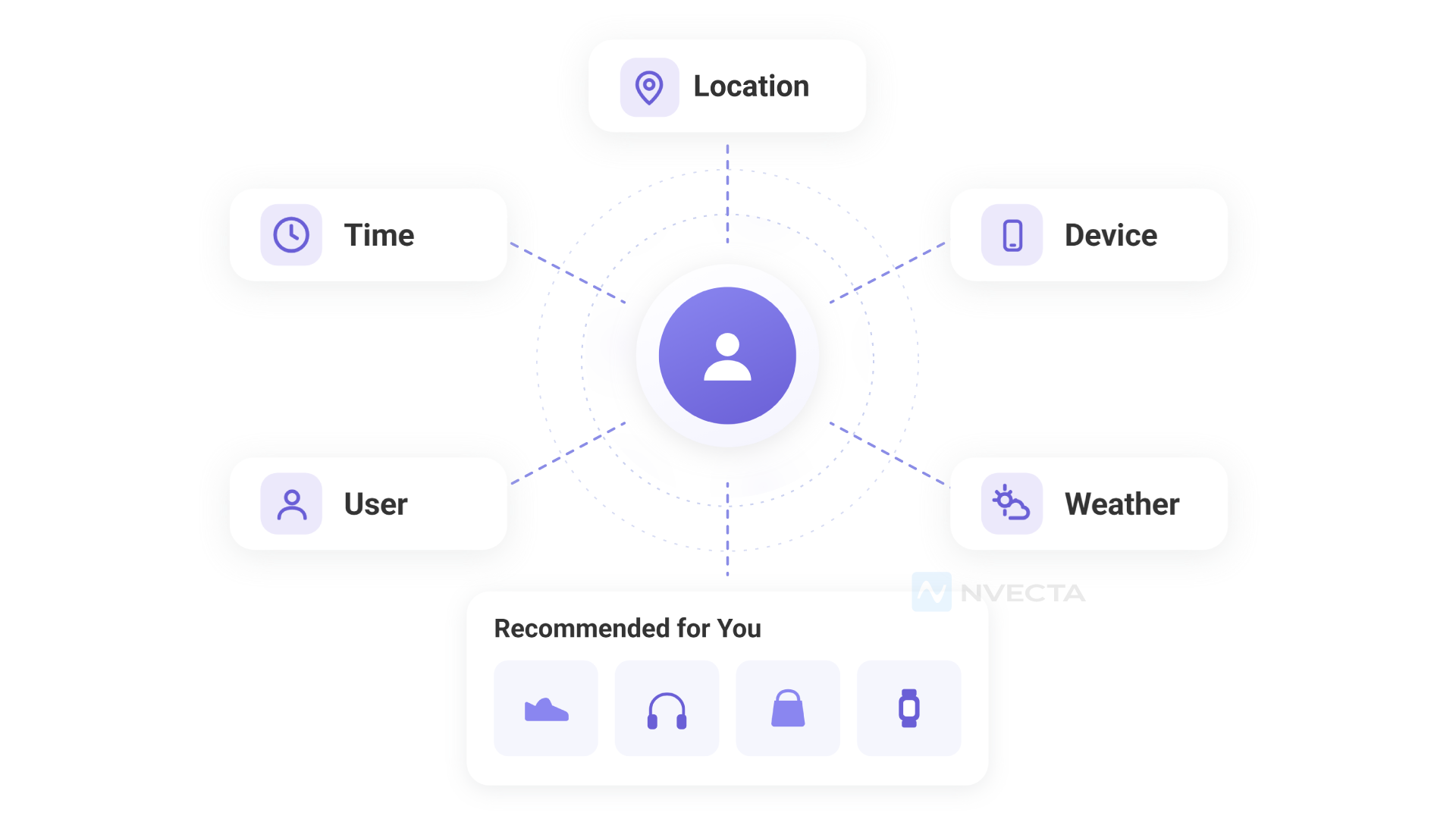
A context-aware recommendation engine is a system that picks what to suggest to a user by looking at their broader situation,
Not just their past behavior—building on behavioral segmentation to refine and personalize suggestions even further.
It treats context — time, location, device, intent, mood, weather, even who else is in the household — as a first-class input to the model.
In plain English: the old engines asked “what did similar people buy?” These engines ask “what would help this person, right now, in this exact moment?”
That’s a much harder question. It’s also the one that actually drives conversions.
How it Differs from Traditional Recommendations
Here’s a quick comparison so you can see the gap clearly.
| Aspect | Traditional engine | Context-aware engine |
|---|---|---|
| Main input | Past purchases, ratings | Past behavior plus live context |
| Signal types | Static, historical | Real-time and historical |
| Re-ranking | Rare or batch | Continuous, per session |
| Personalization depth | User-level | Session and moment-level |
| Example output | “Customers also bought” | “Trending near you, raining, evening” |
A traditional engine might keep recommending winter jackets in March because that’s what your purchase history says you like.
A context-aware one notices the season changed, you’re browsing on mobile during a lunch break, and the weather is warm where you live, so it shows lighter pieces instead.
Why Context-Aware Recommendations Matter Now
A few things changed at once, which is why this stopped being a research-team conversation and became a roadmap conversation.
Customer expectations moved first. People got used to TikTok and Spotify reading them in minutes. Generic widgets feel lazy next to that.
The data caught up too. Real-time event streams, customer data platforms, and edge analytics made it cheap to capture signals that used to live in batch reports nobody opened.
Vector databases and lightweight transformers can now re-rank a list within milliseconds of a click, which sounds boring on paper and is genuinely a big deal in production.
McKinsey has been saying for years that personalization at scale can lift revenue by 10 to 15 percent.
The brands hitting the upper end of that range are not running 2015-style “customers also bought” logic. They moved on. Most of their competitors haven’t, which is the opportunity.
How Context-Aware Recommendation Engines Work
The basic idea is straightforward, even if the engineering gets messy.
You collect signals. You turn them into features. You feed those features into a model that scores items. You re-rank. You serve. You measure. You learn.
Here’s a closer look at each step.
Step 1: Signal Collection
The system pulls in data from many places at once. Common signals include:
- Identity signals: who the user is, account history, loyalty tier
- Behavioral signals: clicks, dwell time, scroll depth, search queries, abandoned carts
- Contextual signals: location, device, time of day, day of week, weather, language
- Session intent signals: what the current session looks like compared to past ones
- External signals: stock levels, pricing changes, trending content, local events
The richer the signal mix, the smarter the engine can be. The trade-off is privacy and complexity, which we’ll get to.
Step 2: Feature Engineering and Embeddings
Raw signals get turned into numerical features the model can use. Modern systems lean heavily on embeddings, which are dense vector representations of users, items, and context.
Vector databases like Pinecone, Weaviate, and Milvus have made this part much easier. You can store millions of embeddings and run nearest-neighbor searches in milliseconds.
Step 3: Candidate Generation
Before ranking, the system narrows the universe of possible items down to a manageable shortlist.
For an e-commerce store with 200,000 SKUs, you might shortlist a few hundred candidates per request based on category, availability, and rough relevance.
Step 4: Real-Time Ranking
This is where the model earns its keep. Each candidate gets scored based on the user, the context, and the predicted likelihood of a click, purchase, or other goal action.
Re-ranking happens per request, not per user per day.
Step 5: Serving and Feedback
The top items get served. The user clicks, ignores, scrolls, or buys. That signal flows back into the system and updates the model, sometimes in real time, sometimes in nightly batches.
Real Examples and Use Cases
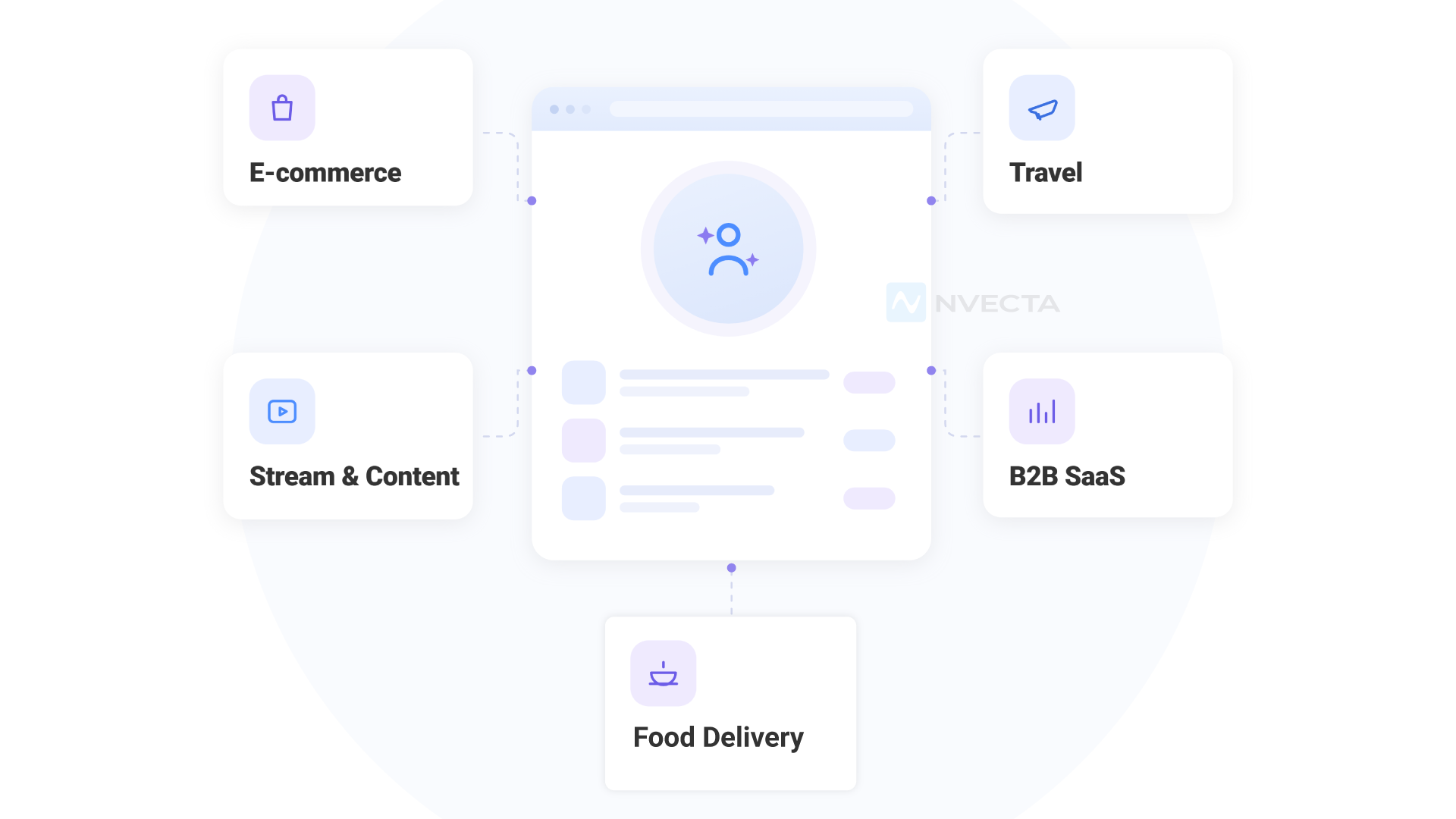
This stuff is already running everywhere. You probably touched five context-aware engines today without noticing.
E-commerce
Amazon, Shopify, and Zalando all run context-aware ranking on category pages, product detail pages, and email—capabilities that are increasingly powered by an ecommerce CDP, which unifies customer data to deliver more relevant, personalized experiences across every touchpoint.
A recently abandoned cart, the device you’re on, and your location all change what shows up on the homepage next time you visit.
Streaming and Content
Netflix’s homepage is a famous example. The artwork, the row order, even the trailer auto-play are personalized to your session, not just your profile.
Spotify’s Discover Weekly works the same way underneath.
Food Delivery
Uber Eats and DoorDash use time of day, weather, and your past order patterns to decide whether to push breakfast, comfort food, or something light.
Rainy Tuesday at 8pm? You’re getting ramen, biryani, and pizza near the top. That isn’t an accident.
Travel
Booking.com and Airbnb factor in trip length, group size, season, and even what you searched in the past hour.
Search for “Goa beach villas” and the next day the homepage will look very different from someone searching “Manali snow trips.”
B2B SaaS
This one gets less attention, but it’s growing fast.
Tools like HubSpot and Intercom now recommend next best actions inside the product, contextual help articles, and even outbound message templates based on what the user just did.
Best Tools and Platforms to Build with
You don’t have to build all of this from scratch. The ecosystem is solid.
Managed Recommendation Platforms
- Amazon Personalize: deep AWS integration, good for teams already on that stack
- Google Vertex AI Recommendations: strong for retail, easy to plug into existing GCP setups
- Algolia Recommend: light, fast, works well for search-driven sites
- Dynamic Yield: enterprise-grade, focused on personalization across web, app, and email
Vector Databases
- Pinecone
- Weaviate
- Milvus
- Qdrant
These are the backbone for embedding-based retrieval and are basically required if you want sub-100ms ranking.
Open-Source Frameworks
- TensorFlow Recommenders
- PyTorch BigGraph
- Microsoft Recommenders
- NVIDIA Merlin
If your team has the ML talent, open-source gives you more control over the model and the signals it uses.
Customer Data Platforms
- Segment
- RudderStack
- mParticle
You need these (or something like them) to get clean, unified, real-time event data flowing into the engine. Without good signal plumbing, even the best model will produce mediocre output.
How NVECTA Approaches Context-Aware Recommendations
The pattern we keep seeing at NVECTA is teams that obsess over the model and treat the data plumbing as an afterthought. That order is backwards and it costs months.
Start with the signal layer. Get event tracking clean. Pin down which contextual signals actually move the needle for your category — they’re different for fashion than for grocery than for SaaS.
Then bring in the model. Engines built this way are also easier to debug six months later when a metric drifts and someone asks why.
If you’re moving past “customers also bought” and want a system that responds to context properly, this signal-first sequencing is the part most teams underestimate.
Common Mistakes Teams Make
A few patterns come up again and again. Worth flagging before you start.
Building the model before the data pipeline. A great model on patchy data is worse than a basic model on clean data. Fix the pipeline first.
Over-personalizing. If every user sees a totally unique homepage, you lose the social proof signal that makes new and trending items work. Some shared experience is good.
Ignoring the cold-start problem. New users have no history. New products have no signal. Plan for both from day one with content-based fallbacks and onboarding signals.
Treating context as a single feature. Time of day matters differently in food delivery than in fashion. Build category-specific context models, not one-size-fits-all.
Skipping the privacy conversation. Location and behavioral data are sensitive. Make sure your consent flows, data retention, and anonymization are sorted before launch, not after a regulator calls.
Optimizing for clicks instead of value. Click-through rate is easy to measure and easy to game. Long-term metrics like repeat purchase rate or content completion are harder, but they’re the ones that matter.
Quick Summary
Context-aware recommendation engines pick what to show based on the user’s full situation, not just their purchase history. They use real-time signals like time, location, device, weather, and session behavior to re-rank items continuously.
They’re already standard at the top of most consumer tech stacks, and they consistently lift conversion and retention when the data layer underneath them is clean. Most failures are pipeline problems, not model problems.
Ready to Upgrade Your Recommendation Engine?
If your store, app, or platform is still leaning on basic “customers also bought” logic, you’re leaving real revenue on the table. NVECTA helps brands design and ship context-aware recommendation systems that actually respond to what users are doing right now, not what they did last quarter.
Get in touch for a recommendation audit. We’ll look at your current setup, the signals you’re capturing, and where context-aware ranking would move the needle fastest.
FAQ
What is the difference between collaborative filtering and context-aware recommendations?
Collaborative filtering recommends items based on what similar users liked or bought in the past. Context-aware recommendations add real-time signals like location, device, time, and session behavior on top of that. The result is a suggestion that fits the moment, not just the user profile. Most modern engines combine both.
Can small businesses use context-aware recommendation engines?
Yes. Tools like Algolia Recommend, Amazon Personalize, and Shopify’s built-in product recommendations let small teams use context-aware ranking without building anything from scratch. The cost has dropped sharply in the last three years. The bigger barrier for small teams is usually clean event tracking, not the engine itself.
Do context-aware engines work without large amounts of user data?
They work better with more data, but they don’t need millions of users to start. Content-based signals, contextual signals like time and location, and item embeddings all work even with small user bases. The cold-start problem is real but solvable with smart fallbacks during the first few months.
Are context-aware recommendations a privacy risk?
They can be if handled carelessly. Location, device, and behavioral signals are sensitive under regulations like GDPR and India’s DPDP Act. The fix is consent-first design, on-device processing where possible, short data retention windows, and clear opt-out controls. NVECTA always recommends a privacy review before launch.
Which industries benefit most from context-aware recommendations?
E-commerce, streaming, food delivery, travel, and B2B SaaS see the clearest lift. Anywhere the right suggestion at the right moment changes user behavior, context-aware ranking pays off. Industries with low purchase frequency or very narrow catalogs see less impact.
