













 Email
Email SMS
SMS Whatsapp
 Web Push
 App Push
 Audience Sync for Ads
 Popups
 Channel A/B Testing
  Control groups Analysis
 Frequency Capping
 Funnel Analysis
 Cohort Analysis
 RFM Analysis
 Signup Forms
 Surveys
 NPS
NPS Landing pages personalization
  Website A/B Testing
  PWA/TWA
 Heatmaps
 Session Recording
 Wix
Wix Shopify
 Magento
 Woocommerce
 eCommerce D2C
  Mutual Funds
 Insurance
 Lending
  Recipes
  Knowledgebase
 Developer Docs
 Product Updates
 App Marketplace
 Academy
 Ebooks
 Case Studies
 Blog
Blog Templates
 Aparupa Saha
The consumer’s journey, which starts from first contact with the product to the final transaction to buy that product, is the most important thing for successful marketing. The company should also maintain good communication with customers even after purchase.
Understanding the whole journey of the customer and converting them into loyal customers is the main goal of any marketing tactic. Conversion funnel marketing is the tactic that helps you understand the customer journey in your funnel. If your company is selling products, whether online or offline, then you have a conversion funnel. You just need to optimise the funnel to get the best results.
What Is a Conversion Funnel?
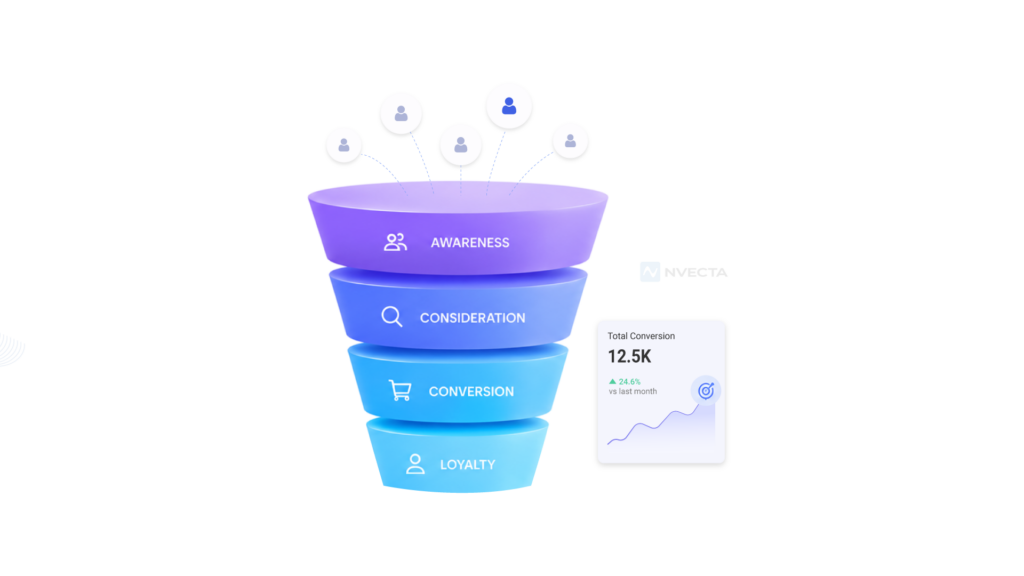
A Conversion Funnel is an e-marketing term that helps you to visualise and understand the full journey of a consumer from a potential customer to be or converted into a paying customer. It starts from the top of the funnel, which is when customers get aware of the product, and gets closer when the customer purchases your product or service.
It is essential for marketers to know the flow of customers in your conversion funnel, as it will help you get more leads, feedback for business, and address concerns.
Why does a Conversion Funnel Matter?
A conversion funnel is important and meaningful for marketers as it helps them to know how an audience converts into a customer. It helps them to plan the right strategy that will bring in more customers.
A conversion funnel is also known as a sales funnel. Optimising the conversion funnel is essential as it helps marketers to analyse their plan at every stage of the funnel. The framework of the conversion funnel will let you know about its strengths and weaknesses.
Conversion Funnel vs Sales Funnel
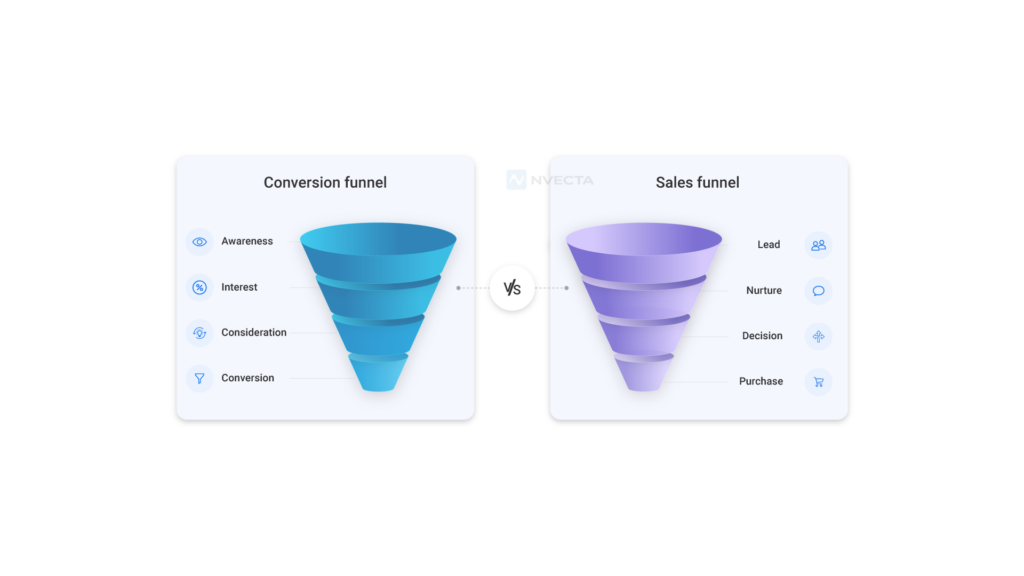
Many people use the terms conversion funnel and sales funnel interchangeably, but there is a difference between the two.
A sales funnel mainly focuses on converting leads into customers. It is generally used by sales teams and starts when a person has already shown interest in the product or service.
A conversion funnel is broader. It starts from the awareness stage and continues even after the purchase. It includes retention and referrals, helping businesses understand the complete customer journey.
Here is a quick comparison:
| Aspect | Conversion Funnel | Sales Funnel |
|---|---|---|
| Scope | Full customer journey | Lead to close |
| Used by | Marketing and sales teams | Primarily sales teams |
| Starts at | Awareness | Interest or intent |
| Ends at | Retention and referrals | Closed deal |
| Tools used | CDPs, analytics, automation | CRM and email sequences |
For e-commerce businesses and SaaS companies, the conversion funnel provides a more complete picture of customer behaviour. It helps businesses understand how customers discover, engage with, and continue interacting with their brand over time.
Stages of Conversion Funnel
The main goal of a conversion funnel is to get, keep and grow your customer with the help of effectivee-commerce marketing strategies and new, improved marketing tools to meet their needs. It leads to nurturing, behavioural targeting, retention, and referrals.
Optimization of a conversion funnel is important as it helps marketers to understand the customer journey and develop more effective marketing tactics to convert more people into customers.
To simplify a conversion funnel, it is divided into stages. Conversion funnels follow the basic AIDA model (Awareness, Interest, Desire, Action). Each stage needs different tactics to increase effectiveness.
Stage 1: Awareness
This is the first step in a conversion funnel to come into the knowledge of your audience. You have to make that audience reaches you from different channels. You have to analyse or compare which channel brings the most of the customers to know what attracts them the most.
You can make them aware through any channel like social media, search engines, blogs, ads, etc., but you have to present your brand or product in the right place and at the right time. You can attract an audience with different content, like pay-per-click ads, creating content that is relevant to them, or solving their problems.
Stage 2: Interest
In the second stage of a conversion funnel, you have to build the interest of the potential customer in your product. In this stage, your content is very important. Here you have to understand the user’s needs.
Content must be interesting, which makes the audience engaged. Offer your audience interesting discounts, coupons, and one-time offers. Also, design the website to be user-friendly and visually interesting. Ask them to sign up for your newsletter.
Stage 3: Desire
In this stage, you have to build trust and keep engaging your audience so they learn more about your product. Nurture them as they are considered potential leads. In this phase, provide them with all the necessary information. Focus on the solution and how your solution is different.
It will help them to make a smart decision to buy your product. Try to convince your audience with your product to convert into your customer. Make them think that your product is the best solution for them.
Stage 4: Action
This is the last and most important stage. At this point, the customer takes the action. Up until the point at which the potential lead travelled through the funnel and took a few small steps like signing up for the newsletter, downloading eBooks, etc.
The main goal of the conversion funnel from top to bottom is to convert a potential lead into a customer. The potential lead buys your product. For that, you have to map out all the relevant information from every stage of the funnel.
Funnel stage KPIs table-
| Funnel stage | Goal | Key metrics | Tactics |
|---|---|---|---|
| Awareness | Reach new audiences | Traffic, impressions, CPC | SEO, paid ads, social |
| Interest | Engage and educate | Time on site, email opens | Retargeting, content, email |
| Desire | Build trust and intent | Demo requests, trial sign-ups | Testimonials, free trials, chat |
| Action | Convert to customer | CVR, AOV, CPA | Checkout UX, cart recovery, urgency |
| Retention | Bring them back | Repeat purchase rate, NPS | Loyalty programs, win-back emails |
How to Optimise a Conversion Funnel?
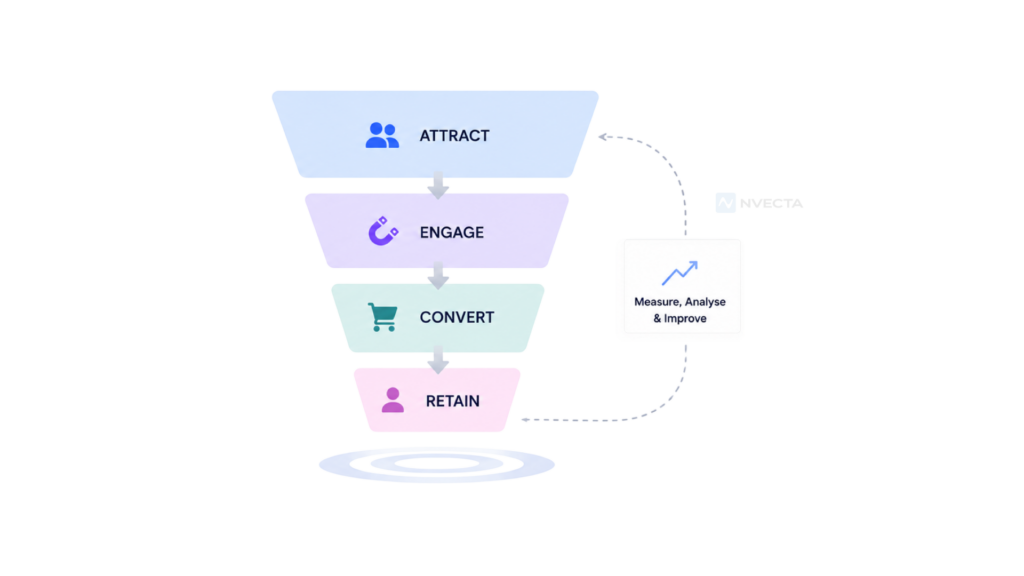
The simplest way to start optimising a conversion funnel is to break it down. The main phases are upper funnel optimisation, middle funnel optimisation, and lower funnel optimisation.
Each phase of a conversion funnel should be considered as different and must use different and effective strategies for each. The function of each phase is different. Now we will discuss each phase of a conversion funnel:-
Top funnel optimisation (TOFU)
This is the Top of the Funnel (TOFU). Your potential customer enters the funnel at this phase. To optimise that phase, you should provide the right content to the audience.
The audience enters TOFU through different channels like your website, an ad, an email, or social media. Optimise your keywords, create unique content and use the power of social media to capitalise on your content.
Middle funnel optimization(MOFU)
This is the Middle of the Funnel (MOFU). This is the phase where real work starts. As you manage to land your potential customer on your website.
Now you have to provide them with clear information about your product and service. You have to engage them more on your website with the right content so that customers get more involved and may sign up for newsletters or start following on social media.
Bottom of the funnel (BOFU)
This is the Bottom of the Funnel (BOFU). This is the last phase of the funnel, and it is the conversion phase. Here you have to encourage your potential customer to take action by purchasing your product or services.
In previous phases, if you provide the right information and convince them that your product is the right solution for them, then it becomes easy for you to convert them into a customer. Encourage them to convert by making purchases easy, offering trials, or sending discounts, etc.
A conversion funnel helps you to understand the customer journey. By understanding this, you will also know about the audience who take action and who don’t. It will optimise more potential to tell you about the leakage or where you are losing your customers. Always look from the view of customers and make their journey easier.
How NVECTA Helps Improve Conversion Funnel Performance
Understanding each stage of the conversion funnel is only the first step. Businesses also need the right tools to identify customer behaviour, reduce drop-offs, and engage prospects effectively. NVECTA provides features that help marketers optimise every stage of the funnel and improve conversions.
Track Funnel Drop-Offs
NVECTA helps businesses visualise the customer journey and identify where potential customers leave the funnel. Understanding these drop-off points allows marketers to find weaknesses in their strategy and optimise each stage to improve conversions.
Analyze Customer Behavior
NVECTA collects customer interactions and behavioural data to help businesses understand their audience better. These insights make it easier to create targeted campaigns and deliver experiences that are more relevant to customers.
Engage Across Channels
NVECTA enables businesses to connect with customers through channels like email, SMS, push notifications, and WhatsApp. Consistent communication across different touchpoints helps keep prospects engaged and move them further down the funnel.
Automate Lead Nurturing
NVECTA automates follow-up campaigns based on customer actions and engagement. This allows businesses to deliver the right message at the right time and guide potential customers toward conversion more effectively.
Deliver Personalised Experiences
NVECTA uses customer data and behavioural insights to provide personalised experiences. Relevant recommendations and communications help businesses increase customer engagement, build trust, and improve the chances of conversion.
Drive Repeat Purchases
NVECTA helps businesses retain customers through personalised campaigns and re-engagement journeys. Strengthening relationships after the first purchase encourages repeat business and helps increase long-term customer value.
Wrap Up
Every business has a conversion funnel, but achieving consistent growth depends on how effectively that funnel is managed. Understanding customer behaviour, engaging prospects at the right moment, and creating seamless experiences are essential for turning interest into action.
Modern marketers need tools that not only reveal where customers drop off but also help deliver meaningful interactions throughout the journey. NVECTA supports this with powerful insights, automation, and omnichannel engagement capabilities, enabling businesses to create experiences that drive higher conversions and long-term customer value.
Transform every stage of the customer journey into a conversion opportunity with NVECTA.
Schedule a demo now.
Frequently Asked Questions
What is a conversion funnel in simple terms?
A conversion funnel is the path a customer takes from first hearing about your business to making a purchase. It starts broad at the top (awareness) and narrows down to a smaller group of buyers at the bottom. The goal is to understand and improve each step of that journey to convert more people.
What is the difference between a conversion funnel and a sales funnel?
A conversion funnel covers the entire customer journey, from awareness through to retention. A sales funnel typically focuses on the later stages, from qualified lead to closed deal. The conversion funnel is broader and is used by marketing teams alongside sales. Most modern businesses use both models together for a complete view.
What are the stages of a conversion funnel?
Most conversion funnels follow the AIDA model with four stages: Awareness (the customer discovers your brand), Interest (they engage with your content), Desire (they want your product), and Action (they buy or sign up). Some models add a fifth stage, Retention, to account for repeat purchases and loyalty.
How do I know if my conversion funnel is working?
Look at the conversion rate between each stage. If a large percentage of people drop off between Interest and Desire, your nurture content needs work. If most drop off at checkout, the issue is likely friction in the buying process. Tools like Google Analytics 4 and NVECTA’s funnel analysis feature help you see these drop-off points clearly.
What is a good conversion rate for a funnel?
It depends on your industry and funnel stage. For e-commerce, average checkout conversion rates sit around 2 to 4%. SaaS free-to-paid conversion typically ranges from 2 to 5%. Landing pages for lead generation average around 2.35%, with top performers hitting 10% or higher. The best benchmark is your own historical data — focus on improving your rate over time rather than comparing to industry averages alone.
What causes customers to drop off in a conversion funnel?
Common drop-off reasons include slow page load times, unclear messaging, unexpected costs at checkout, lack of trust signals (no reviews, no return policy), too many form fields, and content that does not match where the customer is in their journey. Running heatmaps and session recordings on your key pages is one of the fastest ways to find the exact friction point.
How does NVECTA help with conversion funnel optimisation?
NVECTA provides a built-in funnel analysis tool that visualises drop-off rates at every stage across your website, app, and offline touchpoints. It also includes behavioural analytics, A/B testing, session recording, and marketing automation so you can identify gaps and fix them in the same platform, without stitching together five separate tools.
