














 Email
Email SMS
SMS Whatsapp
 Web Push
 App Push
 Audience Sync for Ads
 Popups
 Channel A/B Testing
  Control groups Analysis
 Frequency Capping
 Funnel Analysis
 Cohort Analysis
 RFM Analysis
 Signup Forms
 Surveys
 NPS
NPS Landing pages personalization
  Website A/B Testing
  PWA/TWA
 Heatmaps
 Session Recording
 Wix
Wix Shopify
 Magento
 Woocommerce
 eCommerce D2C
  Mutual Funds
 Insurance
 Lending
  Recipes
  Knowledgebase
 Developer Docs
 Product Updates
 App Marketplace
 Academy
 Ebooks
 Case Studies
 Blog
Blog Templates
 Shivani Goyal
Quick answer: Agentic AI in marketing means AI agents that plan, execute, and optimize campaigns autonomously, not copilots that suggest things and wait for a human to click. They only work when grounded in unified customer data. Real use cases, the copilots vs agents distinction, why a CDP is the prerequisite, and how to get started below.
Most of what gets called “AI marketing” today is still a human doing the work with a slightly smarter assistant. A copilot suggests a subject line. A dashboard highlights a segment. A recommendation engine serves up the next product. The marketer still decides, still builds, still launches, still monitors. That’s not autonomy. That’s a smart helper.
Agentic AI is the next thing. AI agents that plan, execute, and optimize campaigns on their own, grounded in real-time customer data, learning from outcomes, operating at a scale no human team can match. The shift from copilot to agent is the most significant change in marketing technology since marketing automation arrived a decade ago.
Here’s the catch nobody wants to say out loud. According to the Marketing AI Institute’s 2025 State of Marketing AI Report, 82% of marketers say their primary goal with AI is reducing time on repetitive tasks. Meanwhile, Salesforce’s State of Marketing 9th Edition found that only 31% of marketers are fully satisfied with their ability to unify customer data sources. The math is brutal: you can’t get autonomous AI working on data that’s still sitting in five disconnected tools. The Customer Data Platform foundation is the prerequisite, not the cherry on top.
This article walks through what agentic AI actually is in a marketing context, how it differs from the copilots and chatbots that came before, the architecture that makes it work, and how teams are getting started without burning a year on proof-of-concept projects.
Copilots vs Agents: The Distinction That Matters
Before getting into use cases, worth being clear on what “agentic” actually means. The word is getting used loosely, which makes the conversation confusing fast.
A copilot keeps the human in the driver’s seat. AI suggests. Human decides. Examples: a subject line generator, a segment recommender, a content optimization tool. Useful, but the human is still the bottleneck for every decision.
An agent operates with defined oversight rather than constant control. The human sets the strategy and guardrails. The agent perceives the environment, reasons through options, and takes action. Then it learns from what happened and adjusts. Talkwalker’s 2026 marketing report puts it simply: with copilots, you’re hands-on the keyboard. With agentic systems, you can be hands-off.
A useful analogy: a copilot is a research assistant who hands you a stack of options. An agent is a junior employee who can take initiative inside boundaries you’ve defined. Both have value. The capability ceiling is wildly different.
Adoption is moving fast. Talkwalker reports that over half of senior executives say their companies are already using AI agents. The category jumped from “interesting concept” to “table stakes” in about 18 months.
LLMs and AI Agents: How They Fit Together
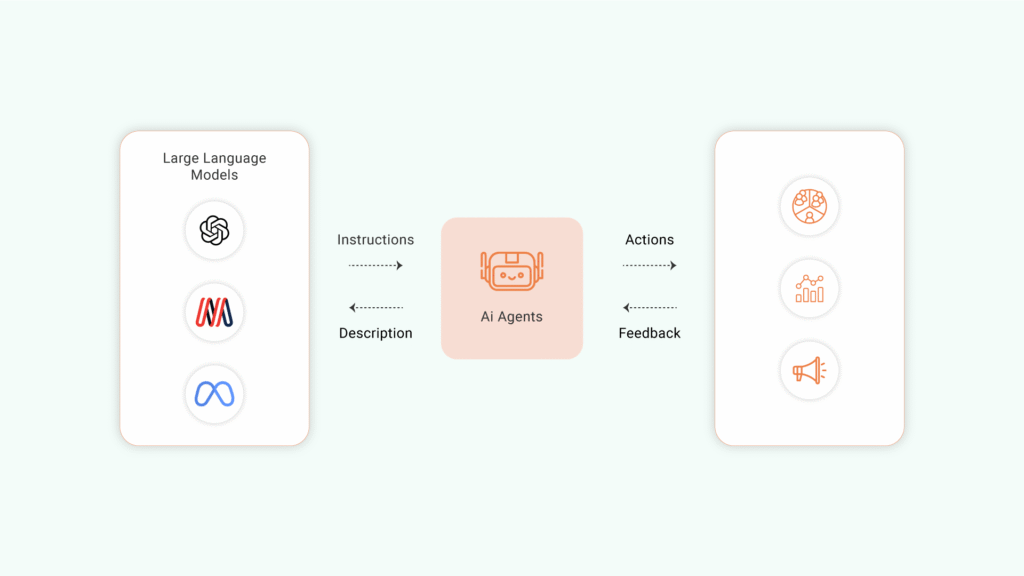
Large Language Models (LLMs) are the reasoning engine inside most modern AI tools. Trained on massive volumes of text, they understand, generate, and reason in natural language. Common examples include Claude from Anthropic, Gemini from Google, LLaMA from Meta, and GPT-4 from OpenAI. These models can be orchestrated through platforms like InClaw AI to handle complex deep learning tasks. LLMs are what power tasks like summarization, sentiment analysis, customer support, personalization, and prediction.
Agentic AI takes the LLM and wraps it in a system that can act. AI agents are independent systems that use LLMs plus rules to make decisions, execute tasks, and learn from outcomes. Modern conversational platforms like AI agents built on this stack are showing up across automation, decision-making, and enterprise workflows, with adoption increasingly covered in AI Agents News.
An AI agent can perform a sequence of tasks with minimal human input: finding a customer segment, running campaign performance analysis, suggesting better next steps. That’s different from a chatbot that follows a static script. Agentic systems think, plan, and act based on situation and data. The result when paired with a composable CDP: smarter campaigns, faster decisions, less time spent staring at dashboards.
The technical leap that made this possible recently is the maturation of three things together: LLMs powerful enough to reason reliably, tool-use APIs that let agents take real actions, and emerging standards like MCP (Model Context Protocol) that let agents connect cleanly to multiple data sources. None of those existed at production quality three years ago. All three exist now.
What AI Marketing Agents Actually Do (Real Use Cases)
Abstract talk about agentic AI gets old fast. Concrete examples help.
The 2am Tuesday ROAS investigation. Your ad spend dashboard shows a ROAS anomaly at 2am on a Tuesday. A copilot would surface the anomaly and wait for someone to log in Wednesday morning. An agent investigates the anomaly itself: identifies the underperforming ad set, pauses it, reallocates the budget to better-performing creative, and sends your team a summary in the morning explaining what it did and why. That’s not automation in the old sense. That’s actual judgment within defined boundaries.
The lifecycle agent. Monitors customer behavior continuously, flags at-risk customers based on engagement decay patterns, triggers personalized win-back flows automatically, and escalates to a human only when the customer signals something the agent can’t handle (high-value account, unusual complaint pattern, account-level churn risk). For ecommerce CDP use cases, this lifecycle work is where most of the ROI shows up.
The personalization agent. Optimizes send-time, channel, and creative variant per individual customer in real time. Most personalization today is rule-based (“send at 10am on weekdays”). Agentic personalization watches each customer’s actual engagement pattern and adjusts. Marketers set the brand guardrails. Inside those, the agent handles the millions of micro-decisions that would crush a human team.
The cross-channel orchestration agent. Decides email vs SMS vs in-app vs push for the same customer based on which channel they actually engage with. Most teams hard-code this. Real customer journey orchestration learns it from behavior and updates continuously as customer preferences shift.
The unifying pattern across all of these: the agent makes decisions and takes action on customer data without a human approving each step. Defined oversight, not constant control. That’s what makes the category meaningful rather than just rebranded automation.
Why Agentic AI Only Works on Unified Customer Data
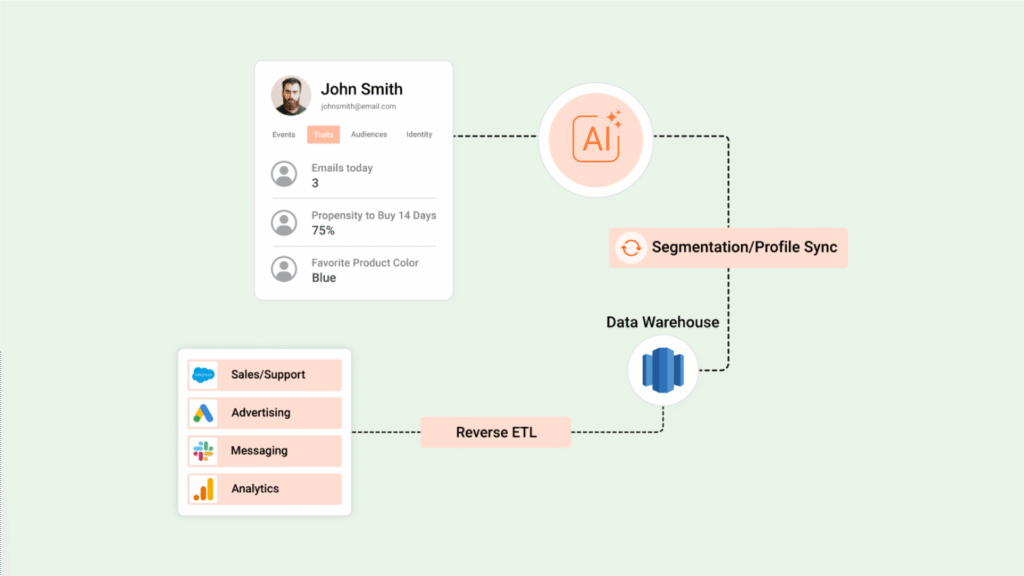
Here’s the part of the agentic AI conversation that doesn’t get enough airtime. Agents only work when they have access to unified, trustworthy customer data. Without a CDP-grade foundation, agents are making millions of decisions in the dark. Personalization happens on fragments. Optimization happens toward incomplete signals. Bad judgment scales instead of good strategy.
That 31% number from Salesforce keeps coming back. The majority of marketing teams cannot unify their customer data. They have data scattered across five or six tools, with different definitions of “active customer,” different identifiers, and no real way to stitch them together. Agentic AI on top of that mess doesn’t fix it. It accelerates it.
Composable CDPs solve this by connecting directly to your data warehouse (Snowflake, BigQuery, Databricks, Amazon Redshift). One source of truth. Real-time customer identity resolution. No duplicated data, no copying between systems. The AI Agents layer reads from the same unified profiles every team uses. That’s how agents end up making decisions on the same data the rest of the business is using, instead of operating in their own little world that drifts out of sync.
Here’s how a composable CDP and agentic AI fit together in practice:
- Direct data access. AI agents query the warehouse directly and pull enriched customer details (browsing behavior, purchases, identity data, engagement history). No staging, no lag, no waiting on a nightly batch.
- Real-time intelligence. As campaign data flows back into the warehouse, agents evaluate results on the fly and recommend next-best actions, audiences, or messaging strategies.
- Natural language queries. Marketers interact using plain-language prompts like “find users likely to churn next month” or “suggest a lookalike audience based on high-LTV customers.” The agent translates that into the SQL or API calls that actually retrieve the right data.
- Automated customer segmentation. Instead of marketing ops manually building segments, agents identify high-value segments using advanced propensity scoring models. The segments update themselves as customer behavior shifts.
- Personalized campaign execution. Agents create, run, and optimize marketing campaigns end-to-end. Hyper-personalized content, exact send timing per customer, continuous A/B optimization across creative variants.
- Enhanced customer journeys. Agentic AI builds and adapts journey workflows in real time based on user behavior. Each interaction is contextually relevant rather than following a static branching tree built six months ago.
- Instant, actionable insights. Agents deliver automated performance insights, proactive improvement suggestions, and detailed analytics directly to the dashboard. This helps marketing teams adjust strategies quickly and optimize continuously.
The Architecture: How Agentic AI Actually Plugs In
The technical picture is simpler than the marketing copy makes it sound. Three layers do the work.
| Layer | What It Does | Common Tools |
|---|---|---|
| Data foundation | Warehouse + CDP + identity graph. The unified source of truth the agent reads from. | Snowflake, BigQuery, Databricks, Amazon Redshift, Nvecta |
| Agent layer | LLM-powered reasoning, planning, tool use, retrieval. The decision-making brain. | Claude, GPT-4, Gemini, LLaMA, agent frameworks (LangGraph, CrewAI) |
| Activation layer | Existing martech stack. Where the agent’s decisions actually reach the customer. | Email tools, SMS, ad platforms, web personalization, CRM |
The emerging standard tying these layers together is MCP (Model Context Protocol), an open specification that lets agents connect cleanly to multiple data sources without custom integration for each one. MCP isn’t required for agentic AI to work, but it’s becoming the most common way teams handle the integration problem.
The key thing to understand: agents don’t replace your stack. They sit on top of it and coordinate it. Your email tool still sends the email. Your ad platform still buys the impression. The agent just decides what should happen, when, and for whom, based on data the CDP makes available.
Multi-Agent Collaboration (The 2026 Frontier)
Single-agent setups handle simple tasks well. The frontier in 2026 is multi-agent systems where specialized agents work together. A segmentation agent identifies the right audience. A creative agent generates the message variants. A budget allocation agent decides spend distribution. A measurement agent tracks outcomes and feeds learning back to the others.
Why this matters: a single LLM trying to do all four jobs at once does each of them less well than four specialized agents. A well-designed multi agent framework keeps each specialist focused on its core task while letting them hand off subtasks, query shared state, and recover from partial failures without freezing the wider pipeline. Multi-agent systems also handle edge cases better because each agent can ask another for help when it hits the edge of its capability.
The hard part is orchestration. Getting agents to communicate without descending into infinite loops, contradicting each other, or making decisions that conflict with the overall strategy. This is where the platform layer matters. Teams that try to wire multi-agent systems together from scratch usually spend six months on plumbing before the agents do anything useful. Teams that use a platform designed for it ship faster but trade flexibility.
How Nvecta’s Composable CDP Connects to Agentic AI
Nvecta has built an ecosystem of intelligent AI agents that connect directly to our Composable CDP. The goal is straightforward: give marketing teams agentic capability that runs on data they actually own, with no copying, no syncing lag, and no fragmented profile problem.
Our Composable CDP connects your existing data warehouse or data lake (Amazon Redshift, Snowflake, BigQuery, Databricks) directly to the Nvecta platform through secure Data Connectors. Once connected, your data becomes immediately actionable. Unified customer profiles, real-time segmentation, no data duplication. One secure source of truth that every Nvecta agent reads from.
Here’s how Nvecta’s specialized agents work inside this ecosystem:
- Segment Agent. Creates query-based segments directly from your user or event tables in the data lake. Sophisticated targeting without manual SQL.
- Propensity Scoring Agent. Continuously predicts which customers are most likely to convert. Your team gets a constantly-updated list of high-value targets rather than a stale weekly export.
- Campaign Creation Agent. Develops and executes marketing campaigns end-to-end. Creative, content, scheduling, deployment. Useful for teams that want speed-to-launch on standard campaign types.
- Journey Automation Agent. Designs personalized customer journeys that adapt to each customer’s actions. Branches based on real behavior rather than predicted behavior.
- Onsite Campaign Agent. Builds and deploys onsite elements (forms, nudges, popups) without needing designers or developers in the loop.
- Insights Agent. Analyzes campaigns and customer behavior continuously, delivering immediate insights and recommendations to the dashboard. The team optimizes based on what’s actually happening rather than what last week’s report said.
By connecting our agentic AI ecosystem directly to the composable CDP, Nvecta lets marketing teams activate data quickly, deliver hyper-personalized experiences at scale, and keep customers engaged across the full lifecycle.
Common Failure Modes (What Goes Wrong)
For balance, here are the four ways agentic AI deployments typically fail. Worth knowing upfront because the failure modes are predictable.
- Data fragmentation makes the logic wrong before the campaign starts. The agent operates on dirty, fragmented data. It does what was asked, but the inputs were wrong. Result: scaled bad judgment. Fix this before deploying agents, not after.
- No governance or audit trail. The agent makes thousands of decisions a day. Nobody knows why it made any specific one. When something goes wrong, troubleshooting is nearly impossible. Set up logging and audit infrastructure before you turn the agent loose.
- Over-reliance on autonomy without escalation paths. Some decisions need human review (high-value accounts, regulatory questions, brand-sensitive responses). Without clear escalation triggers, agents make decisions that should have been escalated. The fix is good guardrails, not less agentic capability.
- Hallucination on sparse data. LLMs invent plausible-sounding things when they don’t have real data to ground their response. In marketing, this might mean creative that’s slightly off-brand or segment definitions that don’t actually match the customer base. Grounding agents in unified CDP data and citation-checking high-stakes outputs reduces this significantly.
Integration With Your Existing Martech Stack
One of the most common questions teams ask: do I have to rip out my existing stack to use agentic AI? No. Agents augment the tools you already have rather than replacing them.
The integration points that matter most:
- Communication tools (Slack, Microsoft Teams). Agents send alerts and summaries to where your team already works. No new dashboard to check.
- CRM systems (Salesforce, HubSpot, others). The agent reads from and writes to your existing CRM, keeping the customer record as the system of record.
- Email and SMS platforms (Klaviyo, Mailchimp, Iterable, Braze). The agent decides what should send to whom. The email tool still handles delivery.
- Ad platforms (Google Ads, Meta, TikTok). Suppression lists and audience updates flow from the agent directly to the ad platform.
Agentic systems like AI sales agents are also becoming the backbone of sales and customer engagement processes, not just marketing, bridging insights into action automatically across the funnel. On the outbound side, an AI SDR applies the same agentic model to prospecting, first-touch outreach, and meeting booking, then hands qualified conversations to human reps.
How to Get Started Without Burning a Year on POCs
Most teams that fail with agentic AI fail the same way: they try to build a multi-agent system that handles everything at once, spend six months on it, and have nothing in production at the end. The teams that succeed start small and earn the right to expand.
Start with one agent doing one thing well. Pick a single use case where the failure mode is recoverable. Suppression list maintenance is a great starter. Win-back trigger orchestration is another. Avoid use cases where a bad agent decision causes immediate revenue impact (don’t start with “agent reallocates the entire ad budget”).
Establish escalation paths. Define clear rules for when the agent should hand back to a human. High-value account? Escalate. Unusual sentiment in customer reply? Escalate. The agent handles the routine 95%. Humans handle the 5% that needs judgment.
Audit before you trust. Run the agent in observer mode for two to four weeks before letting it take action. Compare its recommendations against what your team would have done. Adjust the rules and prompts until the agreement rate is high enough to give the agent autonomy.
Then expand. Once one agent is working reliably, add another. Build the multi-agent system iteratively rather than all at once. For teams new to this category, a roundup of the best customer data platforms is a useful starting reference.
Why This Matters Now
Two forces are making agentic AI the priority for marketing leaders in 2026.
First, the privacy environment has fundamentally changed. Third-party cookies are mostly dead, regulations are stricter year over year, and the external data signals marketers used to rely on for targeting and measurement are unreliable or unavailable. First-party data became the only durable foundation. But first-party data is only useful if teams can actually access it and use it intelligently. That’s where the agent + CDP combination earns its keep.
Second, the AI capability cliff. Eighteen months ago, LLMs weren’t reliable enough to take autonomous action. The hallucination rate was too high. The reasoning was too shallow. Today, with frontier models like Claude, GPT-4, and Gemini, plus emerging standards like MCP, agentic systems are crossing the production-readiness threshold. The teams that figure out how to deploy them well in 2026 will have a structural advantage that’s hard to catch up to in 2027.
The honest take: agentic AI in marketing isn’t a “nice to have” upgrade. It’s the new baseline that mid-market and enterprise teams will need within 24 months to compete on customer experience. Teams that wait for the technology to mature further will find their competitors have already moved.
Frequently Asked Questions
What is agentic AI in marketing?
Agentic AI in marketing means AI agents that plan, execute, and optimize campaigns autonomously, rather than copilots that suggest actions for a human to approve. Agents perceive the customer environment, reason through options, take action, and learn from outcomes, all within defined oversight set by the marketing team. The big shift from previous AI marketing tools is autonomy: the agent acts, then reports back, instead of asking permission for every decision.
What’s the difference between agentic AI and AI copilots?
A copilot keeps the human in the driver’s seat. AI suggests, human decides. An agent operates with defined oversight rather than constant control. The human sets strategy and guardrails. The agent perceives, reasons, and acts. Simple test: if you have to click “approve” on every recommendation, it’s a copilot. If decisions happen autonomously inside your defined rules, it’s an agent.
Do I need a CDP for agentic AI?
Effectively yes, even though the technical answer is “you need unified customer data, and a CDP is the most common way to get it.” Agents making decisions on fragmented data make worse decisions faster. The Salesforce State of Marketing 9th Edition found that only 31% of marketers can fully unify their customer data. The other 69% won’t get meaningful value from agentic AI until they fix that foundation first.
What’s the best CDP with agentic AI for marketing?
Depends on your team size, data complexity, and which marketing tools you already use. The two key factors are warehouse compatibility (a modern CDP should read from your existing warehouse rather than copying your data) and native agent capability (built-in agents for segmentation, propensity scoring, journey automation). Hybrid CDPs like Nvecta combine warehouse-native data access with packaged-style activation and a built-in agent ecosystem, which tends to fit mid-market and enterprise marketing teams better than purely composable or purely packaged options.
How do AI agents fit into my existing martech stack?
Agents augment your existing stack rather than replacing it. They read from your CRM, write to your email tool, push suppression lists to your ad platforms, and send alerts through Slack or Teams. The agent layer decides what should happen. The tools you already use still handle execution. Integration typically happens through APIs and emerging standards like MCP (Model Context Protocol).
What is MCP (Model Context Protocol)?
MCP is an open specification for connecting AI agents to data sources and tools without custom integration for each one. Think of it as the USB-C of agent integration. Instead of building a custom connection between every agent and every tool, the agent speaks MCP and the tool speaks MCP, and they connect cleanly. MCP is becoming the most common way teams handle the integration problem in 2026, though it isn’t strictly required for agentic AI to work.
What are common failure modes of agentic AI in marketing?
Four main ones. Data fragmentation makes the agent’s logic wrong before the campaign starts. No governance or audit trail means decisions can’t be reviewed when something goes wrong. Over-reliance on autonomy without escalation paths leads to agents handling decisions that should have been routed to humans. Hallucination on sparse data leads to plausible-sounding but wrong outputs. Most failure modes have the same root cause: deploying agents on top of broken foundations. Fix the foundations first.
Conclusion: The Future Is Agentic, But Only on Real Data
Composable CDPs are the backbone of modern marketing data infrastructure. Adding agentic AI on top transforms them from a passive data layer into an active decisioning system that adapts, learns, and acts on customer behavior in real time.
One catch worth repeating: agents only work on unified data. That 31% of marketers who’ve solved customer data unification are the ones positioned to win the agentic shift. Everyone else, the 69%, will find that adding AI agents to fragmented data just makes their existing problems happen faster and with less visibility.
Nvecta is built for marketing and data teams who want to actually do this work, with a composable CDP foundation plus a native agent ecosystem that runs on data you own. The team spends less time on manual data tasks and more time on the creative, strategic, judgment-heavy work that humans are still better at than any AI.
Want to see how this works in practice?
Schedule a demo to see Nvecta’s Agentic Composable CDP in action.
