














 Email
Email SMS
SMS Whatsapp
 Web Push
 App Push
 Audience Sync for Ads
 Popups
 Channel A/B Testing
  Control groups Analysis
 Frequency Capping
 Funnel Analysis
 Cohort Analysis
 RFM Analysis
 Signup Forms
 Surveys
 NPS
NPS Landing pages personalization
  Website A/B Testing
  PWA/TWA
 Heatmaps
 Session Recording
 Wix
Wix Shopify
 Magento
 Woocommerce
 eCommerce D2C
  Mutual Funds
 Insurance
 Lending
  Recipes
  Knowledgebase
 Developer Docs
 Product Updates
 App Marketplace
 Academy
 Ebooks
 Case Studies
 Blog
Blog Templates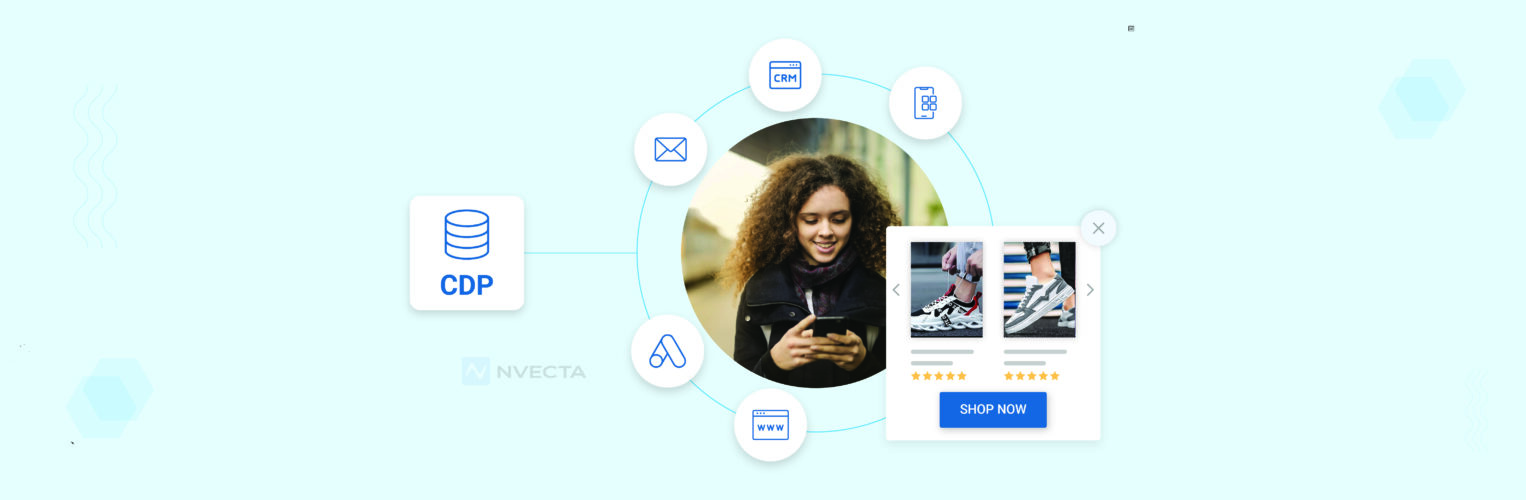
 Aparupa Saha
Effective management of customer data in an ecommerce CDP plays an integral role in helping brands better understand their customers. Customer data for brands is spread across multiple touchpoints, including emails, CRM systems, websites, mobile apps, and ads. It becomes difficult to pull meaningful insights from such scattered data. Marketers struggle to gain a precise view, leading to inadequate targeting and poor campaign performance.
A CDP processes your customer data into one centralised system. It organises customer data from every touchpoint, combines interactions from the same customer, and creates a complete view of each customer. With such a clear view, marketers can send relevant messages, deliver personalised experiences and improve overall marketing results.
NVECTA provides advanced CDP features for the e-commerce industry, empowering brands to design highly personalised marketing campaigns. Its AI-driven analytics help brands stay competitive in marketing.
In this blog, we will explore what an e-commerce CDP is, how it works, what benefits it offers—including the key benefits of implementing a customer data platform—and how to choose the right CDP for your brand.
What is an e-commerce Customer Data Platform?
An e-commerce CDP is a unified system that helps brands organise customer data in a smarter and more meaningful way. Instead of storing customer information in multiple systems, a CDP connects such information and presents it in a unified view of every customer’s journey.
An e-commerce CDP has striking features such as omnichannel personalisation, segmentation, customer journey orchestration and real-time data activation.
Such a mechanism excels at handling fast-moving online shopping. For example, it can identify what a customer is looking for, suggest the right product or personalise a page for them.
This level of real-time insights helps improve customer satisfaction and contribute to business growth.
Such platforms integrate with other online systems such as website builders, analytics systems, marketing tools, loyalty programs, and offline PoS devices. This ensures a consistent customer experience across all communication channels.
CDP prioritises a brand’s requirements and creates a workflow for marketing activation, data analysis or technical data management. The main objective is to support e-commerce brands in making better decisions through valuable insights.
How an e-commerce CDP Works (Step by Step Guide)
It has a well-structured approach to handling customer data and delivers noticeable results for brands.
Let us have a look at step by step working of an e-Commerce CDP
1. Collecting Data from Every Touchpoint
It extracts data from all sources a brand uses to engage its customers, such as websites, apps, CRM systems, and social media.
Using APIs and tracking pixels, it gathers data and later tracks everything from browsing to purchasing. With such tracking, a quick action can be taken to engage customers.
2. Data Unification and Identifying Customers
After collecting data, CDP processes it to build a single, unified profile for each customer. It removes duplicates and links anonymous visitors to their profiles when they log in.
This provides a complete view of each customer. Understanding the role of CDPs in ecommerce helps brands see how unified customer profiles improve personalization, targeting, and customer engagement across every touchpoint.
3. Smart Customer Segmentation
A CDP creates multiple segments based on customer behaviour, interests and past purchases. You can also create custom segments like frequent shoppers, high-value customers, cart abandoners, or discount seekers.
Some CDPs utilise AI to predict who might buy next or who may stop buying, helping you reach the right people at the right time.
4. Data Activation Across Channels
Once the data is grouped, automated campaigns start to run and deliver personalised messages over channels such as email, SMS, WhatsApp, push notifications and social media. With such relevant message delivery, brands engage in better targeting.
Beyond traditional communication channels, brands can also activate customer insights through engagement-focused tools such as Loyalty and referral systems, rewards programs, and customer advocacy initiatives to strengthen relationships and encourage repeat interactions.
5. Real Time Analytics and Optimisation
CDP provides users with real-time insights from continuous customer tracking and campaign performance.
Brands can instantly find what journeys are working, where customers are dropping off, and which products are driving interest. This helps fix issues quickly, boost conversions, and run campaigns.
How do Customer Data Platforms Benefit e-commerce Businesses
1. Improved ROAS and Reduced CAC
With real-time customer insights, brands can deliver ads to the right customer at the right moment—driving lower customer acquisition costs and higher return on ad spend.
Understanding how a CDP enhances e-commerce strategy also helps businesses unlock deeper customer intelligence, automate personalized engagement, and optimize marketing performance across every channel in real time.
This becomes even more powerful when paired with how a customer data platform can enhance business insights, enabling businesses to unify data, uncover deeper behavioral patterns, and make smarter, data-driven marketing decisions in real time.
2. Consistent Omnichannel Experiences
A CDP connects customer data from multiple communication channels. With unified profiles, every individual customer receives consistent messages. This creates smooth customer journeys.
3. Quick Decision-Making With Real-Time Data
Every customer behaviour is tracked and updated in real time, so you can quickly respond to dynamic trends and optimise campaigns. Such fresh insights yield positive results, such as increased sales, CTR, etc.
4. Privacy, Security and Consent Management
With strict compliance laws, CDPs support safe data and responsible handling by adhering to GDPR/CCPA. This ensures transparency and builds customer trust.
5. Stronger Retention and Customer Loyalty
CDP identifies customers who are likely to disengage and those most likely to make a purchase. Such predictions prevent churn by giving attention to disengaged customers.
Brands can also run automated welcome or win-back campaigns or reward loyal customers at the right time. This helps strengthen retention and increase lifetime value.
How to Choose the Right e-commerce CDP for Your Business
Finding the right CDP for your e-commerce brand is a bigger decision than it might seem. The wrong platform can leave your data siloed, your team frustrated, and your campaigns underperforming. The right one aligns with your growth strategy, plugs into your existing tools, and gives your marketers the speed and clarity they need to act on data.
Before diving into individual platforms, get clear on what you actually need: the volume of customer data you handle, the channels you market across, and how quickly you need to move from data to action. From there, it becomes easier to evaluate which CDP genuinely fits versus which one just looks good on a demo call.
Here are six factors that should drive your decision:
| Factor | What to Look For | Why It Matters |
|---|---|---|
| Integration with E-commerce Tools | Native connectors to your CRM, analytics stack, ad platforms, and storefront | Prevents data gaps and keeps customer profiles accurate across systems |
| Setup, UI and Support | Fast onboarding, no-code interface, strong documentation and support team | Reduces time-to-value and dependency on your dev team |
| Anonymous Visitor Tracking | Ability to build temporary profiles for logged-out shoppers | Lets you personalise and convert visitors before they identify themselves |
| Built-in Activation Tools | Centralised campaign, personalisation and journey management | Cuts complexity and keeps your marketing stack lean |
| Real-Time Data Processing | Instant profile updates as customer behaviour changes | Enables timely, relevant messaging that actually drives conversions |
| Privacy and Consent Management | GDPR/CCPA compliance, consent workflows, secure data handling | Builds customer trust and keeps your brand on the right side of data laws |
Let’s break each of these down.
1. Effortless Integration with Your Entire E-commerce Stack
Most e-commerce brands run on a mix of tools: a CRM, an analytics platform, an ad account, a storefront, maybe a loyalty program. Your CDP needs to connect with all of them cleanly. Look for native integrations rather than workarounds, and check whether data flows both ways. A CDP that can only pull data but not push segments back to your ad platforms is only doing half the job. When a CDP must connect with legacy commerce systems, proprietary databases, or non-standard APIs, custom software development services can help build the integration layer, data pipelines, and synchronization logic required for reliable two-way data flow.
2. Quick Setup, Clean UI and Reliable Support
A CDP that takes months to implement defeats the purpose. Prioritise platforms that offer a structured onboarding process, solid documentation, and a support team that actually responds. The UI matters too: if your marketers need a developer present every time they want to build a segment or launch a journey, you will lose the speed advantage a CDP is supposed to give you.
3. Anonymous Visitor Tracking for Higher Conversions
Most shoppers browse without logging in. If your CDP can only track known users, you are missing a large chunk of your audience. Look for a platform that builds temporary profiles for anonymous visitors, tracks their behaviour, and personalises their experience in real time. When they eventually identify themselves, that history should carry over seamlessly.
4. Built-in Activation Tools That Streamline Marketing
Data sitting in a CDP without a way to act on it is just storage. The best CDPs come with built-in tools to launch campaigns, trigger automations, and personalise experiences directly from the platform. Centralising this reduces the number of tools your team has to juggle and makes it easier to keep messaging consistent across channels.
5. Real-Time Processing for Faster, Smarter Decisions
Timing is everything in e-commerce. A customer who adds something to their cart and walks away needs to hear from you within minutes, not hours. Choose a CDP that processes behavioural data instantly and updates customer profiles in real time, so your campaigns are always working off current information rather than yesterday’s snapshot.
6. Strong Privacy and Consent Management
Data regulations are not getting looser. Your CDP needs to handle consent properly, store data securely, and give customers control over their information. This is not just a compliance checkbox: brands that handle data transparently build stronger customer relationships and avoid the reputational damage that comes with a breach or a violation.
1. Effortless Integration with Your Entire e-commerce Tools
Brands that have online stores use multiple systems or tools to manage customer data, like CRMs, analytics systems, etc.
A CDP must integrate with those platforms and pull accurate customer information, making data sharing effortless.
2. Quick Setup, Clean UI and Reliable Support
Setting up a CDP is complex and time-consuming. Choose a platform that is quick in installation and does not hinder the purpose you choose CDP for.
It should provide a step-by-step onboarding, good documentation, and an experienced support team for seamless implementation. This will ensure you set up quickly and start using CDP without technical assistance.
3. Anonymous Visitor Tracking for Higher Conversions
For e-commerce brands, a CDP must be able to track anonymous visitors to their websites. Shoppers scroll through websites without logging in, a CDP must be equipped to monitor such activity by building temporary profiles and personalising their journeys.
This helps in increasing conversions even before they share any personal information.
4. Built-in Activation Tools that Streamline Marketing
A CDP must be able to activate all tools from a single place to simplify marketing efforts. Campaigns, performance, and personalisations must be a part of a centralised system, reducing complexity and understanding of the platform.
5. Real-Time Processing for Faster and Smarter Decisions
For online e-commerce stores, message timing is crucial. A CDP must be able to process customer actions instantly and update their profiles in real time.
Such updated insights help in understanding customer behaviour and making better marketing decisions that later improve conversions and campaign performance.
6. Strong Privacy and Consent Management
A CDP must be compliant with data protection laws. It should use data wisely by proper consent management and security guidelines. This is important for e-commerce brands to win customers’ trust and build confidence.
NVECTA: The Ultimate eCommerce CDP & Omnichannel Marketing Solution
NVECTA is one of the best e-commerce CDP platforms, offering next-generation features designed for fast-growing online brands—while also helping businesses deepen their understanding of ecommerce CDPs and their advantages.
It provides brands with advanced marketing automation and personalisation capabilities, powered by AI at almost every step in handling customer data.
Let us have a look at its amazing features:
1. Real-Time Unified Customer Data
NVECTA organises customers’ data from every touchpoint (online or offline) an e-commerce brand uses to interact with their shoppers.
This data is transformed into unified customer profiles that update in real time as customers’ behaviour changes.
Integrated touchpoints include:
- Website & mobile app
- CRM & POS systems
- Email, SMS & WhatsApp
- Web push & app push
- Ad platforms (like Google and Meta)
- Loyalty and referral systems
It further supports real-time event tracking, such as:
- Page view events
Session start & end - Static/custom events
- Enhanced user acquisition events
- Improved analytics filters
These features give a real-time 360-degree view of customers, promoting relevant personalisation and better decisions.
2. Advanced Identity Resolution
NVECTA monitors every customer’s activity across browsers, devices, and channels and creates single, accurate profiles. There is no chance of a duplicate profile.
Key capabilities:
- Cross-device identity stitching
- Anonymous visitor tracking
- Auto duplicate profile merging
- Returning user detection
- Advanced user flow tracking
Such tracking helps in mapping the entire customer journey,
This helps in tracking the entire customer journey from anonymous visitors who are browsing to existing customers who are purchasing without any data gaps.
3. AI-Powered Segmentation
NVECTA facilitates e-commerce brands with a feature to create smart segments that update as per customers’ behaviour. Such dynamic segments are a mix of event attributes and predictions.
The platform lets you create segments like:
- High-intent or “ready to buy” shoppers
- Discount-driven customer
- Price-sensitive buyers
- Likely-to-churn customers
- High-LTV customers
- Inactive users
- Category-wise or product-wise audiences
Smart segmentation features:
- AI Smart Assistant (build segments using natural language)
- Distinct count metrics
- Segment preview
- Direct audience sync to Meta & Google
These features help in targeting the right customers at the right time.
4. Hyper-Personalisation Across All Digital Touchpoints
NVECTA enables real-time personalisation without coding and ensures every customer sees content that fits their interests.
Personalisation options include:
- Dynamic product recommendations
- Personalised banners & popups
- Behaviour-triggered website widgets
- Exit-intent messages
- Rule-based & AI-powered targeting
- App & mobile web personalisation, etc.
Using these features, customers feel understood and more connected with the brands. Conversions naturally increase as a more consistent experience is delivered.
5. Omnichannel Marketing
NVECTA connects and interlinks all of the communication channels an e-commerce brand uses. This allows you to build automated journeys that run smoothly.
Supported channels include:
- SMS
- Web push
- App push
- Retargeting ads
Such automation helps in sending connected messages in a single flow, leading to higher engagement and conversions.
6. Deep Analytics & Revenue Attribution
NVECTA gives brands a clear picture of performance, helping you understand what truly drives conversions and sales.
Available insights include:
- Conversion funnels
- User flow analysis (with depth view)
- Campaign performance & attribution
- ROAS and revenue tracking
- Multi-event insights report
- Real-time behaviour analytics
Marketers can quickly identify drop-offs, optimise journeys, and focus campaigns on delivering the highest ROI.
7. Easy Setup, No-Code Tools & Enterprise Scalability
NVECTA is built for marketing teams, without relying on developers.
What you get:
- Easy setup via SDK or integrations
- No-code personalisation and journey builder
- AI chatbot assistance
- Secure SSO (Google & Microsoft)
- Faster UI with new Smart Sidebar
- Scalable infrastructure for SMBs to enterprise brands
You launch faster, test faster, and personalise faster, without relying heavily on your tech team.
8. Agentic AI Co-Pilot
One of the most transformative features in NVECTA is the AI Co-Pilot, a smart assistant for marketers. You can do anything at any time, as it will automate things accordingly.
With one natural-language command, the AI Co-Pilot can:
- Analyse funnels and performance
- Build customer segments
- Launch automation journeys
- Write campaign messages
- Create forms and popups
- Suggest optimisations in real time
It’s like having an expert marketing analyst, strategist, and automation specialist working beside you, 24/7. Businesses looking for an AI Chatbot Development Company can also benefit from similar AI-powered assistants that automate customer interactions and improve engagement.
Conclusion
An e-commerce CDP is no longer a “good-to-have” tool. It is a growth engine for modern growing online brands. Advanced personalisation, data unification, and segmentation give recognisable results. A CDP transforms the way a brand understands customers and their dynamic behaviour to engage them.
For brands focused on scaling sustainably, understanding the real advantages of CDPs for online stores can help unlock smarter customer engagement, better retention strategies, and stronger long-term revenue growth.
NVECTA provides a smart CDP solution for e-commerce brands. Its AI-powered capabilities help teams work faster and achieve better results. If you want scalable, efficient, and revenue-focused marketing, NVECTA is one of the best platforms to consider.
Ready to grow faster? Explore NVECTA and book a free demo to see how it can transform your e-commerce marketing.
FAQs
What is an e-commerce CDP?
An e-commerce CDP (Customer Data Platform) is a centralised system that collects customer data from every touchpoint, such as websites, apps, emails, CRM systems, and ad platforms, and unifies it into a single customer profile. Unlike other data tools, it updates these profiles in real time and makes them available for marketing activation across all channels.
How is an e-commerce CDP different from a CRM?
A CRM primarily stores data about known customers and manages relationships, usually through a sales or support lens. An e-commerce CDP goes further by pulling in behavioural data from every channel, tracking anonymous visitors, resolving identities across devices, and making that data available for automated, real-time marketing. A CDP feeds your CRM; a CRM alone cannot do what a CDP does.
Does a CDP track anonymous website visitors?
Yes, and this is one of its most valuable capabilities for e-commerce brands. A CDP builds temporary profiles for visitors who browse without logging in, tracks their on-site behaviour, and uses that data to personalise their experience. When a visitor eventually identifies themselves, their anonymous history automatically merges with their known profile.
How does a CDP improve personalisation?
A CDP gives marketers a complete, real-time view of each customer, including their browsing history, purchase patterns, preferred channels, and predicted next actions. This makes it possible to deliver product recommendations, triggered messages, and personalised on-site experiences that are based on actual behaviour rather than broad assumptions.
What channels can a CDP activate?
A CDP can activate customer data across email, SMS, WhatsApp, web push, app push, retargeting ads, and on-site personalisation. Because all these channels draw from the same unified profile, the messaging remains consistent wherever a customer encounters your brand.
Is a CDP suitable for small and mid-sized ecommerce brands, or only for enterprises?
CDPs are increasingly built for brands at all stages. Many modern platforms, including NVECTA, offer no-code tools, fast onboarding, and scalable infrastructure that work just as well for growing mid-market brands as they do for large enterprises. The right CDP scales with your data volume and marketing complexity as your brand grows.
How does a CDP help with customer retention?
A CDP identifies behavioural signals that indicate a customer is at risk of churning, such as declining purchase frequency or reduced engagement, and flags them for targeted win-back campaigns. It also helps identify high-LTV customers, enabling brands to proactively reward and retain them. Both outcomes directly improve long-term retention and lifetime value.
How does NVECTA’s CDP differ from other e-commerce CDPs?
NVECTA combines real-time data unification, AI-powered segmentation, and omnichannel activation in a single platform built specifically for e-commerce. Its AI Co-Pilot lets marketers build segments, launch journeys, and write campaign copy using natural-language commands, removing the usual dependence on technical teams. The platform also supports anonymous visitor tracking, cross-device identity resolution, and deep revenue attribution out of the box.
