














 Email
Email SMS
SMS Whatsapp
 Web Push
 App Push
 Audience Sync for Ads
 Popups
 Channel A/B Testing
  Control groups Analysis
 Frequency Capping
 Funnel Analysis
 Cohort Analysis
 RFM Analysis
 Signup Forms
 Surveys
 NPS
NPS Landing pages personalization
  Website A/B Testing
  PWA/TWA
 Heatmaps
 Session Recording
 Wix
Wix Shopify
 Magento
 Woocommerce
 eCommerce D2C
  Mutual Funds
 Insurance
 Lending
  Recipes
  Knowledgebase
 Developer Docs
 Product Updates
 App Marketplace
 Academy
 Ebooks
 Case Studies
 Blog
Blog Templates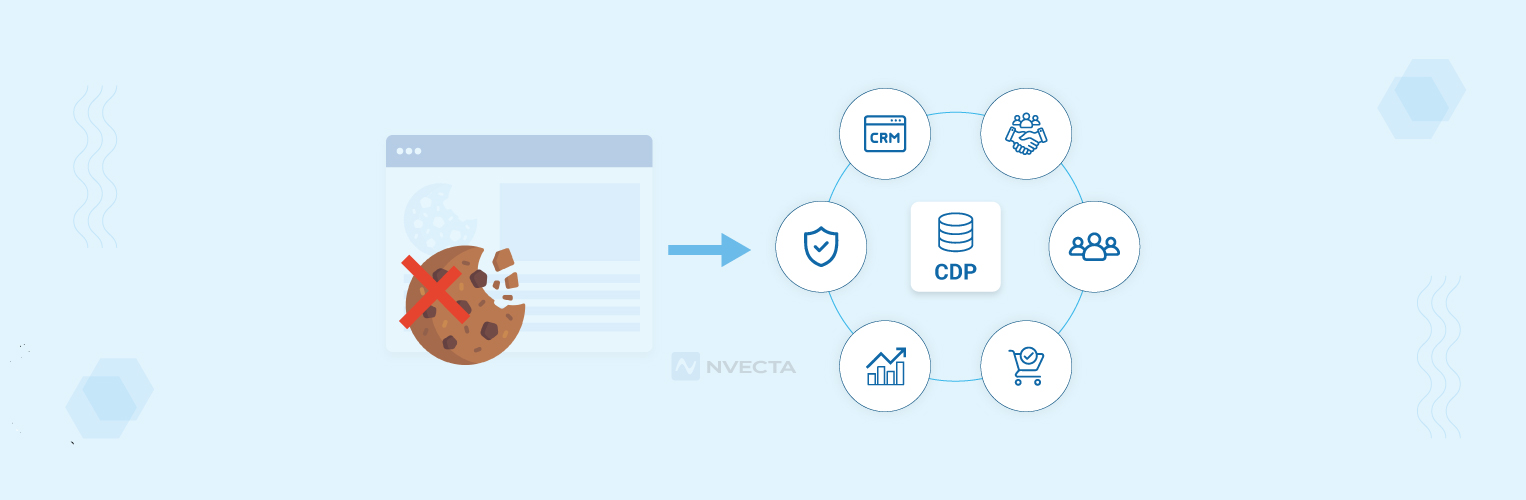
 Afreen Sheikh
📌 Quick Answer: CDP First-Party Data Strategy
A CDP first-party data strategy helps brands collect, unify, and activate customer data gathered directly from their own channels — websites, apps, emails, CRM, and in-store interactions — into a single, continuously updated customer profile. In the post-cookie era, where third-party tracking is increasingly blocked by browsers and restricted by privacy laws like GDPR and CCPA, first-party data has become the only durable foundation for personalised marketing. A Customer Data Platform (CDP) is the system that makes this data usable at scale — unifying it, resolving customer identities across touchpoints, and activating it across campaigns in real time, without relying on any external data source.
The digital marketing world is going through a major change. For many years, brands used to depend on third-party cookies to understand users, track behavior, and show relevant ads. These cookies helped marketers follow people across websites and collect information without direct interaction.
That system is now coming to an end. Browsers are blocking third-party cookies, privacy laws are becoming stricter, and users are more aware of how their data is used. People want transparency and control. They expect brands to respect their privacy.
Because of this shift, businesses can no longer rely on external data sources. Instead, they need to focus on building direct relationships with their customers. This is where a first-party data strategy becomes important. And to unify, manage, and use such data effectively, Customer Data Platforms (CDPs) play a key role.
This blog explains how CDPs support first-party data strategies in the post-cookie era, and why they are important. Also, we will explore how NVECTA CDP supports first-party data strategies.
Understanding the Post-Cookie Era
The post-cookie era is a time when third-party cookies are no longer the main way to track users online. Major browsers have already limited their use, and regulations require clear consent before collecting personal data.
This change is not only about technology. It reflects a shift in mindset. Customers want to know what data is collected, why it is collected, and how it is used. Brands that fail to respect this risk losing trust.
Why Third-Party Cookies are Disappearing
Third-party cookies were created at a time when privacy was not a big concern. Over time, they became associated with hidden tracking and lack of user control. As awareness grew, regulators and browser companies took action.
Privacy laws require brands to be open about data usage. Browsers started blocking third-party cookies to protect users. As a result, cookie-based tracking is no longer reliable or sustainable.
How This Affects Marketing and Customer Insights
Without third-party cookies, many old marketing tactics stop working properly. Retargeting becomes less accurate. Audience data from outside sources becomes limited. Measurement and attribution also become harder.
One of the most effective responses to this shift is building a robust first-party data for Meta Ads strategy — enabling brands to send enriched, consented conversion signals directly to Meta via server-side tracking, bypassing the browser limitations that have eroded pixel-based measurement.
Brands now need a better way to understand customers. Instead of tracking people across the internet, they need to focus on their own channels and data.
First-Party Data in 2026 — What the Numbers Actually Show
The urgency behind the shift to first-party data is not theoretical. The data tells a clear story about where the market is heading and how significant the gap is between brands that have already moved and those that haven’t.
- 49% of marketers still relied on third-party cookies as of 2024 — despite years of warnings about their deprecation. This means roughly half the industry is running on a foundation that is actively being eroded by browser policy and regulation (Adobe 2024).
- 84% of companies now use real-time CDP activation for customer engagement — a figure that reflects just how quickly CDPs have moved from a specialist tool to standard marketing infrastructure (Tealium 2025 Future of Customer Data Report).
- The CDP market is growing from $9.7 billion in 2025 to a projected $37.1 billion by 2030 — making it one of the fastest-expanding categories in the entire marketing technology stack. The primary driver is the shift to first-party data strategies.
- Brands with mature first-party data strategies are projected to see 30–40% lower customer acquisition costs by 2027 compared to competitors still relying on third-party data — because their targeting is more accurate, their audiences are better qualified, and their measurement is cleaner.
These figures matter because they show the window is narrowing. The brands investing now are locking in structural advantages — better data, lower costs, and stronger customer trust — that become harder to close over time.
What is a First-Party Data strategy and why does it matter?
A first-party data strategy is your plan for collecting customer data straight from your own channels (your website, app, emails, CRM, and shops) and actually putting it to use.
Customers share this data with you directly and with their permission, so you own it and you know it’s accurate. No data broker or third-party cookie sits in the middle.
It helps to separate two things people often mix up. First-party data is the raw stuff: what someone clicked, what they bought, what they told you.
The strategy is what you do with it: how you gather it, keep it organised and compliant, and feed it into your campaigns. Plenty of brands sit on piles of first-party data and get nothing out of it, simply because nobody has a plan to join the dots.
Common Sources of First-Party Data
First-party data is collected at multiple touchpoints, including:
- Website activity, such as page visits, clicks, and searches
- Mobile app interactions, like feature usage and session behavior
- Email engagement, including opens and clicks
- Purchase history covering products bought and order frequency
- Customer support interactions, such as queries and feedback
Key Types of First-Party Data
This data can be grouped into different categories:
- Behavioral data that shows interests and intent
- Transactional data that highlights buying patterns
- CRM data that includes customer details and communication history
- Engagement data that tracks responses to messages
- Feedback data that reveals customer expectations
Why First-Party Data Is More Reliable
First-party data is reliable because it comes directly from customers and shows their real actions when interacting with the brand. It helps brands understand customers better, build trust, and offer more relevant experiences.
First-party vs second-party vs third-party data — what’s the difference?
One of the most common points of confusion when building a post-cookie data strategy is understanding how first-party data actually differs from third-party data — and where second-party data fits in. The distinctions matter because they determine what you can legally collect, how reliable it is, and whether it will still work in a cookieless world.
| Comparison Area | First-Party Data | Second-Party Data | Third-Party Data |
|---|---|---|---|
| Definition | Data collected directly by your brand from your own customers | Another company’s first-party data shared directly with you via a partnership | Data collected by external companies and sold or shared broadly across buyers |
| Examples | Website visits, purchase history, email opens, app behaviour, CRM records | Data from a retail partner, airline loyalty data shared with a hotel brand | Data broker files, ad network audience segments, aggregated demographic data |
| Accuracy | High — reflects real interactions with your brand | Medium — accurate but from a different brand context | Low to medium — often aggregated, outdated, or inaccurately modelled |
| Privacy compliance | Fully compliant when collected with consent — the gold standard | Compliant if the originating brand collected with consent | Increasingly restricted under GDPR, CCPA, and browser policies |
| Post-cookie viability | ✅ Fully viable — the foundation of all post-cookie strategy | ⚠️ Viable but depends on partnership access | ❌ Declining rapidly — being blocked by browsers and restricted by law |
The table makes the direction clear. Third-party data is losing ground on every dimension — accuracy, compliance, and reach. First-party data improves on every one of those dimensions.
It is more accurate because it reflects real behaviour with your brand. It is more compliant because it is collected with direct consent. And it gets stronger over time, not weaker, because every customer interaction adds to it rather than eroding it.
What Is a Customer Data Platform (CDP)
A Customer Data Platform is a system that collects and organizes customer data from different sources. It brings all this data together to create a single view of each customer.
This helps brands understand who their customers are and how they interact across different touchpoints. It also makes customer data easier to access, manage, and use for marketing and engagement.
Many data handling tools work in isolation, but a CDP connects data from all channels and teams, ensuring everyone works with the same customer information.
Key Functions of a Customer Data Platform
A CDP helps brands manage and use customer data in several ways:
- Collects data from websites, mobile apps, email platforms, CRM tools, and offline sources
- Connects multiple interactions to one customer profile
- Keeps customer data updated in real time or near real time
- Creates audience segments based on behavior and preferences
- Supports campaigns across multiple marketing channels
This converts fragmented data into useful insights that are utilized for marketing purposes. It further makes customer data truly actionable for business growth.
How CDPs Enable First-Party Data Strategies Post-Cookie
As third-party cookies disappear, brands lose access to external tracking and shared audience data. CDPs help fill this gap by allowing businesses to rely on their own first-party data instead.
They give brands a structured way to collect, manage, and use customer data that comes directly from owned channels. This shift helps brands stay compliant with privacy rules while still delivering relevant and personalised experiences.
CDPs act as the foundation of first-party data strategies by bringing clarity, consistency, and action to customer data.
As brands adapt to privacy-first marketing, many are exploring proven strategies for leveraging first-party data post-cookie to maintain personalization, improve customer engagement, and reduce dependence on external tracking methods.
CDPs make these strategies possible by unifying customer interactions across channels, enabling real-time segmentation, and activating data in a compliant and scalable way.
Centralizing First-Party Data Across Touchpoints
Customers interact with brands across many channels, but their data often sits in different tools. CDPs solve this problem by bringing all first-party data into one central system.
They collect and unify data from:
- Websites and landing pages
- Mobile apps
- Email and messaging platforms
- CRM and sales tools
- Offline sources such as in-store interactions or events
By centralizing this data, CDPs remove silos and help brands understand the full customer journey instead of isolated actions.
Building a Single Customer View
A key role of a CDP is to create a single and consistent customer profile. This profile combines all interactions, preferences, and attributes linked to one customer.
CDPs use identity resolution to connect different actions to the same person, such as website visits, email clicks, and purchases. These customer profiles remain persistent and continue to grow as new data is added. This helps brands recognize returning users and understand long-term behavior instead of treating each interaction as new.
A single customer view makes communication more relevant and reduces repeated or confusing messages.
Activating First-Party Data in Real Time
CDPs do not just store data. They help brands act on it at the right moment. Real-time activation allows brands to respond to customer behaviour as it happens.
Common ways CDPs activate first-party data include:
- Personalized messages based on browsing or purchase behavior
- Behavior-based triggers, such as abandoned cart or product views
- Cross-channel campaign execution across email, push, SMS, and on-site messaging.
Smarter Audience Segments Based on Real Customer Behavior
CDPs help brands create audience segments based on real customer actions like browsing, clicks, and purchases. These segments update automatically, making messages more relevant and campaigns more effective.
Role of CDPs in Privacy and Compliance
In 2026, privacy matters more than ever. Customers are well aware of how their data is used and expect brands to be transparent and responsible. At the same time, data protection laws make privacy an essential part of how businesses collect and use customer information.
CDP functions help in managing both the customer expectation and regulatory requirements.
Consent Management and Preference Tracking
CDPs help brands manage customer consent and communication preferences in one place. They make sure that customer data is used only when permission is given, and they also provide options for users to update their preferences easily. Such features helps brands reduce compliance risks and show customers that their preferences are respected.
Data Governance and Security
CDPs also help control how customer data is accessed and used by various teams. They limit data access to the right teams and store only the information that is truly needed. With secure systems and regular monitoring, CDPs protect sensitive customer data and reduce the risk of misuse or breaches.
How to collect first-party data — 5 methods that actually work
Understanding the value of first-party data is the easy part. The harder question is where it comes from and how to collect enough of it to make your CDP genuinely useful.
The good news is that most brands already have several collection points — they just haven’t connected them properly. Here are five approaches that consistently deliver high-quality first-party data.
1. Loyalty programmes and account registration
When customers sign up for a loyalty programme or create an account, they voluntarily share their name, contact details, and preferences in exchange for something valuable — points, discounts, early access, or exclusive content.
This is one of the richest sources of first-party data because it is explicitly consented, self-reported, and tied to a real person. The key is making the value exchange clear: customers should feel they are getting something worthwhile, not just filling in a form for the brand’s benefit.
2. Preference centres and surveys
Preference centres let customers tell you directly what they want — which topics interest them, which channels they prefer, how often they want to hear from you.
This is sometimes called zero-party data, and it is the most intentional form of data collection because the customer is actively choosing to share it.
Short, well-timed surveys work similarly. A single-question survey sent after a purchase or support interaction can surface insight that no amount of behavioural tracking would reveal. For a deeper look at how this works in practice, see NVECTA’s guide on zero-party data strategy.
3. Progressive profiling
Rather than asking for everything upfront — which tends to put people off — progressive profiling collects data gradually across multiple interactions. The first visit might capture an email address.
The second might add a phone number. Over time, you build a rich profile without ever making the customer feel like they are filling in a lengthy form. A CDP is what makes this practical at scale, because it holds each piece of data as it arrives and assembles it into a growing, unified profile automatically.
4. Website and app behavioural tracking
Every click, scroll, page visit, product view, and search on your own website or app is a signal — and it all qualifies as first-party data when captured through your own tracking infrastructure (first-party tags, server-side tracking, or a CDP SDK).
Unlike third-party cookies, which track users across the internet, this data is collected on your own property with your own tools. It captures intent in real time: what someone is looking at right now, what they almost bought, which content is holding their attention. Feeding this into a CDP means those signals can trigger personalised responses immediately.
5. Transactional and CRM data
Purchase history, order frequency, average spend, support ticket topics, and email engagement records are all first-party data that most brands already have sitting in their CRM or e-commerce platform.
The problem is usually that this data is siloed — your CRM doesn’t talk to your email platform, which doesn’t talk to your website analytics.
A CDP fixes this by pulling all of these sources together, connecting the dots between the customer who bought twice, emailed support once, and hasn’t opened an email in three weeks. That combined view is what drives genuinely relevant communication rather than generic campaigns.
How NVECTA CDP Supports First-Party Data Strategies
NVECTA CDP is designed for a privacy-first, post-cookie environment where first-party data is the core of customer engagement.
It helps brands collect and organize data from their own channels in well structured manner. This allows teams to utilise raw customer data efficiently for achieving business goals while maintaining trust and compliance.
Key Features That Support First-Party Data Strategies
Unified customer profiles
NVECTA combines data from websites, apps, emails, CRM, and offline sources into one customer profile. This gives brands a complete view of each customer instead of disconnected data points.
Real-time data collection
Customer actions are captured as they happen, ensuring data stays fresh and accurate. This helps brands respond quickly to changes in customer behavior.
Behavior-based segmentation
Audience segments are created using real customer actions, not assumptions or third-party data. These segments update automatically as customer behavior changes.
Real-time personalization and automation
NVECTA triggers messages across channels like email, push notifications, and on-site messaging based on customer activity and preferences. This ensures communication is timely, relevant, and consistent.
Consent and preference management
Customer consent and communication preferences are tracked in one place. This ensures data is used only when consent exists and supports privacy compliance.
Secure and privacy-first architecture
NVECTA provides strong security controls to protect customer data at every stage. Privacy-friendly workflows help brands meet regulatory requirements without affecting the marketing efforts.
Altogether, these features help brands in processing first-party data, reducing dependence on third-party cookies, and building long-term customer trust.
Conclusion
First-party data strategies are now an important part of how brands build meaningful customer relationships. CDP capabilities enable businesses to make the most of their customer data. Customer Data Platforms support these strategies by bringing all data into one place, and turning it into actionable insights.
They also aid brands in meeting growing privacy expectations while continuing to deliver relevant and consistent experiences across channels.
NVECTA CDP makes it easier for brands to put first-party data strategies into practice. It helps teams manage customer data securely, engage users at the right moment, and build long-term relationships based on trust and transparency.
Build stronger customer relationships with first-party data. See how NVECTA CDP enables privacy-first personalisation in a post-cookie era. Book a demo now.
Frequently Asked Questions
What is first-party data and why does it matter in 2026?
First-party data is information a brand collects directly from its own customers through owned channels — websites, apps, email, CRM, in-store interactions, and support platforms. It matters in 2026 because third-party cookies, which previously let brands track users across the internet without direct relationships, are being blocked by browsers and restricted by privacy laws like GDPR and CCPA. First-party data is the only form of customer intelligence that is simultaneously accurate, fully consented, and compliant — making it the foundation every sustainable marketing strategy now needs to be built on.
How does a CDP help with first-party data strategy?
A CDP (Customer Data Platform) collects first-party data from all of a brand’s owned sources, resolves customer identities across touchpoints — so a website visitor, email subscriber, and in-store buyer are recognised as the same person — and builds a unified, continuously updated customer profile. From that profile, the CDP segments audiences based on real behaviour, manages consent centrally, and activates the data across marketing channels in real time. Without a CDP, first-party data tends to stay siloed across platforms and never reaches its full value.
What is the difference between first-party and third-party data?
First-party data is collected by your brand, from your customers, through your own channels — with their direct consent. Third-party data is collected by external companies and sold or shared broadly across many buyers, often without a direct relationship with the customer involved. First-party data is more accurate, more trustworthy, and fully viable in a post-cookie world. Third-party data is increasingly blocked by browsers, restricted by regulation, and declining in both accuracy and legal permissibility.
What happens to marketing when third-party cookies disappear?
When third-party cookies go away, several common marketing tactics become less effective or stop working entirely. Cross-site retargeting loses precision. Audience data bought from external sources becomes unreliable. Attribution across channels gets harder to measure. Brands that have built strong first-party data foundations — with a CDP collecting and unifying data from their own channels — are largely insulated from these impacts, because they do not depend on external tracking to understand and reach their customers. Brands that haven’t made that shift will find their targeting less accurate, their costs rising, and their measurement increasingly unreliable.
5. What is the difference between first-party and zero-party data?
First-party data is observed — it comes from tracking what customers actually do on your channels (clicks, purchases, page visits). Zero-party data is declared — it comes from what customers intentionally tell you about themselves, such as preferences shared in a survey, interests selected in a preference centre, or wishes submitted in a quiz. Both types are privacy-safe and fully consented. Zero-party data is generally the most reliable because it reflects stated intent rather than inferred behaviour, but first-party behavioural data tends to be higher in volume and available for more customers. A strong post-cookie strategy uses both together.
