














 Email
Email SMS
SMS Whatsapp
 Web Push
 App Push
 Audience Sync for Ads
 Popups
 Channel A/B Testing
  Control groups Analysis
 Frequency Capping
 Funnel Analysis
 Cohort Analysis
 RFM Analysis
 Signup Forms
 Surveys
 NPS
NPS Landing pages personalization
  Website A/B Testing
  PWA/TWA
 Heatmaps
 Session Recording
 Wix
Wix Shopify
 Magento
 Woocommerce
 eCommerce D2C
  Mutual Funds
 Insurance
 Lending
  Recipes
  Knowledgebase
 Developer Docs
 Product Updates
 App Marketplace
 Academy
 Ebooks
 Case Studies
 Blog
Blog Templates
 Afreen Sheikh
Customer behaviour is inconsistent as they move between channels, interacting based on their intuition, creating complex customer journeys. Customers may actively explore a product for days, interact with emails, check pricing and then suddenly go silent. Marketers using predefined, fixed workflows struggle to handle dynamic customer behaviour, as their intent changes faster than prebuilt journeys can react.
Even the customers are well aware, they know what personalised experiences feel like. They can sense when brands continue to send irrelevant, annoying, and repetitive messages.
This is where next-best-action marketing comes to the rescue. It uses live customer behaviour, predictive insights, and real-time intelligence to help brands decide the most relevant action for each individual. Demand for this is real: in 2026 research, CDP buyers ranked next-best-action their most-wanted AI capability, ahead of content generation and segmentation.
An AI-powered customer data platform supports this strategy by analysing interactions across channels to trigger the right action. It could be a product recommendation, an onboarding prompt, a retention offer, or suppression of communication.
In this blog, we will explore what next-best-action marketing is, how it works, and how CDP enables it to support individualised, personalised engagement.
We will further see how NVECTA uses AI-powered decisioning, predictive intelligence, real time orchestration to deliver individualised experiences throughout the customer journey.
What is the Next-Best-Action Marketing (NBA)?
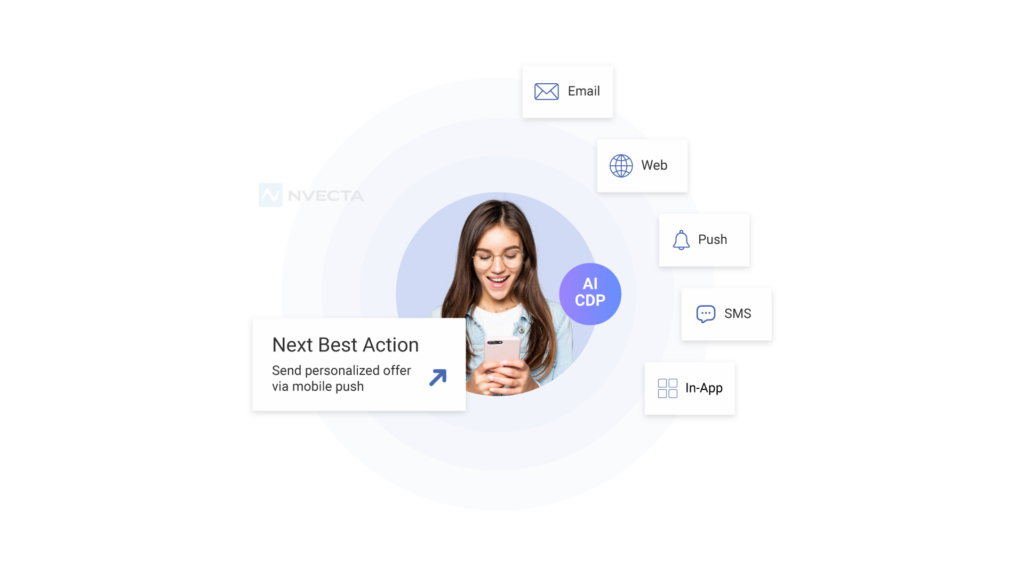
Next-best-action marketing is a strategy that helps brands determine the most suitable action to take after every customer interaction using predictive intelligence.
This action is executed only after careful consideration of customers’ engagement history, intent signals, preferences, and predictive insights to identify the next relevant action that effectively engages a customer at a particular moment.
Modern customer engagement platforms use these insights to deliver personalised interactions that align with customer needs and behaviour in real time. Take a shopper who keeps returning to the same pricing page.
They are probably not browsing for fun. An NBA system can read that repeat visit as buying intent and send a timed offer for that exact item, instead of waiting for a scheduled campaign that goes out three days too late.
Traditional campaigns follow fixed journeys that use predefined triggers and conditions, where every customer receives similar communication after a certain event.
Next-best-action marketing works ahead of this approach. Its AI model continuously evaluates customer interactions to determine the next engagement step or action.
It provides decision-making journeys that are adaptive and personalised engagement.
The purpose is simple- creating an AI-driven automated communication system that turns interactions that match what customers are likely to need, expect, or respond to.
How Does Next-Best-Action Marketing Work?
NBA runs on a loop that repeats every time a customer does something. Four things happen in order.
First, the system collects signals. Every click, product view, email open, cart addition, and pause in activity gets recorded and tied back to one customer profile. A single signal means little. A pattern of signals is where intent starts to show.
Second, it scores the options. The AI looks at a defined list of possible actions for that customer (send an offer, recommend a product, trigger an onboarding tip, or wait) and predicts which one is most likely to earn a useful response right now.
Third, it acts. The chosen action fires on whichever channel the customer actually checks, at a time they are usually active.
Fourth, it learns. The system watches what the customer did next and feeds that result back in, so the following decision for that person is a little sharper.
The part people miss: sometimes the best action is no action. If someone just bought a product, a good NBA system knows not to push a discount for the same thing an hour later. Staying quiet is a valid move.
What Data Does NBA Need?
NBA is only as good as the data under it. Three kinds matter most.
Behavioural data is what someone does: pages viewed, searches, clicks, features used. This is the freshest sign of intent.
Transactional data is what someone has bought: past orders, subscription changes, refunds, average spend. This tells you value and buying patterns.
Contextual data is the where and when: device, location, time of day, traffic source. It shapes the timing and the channel, not just the action.
When this data sits in separate tools, the picture breaks. That is the real reason a CDP matters here. It stitches these three into one profile, so the decision is made on the whole person instead of a fragment.
Next-Best-Action vs Next-Best-Offer: What’s the Difference?
People use these two terms as if they mean the same thing. They don’t.
Next-best-offer is about what to sell. It picks the product or promotion a customer is most likely to buy.
Next-best-action is the bigger decision. It decides whether to make an offer at all, or whether the right move is something else: a how-to, a shipping update, a re-engagement nudge, or nothing. An offer is just one action among many.
Simply put, next-best-offer answers “which product?” Next-best-action answers “what should we do for this person, if anything?”
Why Traditional Personalisation no Longer Works for Effective Marketing
1. Static Journeys
Traditional personalisation relies on fixed customer journeys built in advance; they follow a predefined path and cannot adapt even when customer behaviour changes across interactions and channels.
2. Broad Segmentation
When brands target broader audience groups, personalisation gets limited, and interactions do not reflect individual customer intent and preferences.
3. Rising Customer Expectations
Traditional personalisation is less effective as customer expectations have evolved towards more relevant, timely and connected interactions throughout the journey.
4. Data Silos
When customer data is stored separately across systems, personalisation lacks consistency, accuracy, and the contextual understanding required to engage customers.
5. Generic Automation
Generic automation reacts to isolated actions and creates repetitive experiences. They do not consider the changing customer intent or engagement context.
Traditional Personalisation vs Next-Best-Action Marketing
The table below summarises how next-best-action marketing addresses each of the core limitations of traditional personalisation:
| Challenge | Traditional Personalisation | Next-Best-Action Marketing |
|---|---|---|
| Journey Type | Fixed, predefined paths | Adaptive, real-time decisioning |
| Segmentation | Broad audience groups | Individual-level targeting |
| Data Usage | Siloed across systems | Unified customer profiles |
| Automation | Generic triggers | Predictive AI decisioning |
| Customer Intent | Ignored or delayed | Continuously evaluated |
| Experience | Repetitive, irrelevant | Contextual and personalised |
How AI CDPs Power Next-Best-Action Marketing?
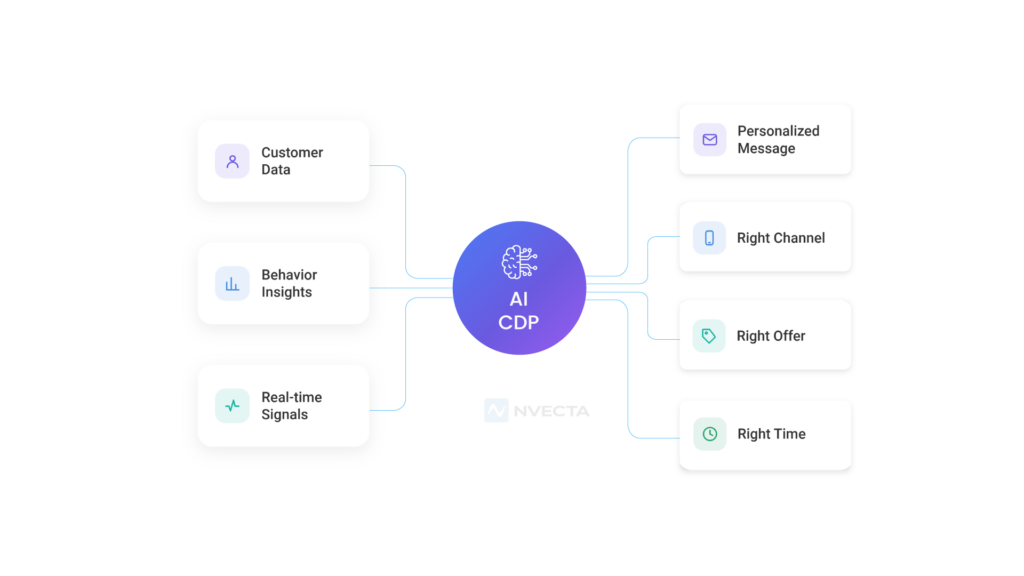
To implement next-best-action marketing, brands need AI-powered CDPs equipped to understand customer behaviour by using predictive intelligence to decide on the next suitable action.
AI CDPs support next-best-action marketing by bringing these capabilities together to deliver the right interactions at the right moment.
Here is a step-by-step flow that enables next-best-action marketing-
1. Unified Customer Profiles
CDP brings customer data from multiple sources together to create a single customer profile.
These unified profiles for every individual provide a complete view of interactions and recurring patterns, delivering a consistent customer experience across channels and supporting personalised, data-driven engagement.
2. Real-Time Behavioural Tracking
AI power tracking captures customer actions across websites, emails, apps, campaigns, and other channels in real time.
CDP uses these insights to personalise communication, optimise engagement timing and identify the most relevant next interaction based on live customer activity and engagement behaviour.
3. AI-Driven Segmentation
CDP uses AI to create more real customer segments based on recent customer behaviour and engagement patterns.
These segments automatically update as customer behaviour moves, helping brands personalise interactions, improve customer targeting, and enhance experiences across different customer journeys and interaction stages.
4. Predictive Analytics and Decisioning
CDP uses AI-driven predictive models to foresee future customer behaviour, including conversion, disengagement, or churn risk. On the basis of such insights,
AI-powered decisioning chooses the most suitable next action to optimise engagement timing and personalised communication, helping businesses create proactive engagement across channels.
5. Predictive vs Adaptive
It helps to split these models in two. Predictive models look back: they read historical data to estimate which action usually works.
Adaptive models look forward: they adjust in real time based on what the customer is doing at that moment. Strong NBA setups use both, one for the baseline bet and one for the live correction.
6. Omnichannel Journey Orchestration
CDP supports omnichannel journeys, helping businesses deliver a coordinated customer experience across multiple communication channels.
It ensures communication remains consistent and relevant even when customers switch between platforms, devices or other touchpoints during different stages of engagement.
7. Dynamic Personalisation Engines
A customer data platform supports dynamic personalisation engines that continuously adjust content suggestions, messaging, and engagement timing based on real-time behaviour insights.
This helps businesses to continuously optimise experiences that reflect current customer interest and preferences across channels.
8. AI-Generated Recommendations
CDPs use AI-powered recommendation systems that suggest appropriate products, content, services, or actions based on continuous evaluation of behaviour and engagement.
These recommendations enhance over time as AI models learn from customer interactions and constantly optimise personalisation based on changing customer interests and preferences.
Common Use Cases and Industry-Specific Examples of Next-Best-Action Marketing
Every industry has its own challenges when it comes to understanding customer behaviour and assessing the next-best action in marketing. Customer expectations, engagement behaviour, and decision-making patterns vary across industries.
It becomes increasingly important for brands to implement CDPs that enable AI-powered decisioning to evaluate real-time customer behaviour, identify relevant interactions, improve engagement quality, and enhance customer experiences.
Let’s have a closer look at common use cases across various industries and the business impact of next-best-action marketing-
1. E-commerce
- Delivering personalised product recommendations based on browsing activity and purchase history
- Recovering abandoned carts with timely reminders and follow-up communication
- Delivering personalised promotional offers and discounts based on customers’ recent shopping activity
- Improving cross-sell and upsell opportunities using behavioural insights to recommend complementary or high-value products
- Encouraging repeat purchases through personalised replenishment reminders based on previous buying behaviour
Say a customer buys running shoes. Instead of a generic newsletter, the system waits about two weeks and then suggests socks and an insole, right when the first pair usually starts to need them. E-commerce businesses can encourage purchase frequency and conversions through NBA marketing strategies and enhance the overall shopping experience.
2. SaaS and Subscription Businesses
- Personalising onboarding journeys based on customer engagement and activity levels
- Encouraging feature adoption by offering tools that align with user activity and usage trends
- Recognising the engaged users and triggering retention-based communication
- Delivering personalised product usage reminders and engagement nudges
- Recommending suitable upgrade or expansion opportunities based on usage behaviour
- Supporting customer re-engagement via AI-driven communication methods
For example, a user who set up their account but never opened the reporting feature gets a short nudge showing what that feature does, rather than the same onboarding email everyone else receives. The SaaS industry can use NBA to support stronger retention, better platform usage, and more sustainable customer value over time.
3. Banking and Financial Services
- Delivering personalised financial guidance based on customer transaction activity and individual banking preferences
- Triggering fraud alerts and risk notifications in real time
- Personalising digital banking engagement through timely, relevant communication across channels and apps
By engaging customers with personalised communication, the banking sector can strengthen customer relationships, improve consistency in engagement, and enhance digital customer satisfaction.
4. Media and Entertainment
- Recommending content based on audience viewing history and content consumption preferences
- Customising audience interactions across streaming and digital platforms
- Launching retention-focused engagement campaigns to maintain audience activity
- Improving content discovery through AI-powered recommendations
- Supporting subscription engagement through contextual viewing experiences
By personalising audience experiences, digital media platforms can maintain engagement activity and improve long-term content consumption.
5. Healthcare and Fitness Platforms
- Sending personalised appointment reminders based on customers’ schedules and preferences
- Delivering personalised wellness/ preventive suggestions based on activity patterns and engagement behaviour
- Recommending wellness program services and health content based on customer preferences
- Identifying inactive patients or low engagement patterns to improve ongoing healthcare communication
Healthcare businesses can improve patient communication, encourage proactive encouragement and create more personalised care experiences.
6. Travel and Hospitality
- Delivering destination and travel recommendations based on customer interest and booking behaviour
- Sending real-time travel updates, booking reminders, and itinerary communication
- Personalising loyalty experience is based on travel frequency and traveller preferences
- Creating seasonal and location-based promotional campaigns using engagement insights
Travel and hospitality brands can create seamless customer journeys, improve engagement throughout the travel experience and strengthen long-term customer loyalty.
Benefits of Next-Best-Action Marketing
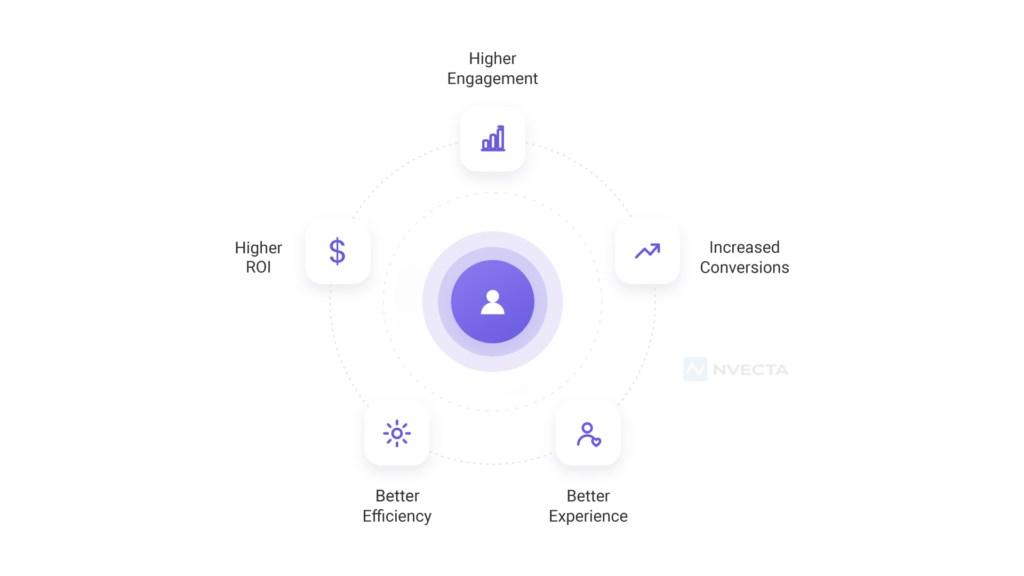
With AI-driven CDPs, brands can implement next-best-action marketing. It helps deliver hyper-personalisation and smarter engagement decisions based on customer behaviour, timing and intent. Let us have a closer look at what all benefits brands can see-
1. Higher Customer Engagement
Customer engagement improves when interactions feel connected to customer interests, activity, and engagement timing, helping brands increase customer engagement through more relevant and personalised experiences.
2. Improve Conversion Rates
When brands deliver meaningful recommendations, offers, or communications that align closely with customers’ intent and decision-making, it leads to improved conversion rates.
3. Reduced Customer Churn
Brands can reduce customer churn by easily identifying early signs of declining engagement and responding with more relevant interactions before customers completely disengage.
4. Better Customer Lifetime Value
Customers are more likely to continue interacting with brands that consider and value their interests and preferences. This encourages stronger relationships and continuous customer interaction over time.
5. Consistent Omnichannel Experiences
When customer engagement remains connected across websites, apps, messaging platforms and other communication channels, brands can deliver smoother customer experiences.
6. Faster and Smarter Decision-Making
With continuous customer insights, brands respond more effectively to changing engagement behaviour, interaction opportunities and customer activity across channels in real time.
Where Next-Best-Action Marketing Gets Hard
NBA sounds clean on paper. In practice, most teams hit the same walls, and it helps to know them before you start.
Messy data is the usual killer. If your customer data is split across an email tool, a CRM, and a website analytics platform that never talk to each other, the model decides on half a picture and gets it wrong quickly.
Too many actions, no clear priority. If everything is “important,” the system has nothing to aim at. Someone has to define what a good outcome actually is, whether that is a purchase, a renewal, or a customer who came back.
Cold start. A new NBA system does not know your customers yet. Early decisions can feel generic while it gathers enough behaviour to learn from. This passes, but teams expecting magic on day one get frustrated.
Over-messaging. A tool built to cut noise can add to it if you let it fire on every signal. Teams that do this well use NBA to say no as often as it says yes.
None of this makes NBA not worth doing. It just means the payoff shows up after the data and the goals are sorted, not before.
How NVECTA Supports Next-Best-Action Marketing
NVECTA combines AI, customer intelligence, automation, and predictive capabilities to enable next-best-action experiences, enabling businesses to create more adaptive strategies.
1. AI-Powered Customer Data Platform (CDP)
NVECTA unifies customer information from multiple sources into connected customer profiles, helping businesses understand interactions, preferences, purchase behaviour, and customer journey progression in a single place.
2. Real-Time Event Tracking and Behavioural Intelligence
NVECTA instantly captures every customer action, such as clicks, browsing activity, product views, or engagement drops. This helps brands respond to changes in customer activity and real-time intent signals.
3. AI-Based Segmentation and Audience Intelligence
NVECTA creates audience groups that update dynamically based on customer activity, interests, and interaction patterns, making segmentation more precise and responsive.
4. Omnichannel Journey Automation
NVECTA helps brands to automate customer journeys across all communication channels through systematic, connected engagement flows.
5. AI-Powered Content and Recommendation Generation
NVECTA helps brands generate personalised recommendations, engagement, and communication content experiences using AI. It aligns all content and recommendations with the customer’s interests and browsing history.
6. Website Personalisation and A/B Testing
brands can personalise the website experience based on visitor behaviour, traffic source, audience category, or engagement patterns. They can also use A/B testing to continuously test different variations and choose the one that performs well
7. Predictive Analytics and AI Insights
With NVECTA predictive analytics, brands can identify conversion trends, churn probability, purchase intent, and shifts in engagement using predictive AI models and behaviour analysis.
8. Smart Assistant/ Agentic AI
NVECTA provides users with AI-powered assistants that help teams automate repetitive tasks, optimise engagement flows, analyse audiences faster, and improve campaign execution through intelligent recommendations.
Conclusion
Every brand is aware that customer engagement depends on its ability to respond effectively to changing customer behaviour. By delivering relevant interactions and personalised experiences at the right moment, brands can build better customer relationships and sustainable business growth.
Next-best-action marketing is a future-ready approach that uses intelligence to understand customers’ intent and identify the most appropriate action to engage customers effectively.
NVECTA supports this with its powerful insights and predictive intelligence, helping businesses deliver individualised customer experiences.
Deliver a hyper-personalised customer experience with AI-powered next-best-action marketing with NVECTA. Schedule a demo now.
FAQs
What is next-best-action marketing?
Next-best-action (NBA) marketing is a customer engagement strategy that uses AI and predictive intelligence to determine the most relevant action to take with each individual customer at any given moment. Rather than following fixed, predefined journeys, NBA marketing continuously evaluates real-time behaviour, engagement history, and intent signals to decide the optimal next interaction, whether that is a product recommendation, a retention offer, an onboarding prompt, or simply suppressing communication.
How is next-best-action marketing different from traditional personalisation?
Traditional personalisation relies on fixed customer journeys and broad audience segments built in advance. It cannot adapt when customer behaviour changes mid-journey. Next-best-action marketing, by contrast, uses AI to continuously evaluate individual customer signals and adjust engagement in real time. It moves personalisation from rule-based automation to dynamic, predictive decisioning that reflects where each customer actually is in their journey.
What role does a CDP play in next-best-action marketing?
A Customer Data Platform (CDP) is the foundational layer that enables NBA marketing. It unifies customer data from multiple sources into a single profile, tracks real-time behavioural signals, powers AI-driven segmentation, and orchestrates omnichannel journeys. Without a CDP, brands lack the data infrastructure needed to evaluate customer intent and trigger the right action at the right moment across channels.
Which industries benefit most from next-best-action marketing?
NBA marketing delivers measurable value across a wide range of industries. E-commerce brands use it to recover abandoned carts and improve product recommendations. SaaS companies apply it to onboarding and churn prevention. Banks leverage it for personalised financial guidance and fraud alerts. Healthcare platforms use it for appointment reminders and wellness engagement. Travel and hospitality brands apply it to loyalty personalisation and real-time booking communication.
What is the difference between next-best-action and next-best-offer?
Next-best-offer decides which product or promotion to show. Next-best-action is broader: it decides whether to show an offer at all, or whether a different move (a reminder, a support message, or no message) fits the customer better right now.
What data does next-best-action marketing need?
It relies on three data types: behavioural (clicks, views, searches), transactional (past purchases and spend), and contextual (device, location, timing). These work best when unified in one customer profile through a CDP.
