














 Email
Email SMS
SMS Whatsapp
 Web Push
 App Push
 Audience Sync for Ads
 Popups
 Channel A/B Testing
  Control groups Analysis
 Frequency Capping
 Funnel Analysis
 Cohort Analysis
 RFM Analysis
 Signup Forms
 Surveys
 NPS
NPS Landing pages personalization
  Website A/B Testing
  PWA/TWA
 Heatmaps
 Session Recording
 Wix
Wix Shopify
 Magento
 Woocommerce
 eCommerce D2C
  Mutual Funds
 Insurance
 Lending
  Recipes
  Knowledgebase
 Developer Docs
 Product Updates
 App Marketplace
 Academy
 Ebooks
 Case Studies
 Blog
Blog Templates
 Afreen Sheikh
Timing decides whether a marketing message is useful or completely irrelevant. Effective marketing is mostly about reaching customers at the right moment when their interest is high. A customer may show strong buying intent through repeated visits, price comparison, and feature exploration, but receives a message hours later, after they have already dropped off. This is where reactive marketing loses its effectiveness, as it responds to actions like churn and inactivity, after they have happened.
Predictive engagement is ahead of this functionality. It uses behavioural analytics, real-time behaviour data, and AI models to understand customer intent and trigger timely, relevant actions.
In this blog, we will see predictive engagement vs reactive marketing, why timing matters for customer engagement, and how CDP help businesses implement predictive engagement. We will further see how NVECTA uses predictive systems to enhance customer engagement.
Understanding Reactive Marketing
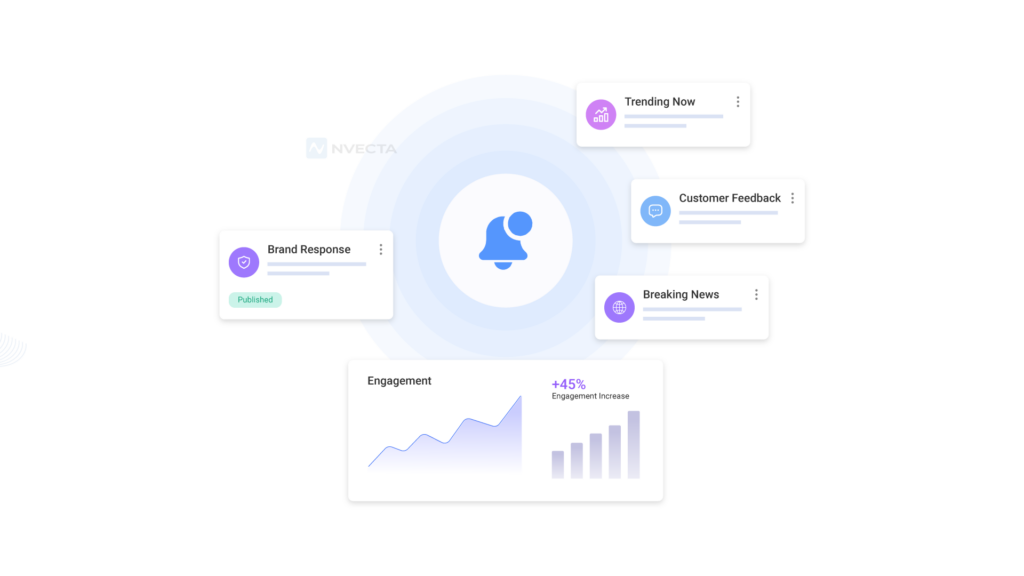
Reactive marketing mainly works on a simple principle- the customer takes an action first, and the system responds afterwards. The action could be inactivity,
Cart abandonment, drop-offs or reduced engagement over time. Communication is triggered only when a system detects the completion of a certain event.
Traditional CRM and automation systems follow this workflow. There are predefined customer events that activate campaigns. It actually worked well for a long time because customer journeys were slower and easier to track.
But today things are different. Customers move quickly between channels and devices, and their attention shifts faster. A delayed engagement can cost you the moment when customer interest was actually high.
Common Examples of Reactive Marketing
Cart Abandonment Emails After Drop-off
A customer shows clear purchase intent by adding products to the cart, but the reminder email often arrives much later, when the interest may already be weaker.
Re-engagement Emails After Inactivity
Streaming platforms, SaaS products, and ecommerce brands often restart communication only after noticing that users have stopped consistently interacting with their platforms or services.
Discount Messages After Churn Signals Appear
Many retention campaigns begin after customer activity declines significantly, using discounts as a recovery tactic once disengagement has already started becoming visible.
Support Outreach After Complaints
Support communication in many businesses still starts only after complaints or negative experiences, which means engagement remains reactive rather than preventive or proactive.
Push Notifications are Triggered Only After the App Opens
Many engagement systems still depend on basic app activity triggers, making notifications more reactive to actions rather than responsive to real-time customer intent.
The Hidden Cost of Late Engagement
The value of engagement drops quickly when you miss the opportunity to engage customers at the right time.
This becomes especially visible in competitive industries where brands respond faster to create relevant customer experience. Customers are quite aware-they know what repeated reminders and generic communication feel like. Moreover, it contributes to communication fatigue. Brands can only thrive when they engage customers naturally at the important moment.
Understanding Predictive Engagement
Predictive engagement starts much earlier than traditional marketing workflows.
It focuses on identifying customer intent while the interaction is still happening. It pays attention to small behavioural changes that usually appear before a customer converts, churns or disengages completely.
The system evaluates behavioural signals to anticipate what the customers are likely to do next.
Some customers spend more time comparing products, services, or plans; some may return to the same category repeatedly or suddenly become highly active after weeks of silence; every interaction communicates intent through behaviour.
Predictive systems are designed to recognise those moments and trigger timely engagement.
This completely changes how customer engagement works. The campaigns become Proactive, more contextual and better aligned with real customer behaviour.
This is what makes predictive engagement different from reactive marketing. Here, the system is not waiting for the customer journey to break before responding; it tries to engage while the customer is still moving through the journey.
How Predictive Engagement Works: Step-by-Step
Let us have a look at the steps involved for predictive engagement workflows-
Step 1: Collect Real-Time Customer Data
It starts by collecting real-time customer data from multiple channels- including website activity, app interactions, purchase behaviour, email engagement or product usage patterns. This creates a foundation by continuously monitoring customer activity over communication channels.
Step 2: Unify Customer Identities Across Channels
Once the data is collected, predictive systems connect interactions spread across multiple channels and devices into one unified customer profile. It creates a complete view of the customer journey.
Step 3: Analysing Behavioural Patterns Using AI
Now, AI models process customer data to identify behavioural patterns such as browsing activity, purchase frequency, and engagement consistency to identify strong intent signals. The signals help in determining possible future action.
Step 4: Predict the Next Customer Action
Once behaviour patterns are analysed, AI models estimate what customers are likely to do next, such as making purchases, disengaging, upgrading plans or returning to the platform.
Step 5: Trigger Personalised Engagement in Real Time
Now that the system is aware of the customer’s actions, it automatically triggers real-time, well-timed, contextually relevant communication when the customer’s interest is still active. It could be an email, a notification, a recommendation, or in-app messaging.
Step 6: Continuously Learn and Improve Predictions
Predictive engagement systems continuously learn from every new customer interaction, all engagement outcomes and behavioural changes to optimise future prediction accuracy and engagement timing.
The Core Role of Timing in Predictive Engagement
The strength of predictive engagement comes from timing. It uses a structured process to identify the optimal timing for engaging customers.
Timely engagement enhances the entire customer experience across decision-making stages as communication feels more naturally aligned with the ongoing intent.
Predictive Engagement vs Reactive Marketing: Core Differences
Let us have a closer comparative view of Predictive engagement vs reactive marketing, the approaches to understand the distinction-
| Aspects | Predictive Engagement | Reactive Marketing |
|---|---|---|
| Data Intelligence Approach | Uses both real-time behavioural signals and past customer interaction data to continuously understand changing intent. | Primarily depends on past customer actions and previously completed interactions. |
| Decision-Making | AI models predict possible customer actions and trigger engagement proactively. | Rule-based systems respond only after predefined customer actions occur. |
| Engagement Timing | Interacts with customers when they are actively exploring, comparing, or making decisions. | Responds after customers have abandoned, disengaged, or completed an action. |
| Customer Understanding | Focuses on identifying intent, behavioural patterns, and likely future actions | Focuses mainly on completed events and visible customer activity. |
| Campaign Execution | Campaigns adapt dynamically based on live customer behaviour and engagement changes. | Campaigns follow fixed workflows with predefined triggers and sequences. |
| Level of Personalisation | Delivers highly individualised experiences using current behavioural context and intent signals. | Personalisation usually depends on broad segments and historical preferences. |
| Customer Experience Quality | Creates proactive, smoother journeys through timely, context-aware engagement. | Engagement often feels delayed because communication starts after key moments pass |
| Retention Strategy | Attempts to prevent churn and disengagement before they become visible problems | Mainly focuses on recovering customers after engagement declines have already occurred |
| Scalability and Automation | AI automation helps businesses efficiently scale real-time engagement across large customer bases. | Scaling often requires manual workflows, segmentation updates, and campaign adjustments. |
| Revenue and Growth Impact | Improves conversions, retention, and long-term customer lifetime value through earlier engagement. | Delayed engagement may increase churn risk and reduce conversion opportunities over time. |
Predictive Engagement vs Reactive Marketing: Timing as a Competitive Advantage
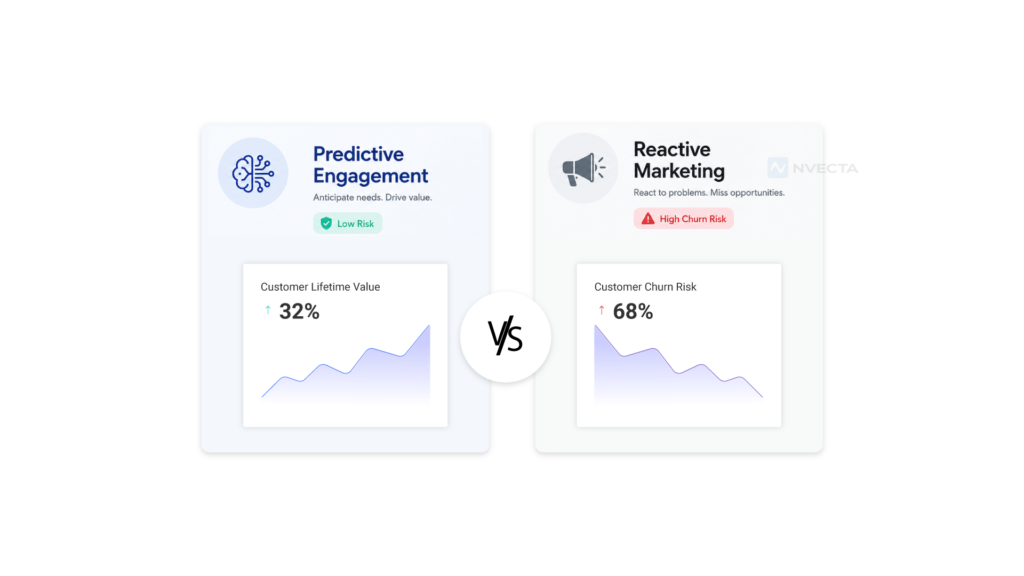
The above comparative view demonstrates that predictive engagement creates an advantage, as it helps brands understand customer intent during active windows by identifying recurring patterns in customer behaviour.
Reactive marketing is a slower process that responds only after customer actions occur, reducing the relevance of engagement.
In today’s market, timing is an essential factor for businesses with strong marketing.
Brands that engage customers earlier in the decision-making process improve conversion, retention, and the quality of the customer experience more effectively than brands that rely on delayed, reactive systems.
Timing Impacts Every Core Marketing Metric
Conversion Rates
Conversion rates improve when relevant offers and recommendations appear while customers are actively exploring products or services.
Customer Retention
Early engagement helps brands keep customers interested before inactivity or Disengagement starts to appear.
Engagement Rates
Interaction rates increase when communication aligns with real-time customer activities and behavioural interest patterns.
Repeat Purchases
Relevant engagement timing encourages repeat purchases by matching communication with customers’ buying behaviour.
Customer Satisfaction
Faster support and contextual recommendations make the customer experience more and less annoying.
Customer Lifetime Value
Better timing improves long-term customer relationships, repeat purchases and overall engagement with the brand.
Understanding the Technology Powering Predictive Engagement
Customer engagement systems have evolved significantly over the last few years. Traditional CRM were designed to organise customer records and manage communication history.
Predictive engagement requires dynamic technology, which is why AI-powered CDPs use behavioural intelligence, real-time customer visibility, and proactive engagement across engagement channels.
Let us decode the technology behind the predictive engagement.
Artificial Intelligence and Machine Learning
AI technologies process behaviour relationships across customer journeys to estimate engagement readiness, conversion potential, churn likelihood and campaign responsiveness.
Also, its predictive scoring and propensity analysis enable businesses to make engagement decisions based on continuously evolving customer behaviour.
Real-Time Data Processing
Predictive engagement relies on systems capable of reacting immediately to changing customer behaviour.
Real-time data processing continuously updates audience behavioural signals and adjusts engagement logic as interactions occur across channels.
Customer Data Platforms (CDPs)
CDPs organise fragmented customer activity into unified engagement profiles. It applies identity resolution that recognise is customers across platforms.
It uses cross-channel orchestration to maintain consistent customer interactions across communication systems and devices.
Marketing Automation Engines
Advanced automation systems support continuous customer journey management. It uses automated next-best-action workflows that decide appropriate action based on live customer behaviour.
It further triggers prioritisation and journey orchestration, helping brands avoid repetitive and poorly timed communication.
Predictive Analytics
Predictive analytics identify engagement opportunities by forecasting likely customer actions through the study of consistent behavioural changes over time.
Predictive Engagement Use Cases Across Industries
E-commerce
- Predicting cart abandonment before exit– Predictive system identifies early hesitation patterns and triggers engagement before the customer completes checkout completely
- Small replenishment campaigns– purchase frequency and usage behaviour help brands automatic replenishment engagement more accurately
- Dynamic product recommendations: predictive systems personalise recommendations based on engagement activity and evolving customer preferences.
- Real-time discount optimisation: promotional offers dynamically adjust based on cart value and buying intent.
SaaS
- Onboarding risk prediction– a predictive system detects incomplete onboarding and triggers communication before drop-off occurs.
- Feature adoption campaigns– activity analysis helps the platform to recommend features customers are most likely to adopt next.
- Expansion opportunity identification– Product usage trends help businesses identify potential user accounts likely to upgrade or expand.
- Churn prevention automation– early disengagement signals are identified, and retention engagement workflows are triggered
Media and Publishing
- Predicting content preferences– predictive systems personalise future content recommendations using browsing behaviour and interest
- Increasing session duration– predictive recommendations encourage users to be engaged for longer sessions naturally.
- Personalised article recommendations- Article recommendations adjust dynamically according to current reader interest
- Subscriber retention workflows– Declining reading activity and reduced interactions help businesses automate retention workflows before subscriptions are cancelled.
Fintech and Banking
- Fraud detection alerts– predictive monitoring detects unusual transaction behaviour and account activity patterns before fraudulent activity escalates.
- Credit behaviour prediction -pending habits and repayment activity help in estimating credit reliability more accurately.
- Personalised financial recommendations – Predictive systems personalise financial schemes based on customer financial behaviour.
- Engagement-driven retention- declining account activity predictions help in triggering personalised retention communication
Healthcare
- Appointment reminders based on the likelihood of no-show- attendance history helps trigger timely reminders for patients who are likely to miss appointments.
- Personalised wellness engagement– analysing patient activity and wellness interest helps in personalising communication
Travel and Hospitality
- Dynamic pricing engagement -predictive systems adjust travel offers according to customer interest and booking activity in real time.
- Travel recommendation- Personalise travel suggestions based on customer exploration and browsing behaviour.
- Personalised loyalty campaigns– evaluate customer travel frequency and deliver retention and loyalty engagement.
How AI-Powered CDPs Enable Predictive Engagement?
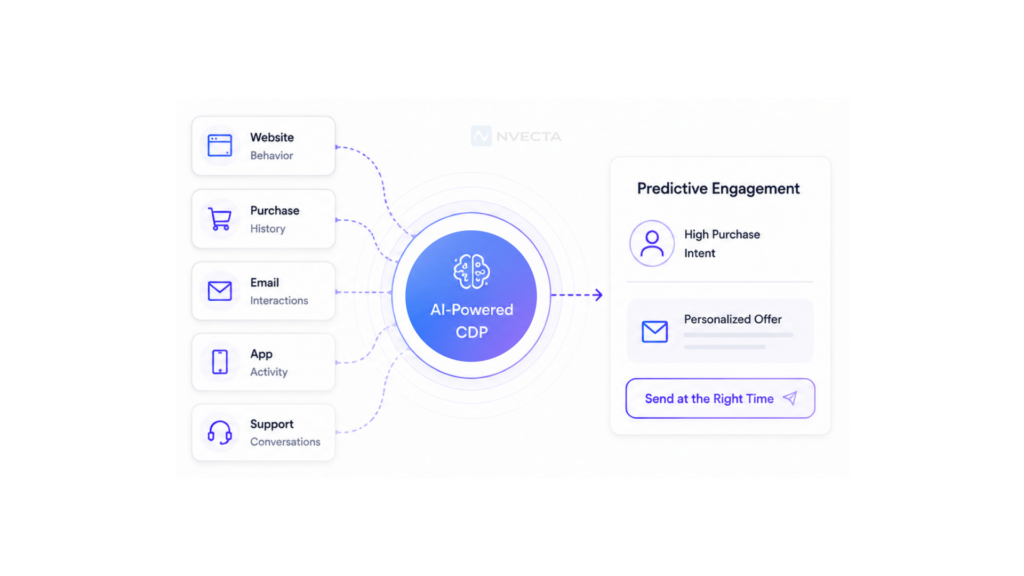
Customer data platforms have advanced features that support predictive engagement. Many brands are shifting to AI-powered CDPs that deliver better results and support long-term business growth.
Let us see its features that support predictive marketing-
Unified Customer View
They combine customer activity across multiple platforms into a single connected profile, creating a foundation for consistent visibility into engagement.
They resolve data silos by unifying fragmented data from across systems into complete, understandable journeys.
Turning Behavioural Data into Predictive Signals
CDPs use AI to study customer behaviour data and facilitate –
- Purchase intent prediction
- Churn likelihood detection
- Engagement propensity scoring
- Life cycle stage prediction
Real-Time Audience Segmentation
CDP creates dynamic customer groups that update continuously based on changing customer behaviour, interests, and engagement conditions.
Orchestrating Next Best Action Across Channels
CDPs optimise next-best actions across channels such as email, push notifications, SMS, WhatsApp, in-app messaging, and web personalisation, using predictive systems based on customers’ behavioural patterns and preferences.
Hyper-Personalisation at the Individual Level
CDP is a personalised customer journey based on predicted outcomes, delivering context-aware messaging and recommendations that align with live customer context and interaction behaviour.
How NVECTA Supports Predictive Engagement Marketing?
Static automation and traditional campaign workflows no longer fit in the present-day marketing era.
NVECTA is an AI-powered CDP that has evolved from reactive marketing to predictive engagement, with smart features that have helped numerous businesses scale and achieve measurable business outcomes.
It is well equipped with technologies that power predictive engagement -for example, customer intelligence, real-time orchestration, behaviour segmentation, Omnichannel engagement, etc., into one connected platform.
Let us, one by one, see how every function provides value to its users-
AI-Powered Customer Intelligence
NVECTA convert scattered customer activity into actionable intelligence by analysing customer behaviour, activity and interactions that support faster engagement decisions.
Real-Time Journey Orchestration
NVECTA keeps the customer journey responsive by continuously adjusting engagement flows to changing interaction patterns.
Omnichannel Email Automation
NVECTA supports consistent and coordinated customer communication across channels, maintaining a natural flow of interactions.
Behavioural Segmentation
NVECTA supports advanced segmentation that creates dynamic customer groups based on common customer behaviour patterns. These segments update automatically by organising customers as per their changing behaviour.
Predictive Audience Activation
NVECTA helps brands activate customer audiences based on strong engagement probability and opportunities.
Intelligent Personalization
NVECTA personalises engagement experiences by recommending relevant product services. It also provides built-in templates and AI-generated content that hyper-personalise customer experiences more quickly and effectively.
Seamless Integration and Scalability
NVECTA integrates smoothly with existing business systems without disrupting operations and supports a scalable infrastructure for expansion.
Wrap up
Predictive engagement is emerging as a present-day necessity and a future-ready approach to customer engagement for businesses looking to move away from reactive marketing. It prioritises customer engagement timing that directly impacts conversions retention, and long-term customer relationships.
NVECTA supports the shift from reactive marketing to predictive marketing with its AI-driven engagement and customer intelligence capabilities.
Enhance customer engagement timing with AI-powered predictive engagement marketing using NVECTA CDP.
Schedule a demo now.
FAQs
Q1. What is predictive engagement, and how is it different from reactive marketing?
Predictive engagement uses AI models and real-time behavioural data to anticipate what a customer is likely to do next — and engage them while the intent is still active. Reactive marketing, by contrast, responds only after a customer action has already occurred, such as cart abandonment, inactivity, or churn signals. The key difference is timing: predictive engagement acts during the decision window, while reactive marketing acts after it has passed.
Q2. Why does timing matter so much in customer engagement?
Customer interest is highest at specific moments — while they are actively comparing products, revisiting a category, or exploring a pricing page. Engaging at that moment produces better conversions, higher satisfaction, and stronger retention. A message sent hours later, after the customer has moved on, is far less relevant and can even contribute to communication fatigue.
Q3. What kind of data does a predictive engagement system use?
Predictive systems collect and process data from multiple sources: website activity, app interactions, purchase history, email engagement, and product usage patterns. This data is unified into a single customer profile across all channels and devices, then analysed by AI models to detect intent signals such as browsing patterns, purchase frequency, and engagement consistency.
Q4. How does a Customer Data Platform (CDP) support predictive engagement?
A CDP unifies fragmented customer data from multiple platforms into one connected profile, resolving identity across devices and channels. AI-powered CDPs go further — they score purchase intent, predict churn likelihood, create dynamic audience segments that update in real time, and orchestrate next-best-action engagement across email, SMS, push notifications, and in-app messaging.
Q5. Which industries can benefit from predictive engagement?
Predictive engagement applies across a wide range of industries. E-commerce brands use it for cart abandonment prevention and replenishment campaigns. SaaS companies use it for onboarding, risk detection and churn prevention. Media platforms personalise content recommendations and subscriber retention. Fintech and banking use it for fraud detection and personalised financial recommendations. Healthcare, travel, and hospitality also benefit from timely, behaviour-driven communication.
Q6. What are the main limitations of reactive marketing?
Reactive marketing relies on predefined triggers and past customer actions, so engagement often occurs after the critical moment has passed. It depends on broad segments rather than individual behaviour, making personalisation shallow. Scaling reactive campaigns usually requires manual updates to workflows and segmentation. In fast-moving, competitive markets, this delay can meaningfully increase churn risk and reduce conversion opportunities.
Q7. How does predictive engagement improve customer retention specifically?
Instead of waiting for engagement to decline before acting, predictive systems detect early signs of disengagement — such as reduced login frequency, shorter session durations, or changes in purchase behaviour — and trigger retention workflows before churn becomes apparent. This early intervention keeps customers interested and reduces the need for costly win-back campaigns.
Q8. What makes NVECTA different from a traditional CRM or marketing automation tool?
Traditional CRMs organise customer records and manage communication history, but do not analyse real-time behaviour or predict future actions. NVECTA is an AI-powered CDP that combines customer intelligence, real-time journey orchestration, behavioural segmentation, predictive audience activation, and omnichannel automation on a single platform. It goes beyond rule-based triggers to dynamically adjust engagement in response to live customer behaviour.
