














 Email
Email SMS
SMS Whatsapp
 Web Push
 App Push
 Audience Sync for Ads
 Popups
 Channel A/B Testing
  Control groups Analysis
 Frequency Capping
 Funnel Analysis
 Cohort Analysis
 RFM Analysis
 Signup Forms
 Surveys
 NPS
NPS Landing pages personalization
  Website A/B Testing
  PWA/TWA
 Heatmaps
 Session Recording
 Wix
Wix Shopify
 Magento
 Woocommerce
 eCommerce D2C
  Mutual Funds
 Insurance
 Lending
  Recipes
  Knowledgebase
 Developer Docs
 Product Updates
 App Marketplace
 Academy
 Ebooks
 Case Studies
 Blog
Blog Templates
 Afreen Sheikh
For years, Omnichannel marketing has been the go-to framework for customer engagement, unifying communication across channels such as email, apps, websites, SMS, WhatsApp, and push notifications. Marketers could easily coordinate engagement across multiple touchpoints, automatic campaigns at scale, and maintain consistency throughout the customer journey. The problem arose when customer journeys became far too dynamic for omnichannel systems, since the systems primarily worked with predefined workflows, historical behaviour, and static customer journeys. It struggles to adapt to frequent, real-time changes in customer intent, leading to delayed, repetitive, or irrelevant engagement.
This is where cross-channel intelligence comes in, adding a real-time intelligence layer to customer engagement. Using AI, it evaluates behavioural context in real time and identifies patterns to dynamically adjust messaging timing and channels. It treats customer behaviour as a continuous flow of signals, creating a responsive experience system that engages customers based on their current intent.
In this blog, we will learn about cross-channel intelligence, its evolution, how it differs from omnichannel marketing, its benefits and how AI-powered CDPs support this approach to help businesses.
We will further see how NVECTA enables cross-channel intelligence for a smarter customer experience.
What is Cross-Channel Intelligence?
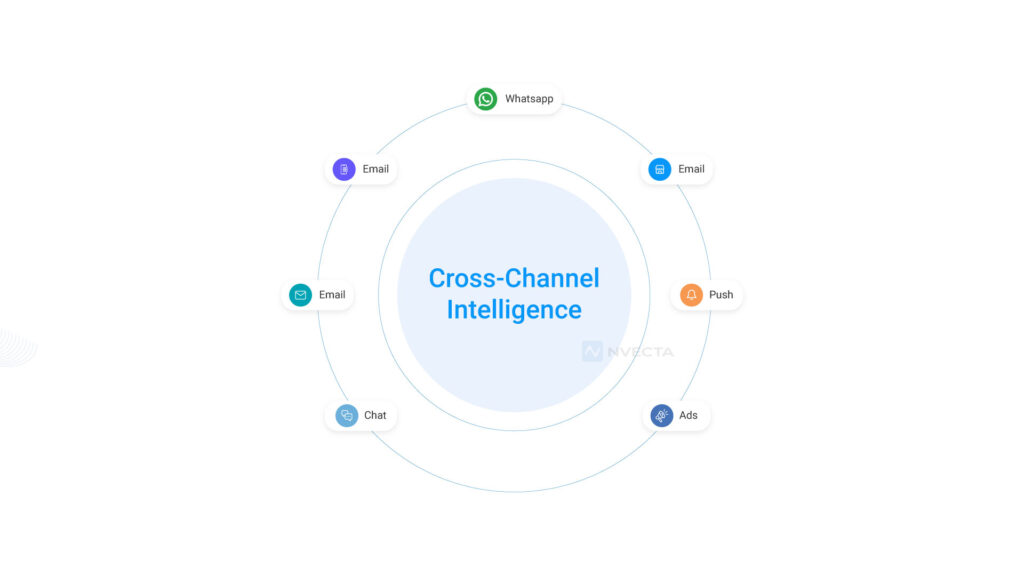
It is basically an advanced engagement system that helps brands understand customer intent by connecting behavioural signals across multiple communication channels.
Such as websites, mobile apps, CRM systems, email campaigns, ads, support interactions, and transactional platforms, into a unified engagement view. The focus is not just on tracking activity across these channels but also on interpreting how the interactions relate to one another over time.
For example, when a customer abandons a cart, it may not immediately indicate a lost purchase. But if that same customer is actively checking the product page, By comparing prices, app activity, and engagement with promotional campaigns, the system can identify stronger purchase intent.
Cross-channel intelligence continuously links these behavioural signals to improve understanding of customer intent. This is where AI and real-time analytics play a major role.
The AI model continues analysing live patterns to generate smart insights that are later used to adjust engagement strategies, including timing, messaging, channels, recommendations, and journeys, based on evolving customer context.
Evolution of Multi-Channel-> Cross-Channel ->Omnichannel-> Cross-Channel Intelligence
The evolution from multi-channel to cross-channel intelligence has mainly been about solving the customer-engagement infrastructure problem.
Multi-channel marketing allowed brands to connect with customers through emails, websites, apps, WhatsApp, SMS, and ads, but each channel operated separately with its own data and workflows, creating a fragmented customer experience and disconnected data.
Cross-channel marketing improves this by connecting channels together. Actions over one platform could trigger engagement on another, making campaigns more coordinated and customer journeys connected.
Still, the systems relied on fixed workflows and predefined rules.
Then came omnichannel marketing, which further expanded this by unifying the customer experience across touchpoints. Customer data became more centralised, and brands worked towards maintaining consistency across channels and devices.
Cross-channel intelligence takes this further by introducing AI-driven decision-making and real-time behavioural analysis into engagement systems. It enables brands to analyse live customer signals, predict intent and optimise engagement dynamically across channels.
Why Omnichannel Marketing Falls Short? (Cross-Channel Intelligence)
Most omnichannel platforms are built for campaign orchestration and channel synchronisation, and they do that well. But today’s customers move fast, and their intent changes faster than traditional automation workflows and segmentation models can keep up with. Here is where the cracks begin to show.
Coordinated Communication, but Struggles with Customer Intent
Omnichannel marketing made engagement more connected across interaction channels, creating smoother and more consistent customer journeys. However, these systems are built to execute workflows, not to interpret evolving customer intent. They know when to send a message, but not necessarily why a customer is behaving the way they are at that moment.
Static Customer Journeys Cannot Manage Real-Time Intent Shifts
Traditional workflows rely on fixed, automated logic and rule-based triggers. They cannot adapt to dynamic shifts in customer behaviour, which means high-intent moments are often missed entirely. By the time the system reacts, the opportunity has already passed.
Fragmented Data Still Exists Within Omnichannel Stacks
Even highly orchestrated omnichannel ecosystems are not immune to data fragmentation. CRM systems, marketing platforms, analytics dashboards, support tools, and product databases often operate with incomplete synchronisation, leaving marketers with an incomplete picture of the customer.
Personalisation Often Stops at Segmentation
Traditional personalisation is built on broad customer segments. Customers in the same audience group receive similar campaigns and journeys, even when their real-time behaviour differs significantly. Static segmentation misses the behavioural context that is increasingly critical for meaningful engagement.
Coordinated Channels Do Not Automatically Improve Relevance
Channel coordination does not guarantee relevance. Customers often receive repetitive promotions, duplicate reminders, and overlapping communication across multiple touchpoints. Consistency across channels matters, but contextual relevance matters far more to modern customers.
A Reactive Engagement Model
At its core, omnichannel engagement is reactive. It triggers actions only after a customer has taken an action. These systems are not designed to continuously predict intent or adjust engagement dynamically as behaviour evolves, which is exactly what cross-channel intelligence is built to do.
The table below summarises how cross-channel intelligence differs from traditional omnichannel marketing across key dimensions:
| Factor | Omnichannel Marketing | Cross-Channel Intelligence |
|---|---|---|
| Data Processing | Historical & batch-based | Real-time & continuous |
| Customer Journeys | Fixed, predefined workflows | Dynamic, adaptive journeys |
| Personalisation | Segment-based | Individual behaviour-based |
| Decision-Making | Rule-based triggers | AI-driven decisioning |
| Intent Detection | Reactive (post-action) | Predictive (pre-action) |
| Channel Coordination | Synchronised but static | Context-aware & fluid |
| Data Unification | Partially centralised | Fully unified profiles |
| Engagement Timing | Scheduled or triggered | Optimised in real time |
How Cross-Channel Intelligence Works: step by step
Cross-channel intelligence works like a live engagement engine, with a continuous cycle of collecting customer behaviour, connecting those actions, predicting intent, and adjusting engagement or automatically as customers move across channels.
Step 1: Collect Customer Data Across Channels
The process begins by collecting customer activity across multiple touchpoints, including CRM systems, websites, mobile apps, support platforms, transaction platforms, campaigns, and product usage environments.
The interactions are consolidated into a centralised customer view, creating a foundation for understanding customers.
Step 2: Build a Unified Customer Profile
The system then consolidates this fragmented data into accurate customer profiles through identity resolution.
Identity resolution unifies customer data, resolving multiple customer identities and creating a complete profile for each customer.
Step 3: Analyse Behavioural Signals in Real Time
Once the data is unified, behaviour analytics continuously evaluate ongoing customer interactions across channels.
The system identifies patterns such as repeated product comparisons, reduced product usage, pricing page visits, or purchase frequency to understand changing customer intent.
Step 4: Use AI to Predict Customer Intent
AI and machine learning models process these behaviour patterns to predict likely outcomes such as churn risk, engagement potential, purchase readiness, upsell opportunities, and disengagement signals.
Step 5: Determine the Next Best Action
Based on these predictions, the system uses predictive decisioning to select the most relevant action for effective engagement.
It could be a personalised recommendation, a change in communication frequency, channel switching, retention-triggering messaging, or campaign timing optimisation.
Step 6: Optimise Engagement Dynamically
Now cross-channel intelligence adjusts engagement dynamically across touchpoints- messaging, recommendations, offers, personalisation,
Channels and journey flow continuously optimise based on live customer behaviour rather than fixed rules.
Step 7: Continuously Learn and Improve Decision-Making
AI models continuously learn from interactions and refine decisions based on customer responses, behavioural shifts and campaign outcomes.
This creates an adaptive engagement system where customer experiences improve continuously through predictive intelligence.
Key Benefits of Cross-Channel Intelligence for Marketing Teams
Cross-channel intelligence helps marketing teams improve the quality of engagement, campaign responsiveness, customer understanding, and decision-making by leveraging predictive intelligence and real-time behaviour analytics to build a smarter customer engagement system.
Create More Context-Aware Personalisation
Processing live customer actions helps marketers personalise communication more accurately as engagement adapts continuously based on browsing activities, product interactions, behavioural intent signals, etc.
Improve Customer Retention and Loyalty
Using predictive intelligence, marketers can identify disengagement patterns earlier and trigger personalised retention and loyalty campaigns to engage customers before they fully disengage.
Increase Conversion Potentials
With cross-channel intelligence, marketers can foresee high-intent actions and optimise strategies to encourage conversions.
Enhances Marketing and Sales Alignment
Unified customer intelligence gives marketing and sales teams shared visibility into insights, customer intent, lifecycle progression, follow-up timing and engagement readiness.
Smarter Decision-Making with AI
AI-driven decisioning helps marketers identify the next-best action based on current customer intent. It eliminates the guesswork and adopts a data-driven approach to engage customers more effectively.
Real-World Cross-Channel Intelligence Use Cases Across Industries
Different industries are adopting cross-channel intelligence in their own ways, as businesses seek to understand their customers deeply and optimise their strategies.
E-commerce brands use it for conversion; SaaS companies prioritise retention; travel and media optimise ongoing engagement; and many more.
Here are a few real-world use cases across different industries-
E-commerce
Cart abandonment recovery -with real time intend tracking, brands can trigger relevant communication to recover abandoned carts
Dynamic product recommendations – send personalised product recommendations that update based on what customers are actively browsing and engaging with.
Cross-device journey tracking – maintain a continuous purchase journey across devices even when the customer switches multiple times.
Repeat-purchase optimisation– identify repeat buyers earlier and personalise retention campaigns more effectively.
SaaS and Subscription Businesses
Onboarding journey optimisation– enhance onboarding engagement using product adoption and early behaviour activity signals
Product adoption monitoring– track feature usage patterns, declining engagement and behaviour in activity to improve adoption strategies continuously.
Churn prediction and retention- identify churn signals at an early stage with product usage patterns.
Expansion and upsell opportunities– detect high expansion accounts and optimise upgrade recommendations based on customer usage maturity
BFSI
Financial product personalisation– personalise banking, lending, insurance, and investment recommendations based on transaction activity, behaviour patterns and lifecycle data.
Fraud risk monitoring– identify unusual engagement behaviour and improve fraud risk detection frameworks.
Media and Publishing
Content recommendations– send personalised article videos, news, articles, and streaming content based on identified customer intent.
Session engagement optimisation– track content consumption behaviour and optimise recommendations to improve session duration, engagement depth, and platform interaction quality.
Subscriber retention– identify disengaged subscribers, as well as viewers who show high subscription behaviour, and send personalised communications to induce subscriptions.
Healthcare
Appointment and follow-up engagement- optimise reminders, follow-up, and patient communication ways to engage patterns and appointment behaviour
Personalised healthcare communication– patient interactions, treatment journey, and engagement activity help personalise recommendations and communication timing.
Travel and Hospitality
Booking intent detection– analyse browsing patterns, destination searches and repeat session activities to identify strong booking signals.
Personalised travel recommendations– send personalised destinations, recommendations, accommodations, loyalty offers and travel experience.
Real-time travel communication– optimise communication continuously through notifications, booking updates, support communications, and journey engagement across channels.
Cross-Channel Intelligence with NVECTA’s AI-Powered Engagement
NVECTA brings the best cross-channel intelligence capabilities, elevating brands’ engagement and growth.
From predicting customer intent to identifying the next-best action, it helps brands move beyond basic channel engagement and create a much smarter customer experience.
Let us, one by one, look at its features-
Centralised Customer Profiles
NVECTA creates centralised profiles of every customer that help the team manage their audiences. It helps brands organise scattered information and understand customer journeys within a single connected system.
Real-Time Behavioural Tracking and Analytics
The platform tracks customer behaviour in real time across website campaigns and other channels. This helps brands react faster to important customer movements, enabling them to engage them.
AI Segmentation and Predictive Intelligence
NVECTA offer advanced predictive segmentation. It helps build smarter audience segments using live Customer behaviour and intent signals. This helps brands to identify high-intent users, predict churn risk, and improve targeting.
AI Decisioning and Next Best Action
NVECTA uses advanced AI decisioning to automatically determine the next-best engagement step for every customer, enhancing their journeys. It offers an adaptive, responsive engagement mechanism that delivers better results.
AI-Driven Hyper-Personalisation
NVECTA personalises customer experiences by using their interaction history and life cycle stages, helping brands to deliver relevant recommendation messaging and content across channels.
It also offers AI-generated content and pre-built templates that help in faster, more effective personalisation.
AI-Driven Insights and Reporting
NVECTA offers advanced insights into real-time campaign performance, engagement trends, and conversion activity, helping teams improve communication and the customer experience with greater confidence.
Scalable enterprise integrations
NVECTA connects seamlessly with multiple business tools such as CRM systems, E-Commerce platforms, analytics tools, payment systems, support software and existing enterprise databases. It helps brands to maintain a smoother workflow without affecting business operations.
Wrap up (Cross-Channel Intelligence)
Omnichannel marketing helps brands improve communication consistency across channels, but modern engagement requires a deeper understanding of behaviour, intent, and interactions in real time. With cross-channel intelligence, brands can create a more relevant, adaptive, and connected customer experience throughout the journey.
NVECTA enables this through AI-powered customer intelligence, predictive engagement and real-time orchestration, helping businesses to scale effectively in the market. Deliver smarter engagement experiences with AI-powered predictive intelligence using NVECTA CDP.
Schedule a demo now.
FaQs
What is cross-channel intelligence?
Cross-channel intelligence is an advanced customer engagement system that connects behavioural signals across multiple channels, including websites, apps, CRM, email, ads, and more into a unified view. It uses AI and real-time analytics to understand customer intent and dynamically adjust messaging, timing, and channel selection based on live behaviour.
How is cross-channel intelligence different from omnichannel marketing?
Omnichannel marketing focuses on coordinating communication across channels using fixed workflows and predefined rules. Cross-channel intelligence goes further by adding AI-driven decision-making and real-time behavioural analysis, enabling brands to predict customer intent and dynamically adjust engagement rather than reacting to actions after they occur.
Why does omnichannel marketing fall short for modern customer engagement?
Omnichannel marketing struggles to keep pace with dynamic customer behaviour because it relies on static journeys, rule-based triggers, and segment-level personalisation. It is reactive by design: engagement fires only after a customer action, so high-intent moments are often missed. Fragmented data across tools also limits how well these systems understand the complete customer picture.
What types of data does cross-channel intelligence use?
It draws from a wide range of sources, including CRM systems, website and app behaviour, email engagement, ad interactions, support conversations, transaction data, and product usage activity. These signals are unified into a single customer profile that is continuously updated in real time.
Which industries benefit most from cross-channel intelligence?
Cross-channel intelligence delivers value across e-commerce (cart recovery, repeat purchase optimisation), SaaS and subscription businesses (churn prediction, onboarding), BFSI (product personalisation, fraud monitoring), media and publishing (content recommendations, subscriber retention), healthcare (patient engagement), and travel and hospitality (booking intent detection, real-time communication).
How does AI play a role in cross-channel intelligence?
AI processes real-time behavioural patterns to predict outcomes such as churn risk, purchase readiness, and upsell opportunities. It then uses predictive decisioning to identify the next best action for each customer, whether that is a personalised recommendation, a channel switch, a retention message, or optimised campaign timing. The models continuously learn from customer responses, improving the quality of engagement over time.
What is the role of a unified customer profile in cross-channel intelligence?
A unified customer profile consolidates data from all touchpoints into a single, accurate view of each customer through identity resolution. This removes fragmentation across tools and provides the engagement system with a complete, up-to-date foundation for analysing behaviour, predicting intent, and personalising interactions effectively.
How does NVECTA support cross-channel intelligence?
NVECTA brings together centralised customer profiles, real-time behavioural tracking, AI-powered segmentation, predictive decisioning, and hyper-personalisation on a single platform. It integrates with CRM systems, e-commerce platforms, analytics tools, and support software, enabling brands to deliver smarter, more responsive customer experiences at scale.
