














 Email
Email SMS
SMS Whatsapp
 Web Push
 App Push
 Audience Sync for Ads
 Popups
 Channel A/B Testing
  Control groups Analysis
 Frequency Capping
 Funnel Analysis
 Cohort Analysis
 RFM Analysis
 Signup Forms
 Surveys
 NPS
NPS Landing pages personalization
  Website A/B Testing
  PWA/TWA
 Heatmaps
 Session Recording
 Wix
Wix Shopify
 Magento
 Woocommerce
 eCommerce D2C
  Mutual Funds
 Insurance
 Lending
  Recipes
  Knowledgebase
 Developer Docs
 Product Updates
 App Marketplace
 Academy
 Ebooks
 Case Studies
 Blog
Blog Templates
 Aparupa Saha
Today’s customers constantly move across devices. A person may first see a brand through an ad on social media, later explore its products on a laptop, and finally make a purchase on a tablet or through an app. For the customer, it feels like one continuous journey, but for many brands, these interactions still appear as separate users spread across multiple disconnected systems.
This poses a challenge for businesses in modern marketing and customer engagement. When brands fail to recognise the same user across devices, personalisation weakens, attribution becomes inaccurate, and customer experiences feel repetitive or disconnected. As customer journeys become increasingly complex, businesses now need an intelligent way to connect behavioural signals across platforms and build a unified customer view.
In this blog, we will understand how cross-channel identity works, why it matters, the challenges businesses face, and how NVECTA helps solve this problem with its advanced AI-driven cross-channel identity resolution.
What Is Cross-Channel Identity?
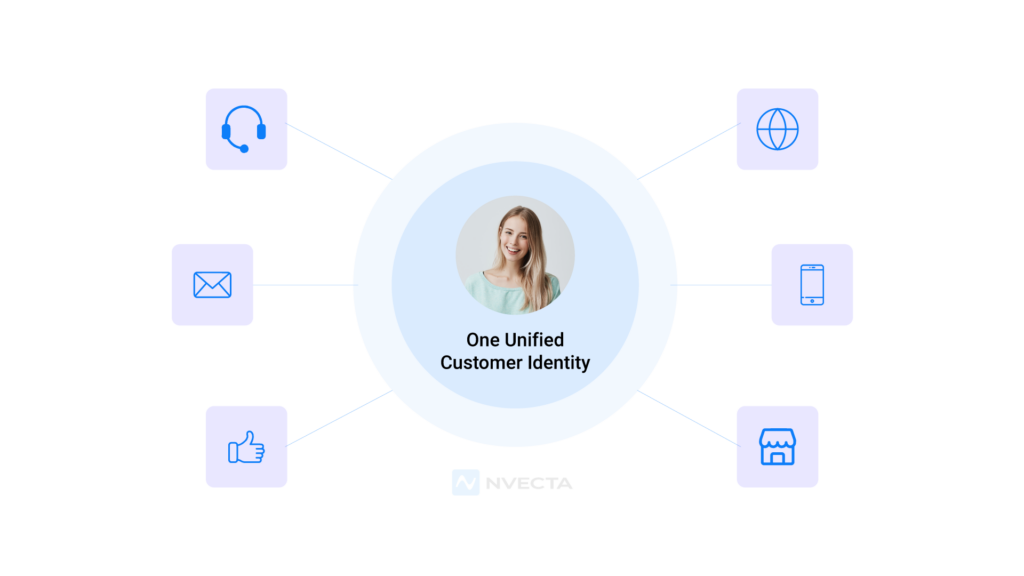
Cross-channel identity is the process of recognising the same customer across multiple devices, browsers, apps, and communication channels. It helps businesses consolidate customer interactions into a single, continuous profile rather than treating each interaction separately.
Customers interact with brands over multiple touchpoints, including websites, mobile apps, email campaigns, CRM systems, social media platforms, e-commerce stores, customer support systems, ads, retargeting campaigns, and push notifications.
A customer may browse products anonymously on mobile, open a promotional email later on desktop, and eventually complete the purchase from an app. Without identity resolution, these interactions often remain disconnected inside different systems.
Cross-channel identity solves this problem by linking behavioural signals together and building a unified customer profile. This helps businesses understand customer intent much more clearly across the entire journey.
Why Cross-Channel Identity Matters for Modern Businesses
Customer journeys are no longer linear. People continually switch between devices before making decisions, and businesses that fail to recognise these connected interactions often struggle with fragmented engagement.
Here are some major reasons why cross-channel identity has become extremely important today.
Customers No Longer Stay on One Device
Modern users naturally move between devices throughout the day. For example: Mobile phones during travel, Work laptops during office hours, tablets at home, smart TVs for streaming, apps for browsing, and desktop websites for purchases.
When businesses fail to connect these interactions, they see only fragments of the customer journey rather than the full picture.
Personalisation Depends on Unified Customer Recognition
Modern personalisation goes far beyond using a customer’s first name in emails. It depends on understanding customer behaviour continuously across channels.
Without cross-channel identity:
- Recommendations become repetitive
- Campaigns lose relevance
- Offers feel disconnected
- Journeys restart from zero repeatedly
When businesses recognise the same user across devices, engagement becomes far more contextual and relevant.
For example, if someone explored a product category on mobile earlier in the day, the business can continue the journey later on desktop through recommendations or personalised emails, maintaining continuity.
Customer Experience Improves Significantly
Disconnected systems often create frustrating experiences. Customers may receive duplicate ads, repeated onboarding emails, irrelevant promotions, excessive reminders, and conflicting recommendations.
Cross-channel identity helps businesses create smoother experiences because every interaction becomes part of one connected journey rather than isolated touchpoints.
Attribution Becomes More Accurate
One of the biggest challenges in digital marketing is understanding what actually influences conversions.
A customer may click a social media ad on mobile, visit the website later on desktop, return via an email campaign, and convert days later on another device.
Without identity resolution, businesses often give credit only to the final touchpoint and lose visibility into the real journey.
Cross-channel identity provides a much clearer attribution model by connecting interactions across devices.
Better Retention and Lifecycle Engagement
Unified customer visibility also improves retention strategies. Businesses can identify declining engagement patterns, churn risks, inactive users, high-intent customers, and repeat purchase behaviour.
It becomes much earlier and responds with more personalised engagement strategies.
Why Traditional Tracking Methods Fall Short in Cross-Channel Identity
Older tracking systems were designed for a much simpler digital environment. Today’s customer behaviour is far more dynamic, making traditional approaches increasingly unreliable.
Third-Party Cookies Are Losing Relevance
Privacy regulations and browser restrictions have significantly reduced the effectiveness of third-party cookies. Many browsers now limit cross-site tracking, external cookie usage, and behavioural data sharing
As a result, businesses can no longer rely on traditional cookie-based tracking alone.
Customer Journeys Are Highly Fragmented
A single customer may use multiple browsers, different mobile devices, desktop systems, apps, websites, and personal and work devices.
Traditional systems struggle to accurately connect these scattered interactions.
Anonymous Browsing Creates Visibility Gaps
Many customers interact anonymously before identifying themselves.
They may compare products, read reviews, browse pricing pages, watch demos and explore features without logging in immediately.
This anonymous activity contains valuable intent signals, but traditional systems often fail to connect it later with known customer identities.
Customer Data Remains Scattered Across Systems
Most businesses manage customer information across multiple disconnected tools, including CRM platforms, analytics software, marketing automation systems, customer support tools, payment platforms, and ad networks.
A modern customer data platform helps unify this fragmented information into a single, connected customer view, improving identity resolution and consistency of engagement across channels. Each system typically stores only partial customer information, resulting in fragmented visibility.
How Cross-Channel Identity Resolution Works: a step-by-step process
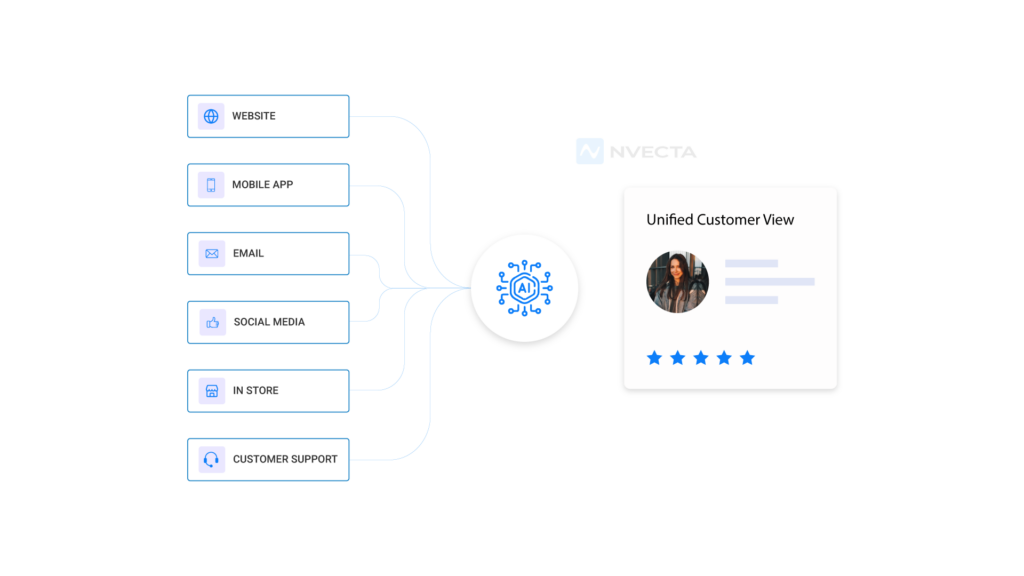
Cross-channel identity resolution works by analysing multiple customer signals and determining whether different interactions belong to the same person.
Modern identity systems combine behavioural analysis, AI models, deterministic matching, and probabilistic analysis to build unified customer profiles.
Let us understand the process step by step.
Step 1: Collect Customer Behaviour Across Channels
The process begins by collecting customer activity from different touchpoints, including: Website visits, app activity, email engagement, CRM interactions, purchase behaviour, campaign responses, customer support interactions, and device usage patterns
The goal is to gather behavioural context continuously across platforms.
Step 2: Identify Known and Anonymous Users
Some customers can be identified by their login credentials, email addresses, phone numbers, and customer account IDs.
Others remain anonymous during browsing sessions. Modern identity systems continuously evaluate both known and anonymous interactions to identify possible relationships between them.
Step 3: Analyse Behavioural Signals
Identity resolution engines analyse multiple behavioural signals to resolve multiple identities associated with a customer. It analyses device fingerprints, browser activity, IP addresses, session timing, geographic patterns, usage behaviour, and purchase history
The system determines whether multiple interactions likely belong to the same individual.
Step 4: Build a Unified Customer Profile
Once identities are matched, fragmented customer information is consolidated into a single connected customer profile.
This unified profile contains complete information about a customer, including browsing behaviour, purchase history, product interests, communication engagement, preferred devices, lifecycle stage, loyalty activity, and support interactions.
The profile continuously evolves as customer behaviour changes.
Step 5: Enable Real-Time Personalisation
After identity resolution, businesses can personalise engagement much more effectively across devices and channels.
It mainly includes smarter product recommendations, cross-device retargeting, personalised messaging, better timing of communication, dynamic journey optimisation, and seamless customer experiences.
Types of Cross-Channel Identity Matching
Businesses generally use multiple identity-matching approaches, depending on their infrastructure and customer engagement model, to better recognise users across devices, personalise interactions, and ultimately increase customer engagement.
Deterministic Cross-Channel Identity Matching
Deterministic matching uses direct customer identifiers such as email addresses, login credentials, customer account IDs, and phone numbers. This method provides highly accurate identity matching because customers explicitly identify themselves. For example, if someone logs into both a mobile app and a desktop website using the same email address, the platform can confidently recognise both sessions as the same user.
Probabilistic Cross-Channel Identity Matching
Probabilistic matching works differently. Instead of relying on direct identifiers, it uses behavioural and device signals to infer relationships between identities. The system analyses browsing patterns, device behaviour, IP activity, session timing, geographic consistency, and behaviour repetition. AI models then calculate the probability that multiple interactions belong to the same individual. This method becomes especially useful during anonymous browsing journeys.
Hybrid Cross-Channel Identity Resolution
Most modern customer intelligence platforms combine deterministic and probabilistic matching. This hybrid approach helps businesses improve matching accuracy, reduce duplicate identities, expand customer visibility, and build stronger identity graphs. Hybrid identity resolution is now becoming the standard for enterprise customer intelligence systems.
The table below summarises the key differences across all three matching methods to help you evaluate which approach best fits your business needs:
| Feature | Deterministic | Probabilistic | Hybrid |
|---|---|---|---|
| Data Used | Email, login ID, phone number | Device signals, IP, behaviour patterns | Both direct identifiers + behavioural signals |
| Accuracy | Very High | Moderate to High | Highest |
| Works Anonymously? | No | Yes | Yes |
| Best For | Logged-in users | Anonymous browsing journeys | Full customer lifecycle |
| Privacy Risk | Low (consent-based) | Medium | Low to Medium |
| Common Use Case | CRM matching, email campaigns | Pre-login retargeting, lookalike audiences | Enterprise customer intelligence |
While each method has its own strengths, the most effective identity resolution strategies typically combine all three. Deterministic matching provides a reliable foundation for known users, probabilistic analysis fills in the gaps during anonymous journeys, and a hybrid framework ensures continuous, high-confidence identity coverage across the full customer lifecycle. Choosing the right combination depends on your data infrastructure, privacy requirements, and the complexity of your customer engagement model.
Major Challenges in Implementing Cross-Channel Identity
Although cross-channel identity offers major business advantages, implementing it effectively still comes with several challenges.
Fragmented Customer Data Ecosystems
Most organisations use multiple disconnected platforms that do not synchronise customer data properly.
This creates duplicate customer profiles, partial behavioural visibility, inconsistent records, and disconnected engagement history. Without proper unification, identity resolution becomes much harder.
Data Quality Problems
Identity systems heavily depend on data quality. Common issues include missing customer fields, inconsistent formatting, duplicate records, outdated customer information, and incomplete engagement history. Poor-quality data directly affects identity accuracy.
Privacy and Compliance Requirements
Modern identity systems must comply with GDPR, CCPA requirements, Consent frameworks, and privacy regulations. Businesses now need to balance personalisation with ethical and responsible data usage.
Real-Time Processing Complexity
Cross-channel identity requires continuous behavioural analysis across massive volumes of customer activity.
Processing this data in real time requires a scalable infrastructure, AI-driven processing, fast behavioural analysis, and continuous identity updates. This complexity increases significantly as businesses scale.
How AI Improves Cross-Channel Identity Resolution
AI has become one of the biggest drivers of modern identity resolution systems because traditional rule-based approaches can no longer effectively handle the complexity of customer behaviour.
AI Improves Identity Accuracy
Machine learning models continuously analyse customer behaviour and improve the precision of identity matching over time. This helps reduce duplicate user profiles, false identity matches, and fragmented customer records, while still improving overall customer visibility.
AI Helps Detect Hidden Behaviour Patterns
Modern AI models can identify subtle behavioural relationships that traditional systems may miss completely. For example: device-switching behaviour, repeated engagement timing, similar browsing journeys, cross-platform activity patterns.
These behavioural signals significantly improve identity confidence.
AI Enables Predictive Customer Intelligence
Once customer identities are unified, AI models can predict purchase intent, churn probability, engagement readiness, upsell opportunities, and customer lifetime value.
This allows businesses to make smarter engagement decisions much earlier.
AI Supports Real-Time Personalisation
AI continuously optimises messaging, recommendations, timing, communication channels, and customer journeys based on live customer behaviour rather than static rules.
Real-World Cross-Channel Identity Use Cases Across Industries
Cross-channel identity is not a one-size-fits-all capability. Across industries, the way businesses apply it reflects the unique rhythms of their customer journeys. Whether a customer is browsing a product catalogue on mobile, streaming content on a smart TV, or reviewing a loan offer on desktop, the underlying need is the same: a seamless, connected experience that picks up exactly where the last interaction left off. Here is how different industries are putting cross-channel identity to work.
| Industry | Key Use Cases | Identity Benefit | Business Outcome |
|---|---|---|---|
| E-Commerce | Cross-device shopping journeys, cart recovery, and smarter retargeting | Maintains continuity from browse to purchase across devices | Higher conversions, reduced cart abandonment |
| SaaS & Subscriptions | Product adoption monitoring, churn prediction, retention campaigns | Unified behavioural visibility across product and support channels | Improved retention, earlier churn intervention |
| BFSI | Fraud detection, personalised financial recommendations | Cross-account behavioural matching across sessions and devices | Reduced fraud, higher product relevance |
| Media & Streaming | Personalised content experiences, subscriber retention | Device-agnostic viewing journey continuity | Lower churn, stronger content engagement |
| Travel & Hospitality | Seamless booking journeys, personalised travel recommendations | Unified cross-platform activity from research to booking | Higher bookings, stronger loyalty engagement |
E-Commerce: From Browse to Buy, Without Losing the Thread
Online shoppers rarely complete their journey in one sitting. A customer might discover a product through a social ad on their phone during a commute, revisit it on a laptop that evening, and finally check out via a tablet app over the weekend. Each of these sessions can appear to be a different user in a disconnected system.
Cross-channel identity connects these moments into a single, continuous shopping journey. Rather than serving repetitive ads for products already viewed or losing context between sessions, brands can deliver smarter retargeting that reflects where the customer actually is in their decision-making. When a cart is abandoned, the follow-up does not feel like a generic reminder — it continues the specific conversation the customer started, across email, push notifications, or a personalised homepage, whichever channel they return to next.
SaaS and Subscription Businesses: Spotting Engagement Signals Early
For software and subscription businesses, the customer journey unfolds across a product interface, a mobile app, onboarding emails, support tickets, and renewal communications. Without identity resolution, engagement patterns across these touchpoints remain invisible, and early warning signs of disengagement are easy to miss.
A unified identity layer allows SaaS teams to track product adoption holistically, understanding not just whether a user logged in but how deeply they engaged across every surface. When behavioural signals indicate declining activity, businesses can intervene with timely, personalised retention messaging rather than reacting after cancellation has already occurred.
BFSI: Precision Across High-Stakes Interactions
In financial services, every interaction carries weight. A customer may research a mortgage product on a personal device, compare options on a work laptop, and follow up via a bank’s mobile app. Without cross-channel identity, these touchpoints are treated as separate individuals, creating both a personalisation gap and a potential security blind spot.
Identity resolution helps financial institutions accurately connect these interactions. On the security side, it enables the detection of unusual cross-device or cross-session activity that may indicate fraud. On the engagement side, it enables the delivery of loan offers, insurance products, and investment recommendations based on a complete picture of customer behaviour rather than a single snapshot.
Because many of these fraud and personalisation systems now run on machine learning models, banks also rely on LLM security tools to guard those models against manipulation, data leakage, and adversarial attacks.
Media and Streaming: Keeping Viewers Engaged Across Every Screen
Audiences today are device-agnostic. A viewer might start a documentary on a smart TV, continue it on a phone during their commute, and finish on a laptop. For streaming platforms, losing the thread between these sessions can feel disjointing and drive passive churn.
Cross-channel identity allows platforms to maintain viewing continuity and deliver personalised content recommendations that reflect the viewer’s complete history, not just the last session on a single device. It also enables early identification of engagement drop-offs, giving platforms an opportunity to re-engage subscribers before they quietly fade away.
Travel and Hospitality: Connecting the Journey Before the Journey Begins
Travel decisions rarely happen in a single session. A customer might research destinations on their phone, compare hotels on a desktop, revisit flight options days later, and eventually book through an app. Each of these touchpoints is part of one intention-driven journey, even if days or devices separate them.
Cross-channel identity allows travel brands to treat these fragmented sessions as one continuous conversation. A customer who browsed beach destinations last week can be greeted with relevant offers rather than generic promotions the next time they return. Loyalty activity, booking history, and browsing behaviour combine to create a profile that makes every touchpoint feel as if the brand already knows who they are and what they are looking for.
What Businesses Need to Build Strong Cross-Channel Identity
Building an effective identity resolution framework requires more than simply collecting customer data. Businesses need the right infrastructure, intelligence systems, and engagement capabilities.
Centralised Customer Data Infrastructure
Customer information should flow into a single connected environment rather than remain fragmented across multiple tools. A modern customer data platform helps businesses centralise customer interactions, unify behavioural signals, and improve identity resolution across channels.
Real-Time Behavioural Tracking
Modern engagement requires continuous behavioural visibility rather than delayed reporting systems.
AI-Powered Identity Resolution
AI-driven identity systems improve customer-matching accuracy, behavioural analysis, predictive intelligence, and identity scalability far more effectively than static, rule-based approaches.
Privacy-Focused Data Management
Businesses need consent-driven and privacy-compliant identity frameworks to maintain customer trust.
Scalable Enterprise Integrations
Identity systems should integrate smoothly with CRM systems, analytics platforms, marketing automation tools, e-commerce systems, customer support software, and existing databases without affecting business operations.
How NVECTA Helps Businesses Enable Cross-Channel Identity
NVECTA helps businesses build unified customer intelligence systems using AI-powered behavioural analytics, predictive engagement, and real-time identity resolution.
It enables brands to move beyond fragmented customer tracking and create connected engagement experiences across devices and channels.
Let us look at some of its key capabilities.
Centralised Customer Profiles
NVECTA unifies fragmented customer information into connected profiles that combine behavioural activity, transactional data, engagement history, and lifecycle information into one intelligent customer view.
Real-Time Behavioural Tracking
The platform continuously tracks customer interactions across websites, mobile apps, CRM systems, campaigns, and communication channels. This helps businesses react faster to important behavioural shifts.
AI-Powered Cross-Channel Identity Resolution
NVECTA uses AI-driven identity matching to more accurately recognise users across devices and platforms. It combines deterministic and behavioural matching techniques to continuously improve customer visibility.
Predictive Intelligence and Smart Segmentation
NVECTA helps businesses build smarter audience segments using live behavioural signals, engagement patterns, customer intent analysis, and lifecycle behaviour. This improves targeting, retention, and conversion strategies.
AI-Driven Hyper-Personalisation
The platform personalises recommendations, messaging, offers, communication timing, and engagement journeys across devices based on real-time customer behaviour.
Enterprise-Scale Integrations
NVECTA integrates smoothly with multiple marketing management tools, including CRM platforms, analytics systems, e-commerce platforms, support software, and existing enterprise infrastructure.
This allows businesses to scale customer intelligence without disrupting operations.
Future of Cross-Channel Identity in Customer Engagement

Customer journeys will continue becoming more connected, dynamic, and device-driven. As privacy regulations evolve and third-party tracking becomes less effective, businesses will increasingly rely on AI-powered first-party identity systems.
The future of customer engagement will focus heavily on:
- Real-time identity intelligence
- Privacy-first personalisation
- Predictive customer engagement
- AI-driven behavioural analysis
- Cookieless identity frameworks
Businesses that successfully recognise customers across devices will be far better positioned to deliver smoother, more relevant, and more intelligent customer experiences.
Wrap Up
Recognising customers across multiple channels and devices helps brands to enhance engagement with relevant, personalised, and consistent experiences. As engagement channels continue growing, businesses need systems that can evaluate interactions while resolving multiple user identities without losing continuity across the journey.
NVECTA supports this with AI-powered customer intelligence, real-time behavioural insights, and intelligent identity resolution, helping businesses build stronger customer connections across channels and devices.
Resolve fragmented customer identities with a real-time, intelligent cross-channel identity system using NVECTA. Schedule a demo now.
FAQs
What is cross-channel identity resolution?
It is the process of recognising the same customer across multiple devices, platforms, browsers, and communication channels to create a single, connected customer profile.
How does cross-channel identity work?
Cross-channel identity analyses behavioural signals, login activity, device information and engagement patterns to determine whether interactions belong to the same customer.
Why is cross-channel identity becoming important for marketing?
Cross-channel identity helps marketers to understand customer journeys more clearly, improving personalisation, engagement, consistent seat targeting and attribution accuracy.
What is the difference between deterministic and probabilistic identity matching?
Deterministic matching uses direct identifiers such as email addresses or login credentials, while probabilistic matching uses behavioural and device signals to estimate relationships between identities.
Is cross-channel identity still possible as third-party cookies disappear?
Yes, modern identity resolution systems mostly rely on first-party customer data, behavioural analysis and a consent-based identity framework instead of only third-party cookies.
