













 Email
Email SMS
SMS Whatsapp
 Web Push
 App Push
 Audience Sync for Ads
 Popups
 Channel A/B Testing
  Control groups Analysis
 Frequency Capping
 Funnel Analysis
 Cohort Analysis
 RFM Analysis
 Signup Forms
 Surveys
 NPS
NPS Landing pages personalization
  Website A/B Testing
  PWA/TWA
 Heatmaps
 Session Recording
 Wix
Wix Shopify
 Magento
 Woocommerce
 eCommerce D2C
  Mutual Funds
 Insurance
 Lending
  Recipes
  Knowledgebase
 Developer Docs
 Product Updates
 App Marketplace
 Academy
 Ebooks
 Case Studies
 Blog
Blog Templates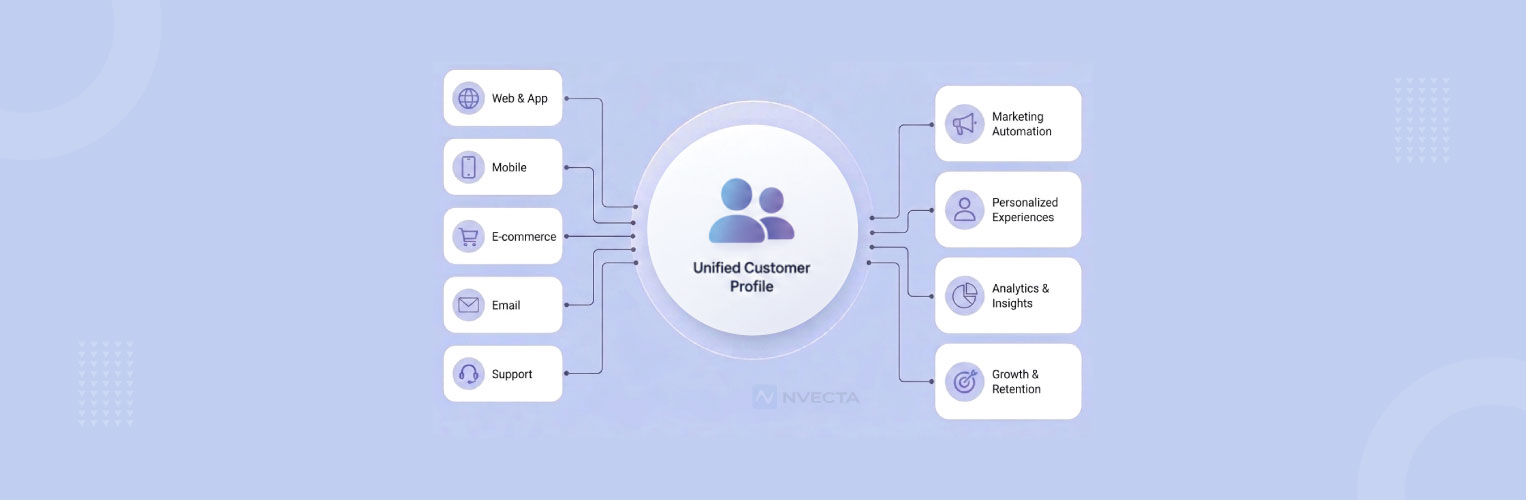
 Aparupa Saha
Your marketing team pulls a report and sees three purchases in the last 30 days. Sales opens the CRM — same customer, flagged as a cold lead with no recent activity. Support checks their queue and finds two complaints that have been sitting open for weeks. Same person. Three different stories. No team is looking at the whole picture, and the customer is the one paying for it. That gap is what a Customer Data Hub is built to close.
This is not a rare edge case. Today is the norm for most mid-size and enterprise businesses. Customer data is being generated at a pace that most organisations simply are not set up to handle.
It flows in from websites, mobile apps, CRMs, point-of-sale systems, support tickets, email platforms, and offline interactions. Each of these systems captures a piece of the customer. None of them talks to each other.
Poor data quality is expensive. Gartner estimates it costs the average organisation $12.9 million a year — and that’s before you count the damage that doesn’t show up on a balance sheet.
Personalisation campaigns fall flat. Customer service agents fumble through calls without the full history. Marketing budgets get burned on audiences that are already customers. These are the real costs most businesses never sit down to calculate.
The answer to this problem is a Customer Data Hub. And if you have not already started thinking seriously about it, this guide will show you why 2026 might be the year you can no longer afford to wait.
At NVECTA, we work with businesses that are done patching over data problems and ready to build something that actually holds together. This guide will show you what that looks like.
What Is a Customer Data Hub (CDH)?
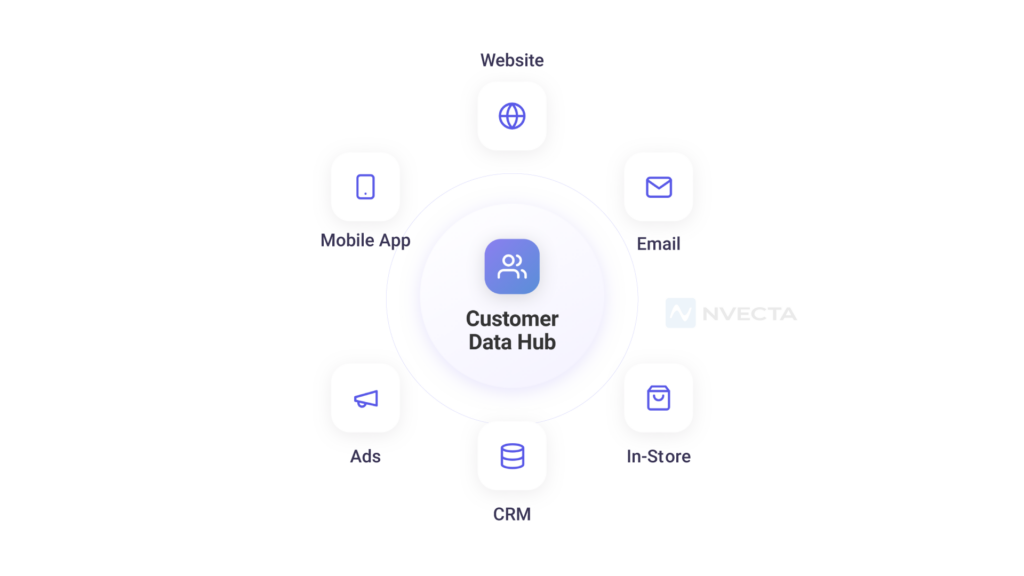
A Customer Data Hub is a centralised system that collects, integrates, and organises customer data from every source across your organisation into a single, unified record.
That record is often called a “golden record”: a single, clean, accurate, continuously updated profile for each customer that every team and every tool can draw from.
The CDH does not just store data. It actively discovers data across disconnected systems, ingests it, resolves duplicate or conflicting records, and makes the unified output available in real time to every consuming application.
That includes your CRM, contact centre software, marketing platform, or compliance system.
Think of it this way. Your customer interacts with your brand across 10 channels over 6 months. Without a CDH, each of those interactions lives in a different silo.
A customer data hub stitches those ten interactions into one continuous story. From that point, every team reads from the same page.
What sets a CDH apart from other data tools is its operational focus. It is designed for real-time, cross-departmental use, and not just for analytics run after the fact.
When a customer calls your support line, the agent sees a complete view of that person’s purchase history, open tickets, loyalty status, and recent web behaviour. That is the CDH working.
What Kinds of Data Ends Up in a CDH
A CDH is only as useful as the data you feed it, so it helps to know what actually goes in. Broadly, customer data falls into four buckets.
Identity data is the “who”: name, email, phone number, account IDs, device IDs. This is what identity resolution stitches together when the same person shows up in five systems under three slightly different spellings.
Descriptive data fills in the profile: job title, company size, location, plan type, lifecycle stage. It is the context that turns a record into a person.
Behavioural data is what the customer actually does: pages viewed, emails opened, features used, carts abandoned, support articles read. This is usually the highest-volume data and the messiest to handle at speed.
Transactional data is the money trail: orders, payments, refunds, subscription renewals, claims. For most businesses this is the data decisions actually hinge on.
A CDH pulls all four together against a single golden record. Miss one and the profile has a blind spot. A support agent who can see identity and transactions but not the angry email the customer sent yesterday is still working half-blind.
CDH vs CDP: What Is the Difference?
This is where many businesses get confused. The terms Customer Data Hub (CDH) and Customer Data Platform (CDP) are often used interchangeably, but they serve different purposes. Understanding that distinction is important when deciding how to manage and activate customer data across your organisation.
At a high level, a Customer Data Hub focuses on creating a trusted, unified customer record that can be used across the business. A Customer Data Platform focuses on using customer data to power marketing and customer engagement activities.
The easiest way to think about it is this: a CDH ensures your customer data is accurate and consistent, while a CDP puts that data to work.
| Feature | Customer Data Hub (CDH) | Customer Data Platform (CDP) |
|---|---|---|
| Primary Purpose | Unify, cleanse, and govern customer data across systems | Build audiences and activate customer data for marketing |
| Primary Users | IT teams, RevOps, data teams, operations leaders | Marketing, growth, and customer engagement teams |
| Data Sources | CRM, ERP, billing systems, support platforms, and operational databases | Websites, apps, email platforms, advertising channels, and customer interactions |
| Core Function | Create a single, accurate customer record | Create customer segments and personalised experiences |
| Focus | Data quality, identity resolution, governance, synchronisation | Audience building, campaign execution, and personalisation |
| Business Value | Establishes a trusted source of customer truth | Improves marketing performance and customer engagement |
| Typical Output | Unified customer profiles available across business systems | Target audiences, customer journeys, and campaign activations |
A Customer Data Hub acts as the operational foundation. It collects customer data from multiple systems, resolves duplicate records, standardises information, and ensures that every department works from the same accurate customer profile.
A customer data platform sits closer to the marketing layer. It captures behavioural signals such as page views, email engagement, app activity, and advertising interactions, then uses that information to build audiences and deliver personalised experiences across channels.
The two technologies are not competitors. In fact, many mature organisations use both. The CDH provides the clean, governed data foundation, while the CDP uses that foundation to power segmentation, personalisation, and campaign execution.
Without a reliable customer data foundation, even the most sophisticated marketing platform can struggle. When incomplete, duplicated, or conflicting customer records are pushed into campaigns, personalisation suffers, and customer experiences become inconsistent. A CDH helps ensure that the data being activated is accurate before it reaches customers.
Where a CDH Sits Next to Your Other Data Tools
A CDP is not the only tool a CDH gets confused with. If you have sat in a data strategy meeting lately, you have probably heard four or five of these names used as if they were interchangeable. They are not.
A CRM is a system of engagement for sales and service. It records deals and interactions, but it was never built to be the clean master record for the whole business, and it usually holds only the data your reps bothered to enter. A CRM with lead routing can also help direct incoming leads to the appropriate sales representatives.
A data warehouse is built for analytics. It is where you run reports on structured, historical data. It is great at answering “What happened last quarter?” and poor at pushing a live customer record to a call centre screen right now.
A data lake stores huge volumes of raw data in any format, mostly for data science. It is a reservoir, not a source of truth. Data goes in raw and often stays raw.
Master data management, or MDM, is the closest cousin. MDM governs master records across many domains: products, suppliers, locations, and more. A CDH is essentially MDM pointed at the customer and built to run in real time instead of overnight batches.
Short version: warehouses and lakes are for analysis, CRMs are for engagement, and a CDH exists to create one trusted, live customer record and hand it to all of them.
Do You Need a CDH, a CDP, or Both
Not every business needs to buy both on day one. The right starting point depends on where your pain actually lives.
Start with a CDH if your core problem is trust. If teams argue about whose customer list is correct, if the same person exists three times across your systems, if integrations keep breaking, or if a single compliance request sends everyone digging through spreadsheets, your foundation is the issue. A CDP layered on top of broken data will just personalise the wrong things faster.
Start with a CDP if your data is already reasonably clean and your problem is activation. If you can trust your records but your marketing team cannot build a decent audience or trigger a journey without raising an engineering ticket, the gap is in the activation layer.
Most mid-size and enterprise businesses eventually need both, and the order matters. Get the clean, governed record in place first, then activate it. Doing it the other way round is how companies end up with expensive campaigns running on data nobody trusts.
The Customer Data Hub Landscape
The CDH category covers a wide range of tools, and the right fit depends on where you are starting from.
Some options are enterprise MDM-heavy platforms designed to sit across large, complex legacy estates. Others come from the data-engineering world and hand technical teams a lot of control at the cost of a steeper build.
A newer group blends the clean-data foundation of a CDH with the activation strengths of a CDP in one platform, so you are not standing up a separate data warehouse project before you can run a single campaign.
When you evaluate any of them, the questions are the same. How good is the identity resolution, really? Is the sync genuinely real-time, or batch dressed up as real-time?
Is governance built in or bolted on? And how long from signing to the first useful output? That last one separates the platforms that ship value in weeks from the ones that turn into a multi-quarter integration project.
Core Features of a Customer Data Hub
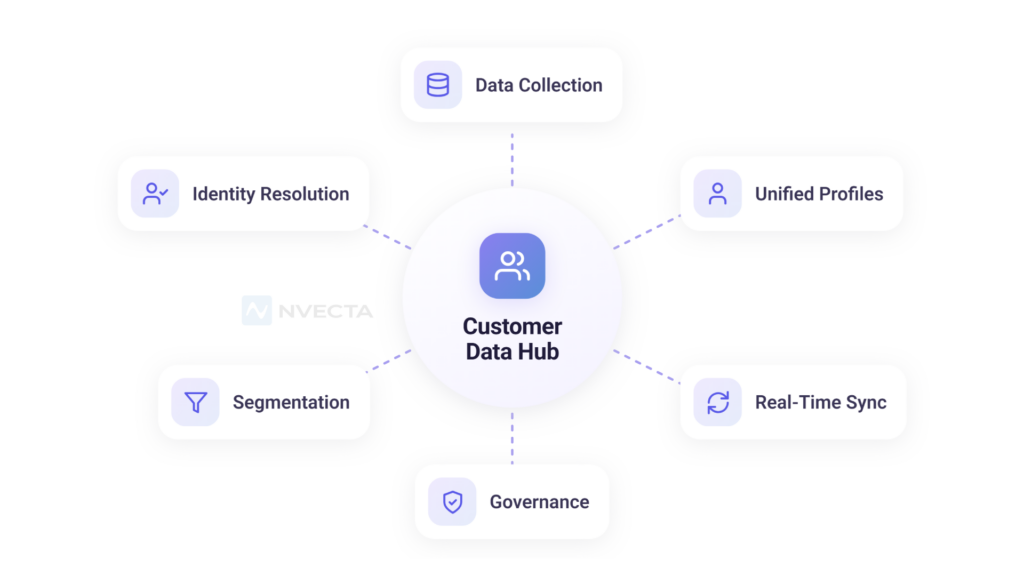
Not all CDH platforms are built the same, but the strongest ones share a set of capabilities that separate them from basic data integration tools.
1. Data Integration Across Every Source
A CDH connects to every system your business runs: CRM, ERP, billing, e-commerce platforms, support tools, mobile apps, offline data, and IoT devices.
It continuously pulls data from these sources, keeping the customer record up to date rather than relying on manual exports or nightly batch syncs.
2. Identity Resolution
This is one of the most valuable features a CDH offers. When the same customer appears under different email addresses, phone numbers, or customer IDs across systems, the CDH recognises these records as belonging to the same person and merges them into a single profile.
No more three versions of the same customer living in three different tools.
3. Data Quality and Governance
Raw data from multiple systems is almost always messy. Fields are named differently, formats do not match, and values are missing or incorrect.
A CDH applies cleansing rules, standardises fields, flags anomalies, and enforces data governance policies so that what comes out of the hub is something teams can actually trust.
4. Real-Time Data Delivery
A CDH does not just store data for reports. It delivers updated customer information to consuming applications in real time, sometimes in milliseconds.
When a customer makes a purchase, that event updates their profile immediately, and every connected system reflects the change right away.
5. Security and Compliance
Enterprise-grade CDH platforms store data in encrypted, compressed formats and are built with GDPR, CCPA, and regional data privacy regulations in mind.
Audit trails, consent tracking, and data lineage are built into the architecture rather than added as afterthoughts.
6. Microservice Automation and Orchestration
A CDH orchestrates data workflows automatically. When a new customer record comes in, a set of automated processes handles integration, deduplication, enrichment, and distribution without manual intervention.
This reduces the burden on data engineering teams and shortens the time between data arriving and being useful.
How a Customer Data Hub Actually Works
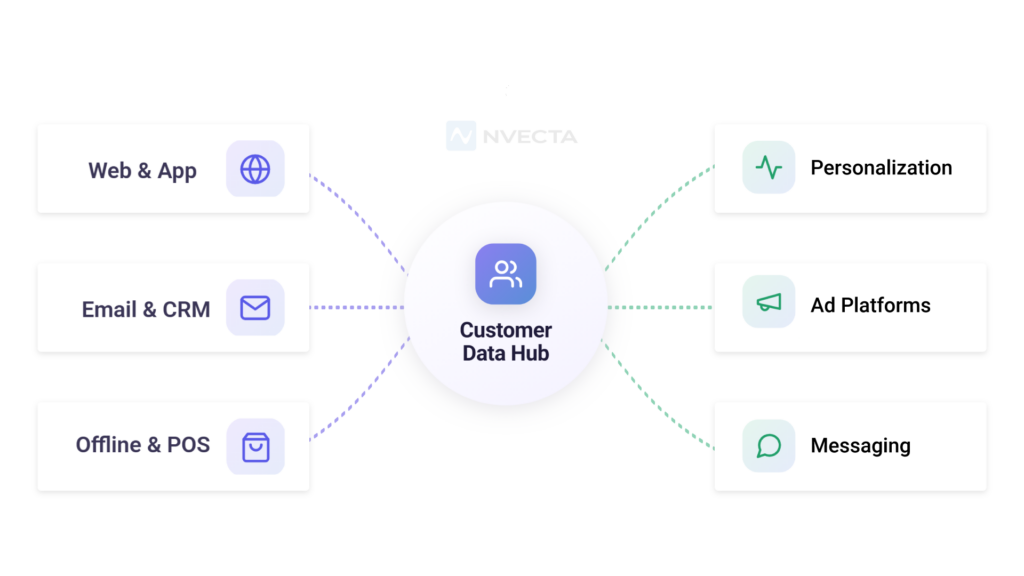
Under the hood, most CDHs run on a hub-and-spoke design. Picture a bicycle wheel. The hub in the middle is the unified customer record. The spokes are your source systems: CRM, billing, support desk, e-commerce platform, and mobile app.
Each spoke feeds data into the hub and reads clean data back out. Nothing talks system-to-system in a tangle of one-off integrations. Everything talks to the hub.
That single change is what stops you from babysitting fifty brittle point-to-point connections that break every time one system updates.
Inside the hub, four things happen, roughly in this order. The CDH ingests raw data from every spoke, either streaming in real time or on a schedule. It runs identity resolution to work out which records belong to the same person.
It cleanses and standardises the fields, so a phone number stored six different ways becomes one. Then it publishes the golden record back out to any system that needs it, often within milliseconds.
The payoff is simple. Add a new tool next year, and you connect it to the hub once instead of wiring it into every other system by hand.
Real-World Use Cases by Industry
Understanding what a CDH is in theory is one thing. Seeing what it actually does for businesses operating in the real world makes the value much harder to ignore.
1. Financial Services
Banks and financial institutions deal with one of the most complex data environments of any industry. A customer might have a checking account, a credit card, a mortgage, and a business loan, each managed by a different system.
A CDH unifies all of these into one profile. This accelerates KYC onboarding because all relevant data is immediately accessible, reduces duplicate account creation, and provides risk teams with a complete view of a customer’s exposure before lending decisions are made.
2. Retail and E-commerce
In retail, customer data lives across the website, the mobile app, in-store point-of-sale systems, loyalty programs, and email lists.
A CDH brings all of this together so that a customer who browses a product online, tries it in-store, and buys it through the app is recognised as one person throughout that journey.
This makes personalisation actually work, and not just in theory, but in the actual customer experience.
3. Telecom
Churn is one of the biggest challenges for telecom companies. A CDH enables a complete view of each subscriber: usage patterns, billing history, support interactions, and contract status.
With that view, teams can identify customers who show early signs of disengagement and trigger the right intervention: a proactive call, a retention offer, or a personalised upgrade before the customer walks.
4. Healthcare
Patient data in healthcare is notoriously fragmented across hospitals, clinics, labs, and billing departments. A CDH unifies patient records from disparate sources, ensuring care teams always have a complete clinical picture.
This reduces duplicate tests, improves care coordination, and helps administrators ensure that billing reflects the complete care history.
5. Insurance
Insurance companies process claims that often involve data from multiple internal departments, third-party vendors, and customer self-service portals.
A CDH gives claims agents instant access to a complete customer profile: coverage details, claim history, past communications, cutting the time it takes to process a claim and improving the experience for the policyholder.
How to implement a CDH (step-by-step)
A CDH project fails more often from scope than from technology. The teams that succeed tend to follow roughly the same path.
First, pick one use case, not ten. Maybe it is giving support agents a full customer view, or cleaning up duplicate accounts before a migration. A narrow, painful, measurable problem beats a vague “single view of the customer” mandate that never ends.
Second, map your sources. List every system that holds customer data and be honest about the state of each. This is usually where teams discover they have more silos than they thought.
Third, define the golden record. Decide which fields matter, which system wins when two disagree, and what “the same customer” actually means for your business. These matching rules are the heart of the project, and getting them wrong is expensive to unwind later.
Fourth, connect, resolve, and cleanse. Bring the sources in, run identity resolution, and standardise the fields. Expect the first pass to surface data problems you did not know you had.
Fifth, publish and integrate. Push the clean golden record back into the systems your teams actually use, so the work shows up where people work rather than in a dashboard nobody opens.
Sixth, govern from day one. Bake in consent tracking, access rules, and audit logs at the start. Retrofitting governance after go-live is painful, and under GDPR or CCPA it is risky.
Start narrow, prove value on one use case, then expand. That is the difference between a CDH that ships in weeks and a data project that quietly dies after a year.
2. Common Pitfalls to Watch For
A few mistakes show up again and again on CDH projects.
Boiling the ocean is the classic one. Trying to unify every source and every use case at once turns a six-week win into a two-year slog. Scope tightly.
Weak matching rules cause the opposite of the intended effect. Too loose and you merge two different people into one record. Too strict and the same customer stays split in two. Either way, the first time someone spots it, they stop trusting the hub.
Treating governance as a phase-two problem is a trap. Consent, access control, and data lineage are far harder to add once data is already flowing.
And underestimating the people side sinks more projects than the tech does. If sales, support, and marketing cannot agree on what a customer record should contain, no platform will settle the argument for them. That alignment work is not a distraction from the project. It is the project.
Key Benefits of a Customer Data Hub
Businesses that implement a CDH tend to see the impact across every department, not just in one corner of the organisation.
1. One Source of Truth
Every team, including marketing, sales, service, compliance, and product, works from the same customer record. Disputes about whose data is correct stop happening because there is only one version.
2. Better Customer Experiences
When your contact centre agent can see a customer’s full history before picking up the phone, the conversation is completely different.
When your marketing team knows that a customer just had a bad support experience, they can make a smarter decision before sending them a promotional email. A CDH makes that context available everywhere, in real time.
3. Faster, More Confident Decision-Making
Leaders can trust the data they review because it has been cleaned, reconciled, and validated at the source. That confidence changes how quickly and how accurately decisions get made.
4. Operational Efficiency
Teams stop spending time reconciling conflicting data from different systems. Data engineers spend less time building one-off pipelines.
Support agents stop switching between five tools to build a picture of who they are talking to. The CDH does that work automatically.
5. Regulatory Compliance
With data governance built into the core, a CDH makes compliance audits significantly less painful. Data lineage, consent records, and access logs are maintained automatically. When a regulation changes or a regulator asks a question, the answers are readily available, and in-house legal teams increasingly use legal AI tools to interpret those new rules and check that customer data practices still line up.”
6. A Foundation for AI
This is the most beneficial aspect that will matter most as AI becomes central to how businesses operate. AI models are only as useful as the data they are trained on and the data they are fed in real time.
A CDH creates the clean, unified, real-time data layer that AI needs to produce accurate, actionable outputs rather than generic, unreliable ones.
What Does a Customer Data Hub Cost
Straight answer: it depends, and anyone who quotes you a firm number before seeing your systems is guessing.
Pricing usually moves with a few things. The number of source systems you connect. The volume of customer records and events. Whether you need real-time sync or can live with batch.
And how much governance and compliance tooling you require. A business with five clean sources and a million records is a very different quote from an enterprise with forty legacy systems and a hundred million records.
Then there is the cost people forget: implementation and maintenance. Building your own hub in-house looks cheap until you count the engineering time spent writing and re-writing integrations every time a source system changes.
For a lot of teams, that hidden maintenance bill is the real reason they buy rather than build.
The more useful question is not “what does it cost” but “what is bad data already costing us”. Gartner puts poor data quality at an average of 12.9 million dollars a year per organisation. Measured against that, the platform is usually the smaller number.
Conclusion: Stop Patching the Cracks. Build the Foundation
Data fragmentation isn’t really a technology problem. It’s a business problem wearing a technology disguise. It shows up everywhere — in the campaign that treats your best customer like a stranger, in the support agent who can’t see the ticket the same customer opened yesterday, in the churn dashboard that flags an account that’s actually mid-purchase on your app. The root cause is always the same: your teams are reading from different copies of the same customer.
A Customer Data Hub fixes the foundation. It unifies the data, resolves identities, enforces governance, and feeds clean records into every connected system in real time. Once that’s in place, everything sitting on top of it — personalisation, AI, lifecycle automation, compliance reporting — actually starts to work.
Here’s where NVECTA comes in. Most CDPs assume you already have clean, unified data sitting somewhere and just bolt activation onto it. We didn’t make that assumption. NVECTA is built as a CDP and CDH in one platform — identity resolution, golden record management, real-time sync, and governance on one side; AI-driven segmentation, predictive insights, journey orchestration, and cross-channel engagement on the other. The foundation and the activation layer, not sold separately, are not stitched together with middleware.
That’s why teams adopting NVECTA typically go from fragmented data to live, personalised campaigns in weeks rather than quarters — without first standing up a separate data warehouse project.
If your marketing, sales, and support teams are still arguing about whose version of the customer is correct, that gap won’t close on its own. [Book a demo](/products/schedule-demo) — we’ll show you what a single source of truth looks like inside your own stack.
FAQs
What is a Customer Data Hub (CDH)?
A Customer Data Hub (CDH) is a centralised platform that collects, integrates, and organises customer data from multiple systems into a single, unified customer record. It helps businesses eliminate data silos, improve data quality, and ensure every team works from the same source of truth.
How is a Customer Data Hub different from a Customer Data Platform (CDP)?
A CDH focuses on unifying, cleansing, and governing customer data across the organisation. A CDP focuses on activating customer data for marketing, personalisation, and customer engagement. In simple terms, a CDH ensures data accuracy, while a CDP uses that data to drive customer experiences.
Why do businesses need a Customer Data Hub?
Most organisations store customer data across multiple disconnected systems, including CRMs, support platforms, billing systems, websites, and mobile apps. A CDH brings this information together, creating a complete customer view that improves decision-making, customer experiences, operational efficiency, and compliance.
What is a “golden record” in a Customer Data Hub?
A golden record is a single, trusted customer profile created by combining and reconciling data from multiple sources. It serves as the definitive version of customer information, usable across departments and applications.
What types of data can a Customer Data Hub integrate?
A CDH can integrate data from CRM systems, ERP platforms, billing systems, e-commerce platforms, customer support tools, mobile applications, websites, loyalty programmes, point-of-sale systems, and even offline data sources.
What is identity resolution in a CDH?
Identity resolution is the process of recognising when multiple records belong to the same customer, even if they exist under different names, email addresses, phone numbers, or customer IDs. A CDH uses identity resolution to create a unified customer profile and eliminate duplicate records.
Can a Customer Data Hub support real-time customer experiences?
Yes. Modern CDHs are designed to process and distribute customer data in real time. When a customer takes an action, such as making a purchase or opening a support ticket, that information can be reflected across connected systems immediately.
How do you build a customer data hub?
Start with one clear use case rather than trying to unify everything at once. Map your customer data sources, define the golden record and the rules for matching duplicate customers, connect and cleanse the data, then publish the unified record back into the systems your teams already use. Build governance in from the start rather than adding it later.
How much does a customer data hub cost?
There is no fixed price. Cost depends on the number of source systems, the volume of records and events, whether you need real-time or batch sync, and your compliance requirements. The larger hidden cost is usually implementation and ongoing maintenance, which is why many teams choose to buy rather than build.
What is the difference between a customer data hub and a data warehouse?
A data warehouse is built for analytics and reporting on historical data. A customer data hub is built to create a single, live customer record and serve it to operational systems in real time. A warehouse answers “what happened”. A CDH powers “what is happening right now” across sales, support, and marketing.
Is a customer data hub the same as MDM?
Not quite. Master data management governs master records across many domains, including products and suppliers. A customer data hub applies the same discipline specifically to customer data, and it is designed to run in real time rather than in overnight batches.
