














 Email
Email SMS
SMS Whatsapp
 Web Push
 App Push
 Audience Sync for Ads
 Popups
 Channel A/B Testing
  Control groups Analysis
 Frequency Capping
 Funnel Analysis
 Cohort Analysis
 RFM Analysis
 Signup Forms
 Surveys
 NPS
NPS Landing pages personalization
  Website A/B Testing
  PWA/TWA
 Heatmaps
 Session Recording
 Wix
Wix Shopify
 Magento
 Woocommerce
 eCommerce D2C
  Mutual Funds
 Insurance
 Lending
  Recipes
  Knowledgebase
 Developer Docs
 Product Updates
 App Marketplace
 Academy
 Ebooks
 Case Studies
 Blog
Blog Templates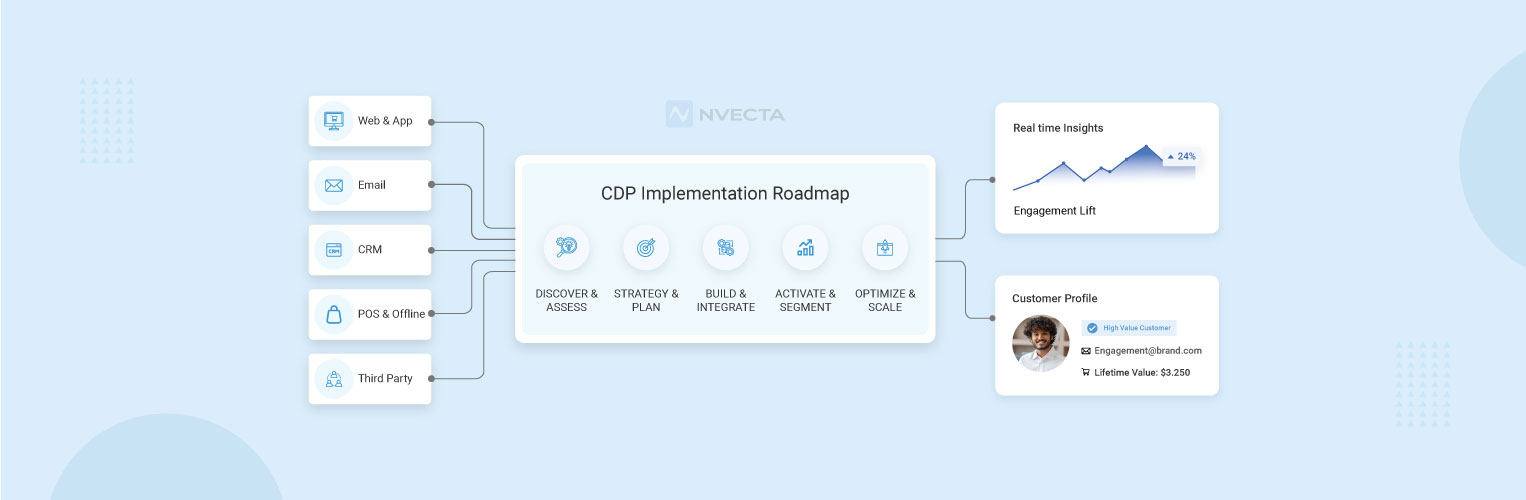
 Aparupa Saha
Quick Answer
A CDP implementation roadmap is a phased plan for deploying a Customer Data Platform — covering data audit, use case definition, identity resolution, integration, go-live, and ongoing governance. For most enterprises, full deployment takes 6–12 months for packaged CDPs and 4–8 months for composable architectures, depending on data complexity, team readiness, and the number of sources being integrated. Most programmes recoup their investment within 6–12 months of full activation.
If you talk to teams inside large organisations, you will often hear the same frustration phrased in different ways: “We have the data, but we cannot use it.”
Marketing teams feel this when personalisation initiatives stall. Analytics teams feel it when reports take weeks to assemble and still do not align. Product and experience teams feel it when customer behaviour looks different in every dashboard. Legal and privacy teams feel it when they cannot confidently answer where customer data is stored or how consent is enforced.
None of these problems exists because enterprises lack technology. They exist because customer data has grown faster than the structures used to manage it.
Customer data platforms (CDP) were created to address this gap. A CDP does not promise perfect data or instant insights. What it offers is something more practical: a way to bring order to customer data across systems, teams, and channels so that it can be trusted and reused.
This article expands on a practical, enterprise-ready CDP implementation roadmap. It focuses less on theory and more on how organisations actually succeed with CDPs in the real world, where data is messy, priorities compete, and progress happens incrementally.
Understanding the Role of a CDP in a Large Organisation
In simple terms, a CDP collects customer data from many sources, links that data to individual customers, and makes it usable for other systems. In an enterprise context, that role becomes much broader.
Most large organisations did not design their data ecosystems intentionally. Systems were added over time to solve specific problems.
A CRM for sales. An email platform for campaigns. An analytics tool for web traffic. A loyalty system for repeat customers. Each tool worked well enough on its own, but very few were built with long-term integration in mind.
A CDP does not replace these tools. Instead, it becomes a shared reference point. It establishes common definitions, identity logic, and governance rules that other systems can rely on.
When this layer is missing, each team builds its own version of the customer, which leads to inconsistency and duplication.
For enterprises, the real value of a CDP is not sophistication. It is reliability. When teams trust that customer data is consistent and up to date, they spend less time validating and more time acting.
Step 1: Start With the Frustrations People Face Every Day
The most effective CDP efforts rarely begin with a checklist of features or a polished vendor presentation.
They usually begin with frustration. The kind people feel when simple questions take too long to answer or when everyday work turns into back-and-forth discussions.
Notice Where Things Start to Fall Apart
Before jumping into requirements or solutions, pause and listen. Talk to people across marketing, analytics, IT, and operations.
Ask them where work slows down. Ask where projects get stuck, bounce between teams, or rely on workarounds because the tools do not quite support what they need to do.
You will probably hear the same themes come up again and again, such as:
- Campaigns that take weeks to launch because audiences must be rebuilt separately for every channel
- Reports that never fully align across teams, even when they are meant to use the same data
- Personalisation that goes no further than basic rules because richer customer data is difficult to access
- Consent and preference rules are handled differently depending on which system is involved
Document these issues using plain, everyday language. Avoid framing them as technical or data problems too early. At their core, these are business issues that slow teams down, create confusion, and increase risk.
Decide What to Tackle First
While a CDP can support many different use cases, trying to address everything at once often leads to delays and diluted impact.
Enterprises tend to make faster progress when they focus on a small number of problems that truly matter.
The strongest early use cases usually sit between teams rather than within a single function. Examples include building a customer view that both marketing and analytics can trust, or creating a centralised approach to consent that finally aligns legal, marketing, and technology teams.
These types of use cases not only deliver visible value, but they also clearly expose the limitations of the current setup.
Define Success in Practical, Relatable Terms
Success does not need to mean a dramatic overhaul from day one. It might simply mean launching campaigns more quickly, cutting down on manual data work, or feeling more confident in customer numbers and reports.
What matters most is shared understanding. Everyone involved should agree on what success looks like and why it is important.
Leadership support is essential at this stage. A CDP touches many parts of the organisation, and without clear backing from leaders, priorities can easily drift or compete.
Step 2: Take an Honest Look at Your Data Landscape
Once you know what you are trying to fix, the next step is understanding what you are working with. This requires honesty and, sometimes, a bit of discomfort.
Lay Everything Out Without Trying to Fix It Yet
Start by listing every system that holds customer data. Do not judge or optimise at this stage. The goal is simply visibility.
This exercise often uncovers:
- Systems that were implemented years ago and largely forgotten
- Duplicate data pipelines doing similar work in different ways
- Regional or team-specific tools solving the same problem separately
Seeing the full picture can be unsettling, but it is an important step toward making better decisions.
Be Realistic About Data Quality
Some data sources will be in good shape. Others will not. Some identifiers will be consistent and reliable, while others will clash or be missing entirely.
Instead of assuming the CDP will automatically fix these issues, document what you already know. Decide which data sources are good enough to support early use cases and which ones need cleanup or longer-term attention.
Decide Who Owns What Early On
Data initiatives struggle when ownership is unclear. Before centralising data, agree on who is responsible for each source, who approves changes, and who is accountable for quality and compliance.
This step is easy to overlook, but it often has more impact on long-term success than any technical decision you make.
Step 3: Build a Business Case That Reflects Reality
Enterprise stakeholders are sceptical by default. A CDP business case needs to feel grounded.
Be Honest About Costs
Beyond licensing, costs include integration work, internal time, training, and ongoing operations. Many CDP programs struggle because they are underestimated.
Transparency builds credibility.
Show Value Across the Organisation
Marketing gains are important, but they should not stand alone. Analytics teams gain faster access to trusted data. IT reduces one-off integrations. Legal teams gain clearer visibility into consent and usage.
A CDP becomes easier to fund when it is seen as shared infrastructure.
Acknowledge What Will Not Happen Immediately
Not every use case will be solved in year one. Setting expectations early avoids disappointment later.
Step 4: Choose Technology That Matches How You Operate
The “best” CDP is the one that fits your organisation, not the one with the longest feature list.
Look Beyond Demos
Demos are designed to impress. Instead, ask how the platform handles scale, failure, governance, and change.
Ask how much technical effort is required for everyday tasks. Ask how non-technical users actually work with the platform.
Build Versus Buy Is a Strategic Choice
Building a CDP internally can offer flexibility, but it also creates long-term maintenance obligations. Many enterprises underestimate this cost.
Commercial platforms trade some flexibility for speed and maturity. Neither approach is universally right. What matters is clarity about trade-offs.
Test With Real Scenarios
Proofs of concept should reflect real data and real workflows. This is often where hidden complexity emerges.
Step 5: Design Identity and Profiles for Longevity
Identity is where many CDP projects struggle quietly.
Agree on What a Customer Is
This sounds simple, but it is not. Is a customer an email address? A loyalty ID? A household? The answer may differ by use case.
Agreeing on core definitions prevents confusion later.
Balance Accuracy and Coverage
Exact matching creates clean profiles but may miss connections. Probabilistic matching increases coverage but introduces uncertainty.
Enterprises need transparency more than perfection. Teams should understand how and why profiles are linked.
Make Privacy Part of the Foundation
Consent rules, access permissions, and auditability should not be bolted on later. They should shape how data is modelled and exposed from the beginning.
Step 6: Put the Plan Into Motion Without Rushing It
This is the stage where all the planning meets reality. Data that looked clean in diagrams starts behaving differently once it is live.
Timelines feel tighter. Dependencies between teams become more obvious. How you handle this phase will shape whether people trust the CDP or quietly fall back to old ways of working.
Take Smaller Steps and Learn as You Go
Trying to launch everything at once usually creates more problems than it solves. Rolling the CDP out in stages gives teams room to adjust, fix issues, and build confidence. Early on, the goal is not to support every use case. It is to make sure what is live actually works.
When the basics are reliable, expanding later becomes much easier.
Treat Data Pipelines as Something That Needs Care
Pipelines are easy to underestimate. They are not just technical plumbing. They are what keep the CDP alive. Each pipeline needs someone who owns it, understands it, and keeps an eye on it.
When data stops flowing or quietly degrades, people lose trust fast. Even small, short-lived issues can make teams question the platform. Clear ownership and simple monitoring go a long way in preventing that.
Test for How the World Really Works
It is not enough to test in perfect conditions. Identity matching, data freshness, and activation flows should be tested the way they will actually be used. That means realistic data volumes, timing delays, and downstream system behaviour.
Finding issues here is much less painful than discovering them after campaigns, reports, or customer experiences depend on the data.
Step 7: Remember That People Decide Whether the CDP Succeeds
A CDP does not create value on its own. People do. Adoption is rarely about how advanced the platform is. It is about whether it genuinely helps people do their jobs better.
Show Value Early, Not Someday
People are far more open to change when they see quick, practical benefits. Early use cases should remove friction, save time, or solve problems teams already complain about.
Small wins build confidence and make it easier to introduce more advanced capabilities later.
Train People Around Real Work, Not Features
Different teams use the CDP in very different ways. Marketers care about speed and flexibility. Analysts care about consistency and trust. Engineers care about stability and control.
Training should reflect those realities. Show people how the CDP fits into the work they already do, not just what buttons exist.
Expect Interest to Grow Over Time
Once teams start trusting the data, they will want more from it. More sources. More attributes. More use cases. That is a good sign.
The challenge is making sure governance keeps things aligned without slowing everything down with unnecessary processes.
Step 8: Keep Checking, Adjusting, and Moving Forward
A CDP is never “done.” It changes as the business changes.
Revisit Goals More Often Than You Think
What mattered six months ago may not matter as much today. Regular check-ins help make sure the CDP is still supporting current priorities instead of yesterday’s ones.
Improve What You Already Have
As usage grows, identity rules, attributes, and activation logic will need tuning. Small adjustments made regularly often have more impact than big redesigns done once in a while.
Grow Carefully and With Intention
When it is time to bring new teams, regions, or brands onto the CDP, resist the urge to rush. Apply the same discipline you used early on.
A solid foundation makes growth far less painful.
Realities Most Enterprises Eventually Run Into
Once a CDP effort is underway, a few things usually become clear. The data is rarely as clean or as consistent as people hoped. Adoption takes longer than anyone originally planned. Questions around ownership and responsibility tend to resurface, even after they were supposedly settled.
None of this means the initiative is off track. It is simply how enterprise data works in practice. Teams that expect these challenges are generally better equipped to handle them. They leave room for adjustment, avoid overreacting to early friction, and understand that progress is rarely linear.
What Long-Term Success Tends to Look Like
Organisations that get lasting value from a CDP approach it as something that grows over time, not as a project with a clear finish line.
They invest in governance early, encourage collaboration between teams that do not always work closely together, and make continuous improvement part of how the platform is managed.
They also accept that customer data is never static. New channels appear, regulations evolve, and business priorities shift.
Instead of trying to design something perfect from the start, they focus on building a foundation that can adapt as things change.
Where NVECTA Fits In
The frustrations described in this roadmap are not hypothetical. Teams really do struggle with fragmented data. Reports really do misalign. Consent rules really do vary depending on which system handles them.
And most organisations genuinely want to fix these things, but find themselves caught between the complexity of their current setup and the risk of trying to change too much at once.
NVECTA is built for this reality. It does not promise to transform your organisation overnight. What it does is help you move from the frustration phase toward something more practical: a shared foundation for customer data that teams can actually trust and use.
At its core, NVECTA brings three things together: identity, consent, and activation. It does this in a way that fits how enterprises actually operate. It works alongside your existing systems rather than demanding you rebuild them.
It supports the kind of incremental, staged approach described in this roadmap, so you can start small, build confidence, and grow without overcommitting resources or risking widespread disruption.
Governance is not bolted on as an afterthought. It is built in from the beginning, which means teams can move faster without creating compliance headaches or losing visibility into how customer data is being used.
The result is something that feels less like a big technology project and more like finally having a shared language and structure that lets different teams work together. Customer data stops being a daily frustration and becomes what it should be: a dependable asset that grows with your business.
Final Thoughts: CDP implementation roadmap
A Customer Data Platform is not a quick fix, and it is rarely the turning point people expect on day one. Most of the value shows up gradually. It shows up when teams stop arguing about numbers, when decisions take less time, and when customer interactions start to feel more consistent across channels.
The biggest shift usually is not technical. It is cultural. When organisations focus on solving real, everyday problems, stay realistic about how complex their data is, and put as much effort into people and process as they do into tools, the CDP starts to make sense. It becomes something teams rely on, not something they work around.
Solutions like NVECTA fit into this journey by helping turn unified customer data into action. When customer profiles are directly tied to engagement, personalisation, and messaging, the impact of the CDP becomes visible in daily work, not just in reports or planning sessions.
Over time, a well-run CDP fades into the background. It is no longer discussed as a “platform” but experienced as shared infrastructure that simply works. It supports better conversations, clearer measurement, and more confident decisions. For enterprises willing to move patiently and stay grounded, that kind of progress is often the most valuable outcome.
CDP Implementation Phases — A Practical Roadmap
The steps described throughout this guide do not happen in isolation. They fit into a sequence. Here is how a realistic enterprise CDP implementation plays out across five phases — with an honest look at what typically happens in each one and where projects commonly run into trouble.
| Phase | Typical timing | What happens | Where it commonly stalls |
|---|---|---|---|
| 1. Discovery & Audit | Weeks 1–4 | Map every data source. Interview teams across marketing, IT, analytics, legal. Define 2–3 priority use cases. Agree on what a “customer” means. | Scope creep — teams want to solve everything at once. Leadership sign-off takes longer than expected. |
| 2. Data Mapping & Use Case Design | Weeks 4–8 | Document data schemas, ownership, and quality. Design identity resolution logic. Draft consent model. Define what a “good” customer profile looks like. | Data quality is worse than expected. Ownership disputes emerge. Privacy requirements not agreed across legal and engineering. |
| 3. Integration & Identity Build | Weeks 8–16 | Connect data sources. Build ingestion pipelines. Implement identity resolution. Set up consent management. Test profile quality with real data volumes. | Pipeline dependencies between teams cause delays. Identity matching behaves differently at scale than in staging. Downstream tool integrations take longer than quoted. |
| 4. Go-Live & Validation | Weeks 16–20 | Launch first use case in production. Monitor data quality. Validate profiles against known customer records. Run first activation. Collect team feedback. | Teams lose trust quickly if early data quality issues are not fixed fast. Success metrics were not agreed before go-live, making it hard to demonstrate value. |
| 5. Optimisation & Expansion | Month 5 onwards | Tune identity logic. Add new data sources. Bring additional teams onto the platform. Expand use cases. Establish governance review cadence. | Governance becomes a bottleneck if not designed for scale. New teams repeat early mistakes without documentation. Technical debt accumulates if pipelines are not maintained. |
The timings above are approximate. Enterprise implementations with complex data landscapes, multi-brand environments, or strict regulatory requirements will take longer — typically at the Integration and Go-Live phases where real data behaves differently from what was mapped on paper. The teams that move fastest tend to be the ones that over-invested in the Discovery phase rather than rushing to integration.
How Long Does CDP Implementation Take?
This is the question every enterprise buyer asks early — and the one that gets the most diplomatic non-answers from vendors. Here are the actual numbers, with context.
| CDP type | Pilot / first use case | Full enterprise deployment |
|---|---|---|
| Packaged CDP | 2–4 months | 6–12 months |
| Composable CDP | 4–6 months | 6–12 months (engineering-heavy) |
| Build-internally | 6–12 months | 12–24 months (ongoing) |
These timelines come from CDP Institute research across enterprise deployments. The variation within each range is mostly explained by three factors: how clean the source data is going in, how quickly ownership and governance decisions can be made, and how many teams need to be involved before a first use case can go live.
Packaged CDPs move faster to a pilot because the infrastructure is already built — you are configuring, not constructing. Composable CDPs offer more control over the data layer but the integration and identity setup takes longer. Building internally gives the most flexibility but the timeline almost always runs over because maintaining custom data infrastructure is a full-time engineering commitment that is easy to underestimate before the project starts.
One thing most enterprise teams do not plan for: the time between go-live and the point where the CDP is genuinely trusted and used daily. That gap — usually three to six months — is the change management phase, and it is rarely on the original project plan. Build it in from the start.
CDP Implementation Team — Who Needs to Be Involved
CDP implementations fail for many reasons, but a surprisingly large number come down to one thing: the wrong people were in the room — or the right people were not. Here are the five roles that make the biggest difference, and what each one actually owns.
Data Engineer. Builds and maintains the ingestion pipelines that bring data into the CDP from source systems. Owns pipeline reliability, monitors data freshness, and handles schema changes when source systems update. Without someone in this role, pipelines break silently and teams lose trust in the data before they ever fully rely on it.
Marketing Technologist. Owns the activation side — building segments, configuring campaign triggers, and connecting the CDP to downstream channels like email, SMS, and paid media platforms. Acts as the bridge between the data team and the marketing team, translating use case requirements into technical specifications and back again.
Privacy and Compliance Officer. Defines the consent model, approves data retention rules, and ensures that how data is collected, linked, and used stays within regulatory requirements. This person needs to be involved from Phase 1, not brought in at the end to review what has already been built. GDPR, CCPA, and India’s DPDP Act all have implications for how identity resolution is designed — not just how data is stored.
Analytics Lead. Defines what a validated customer profile looks like, sets the quality thresholds for identity resolution, and builds the reporting that shows whether the CDP is producing trustworthy data. Without this person, teams have no reliable way to know whether the CDP is working correctly or not.
Platform or IT Owner. Manages infrastructure, integration architecture, vendor relationships, and access controls. Owns the technical decisions that span multiple teams — the ones no single team wants full accountability for. In larger organisations, this role often sits within a Centre of Excellence or a dedicated data platform team.
For smaller enterprise teams working with a tighter resource model, the minimum viable setup is three roles: a data engineer, a marketing technologist, and someone who covers privacy and compliance. Everything else can be shared or brought in through the vendor’s implementation support — but those three need clear internal ownership from day one.
CDP Implementation Cost — What to Budget
CDP pricing is one of the more opaque areas of enterprise software. Licence fees get quoted, but the full cost of implementation is rarely discussed until you are already mid-procurement. Here is an honest breakdown.
Licence fees range from around £10,000 per year for smaller deployments to over £800,000 per year for large enterprise contracts with high data volumes and multiple brand environments. Most mid-market enterprise deployments land in the £40,000–£150,000 per year range depending on the number of profiles, events processed, and channels activated.
Implementation services — whether handled by the vendor, a systems integrator, or internal engineering — typically run at 1x to 2x the annual licence cost in year one. A £60,000 per year platform often involves £60,000–£120,000 in implementation work on top of that. This is the cost most budgets underestimate.
Internal engineering time is the hidden cost no one puts on a spreadsheet. Even with external support, an enterprise CDP deployment typically requires 1–3 internal data engineers for several months, plus ongoing part-time maintenance afterwards. At enterprise salary rates, this can easily add £50,000–£150,000 to year-one cost.
Ongoing maintenance — monitoring pipelines, updating integrations when source systems change, managing identity rules as customer behaviour evolves — is typically 20–30% of the year-one implementation cost per year, on top of the licence. This figure is almost always absent from the initial business case.
As a rule of thumb: total cost of ownership in year one is typically 2x–5x the licence fee when implementation services, internal time, and infrastructure costs are fully included. The organisations that get the best long-term ROI are those that modelled this honestly from the start — not those that approved a licence fee and discovered the rest later.
NVECTA is built to reduce implementation overhead specifically. The platform is designed for marketing teams to operate without constant engineering support, which means the ongoing internal time cost is materially lower than platforms that require technical involvement for routine tasks.
CDP Implementation Checklist — Before You Go Live
Most go-live delays are discovered in the final two weeks when someone realises something was assumed rather than confirmed. Run through this list before you call it ready.
If more than three of these are marked incomplete a week before go-live, it is worth having a direct conversation about whether the launch date is realistic. A two-week delay to fix these properly is less painful than a live platform that teams stop trusting in the first month.
New to CDPs and want to understand the foundations before working through implementation? Start with our complete guide: What Is a Customer Data Platform (CDP)? A Comprehensive Guide — covering how CDPs work, what they can and cannot do, and how to evaluate options for your team.
Implementing a CDP for a retail or ecommerce environment? The data complexity is different — POS, loyalty, web and app data all need connecting. See how NVECTA handles this: NVECTA Customer Data Platform — built for teams that need to move from implementation to activation without heavy engineering overhead.
Frequently Asked Questions
What is a CDP implementation roadmap?
A CDP implementation roadmap is a phased plan for deploying a Customer Data Platform inside an enterprise. It covers data discovery and audit, use case definition, identity resolution design, integration build, go-live validation, and ongoing governance. The roadmap should reflect real organisational constraints — data quality, team capacity, and governance readiness — rather than an idealised sequence of technical steps.
How long does CDP implementation take?
According to CDP Institute research, packaged CDPs take 2–4 months for a pilot and 6–12 months for full enterprise deployment. Composable CDPs typically take 4–6 months for a first use case and 6–12 months for full deployment, with more engineering involvement throughout. Building a CDP internally takes 12–24 months and requires sustained engineering resource. The main factors that extend timelines are poor source data quality, unclear data ownership, and delays in getting governance decisions made cross-functionally.
What are the phases of CDP implementation?
A practical enterprise CDP implementation has five phases:
(1) Discovery and Audit — mapping data sources, interviewing teams, defining priority use cases;
(2) Data Mapping and Use Case Design — documenting schemas, designing identity resolution, drafting the consent model;
(3) Integration and Identity Build — connecting sources, building pipelines, implementing identity resolution;
(4) Go-Live and Validation — launching the first use case, monitoring quality, validating profiles;
(5) Optimisation and Expansion — tuning logic, adding sources, bringing new teams onto the platform.
What does CDP implementation cost?
CDP licence fees range from around £10,000/year for smaller deployments to £800,000+ for large enterprise contracts. Implementation services typically run at 1x–2x the annual licence fee in year one. Internal engineering time adds further cost — usually 1–3 engineers for several months. Ongoing maintenance is typically 20–30% of the year-one implementation cost per year. Total cost of ownership in year one is usually 2x–5x the licence fee when all costs are included. The organisations that get the best ROI are those that modelled the full cost honestly before starting.
Who needs to be involved in a CDP implementation?
Five roles are critical: a Data Engineer (builds and maintains ingestion pipelines), a Marketing Technologist (owns activation and campaign use cases), a Privacy and Compliance Officer (defines the consent model and ensures regulatory compliance), an Analytics Lead (defines profile quality standards and validates data), and a Platform or IT Owner (manages infrastructure and integrations). For smaller enterprise teams, the minimum viable team is three: data engineer, marketing technologist, and privacy/compliance owner.
