














 Email
Email SMS
SMS Whatsapp
 Web Push
 App Push
 Audience Sync for Ads
 Popups
 Channel A/B Testing
  Control groups Analysis
 Frequency Capping
 Funnel Analysis
 Cohort Analysis
 RFM Analysis
 Signup Forms
 Surveys
 NPS
NPS Landing pages personalization
  Website A/B Testing
  PWA/TWA
 Heatmaps
 Session Recording
 Wix
Wix Shopify
 Magento
 Woocommerce
 eCommerce D2C
  Mutual Funds
 Insurance
 Lending
  Recipes
  Knowledgebase
 Developer Docs
 Product Updates
 App Marketplace
 Academy
 Ebooks
 Case Studies
 Blog
Blog Templates
 Aparupa Saha
The expansion of the e-commerce sector has been nothing short of phenomenal. With the growth rate not showing any signs of slowing, competition among digital brands is now fiercer than ever.
However, companies that can successfully decode their customers’ needs and deliver an exceptional experience, often emerge as winners in this competitive landscape.
Central to this success is the efficient management of customer data, often facilitated by a robust customer data platform (CDP). In this blog, we will discuss how a customer data platform for eCommerce can revolutionize your business.
What Is a Customer Data Platform for eCommerce?
A customer data platform (CDP) for eCommerce is a purpose-built software solution that collects, unifies, and activates customer data from every touchpoint in your online store — from website visits and product views to purchases, email clicks, and post-sale interactions.
Unlike generic enterprise CDPs, an eCommerce CDP is specifically designed to solve retail-specific challenges: recovering abandoned carts, delivering real-time product recommendations, reducing customer acquisition costs, and building long-term loyalty through personalised experiences.
At its core, an eCommerce CDP answers one question: Who is this customer, what do they want right now, and how do I reach them before they go elsewhere?
According to industry data, the global CDP market is projected to grow from $9.72 billion in 2025 to $37.11 billion by 2030 — a clear signal that data-driven personalisation is no longer optional for eCommerce brands, it is a competitive necessity. With 72% of companies now doubling down on first-party data strategies, CDPs have become the foundational infrastructure for modern eCommerce marketing.
How an eCommerce CDP Works
An eCommerce customer data platform works in three stages:
| Stage | What Happens | Example |
|---|---|---|
| 1. Data Collection | Ingests data from all sources — website, app, CRM, email, POS, loyalty programmes, paid ads | A customer browses trainers on mobile, clicks an email, then purchases on desktop |
| 2. Identity Resolution | Stitches anonymous and known data into a single unified customer profile across devices and channels | All three touchpoints above are recognised as the same person |
| 3. Data Activation | Makes unified profiles available to marketing, analytics, and personalisation tools in real time | Customer sees a personalised recommendation email within minutes of browsing |
How is Customer Data Platform for eCommerce important?
A Customer Data Platform is a tool designed to enable eCommerce to gather customer data from various sources and store it in a centralized repository.
It leverages personal information to create precise and comprehensive customer profiles that can be accessed by all team members within your business ecosystem.
This customer data encompasses a wide array of information, including basic data, behavioral data, interaction data, demographic data, browsing history, product usage data, product review data, and more.
These varied data points serve as the foundation for product sales and marketing strategies, enabling businesses to offer a tailored shopping experience, thereby enhancing the brand-customer relationship.
How Customer Data Platform for eCommerce Can Boost Your Business
The functionality of a CDP extends beyond capturing, refining, and unifying customer data. From fostering customer loyalty to driving revenue growth, the benefits a CDP for eCommerce offers to businesses are numerous.
Here are five ways a customer data platform for eCommerce can revolutionize your business.
1. Comprehensive View of the Customer

A CDP serves as a singular data hub, compiling all customer data in one place. It processes this information to create unique customer profiles, offering marketers a consolidated view of various customer attributes like personal information, purchasing history, shopping behavior, and interests.
With multiple customer touchpoints available, it is essential to have an efficient aggregation platform to prevent data management from becoming overwhelming.
A consolidated and clear view enables organizations to better understand their customers, decipher the information, and utilize it effectively.
2. Personalized Shopping Experiences

Today’s customers yearn for personalized digital experiences. The more customer data you have, the more opportunities you have to launch personalized campaigns.
In fact, a study by Epsilon reveals that 80% of shoppers are inclined to purchase from a retailer that offers personalized experiences.
Despite this, many retailers struggle to define their personalization strategy due to the lack of sorted and appropriate customer data.
With a CDP, brands can identify the experiences that will be the most personal and relevant. CDPs enable them to engage with customers across channels and create omnichannel experiences that resonate with them.
3. Enhanced Customer Satisfaction

Studies show that over 65% of users abandon websites because they are dissatisfied with the service offered. Customers want to feel heard and understood.
By addressing all customer queries effectively, they are more likely to make a purchase and develop trust, converting them into loyal customers.
CDPs facilitate this by enabling the coordination and synchronization of communication across multiple channels, such as email, phone, and live chat.
By integrating a CDP with their communication software, customer service teams can view recent customer interactions, quickly understand customer issues, and resolve them efficiently.
4. Operational Efficiency

In the past, managing and utilizing customer data through different tools and solutions was resource-intensive. Moreover, team members used manual methods to store and organize data, leading to redundancy and errors.
Given the critical importance of customer data to a company’s success, improper management can impact productivity and sales adversely. A robust Magento hosting solution ensures that ecommerce platforms efficiently handle customer data, providing the reliability and scalability needed to support data-driven strategies.
With a CDP, teams can store and access data from a single platform, reducing data gaps between different departments and avoiding redundancies.
CDPs often come equipped with powerful automation capabilities that activate data through artificial intelligence, further enhancing operational efficiency.
5. Revenue Growth

Collecting and unifying customer data is just the beginning. To boost your bottom line, you need to know how to act on your customer data. CDPs enable retailers to use data thoughtfully.
By creating more personalized experiences, increasing customer retention, and building brand loyalty, brands can drive higher conversion rates and revenue growth.
Moreover, successful marketing campaigns require engaging with customers at multiple touchpoints. CDPs can connect fragmented customer journeys, allowing them to complete their purchases seamlessly.
CDP vs DMP vs CRM: Which Does Your eCommerce Business Actually Need?
Three platforms dominate the eCommerce data conversation — CDP, DMP, and CRM — and they are frequently confused with one another. Each serves a different purpose, and choosing the wrong one means spending on infrastructure that doesn’t solve your actual problem. Here is a clear breakdown:
| Factor | CDP (Customer Data Platform) | DMP (Data Management Platform) | CRM (Customer Relationship Management) |
|---|---|---|---|
| Primary purpose | Unify first-party data & activate personalised experiences | Aggregate anonymous audience data for ad targeting | Manage sales interactions & customer relationships |
| Data type | First-party, identified (PII stored) | Mostly third-party, anonymised (no PII) | First-party, interaction-based |
| Customer profile | Persistent, unified 360° profile per individual | Anonymous segments, short-lived | Contact records with deal & activity history |
| Used by | Marketing, product & analytics teams | Advertising & media buying teams | Sales & customer support teams |
| Best for eCommerce | Personalisation, retention, cart recovery, LTV growth | Prospecting & paid media audience building | Managing post-purchase relationships & support |
| Cookie dependency | No — built on first-party data | Yes — heavily relies on third-party cookies | No — based on direct customer records |
The short answer for most eCommerce brands: You need a CDP as the foundation. A CRM complements it for post-purchase relationship management, and a DMP may be useful for scaling paid acquisition — though its relevance is declining as third-party cookies are phased out globally. The CDP is the only platform of the three built to give you a first-party data advantage that grows more valuable over time.
3 Best Customer Data Platforms for Ecommerce
1. Nvecta
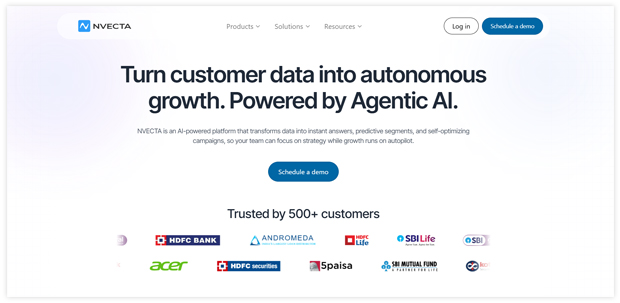
Nvecta is a leading Customer Data Platform (CDP), that seamlessly integrates customer data from different sources. Moreover, iour CDP allows businesses to create a unified profile for each customer, fostering a comprehensive understanding.
Utilizing our platform, businesses can enhance customer experiences by delivering personalized and relevant interactions.
Features
- Unified customer view
- Segmentation
- Journey Builder
- Funnel analysis
- AI-powered features
- Real-time data ingestion and processing
- Identity resolution
- Predictive analytics
Pros
- Seamless integration
- Comprehensive data collection
- Powerful segmentation
- Personalized messaging
- Automated workflows
- Scalability
2. Amperity
Amperity’s AI-driven platform provides a 360-degree view of customer profiles, serving as a unified hub for data intelligence, and offering AI-driven ID resolution and management.
While delivering excellent audience segmentation and predictive analytics, users may find the interface intricate, with limitations in campaign reporting.
Pros
- Easy-to-use audience segmentation
- Excellent predictive analytics
- Unlocks insights instantly
Cons
- Complicated interface
- Limited campaign reporting
3. Segment
Segment offers businesses the essential data foundation for becoming customer-centric brands. The platform enables the collection, consolidation, and utilization of customer data from diverse touchpoints, facilitating real-time decisions to elevate customer experiences.
Pros
- Easy integration with existing CRM
- Real-time data integration
- Standardization of data via a shared data dictionary
Cons
- Confusing onboarding process
- Requires insertion of code snippets for accurate results
How to Choose the Right Customer Data Platform for Your eCommerce Business
With dozens of CDP options available, selecting the right platform requires evaluating your business against five key criteria. The best eCommerce CDP is not necessarily the most feature-rich one — it is the one that solves your specific data challenges and integrates cleanly with your existing tech stack.
1. Identify Your Primary Use Case First
CDPs are not one-size-fits-all. Some are built primarily for marketers who need easy segmentation and campaign automation. Others are built for data engineering teams who need flexible pipelines and warehouse integrations. Before evaluating any vendor, define your core need: Is it cart abandonment recovery? Churn reduction? Personalised product recommendations? Unifying offline and online data? Your answer determines which CDP category fits best.
2. Prioritise Real-Time Data Activation
For eCommerce, timing is everything. A CDP that processes customer behaviour in batch mode — updating profiles every few hours — is too slow to recover an abandoned cart or trigger a browse abandonment email while the customer is still in buying mode. Look specifically for platforms that offer real-time event streaming and can trigger personalised responses within seconds of a customer action. This is especially critical for high-traffic brands during peak periods like sales events.
3. Evaluate Integration Depth With Your eCommerce Stack
Your CDP is only as useful as its ability to connect with the tools you already use. Before committing, map your current stack: eCommerce platform (Shopify, WooCommerce, Magento), email provider, SMS tool, ad platforms, analytics solution, and customer support software. A strong CDP should offer native integrations — not just Zapier connectors — with the core tools in your stack. Poor integration depth means manual data exports, delays, and inaccurate profiles that undermine the entire purpose of the platform.
4. Check AI and Predictive Capabilities
The most advanced eCommerce CDPs in 2025 go beyond data unification. They use machine learning to predict customer lifetime value, churn probability, next-best product, and discount affinity — letting you engage customers proactively rather than reactively. When evaluating platforms, ask vendors specifically about their predictive modelling capabilities and whether they require a dedicated data science team to operate, or whether marketers can use them directly without technical support. This distinction significantly affects the time-to-value of your investment.
5. Assess First-Party Data and Privacy Compliance
With third-party cookies being phased out globally, your eCommerce CDP must be built on a strong first-party data foundation. Verify that any platform you consider handles GDPR, CCPA, and other regional privacy regulations natively — treating consent as a data attribute that governs how customer data flows through the entire system. A CDP that requires manual compliance workarounds will create significant legal and operational risk as privacy regulations continue to tighten worldwide. This is not a secondary consideration: it should be a baseline requirement in your evaluation process.
Final Thoughts
Today’s customers are acutely aware of the fierce competition for their attention, and consequently, they expect more personalised experiences from organisations.
For a business to succeed in today’s competitive e-commerce landscape, it must embrace a CDP that enables it to capture customer data and use it to deliver personalised, omnichannel experiences.
Implementing an advanced customer data platform for eCommerce can help eliminate data silos and consolidate real-time data from all offline and online channels to create a single, trusted customer view. By integrating AI in Ecommerce, businesses can further enhance this process by using intelligent algorithms to analyse customer behaviour, personalise experiences, and make data-driven decisions that boost engagement and conversions.
Remember, every interaction with your customer is a potential opportunity to boost sales, but only if you have the right data and know how to use it.
Frequently Asked Questions: Customer Data Platform for eCommerce
What is an eCommerce customer data platform?
An eCommerce customer data platform (CDP) is software that collects, unifies, and activates customer data from every touchpoint in your online retail operation — including your website, mobile app, email campaigns, purchase history, loyalty programme, and customer service interactions. Unlike a CRM, which primarily manages sales relationships, or a DMP, which handles anonymous advertising data, an eCommerce CDP creates persistent, identified customer profiles that power real-time personalisation, cart recovery, product recommendations, and retention campaigns across all channels.
How does a customer data platform work for eCommerce?
A CDP for eCommerce works in three stages: first, it ingests data from all your customer touchpoints — web, app, CRM, email, ads, and offline channels like POS systems. Second, it uses identity resolution to stitch together data from the same customer across multiple devices and sessions into a single unified profile. Third, it activates those profiles by making them available to your marketing, personalisation, and analytics tools in real time — so you can trigger the right message, recommendation, or offer at exactly the right moment in the customer journey.
What is the difference between a CDP and a DMP for eCommerce?
A CDP stores identified, first-party customer data (names, emails, purchase history, behavioural data) and uses it to personalise experiences for known customers. A DMP primarily handles anonymised, third-party data used to build advertising audiences. For eCommerce brands, a CDP is almost always the more valuable investment: it powers retention, personalisation, and long-term customer value using data you own. DMPs are useful for scaling paid acquisition but their relevance is declining as third-party cookies are phased out globally. If you have to choose one, choose the CDP.
What are the key features to look for in an eCommerce CDP?
The most important features in an eCommerce customer data platform are:
(1) Real-time data ingestion — so customer profiles update instantly as behaviour changes;
(2) Identity resolution — to unify data from multiple devices and sessions into one profile;
(3) Behavioural segmentation — to group customers by purchase patterns, browsing history, and lifecycle stage;
(4) Predictive analytics — to forecast churn, lifetime value, and next-best product;
(5) Native integrations with your eCommerce platform, email tool, and ad channels; and
(6) Privacy compliance built in for GDPR and CCPA. Platforms like Nvecta , Amperity, and Segment cover most of these requirements at different price points and complexity levels.
How can a CDP help reduce cart abandonment in eCommerce?
A CDP reduces cart abandonment by enabling real-time, cross-channel recovery campaigns that are triggered the moment a customer leaves without purchasing. Because the CDP maintains a unified profile of each customer, it knows their preferred communication channel, purchase history, and discount sensitivity — enabling highly personalised recovery messages via email, SMS, or push notification within minutes of abandonment. Unlike basic email automation tools, a CDP-powered recovery campaign can suppress customers who have already purchased on another device, avoiding annoying irrelevant messages and improving overall conversion rates from abandoned sessions.
Is a customer data platform worth it for small eCommerce businesses?
For small eCommerce businesses, the value of a CDP depends on your current data volume and growth trajectory. If you are managing fewer than 10,000 customers and your data lives primarily in one platform (e.g., Shopify + Klaviyo), a full CDP may be premature — your email tool may handle basic personalisation adequately. However, if you are operating across multiple channels, experiencing high customer acquisition costs, or struggling to understand why customers churn, a CDP investment pays off quickly. Many modern CDPs — including Nvecta — offer scalable pricing, making it practical for growing eCommerce brands to start with core CDP features and expand as their data needs increase.
