













 Email
Email SMS
SMS Whatsapp
 Web Push
 App Push
 Audience Sync for Ads
 Popups
 Channel A/B Testing
  Control groups Analysis
 Frequency Capping
 Funnel Analysis
 Cohort Analysis
 RFM Analysis
 Signup Forms
 Surveys
 NPS
NPS Landing pages personalization
  Website A/B Testing
  PWA/TWA
 Heatmaps
 Session Recording
 Wix
Wix Shopify
 Magento
 Woocommerce
 eCommerce D2C
  Mutual Funds
 Insurance
 Lending
  Recipes
  Knowledgebase
 Developer Docs
 Product Updates
 App Marketplace
 Academy
 Ebooks
 Case Studies
 Blog
Blog Templates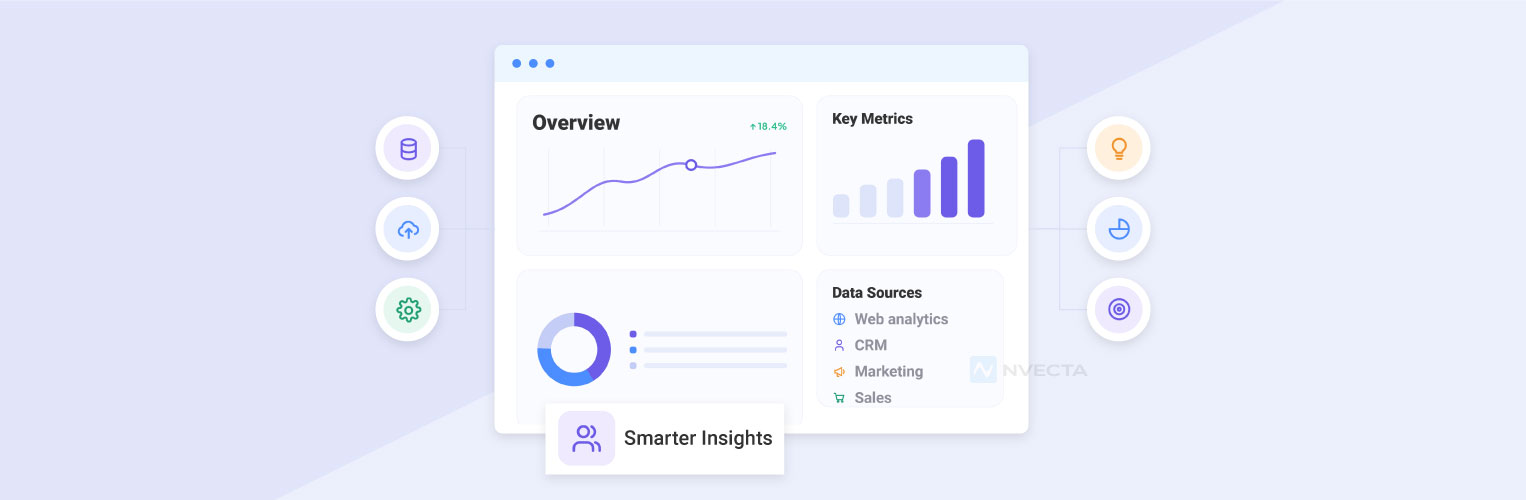
 Afreen Sheikh
Business decisions backed by data analytics actually deliver results. You launch new products, features, and campaigns aiming to engage your audience. Every initiative generates data. But looking at scattered data across disconnected tools reveals nothing on its own.
A data analytics platform systematically connects data to build a clearer picture of your customers, how they interact, what influenced their decisions, and which actions or campaigns actually created impact. NVECTA builds this connection directly into its customer data platform, so that picture updates in real time instead of coming through a report weeks later.
In this guide, we will cover-
- What a data analytics platform actually does and how it’s different from a CDP or a Business intelligence(BI) tool
- The core features and types of analytics every growing business needs
- Real-world use cases where analytics directly affect revenues
- How NVECTA approaches data analytics
Key Takeaways
- A data analytics platform collects, unifies, and analyses customer data from every touchpoint so teams can act on it in real time.
- Predictive analytics and identity resolution are what separate a basic reporting tool from one that actually drives growth.
- NVECTA brings behavioural analytics, funnel and cohort analysis, and AI-powered decisioning into one unified customer profile.
What Is a Data Analytics Platform
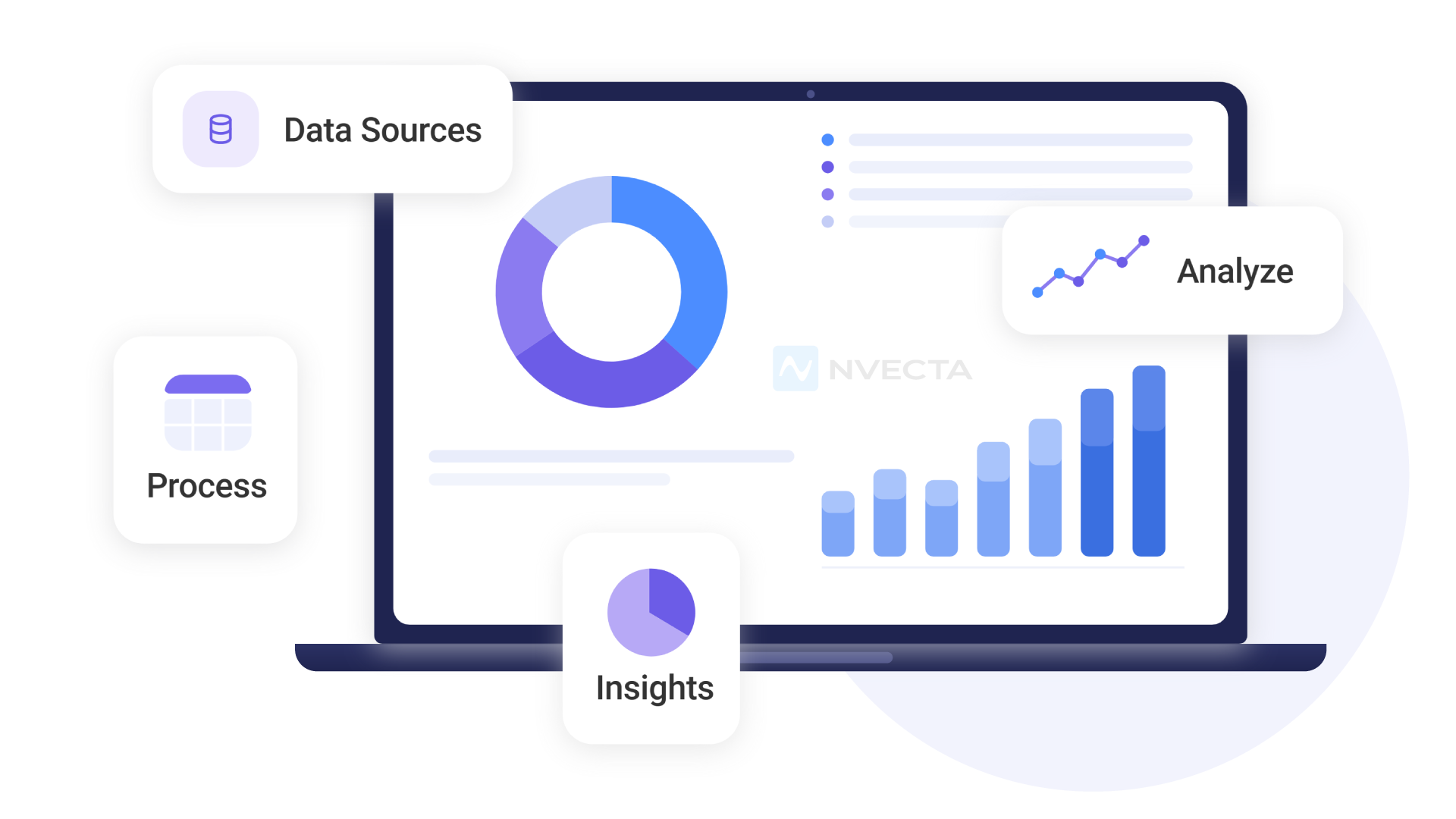
A data analytics platform is a software solution that collects, unifies, and analyses customer data from multiple sources, turning it into actionable insights that help business teams make better decisions.
It brings data from your websites, app, CRM, and support tools into one place, cleans the data by creating consistent user profiles, and continuously updates them with real-time user activity, such as clicks, visits, purchases, cart abandonment, signups, feature usage, etc.
Consider your website analytics living in one tool, your app events in another, and your CRM sitting somewhere entirely separate. Each one tells partial information. A data analytics platform is the layer that sits underneath all three and connects them to depict a fuller picture.
A good platform builds that picture step by step. First, it shows you what happened. Then it explains why. Most basic reporting tools stop right there. A real analytics platform keeps going and starts predicting what’s likely to happen next.
Why Businesses Need a Data Analytics Platform
Customer analytics shows the effect of customer interactions across the journey, so that decisions and strategies can be fixed as per current targets and set business goals.
With customer analytics in place, businesses can:
- See which journeys actually lead to stronger engagement
- Catch friction before it shows up as a lost sale or a support ticket
- Measure what a campaign, product update, or service change really did to behaviour
- Build segments from live behaviour instead of assumptions or guesswork
- Personalise experiences around what a customer actually wants next
- Spot early signs of disengagement before churn becomes final
- Put the budget behind what the data shows works, not what feels right
- Grow customer lifetime value by strengthening relationships that already exist
Without this, teams end up optimising one channel or campaign at a time, that too with no view of what optimisation does to the customer relationship as a whole. Customer analytics connects those pieces, so every team works off the same insights instead of five different ones.
Data Analytics Platform vs CDP vs BI Tool
A data analytics platform analyses data, a CDP unifies customer identity, and a BI tool only visualises data someone else has already collected.
| Capability | Data Analytics Platform | Customer Data Platform | BI Tool |
|---|---|---|---|
| Primary purpose | Uncover patterns and insights in customer and business data | Unify and activate customer data across channels | Visualise and monitor business performance |
| Core function | Behavioural analysis, predictive insights, decision support | Identity resolution, unified profiles, audience activation | Dashboards, KPI reporting, and historical analysis |
| Data collection | Multiple sources or existing data pipelines | First-party data from every touchpoint | Existing databases or data warehouses |
| Real-time processing | Supported by most modern platforms | Native | Varies by platform |
| Behavioural analytics | Core capability | Available in many modern CDPs | Limited |
| Predictive analytics and AI | Common capability | Growing in AI-driven CDPs | Limited or external |
| Best suited for | Understanding behaviour, improving decisions | Unified customer view, personalisation | Measuring performance, tracking KPIs |
A BI tool is built purely for reporting. Someone else collects and cleans the data first, and the tool turns it into charts. It rarely gathers data on its own, and it rarely acts on anything it finds.
A CDP works differently. Its whole reason for existing is to bring data in from every channel a customer touches and merge it into one accurate profile, so marketing and sales are looking at the same person instead of three fragmented versions of them.
A data analytics platform does more than traditional reporting; the data processing and insights support analysis, prediction, and action.
How a Data Analytics Platform Works
A data analytics platform runs in four stages. It collects data from every touchpoint, builds unified customer profiles, analyses behaviour in real time, and then activates that insight across the journey.
Collect Data From Every Customer Touchpoint
Every click, purchase, page view, and support ticket becomes an event the moment it happens, on your website, inside your app, or through a connected tool like your CRM.
Build Unified Customer Profiles
Raw data needs sorting. The same user can show up as anonymous, a subscriber, or a purchasing customer – a good platform resolves those three identities into one true profile rather than treating them as different.
Analyse Customer Behaviour in Real-Time
Funnels, cohorts, and behavioural trends come together here, catching patterns a normal spreadsheet would never reveal, and showing them as soon as they happen.
Activate Insights Across Journey
Insight drives value only when it triggers something real: a campaign, an alert, a message, as a customer shows intent to buy or engage.
Core Capabilities of a Data Analytics Platform
A data analytics platform needs real-time data capture, identity resolution, segmentation, behavioural tracking, and predictive scoring working as one system.
Real-Time Event Collection
Live event data updates into profiles the moment something happens on your site or app. This creates updated insights, which is what makes speedy decisions even possible in the first place.
Identity Resolution
A mobile browse session and a desktop purchase, made by the same person hours apart, get credited to one profile here rather than logged as two strangers who happened to buy the same product.
Customer Segmentation
Group customers by behavioural traits or journey stage to send targeted campaigns to the right audience.
Behavioural Analytics
Behavioural tracking shows how customers move through a product or journey, where engagement builds, where interest drops off, and which interactions tie to real outcomes like retention or revenue.
Predictive Analytics
Forecasts what a customer is likely to do before it happens, using patterns in past behaviour, so teams can act on churn risk or growth early.
Analytics Dashboards
An easy-to-read dashboard that brings customer behaviour and business performance into one clear view, so a marketer or product manager can act without waiting for delay or technical assistance.
Types of Analytics Every Business Should Know
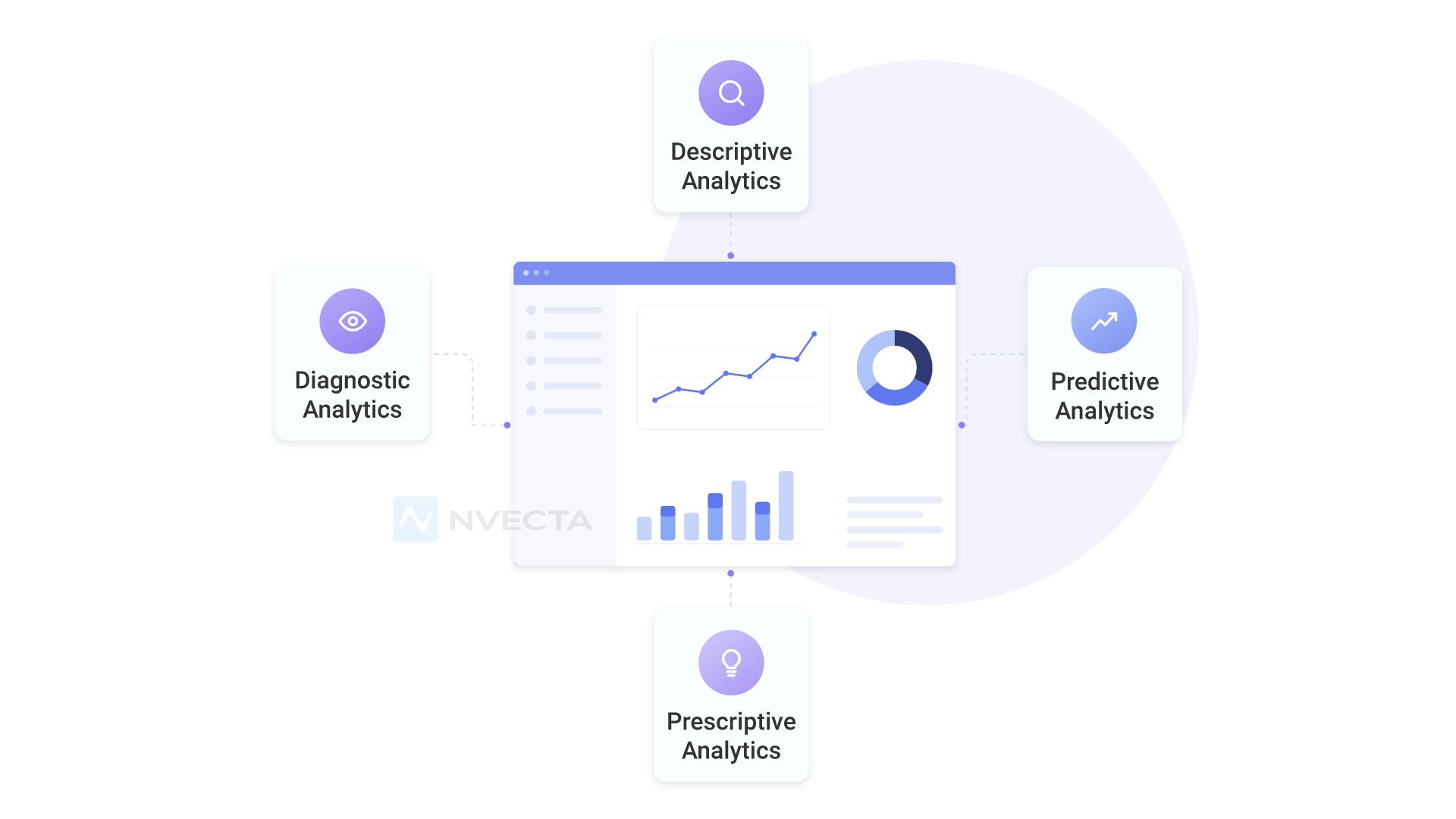
Every business should know these four types of analytics- descriptive, diagnostic, predictive, and prescriptive- and examine which one(s) they require, considering long-term and short-term business goals. Each type answers a completely different question.
Descriptive Analytics
This summarises what already happened using historical numbers, traffic, revenue, and usage over a set period. It’s backwards-looking by design, and still the necessary starting point before anything else makes sense.
Diagnostic Analytics
This finds the cause behind a descriptive number, cross-referencing campaigns, timing, and audience segments until the real driver behind a change becomes clearly visible.
Predictive Analytics
A customer with declining app usage is a churn risk long before they hit cancel. Predictive analytics points out churn risk early enough so that retention strategies can be initiated.
Prescriptive Analytics
This recommends the next-best action, like sending this customer a retention offer now or triggering a journey, etc., because the data points that way. Prescriptive analytics goes past prediction into an actual suggested move.
Business Use Cases for a Data Analytics Platform
A data analytics platform supports multiple business use cases. It supports acquisition, engagement, retention, and personalisation, which are important for almost every business -be it e-commerce, banking, media, etc.
E-commerce and Retail
- Deciding which abandoned carts get a recovery message, and which shopper is already gone.
- Comparing acquisition cost against repeat purchase rate, not just signups
- Catching a drop in purchase frequency among loyal customers before churn comes up
SaaS and Technology
- Linking feature usage to renewals, so onboarding pushes what actually retains users.
- Flagging login drops weeks before renewal, while there’s still time to act
- Spotting upsell-ready accounts from usage growth
BFSI: Banking, Financial Services, and Insurance
- Catching exactly where an application stops, while the customer is still reachable
- Scoring transaction patterns to find customers ready for a new product
- Flagging engagement drops is often the first sign before an account closes
Healthcare
- Cutting missed appointments with reminders based on real visit history, not a fixed schedule
- Point out care journey drop-offs, a missed follow-up, and an unopened test result.
Across all four, everything comes down to one question: which customers are worth the effort right now, and what does the data say about the right moment to reach them?
How to Choose the Right Data Analytics Platform
The right data analytics platform combines data collection, real-time event capturing, AI-driven analytics, easy integration, scalability, and more. Let us look at the key factors you should consider-
Real-Time Processing
Check for real-time data processing that captures and analyses live activity, the instant it’s generated, not batched and reviewed on a schedule.
Unified Customer Profiles
The platform should connect data from every customer touchpoint to build profiles and even resolve multiple customer identities into a single accurate identity.
AI and Predictive Analytics
Look for a platform with predictive insights, next best action recommendations, and AI-driven analytics that automate tasks and reduce manual work.
Journey Orchestration
This is what turns an insight into an automatic action, a message, an alert, a workflow, closing the distance between knowing something about a customer and doing something about it.
Easy Integration
Check whether the platform integrates easily with your existing infrastructure and whether data moves quickly with minimal obstruction.
Privacy and Governance
Consent tracking and role-based access have moved from optional features to compliance requirements, mandated under regulations like GDPR and India’s DPDP Act, and skipping them creates legal exposure on top of the operational risk.
Scalability
Look for flexible architecture that can support future business needs without major changes.
How NVECTA Supports Data Analytics
NVECTA is an AI-powered CDP that supports data analytics platform features like identity resolution, behavioural analytics, and AI decisioning, giving teams insight and action from the same system. That combination matters because every feature below draws from the same unified profile, so what shows up in a funnel report and what triggers an AI Agent are always looking at the same customer.
Unified Profile
Every touchpoint, from website visits to app sessions, purchases and support tickets, merges into a single customer profile, which creates a foundation for every other feature to function and operate accurately.
Behavioural Analytics
NVECTA’s behavioural analytics connects real-time product or site activity to actual outcomes, showing which specific interactions correlate with a customer renewing versus one who disappears after a single use.
Funnel Analysis
Funnel analysis maps each step of a customer journey and isolates the exact stage where people drop off, turning a vague conversion problem into one specific, fixable step.
Cohort Analysis
Cohort analysis groups customers by a shared starting point and follows how each group’s behaviour evolves over months, which is the only reliable way to separate a genuine retention improvement from a short-term spike.
RFM Analysis
RFM analysis scores every customer on recency, frequency, and monetary value, condensing months of behaviour into three numbers that separate who’s at risk of leaving from who’s ready for an upsell.
AI Co-Marketer and AI Agents
AI Agents take what the analysis finds and act on it without a person clicking a single button, routing a high-intent user into a retention journey or triggering a re-engagement message the moment churn signals appear.
NVECTA even supports journey orchestration, A/B testing and experimentation, Predictive analytics, segmentation, next best action recommendation, and privacy compliance to take data management to the next level, leading to measurable business growth.
Conclusion
Data analytics platforms are a present-day requirement for businesses looking to organise customer data and get value out of it. Start with defining goals -what do you want to achieve or improve?
A simple report just reveals what happened, but analytics goes further: why it happened, what is likely next, and what to do about it. Such a strategic approach changes how teams plan campaigns, fixes friction points, understands customers on a deeper level, finds churn at an early stage, etc.
NVECTA’s customer data analytics combine unified customer data, advanced insights, AI decisioning, and next-best-action to answer business questions that lead to steady, long-term growth.
Book a demo to see how NVECTA builds a smarter data analytics strategy for better decisions and results.
Frequently Asked Questions
What is a Data Analytics Platform?
It’s a system that collects customer data from multiple sources, unifies it, and turns it into insights teams can act on, often including predictive scoring and automated actions.
How Is a Data Analytics Platform Different From a Business Intelligence Tool?
A BI tool mainly visualises data that already exists elsewhere. A data analytics platform usually collects that data itself and can act on the insight, not just display it on a screen.
What Is the Difference Between a Data Analytics Platform and a Customer Data Platform?
A CDP unifies customer identity into one profile. A data analytics platform focuses on analysing that data once it’s there. Plenty of modern tools, NVECTA among them, do both at once.
What Features Should a Data Analytics Platform Include?
Real-time processing, identity resolution, segmentation, predictive scoring, and the ability to actually trigger something, not just show a chart and call it done.
Can a Data Analytics Platform Improve Customer Retention?
Yes, and often significantly. Flagging early churn signals through behavioural and RFM analysis lets teams act while a customer can still be won back, instead of analysing why they left once they’re already gone.
