














 Email
Email SMS
SMS Whatsapp
 Web Push
 App Push
 Audience Sync for Ads
 Popups
 Channel A/B Testing
  Control groups Analysis
 Frequency Capping
 Funnel Analysis
 Cohort Analysis
 RFM Analysis
 Signup Forms
 Surveys
 NPS
NPS Landing pages personalization
  Website A/B Testing
  PWA/TWA
 Heatmaps
 Session Recording
 Wix
Wix Shopify
 Magento
 Woocommerce
 eCommerce D2C
  Mutual Funds
 Insurance
 Lending
  Recipes
  Knowledgebase
 Developer Docs
 Product Updates
 App Marketplace
 Academy
 Ebooks
 Case Studies
 Blog
Blog Templates
 Afreen Sheikh
Businesses collect data daily through multiple touchpoints, but fail to connect them in time for engagement and retention. By the time they connect data to find friction points and causes, the moment to engage customers has already passed.
That’s the problem real-time analytics solves. Instead of waiting for someone to build a report, a real-time analytics platform collects and processes data as it happens- a click, a payment, a support call- so you can act on it while it’s still useful.
This guide covers:
- What is real-time analytics, and how it differs from traditional batch analytics
- How it works, use cases and what to check before you choose a platform
- How NVECTA enables real-time analytics
What Is Real-Time Analytics?
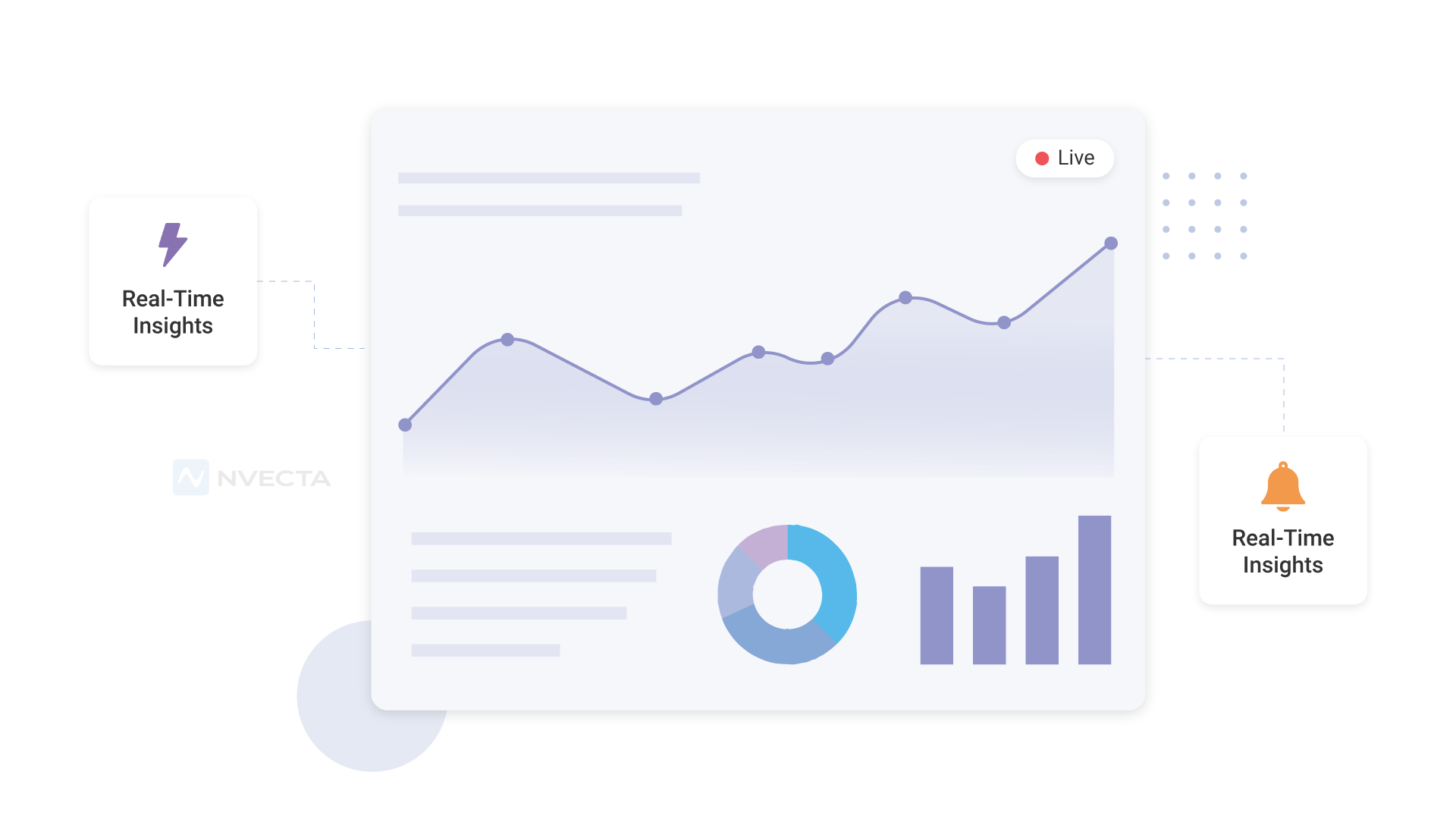
Real-time analytics uses tools to collect, process and analyse live customer data/events as soon as they are generated. This helps teams to implement quick, context-aware, data-driven decisions. For example, if a customer visits a product multiple times in a day, this event is processed so that a personalised email or message can be sent to encourage them.
What Counts as a Real-Time Data Event
Almost anything a user does can become an event. A page visit, a purchase, an abandoned cart, a login, a payment, a dropped call. Each event carries a timestamp the second it happens, and that’s what separates useful data from a pile of random activity with no order to it.
Real-Time Analytics vs Batch Analytics
Real-time analytics uses a continuous data processing approach for engaging users with an immediate action, whereas batch analytics collects data over a specific period of time, say, an hour, a week, or a month and processes it in large batches to give insights.
| Aspect | Real-Time Analytics | Batch Analytics |
| Processing | Processes data as it happens | Processes data at set intervals |
| Data | Uses the latest data | Uses stored data |
| Insights | Shows insights within seconds or minutes | Shows insights after processing |
| Decisions | Helps teams act right away | Helps teams plan future actions |
| Use Cases | Personalisation, alerts, fraud detection, live monitoring | Reports, trends, forecasting, performance analysis |
How Real-Time Analytics Works
Real-time analytics operates through these 4 steps: collect, process, unify, and activate.
Data Collection: Capturing Events as They Happen
Everything starts with capturing events as they occur, usually through gathering data from apps, websites, emails, and other systems.
The goal here is straightforward: catch the event the instant it happens.
Streaming and Processing
Once collected, an event flows through a live stream. A pipeline checks it and cleans it up right away.
This is the part most people picture when someone says real-time. It only holds up, though, if the collection and the steps after it move at the same speed.
Identity Resolution: Unifying Data Into One Customer Profile
A click from someone’s phone and a purchase made later from their laptop look like two unrelated events unless something ties them back together. That’s what identity resolution does.
It matches device IDs, login sessions, email addresses, and other signals to confirm they belong to the same person, then merges them into a single profile.
Activation: Turning Real-Time Data Into a Business Action
Activation is what converts a clean, unified event into something a team can actually use, updating a live dashboard, notifying a sales rep, or sending a message the instant a customer meets a specific condition.
Why Real-Time Analytics Matters for Businesses
Timing is really the whole reason real-time analytics matters. Engaging customers at the right moment before a competitor does gives you multiple advantages.
Real-Time Personalisation That Feels Relevant
A generic email that lands three days after someone browses a product feels out of touch by then. A relevant message sent while they’re still on the page feels helpful instead of pushy.
Quick Data-driven Decisions
Teams stop guessing which campaign actually worked or which feature quietly broke. They see it play out as it happens, so a bug gets fixed, a price gets adjusted, or a ticket gets routed before it is too late.
Real-Time Analytics Use Cases by Business Type
Real-time analytics are useful for multiple business types. What counts as a useful signal or event changes depending on what a business does and who it’s trying to reach. Here are a few specific real-time analytics real-world use cases-
Ecommerce and Retail
- A dropped cart gets flagged while the shopper is still on the site, not after they’ve already left.
- Pricing shifts with demand during a sale or a traffic spike
- Stock stays synced across channels, so nobody sells something that’s already gone
- A flash sale can run without triggering the refunds and complaints that come from overselling
SaaS and Product Teams
- Usage drops the moment a customer stops logging in, and that gets flagged right away.
- Repeated errors get caught before they push someone toward cancelling
- Support gets an actual window to step in, not a postmortem once the account is already gone
Fintech and Financial Services
- A stolen card gets flagged the moment it’s tested with a small purchase
- Odd transactions get stopped before the money actually moves
- The damage window shrinks from a full day to a few seconds
Marketing and Growth Teams
- Campaign performance shows up while the campaign is still running, not after the budget’s spent.
- Spend shifts on the same day instead of waiting for next quarter’s report
- Underperforming creative gets paused early instead of running to the end
Customer Support and Success Teams
- Account health gets tracked as it changes, not on a weekly pull
- A drop in logins works as an early warning sign, well before a cancellation request
- A ticket spike gets caught early enough for someone to actually step in
What to Look for in a Real-Time Analytics Platform
Two things decide the right platform for you: how fast your business needs to move, and how many data sources you’re connecting. Vendors use the words “real time” but fall behind, so check what they actually deliver before choosing a platform.
- Data latency and processing speed- ask how fast events actually reach the platform, in seconds or milliseconds.
- Integration and data source coverage- see that the platform connects with all the data sources and tools you use, like CRMs, payment or support tools.
- Identity resolution and match accuracy-A platform should resolve multiple customer identities to remove duplicate records.
The next four are easy to overlook during a demo, but they’re what actually determine whether the platform holds up once it’s live.
- Activation and workflow automation- Data shown through a dashboard doesn’t help anyone, so look for built-in alerts and links to the tools your teams already use.
- Security, compliance, and data governance- Real-time data processing handles sensitive data at scale. Check for strong data protection, access controls, and rules that fit your industry.
- Scalability for growing data volumes- Your data volume is going to grow with time, so confirm the platform can handle that without a full rebuild down the line.
- Transparent, usage-based pricing- Understand how cost scales with event volume before you sign.
How NVECTA enables Real-Time Analytics
NVECTA works as a customer data platform, so real-time analytics operate through the same pipeline that collects your customer data in the first place.
Real- Time Segmentation
Build smart customer segments based on live behaviour, browsing activity, purchase patterns, and demographic data.
Unified Customer Profiles
NVECTA brings together data from sources like CRM, apps, website, emails, etc, unifies and processes it to create one unique customer profile, while resolving identities that clear out duplicate records.
Real-Time Journey Orchestration
With real-time event capturing, a relevant journey gets triggered the moment they meet a condition, not on the next scheduled send.
Cross Channel Activation
A live signal can go out over email, SMS, WhatsApp, web push, or app push without exporting anything to a separate tool first. This maintains consistency while engaging customers.
Predictive and agentic AI
NVECTA uses predictive scoring for identifying churn and lifetime value. It has AI agents that can act on live data directly, adjusting a journey or triggering a campaign without waiting for someone to approve each step.
Live campaign optimisation
Channel A/B testing, control group analysis, and frequency capping all work against current performance data instead of obsolete reports.
Real-time reporting and insights
Funnel, cohort, and RFM analysis stay current as behaviour changes, rather than refreshing once a week.
Supports Multiple Business Models
NVECTA CDP works well for most of the business models, like ecommerce, SaaS, fintech, BFSI, healthcare, etc., through a single platform. For an ecommerce store, it can track cart activity, or for a SaaS product, it can track churn, all in real time.
Conclusion
With real-time analytics, teams can personalise user experiences, find problems at an earlier stage, and engage them at the right time with the right message over the right channel.
NVECTA works as a real-time analytics platform. With its standard data handling features backed by an intelligence layer and predictive engagement, businesses can move toward steady growth.
Connect customer events, intelligence, and activation in one platform. See how NVECTA turns real-time analytics into real-time action.
Frequently Asked Questions
What does the term real-time analytics actually mean?
It’s about accessing data at the time it happens, rather than some time afterwards in a report. The business can respond instantly to customers’ actions. For example, if a customer leaves the cart without buying, the system tracks this event and triggers a message with an offer, or sends an alert about the cart. This engages customers in time.
How do real-time analytics differ from real-time data?
Real-time data is the inputs that come in immediately without waiting. Real-time analytics is actually what happens when the input is processed and turned into insights that help teams to make decisions.
How quickly does the real-time data take to process?
Usually between milliseconds and a few seconds. If it’s several minutes or more, it’s nearer to near real time than real time.
Can Real-time analytics benefit small businesses?
Small businesses probably need it more. They can’t afford to lose a customer because of a slow response time that is slow. They need it as much as a large organisation.
What is the difference between real-time analytics and a customer data platform?
Real-time analytics works as a feature that processes live data instantly, so that an action is taken. A customer data platform is a broader system that gathers, unifies and works with data to generate useful insights. NVECTA is a customer data platform with real-time analytics capabilities that serves multiple business models.
