













 Email
Email SMS
SMS Whatsapp
 Web Push
 App Push
 Audience Sync for Ads
 Popups
 Channel A/B Testing
  Control groups Analysis
 Frequency Capping
 Funnel Analysis
 Cohort Analysis
 RFM Analysis
 Signup Forms
 Surveys
 NPS
NPS Landing pages personalization
  Website A/B Testing
  PWA/TWA
 Heatmaps
 Session Recording
 Wix
Wix Shopify
 Magento
 Woocommerce
 eCommerce D2C
  Mutual Funds
 Insurance
 Lending
  Recipes
  Knowledgebase
 Developer Docs
 Product Updates
 App Marketplace
 Academy
 Ebooks
 Case Studies
 Blog
Blog Templates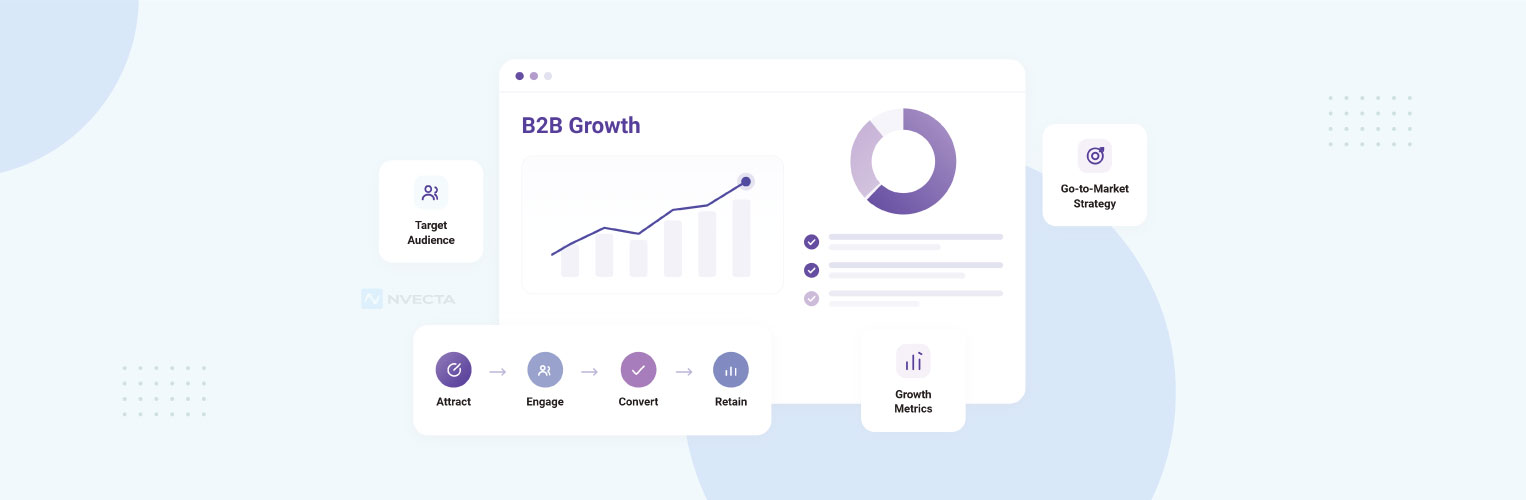
 Afreen Sheikh
Getting the signup is the easy part. Whether that person is still paying in month six is the number that decides everything, and it’s where most SaaS marketing falls apart. A SaaS marketing strategy has to win the first payment and then keep winning it, so acquisition and retention can’t sit with two teams that hand off at the point of sale.
There’s nothing physical to hand over either. You’re selling access that the customer re-approves every month, which pulls onboarding emails, in-app prompts, and noticing when an account has gone quiet into marketing’s job description. That’s also why churn belongs on your dashboard next to CAC instead of being filed away as a product problem.
In this blog, we will cover:
- What SaaS marketing means and why it works differently from traditional B2B marketing
- Where SaaS customers drop off, and how the journey runs from first click to renewal
- How to build your own strategy, step by step
- Proven SaaS marketing strategies relevant in the context of acquisition, retention and growth
- And finally, how NVECTA CDP support SaaS businesses for better marketing
What is SaaS Marketing?
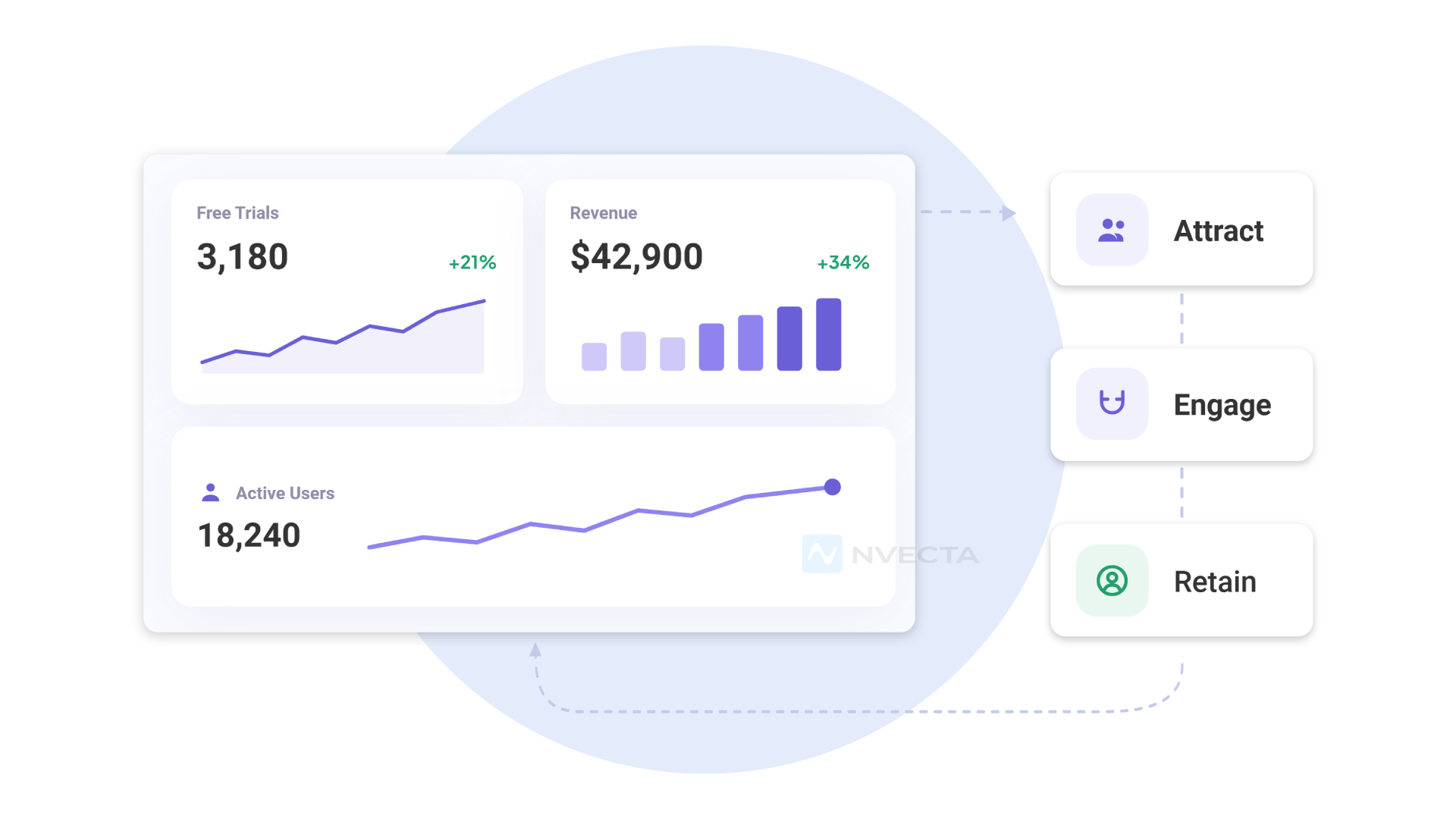
Software as a Service (SaaS) marketing works for subscription-based, cloud-based software. It does not have a product that you can show and sell. It involves giving free trials and demos that users can avail themselves of to find whether the product actually delivers value or not.
This changes the way marketing works. For example, a customer can cancel next month if the product stops delivering value. That means customer lifetime value, not the first sale, is what really counts.
In a B2B setting, this changes everything. Pricing pages, onboarding emails, and even product updates become marketing moments. Every touchpoint builds users’ trust and is a foundation for a long-term relationship.
In simple terms, SaaS marketing is about promoting a software product across multiple channels using strategies that attract, engage, and retain users systematically. Businesses can also use SaaS AI Tools to streamline marketing activities, personalize customer interactions, analyze user behavior, and improve campaign performance. This builds a relationship that leads to enhanced customer lifetime value, revenue, and supports steady business growth.
What Makes SaaS Marketing Different?
SaaS marketing is different from traditional B2B marketing as the selling or promotion part never really ends. You’re not closing one deal; you’re earning a renewal every single month, and that changes how you plan every campaign.
A few specific factors make this shift real. Here’s what sets SaaS marketing different from product marketing:
- There’s no physical product that you can give away for money. Marketers have to make something abstract, like automation or data syncing, feel real and useful.
- Pricing is usually multi-layered by the number of users or usage.
- Buyers compare you against competitors the whole time they’re deciding. The messaging or content needs to stay sharp and current.
- A single deal often involves a buying committee. The finance lead, the end user, and the technical evaluator all need different messages.
- Product-led and inbound strategies cast a wide net. You’re seeking many types of users.
- Revenue depends on renewals and lead conversions, so churn becomes a marketing metric now.
What Stages Does a SaaS Customer Journey Follow?
The SaaS customer journey involves these five stages: awareness, evaluation, activation, adoption, and expansion. Each stage gathers its own set of customer data that shows how ready a customer is to move to the next stage.
Awareness
This is the very first moment users become aware of your software product’s existence. It could be through a blog post, a search result, or a recommendation by a colleague.
Evaluation
This stage is where interest turns into real intent, and it shows up through action. A trial signup, a demo request, or repeated visits to your pricing page are all signs of real intent from the user who is evaluating your product.
Activation
Activation is the point where a user experiences your product’s main value. It could be a page visit, seeing the resources, or a login as well. Such data or a behavioural milestone is the strongest predictor of whether a user is likely to convert and stay engaged.
For example, in a project management tool, a user created a task and invited a teammate. This can be called activation, as there is some level of progression in user engagement.
For teams using consulting project management software, activation could also involve creating a client project, assigning tasks, or inviting team members to collaborate.
Adoption
Adoption is when the product becomes part of a user’s routine, not a one-time experiment. It shows up in frequency: a team that logs in daily to check dashboards behaves differently from the ones that log in once a month.
Expansion
This is where a customer’s relationship with your product advances towards upgrades, renewals, or referrals. An account that reaches a usage limit becomes a natural user for upsell opportunities. A loyal user is the best source of referrals. They are more likely to recommend your product to others.
How to Build a SaaS Marketing Strategy? Step-by-Step
A SaaS marketing strategy involves a structured approach that drives revenue. Here, you need to find the right audience for the product, your core value that will be a part of messaging, pricing and the preferred channels, a feedback mechanism and, most importantly, aligning the operations of every team toward one direction. Let’s see the important steps that businesses need to consider while building an effective SaaS marketing strategy-
Define Your Ideal Audiences
Conduct extensive market research to find audiences that are actually interested in your product. Use engagement data and usage activity to target audiences. You can segment audiences based on industry, size, location, etc. For example, a segment of accounts that activate fast.
Craft a Single Core Value Proposition
Convey a clear value proposition to target audiences. Your product can have multiple features, but you don’t need to propose all at once. Find what sets your SaaS product apart and how it is valuable to target users. Build your digital presence and messaging around that value, which brings in trust and credibility.
Turn That Value Into Clear Messaging
Create clear and engaging messages/content. It should convey what your product does and what your audience is actually seeking. Design it to give a solution to a real problem they face. Sharp saas branding strategies matter here because competing products have largely converged on the same baseline features.
Align Your Sales Approach and Pricing
Your pricing model and your sales approach need to work together, not separately. Sales needs to know how to explain value and handle pushback, while pricing needs to reflect what your market is willing to pay.
Select channels to Market your Product
Reach your audiences on their preferred channels. Also, decide the appropriate distribution mode that suits your product. Channels include email marketing, SMS, push notifications, digital content, ads, social media, etc.
Distribution mode includes a self-service sign-up model, a guided sales process, or a combination of both.
The right choice depends on your product complexity and user preferences. For example, a technically advanced product could be better marketed by the sales team instead of a self- service model.
Build a Real Customer Acquisition Path
Build your acquisition path; it guides users towards a decision. Nurture people with relevant content and consistent follow-up. Do not get stuck on capturing leads with the hope that users will come back on their own.
Design Onboarding Experience
The first experience someone has with your product shapes whether they stay. A thoughtful onboarding process removes confusion early and helps someone reach real value fast.
Create a Loop for Customer Feedback
Build a system that supports easy feedback collection directly from customers, through conversations, surveys, or how they use your product. Customer support can play an important role here, as support conversations often reveal recurring customer concerns, product gaps, and opportunities to improve the overall customer experience.
For SaaS businesses, this also means investing in the customer experience after acquisition, including responsive and effective customer support that helps users get value from the product and stay engaged over time. A strong customer support strategy can therefore become an important part of SaaS retention.
Get Teams to Work in the Same Direction
Bring marketing, sales, product, and support teams to follow a consistent strategy. Shared goals and open communication keep every team focused on the same outcome, so a customer gets a consistent experience no matter who they connect with.
SaaS Marketing Strategies for Acquisition, Retention, and Growth
Now that we know how to build a CDP strategy, let us explore SaaS marketing strategies. Find the right set of strategies that support your goals and implement them with Customer data platforms.
Behavioural Segmentation
Build live segments that update automatically as customer behaviour shifts while using your product. Group accounts by feature adoption, login frequency, or plan tier, and every segment refreshes itself.
Real-Time Personalisation
AI-driven personalisation means your onboarding email, your in-app message, and your homepage banner all reflect what a specific user actually does. Someone exploring your reporting feature sees content about reporting. Someone stuck on setup sees a help prompt.
Predictive Churn Scoring
Engagement drops gradually before a customer actually leaves or cancels. AI-powered churn scoring identifies those accounts at an earlier stage, such as fewer logins or low feature usage. That early warning gives your team time to step in.
B2B Lead Scoring and Sales Handoff
Sales teams waste hours chasing leads that were never ready. A CDP uses lead scoring models to score accounts on real-time user activity, so you can find accounts that are most likely to convert and are worth engaging with strategies.
Usage-Triggered Onboarding
A fixed email schedule treats every user the same, even though no two signups behave the same way. Usage-triggered onboarding sends the next step based on what a user actually did, not what day it is.
Lifecycle Email Automation
Generic drip campaigns feel like spam, because they usually are. Lifecycle automation built on first-party data sends emails triggered by real events, such as a feature being used for the first time, a plan nearing its limit, and a trial about to expire.
Cross-Channel Retargeting
Stale audience lists waste ad spend, as you end up retargeting users who have already converted or churned. Syncing live, unified segments to your ad platforms keeps retargeting accurate.
Usage-Based Expansion Triggers
The easiest upsell conversation starts with a clear sign that the customer needs more. If an account reaches its seat limit, uses a feature heavily, or adds more users, that behaviour signals expansion potential. Sales can act on that signal with a relevant offer.
How do you Evaluate SaaS Marketing Success?
SaaS marketing success comes down to a handful of numbers that actually predict revenue, not vanity traffic and lead counts. Track these consistently, and you’ll know if your strategy is working long before a quarterly report tells you.
- Customer Acquisition Cost (CAC)- What it costs you to win one paying customer, across every channel combined.
- CAC Payback Period- How long it takes for a customer’s revenue to cover what you spent acquiring them.
- Trial to Paid Conversion Rate- The share of signups who turn into paying customers.
- Activation Rate- How many new users reach real product value, not just create an account.
- Net Revenue Retention (NRR)- Whether your existing customers are spending more or drifting toward the exit.
- Churn Rate- How fast you’re losing customers, and the clearest early sign your retention needs fixing.
- Customer Lifetime Value (CLV)– What a customer is worth across their whole relationship with you, not just the first payment.
- Multi-Touch Attribution- Which touchpoints genuinely deserve credit for a closed deal(conversion).
Implement SaaS Marketing Strategies with NVECTA.
NVECTA is an AI-powered customer data platform, equipped to support SaaS marketing. It uses first-party data from every tool a business utilises to create one customer profile, update it with real-time activity, generate insights and then use that data for segmentation, personalisation, and retention campaigns. It even provides AI decisioning, predictive analytics, and Agentic AI features.
Here is how NVECTA enables SaaS marketing strategies-
Unified customer profiles
NVECTA merges behavioural, product, and firmographic data from every connected tool into a single, first-party customer view.
Consistent Omnichannel Messaging
A customer sees the same message whether they’re on your website, in an email, or talking to a sales rep, since every channel operates from the same customer profile.
Live Behavioural Segmentation
Segments update automatically as usage changes, so your campaigns always target the right group.
AI Churn Scoring
NVECTA spots at-risk accounts based on engagement drops, giving your team time to act before a cancellation happens.
Real-Time Personalisation
With NVECTA, your website content, in-app messages, and email, etc all adjust based on real-time user activity.
B2B Lead Scoring Model
NVECTA uses a predictive lead scoring model that assigns scores to core actions relevant for conversions. Marketing and sales teams access the same scored account list. This eliminates manual efforts so as to target users who are actually interested and ready to convert.
Usage-Triggered Journeys
Onboarding, adoption, and expansion campaigns get triggered based on real product usage, so that the experience at every journey stays relevant.
Cross-Channel Segment Sync
Push live segments straight to your ad platforms and email tools, keeping retargeting and outreach accurate at all times.
Revenue-Focused Dashboards
Track CAC, net revenue retention, and activation rate in one place, tied back to the same customer data powering your campaigns.
Next Best Action
NVECTA doesn’t just show you what happened; it recommends the next best action: a specific email, a discount, a sales call, based on each account’s real behaviour. Marketers act on a recommendation to get better results.
Autonomous Agentic Marketing
NVECTA lets AI agents take action on their own, sending a retention email or flagging a sales rep without a marketer clicking a button.
AI Co-Pilot
NVECTA AI Co-Pilot takes natural language inputs to give the required result. It even automates tasks assigned- build segments, launch campaigns, create journeys, and perform marketing actions with ease.
Conclusion
A strong SaaS marketing strategy isn’t built on more tactics. It’s built on knowing your customer well enough that every campaign feels like it was made for them, because it was.
NVECTA makes that possible by giving your team one place to see the full customer story, then turning that story into segments, personalised campaigns, and timely nudges that actually move revenue.
Activate SaaS marketing strategies with NVECTA CDP and see improvements in acquisition, retention, and your overall business growth.
Frequently Asked Questions
What is a SaaS marketing strategy?
It’s a complete plan a SaaS business relies on to acquire, retain, and grow its users over time. The strategy connects messaging, channels, and user data to achieve goals, like signups, renewals, and add-ons.
How do you create a SaaS marketing strategy?
Start with real data to find audiences, pick one clear value proposition, craft messaging, choose a market that fits your price, then set KPIs connected to revenue.
How do you measure SaaS marketing success?
The four key metrics – CAC, CAC payback, net revenue retention, and churn rate – are essential for assessing the success of a SaaS business. These show the real performance of strategies, and you get to know things long before revenues are affected.
How is AI changing SaaS marketing in 2026?
AI now reacts to customer signals faster than any team evaluating a dashboard. Churn scoring flags risk early. Personalisation adjusts in real time. Lead scoring tells sales exactly who to reach out to. NVECTA builds all three directly into one platform, so nothing relies on guesswork and assumptions.
