














 Email
Email SMS
SMS Whatsapp
 Web Push
 App Push
 Audience Sync for Ads
 Popups
 Channel A/B Testing
  Control groups Analysis
 Frequency Capping
 Funnel Analysis
 Cohort Analysis
 RFM Analysis
 Signup Forms
 Surveys
 NPS
NPS Landing pages personalization
  Website A/B Testing
  PWA/TWA
 Heatmaps
 Session Recording
 Wix
Wix Shopify
 Magento
 Woocommerce
 eCommerce D2C
  Mutual Funds
 Insurance
 Lending
  Recipes
  Knowledgebase
 Developer Docs
 Product Updates
 App Marketplace
 Academy
 Ebooks
 Case Studies
 Blog
Blog Templates
 Shivani Goyal
You spent months, maybe years, convincing stakeholders to invest in a Customer Data Platform. You went through the vendor demos, the security reviews, the implementation sprints. You were promised a single view of the customer, smarter marketing, better personalisation.
So why does it feel like nothing has really changed?
If your CDP is sitting half-used, your teams are working around it instead of with it, and the ROI conversation makes you uncomfortable, you’re not alone.
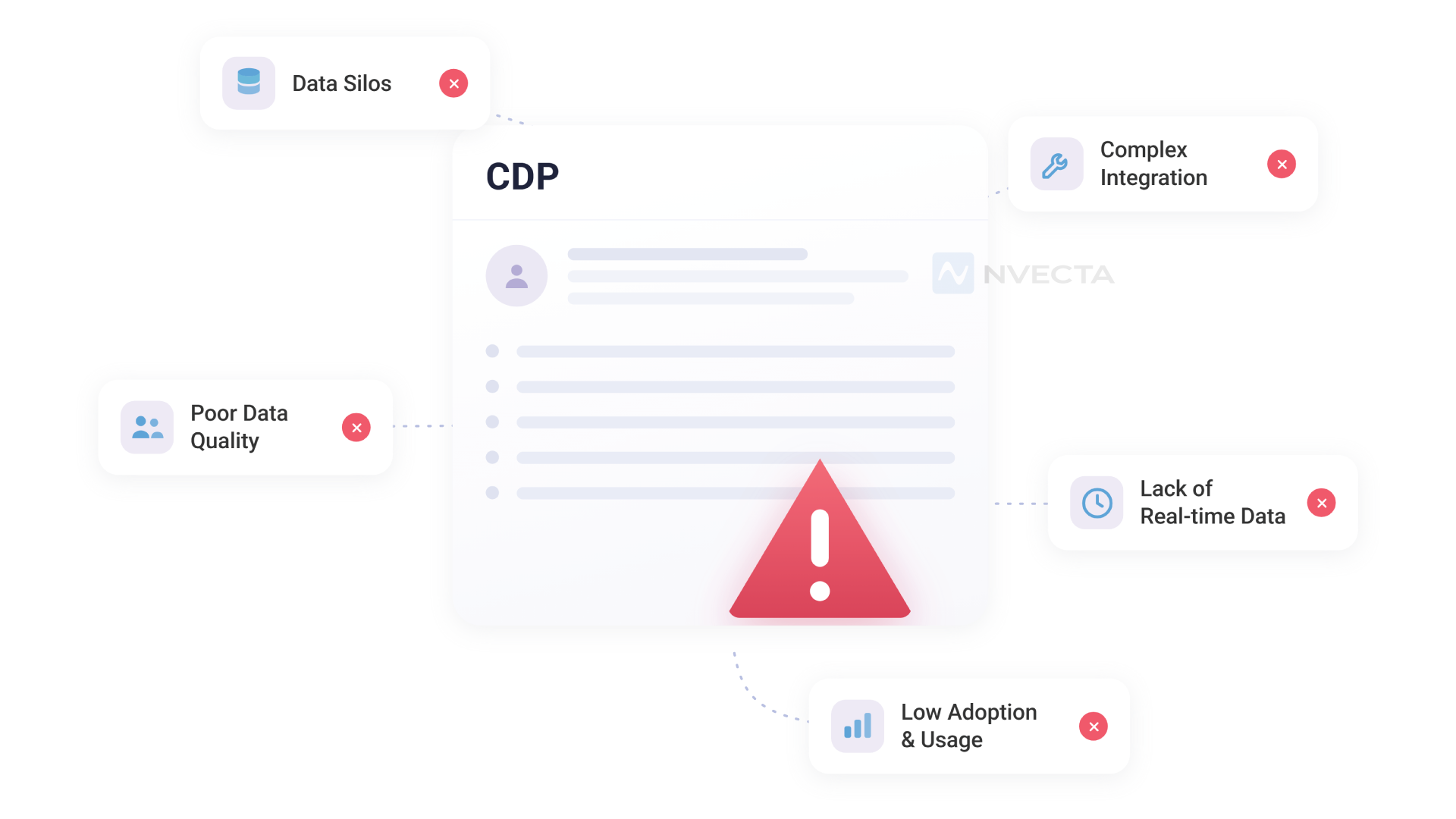
This is one of the most common and least talked-about problems in modern marketing technology. And it’s exactly why your CDP is failing, not because the technology is broken, but because the approach around it is.
At NVECTA, we’ve seen this pattern more times than we can count. We work with organisations who have invested heavily in their CDP and are still waiting for it to deliver. The good news: it’s almost never the technology’s fault. And that means it’s fixable.
Why your CDP is Failing: the Real Reasons Nobody Talks About
1. You Bought the Tool Before You Had the Strategy
This is the number one reason CDPs fail, and it’s incredibly common.
A vendor makes a compelling case. A competitor announces they’ve implemented one. Leadership gets excited.
The purchase gets approved. And somewhere in all of that, nobody stopped to answer the most important question: what specific problem are we solving?
Without a clear answer, the CDP becomes a very expensive place to store data that nobody uses.
What to do: Write down three concrete use cases you want to activate in the next 90 days. Not vague goals like “better personalisation” but actual use cases, like suppressing existing customers from paid acquisition campaigns or triggering a re-engagement email when a high-value customer goes 60 days without a purchase. Let these scenarios, grounded in your customer engagement metrics, shape how you use and evolve your existing content.
2. Dirty data went in, and now it’s just organised dirty data
A CDP can unify your data. It cannot clean it.
If your CRM, website, and e-commerce platform all identify customers differently, with different ID formats, inconsistent email fields, and duplicate records,
Your CDP will faithfully consolidate all of that confusion into one place. You won’t have a single customer view. You’ll have a single view of your data problems.
What to do: Before you expand your CDP’s scope, run a data quality audit focused specifically on identity resolution.
How does your business recognise the same person across different systems and touchpoints? Fix that foundation first. Everything downstream depends on it.
3. Nobody Actually Owns it
CDPs live in an uncomfortable middle ground between marketing, IT, and data teams. Marketing wants to use it but doesn’t control it.
IT manages it but doesn’t understand the use cases. Data teams are stretched thin and have other priorities.
The result? Everyone assumes someone else is responsible for making it work. And quietly, nothing gets done.
What to do: Appoint a CDP owner. Not a committee, a person. Someone whose job includes driving adoption, educating teams, maintaining the roadmap, and connecting business needs to platform capability. It doesn’t have to be full-time, but it has to be genuinely someone’s responsibility.
4. You’re Collecting Data but not Activating It
A CDP that isn’t connected to your channels is just a database with a better interface.
Collecting behavioural data, building audience segments, creating unified profiles, all of that is only valuable if it flows into the places where you actually talk to customers: your email platform, your ad networks, your website personalisation engine, your sales CRM.
If your data is sitting in the CDP with nowhere to go, you’ve built a very sophisticated dead end.
What to do: Map every audience segment you can build to the channel where it gets used. If you can’t answer that question for a segment, it shouldn’t exist yet. Activation is not a feature to add later. It’s the entire point.
5. You Tried to do Everything at Once
CDP vendors sell you the full vision upfront: real-time personalisation, predictive lead scoring, AI-driven journeys, cross-channel suppression, identity graphs across the entire customer journey. It’s genuinely exciting. And it’s a trap.
Teams that chase all of it simultaneously usually end up with none of it working properly. The implementation stretches on. Stakeholders lose patience. The project quietly gets deprioritised.
Bringing in a Salesforce consulting partner to lead the most ambitious workstreams keeps the rollout from sprawling, since external ownership of one or two streams frees the internal team to focus on the quick wins that build momentum.
What to do: Start with one use case. Make it work. Measure the result. Share the win internally. Then expand. This approach sounds too simple to be the answer, but it is. Momentum matters more than ambition in the early stages of a CDP rollout.
6. Your Business Teams don’t Trust the Data
This one often goes unsaid, but it kills adoption more quietly than anything else.
If a marketing manager doesn’t trust the audience size shown by the CDP, they’ll export a list from the old system instead.
If a campaign manager isn’t sure where a customer attribute is coming from, they’ll ignore it. If nobody understands how a segment is built, nobody will stake a campaign on it.
Trust doesn’t come from the platform. It comes from transparency.
What to do: Make the logic visible. Document how audiences are built. Let business users spot-check customer profiles.
When something looks wrong, investigate it openly and fix it publicly. Every small act of transparency compounds into organisational trust over time.
If any of these sound familiar, you’re not alone. Here’s a quick summary of what’s going wrong and where to start:
| Reason | Root cause | Quick fix |
|---|---|---|
| No strategy before buying | Tool before the problem | Define 3 use cases in 90 days |
| Dirty data | Bad inputs unified | Run an identity resolution audit |
| No ownership | Responsibility gap | Appoint a single CDP owner |
| Data not activated | No channel connections | Map every segment to a channel |
| Trying to do everything | Scope creep | Start with one use case |
| Teams don’t trust the data | Lack of transparency | Make segment logic visible |
What it Looks Like When a CDP Actually Works
When a CDP is working, you’ll notice it in the behaviour of your teams, not just in your dashboards.
Business users are requesting new audience segments. Campaigns are being personalised with real signals, not just demographic guesses.
Customer profiles feel accurate enough that people actually refer to them. Someone is actively managing a CDP roadmap based on what the business needs next.
It doesn’t need to be perfect. It just needs to be genuinely useful and getting more useful over time.
How NVECTA Helps you Get There
Every problem outlined in this post is solvable. But solving them requires a clear head, the right expertise, and someone who has done it before.
That’s what NVECTA brings to the table.
We don’t just implement CDPs. We help organisations figure out why their CDP is failing, and then we build the strategy, the data foundations, the governance, and the activation framework to make it work.
Whether you’re six months into a rollout that has stalled, or two years in and still waiting for results, we start from where you are and build forward.
Here’s how we typically work with teams facing these challenges.
We start by understanding what you were trying to achieve and where things broke down. Not to assign blame, but to find the fastest path to value.
We then identify one or two use cases that can work with the data you already have, and we help you execute them completely, from data to decision to channel.
We put the right ownership structure in place, so there’s always someone accountable for moving things forward. And we build trust with your business teams by making the logic transparent and the results visible.
The investment in your CDP is already made. The question is whether you’re going to get a return on it.
And the answer to that question has almost nothing to do with the technology and everything to do with how your organisation decides to use it.
NVECTA exists to make sure that part goes right.
Ready to find out exactly why your CDP is failing and what it will take to fix it? Talk to the NVECTA team and let’s build a path forward together.
FAQ
Why do most CDPs fail?
Most CDPs don’t fail because the software is broken. They fail because the tool got bought before anyone defined the problem it was meant to solve. Add dirty data, no clear owner, and data that never gets activated into real channels, and you end up with an expensive database nobody uses.
Is it the technology’s fault or my strategy’s?
Almost always the strategy and the operating model around it, not the platform. A CDP unifies data, but it can’t clean bad data, decide your use cases, or drive its own adoption. Those are organisational jobs. Fix those and the same “broken” CDP usually starts working.
How do I know if my CDP is actually failing?
A few honest signals: your team exports lists from the old system instead of trusting the CDP, segments get built but never reach a live channel, nobody can explain how an audience was created, and the ROI question makes everyone in the room uncomfortable. If two or more of those sound familiar, it’s stalled.
Can a CDP fix my messy customer data?
No, and this trips up a lot of teams. A CDP consolidates whatever you feed it. If your CRM, website, and e-commerce platform all identify customers differently, you’ll get one tidy view of your data problems. Sort out identity resolution first, then expand the platform’s scope.
Who should own the CDP — marketing or IT?
One named person, not a committee. CDPs sit between marketing, IT, and data teams, so everyone assumes someone else is responsible and nothing moves. The owner drives adoption, keeps the roadmap, and connects business needs to platform capability. It doesn’t have to be full-time, but it has to be someone’s actual job.
How long before a CDP shows ROI?
The first 60 to 90 days usually go into data integration and identity resolution, which produce no visible campaign wins, so expecting revenue from day one sets you up for disappointment. Most organisations see initial ROI within three to six months, with the fastest returns from reduced ad waste and operational efficiency. Full payback for many firms lands in the first 12 to 18 months.
Should I replace my CDP or fix the one I have?
Usually fix it first. Replatforming is expensive and often repeats the same mistakes with a new logo. Before switching, check whether the real issue is strategy, data quality, ownership, or activation, because a new tool won’t solve any of those. Replace only if the platform genuinely can’t support your data or use cases.
Is a CDP worth it for a small business?
Not always. For businesses with fewer than around 50,000 customers, limited data sources, or a single channel, a well-configured CRM or marketing automation tool often does the job without the cost and complexity. A CDP earns its place when you’ve got genuinely fragmented data across multiple channels.
