














 Email
Email SMS
SMS Whatsapp
 Web Push
 App Push
 Audience Sync for Ads
 Popups
 Channel A/B Testing
  Control groups Analysis
 Frequency Capping
 Funnel Analysis
 Cohort Analysis
 RFM Analysis
 Signup Forms
 Surveys
 NPS
NPS Landing pages personalization
  Website A/B Testing
  PWA/TWA
 Heatmaps
 Session Recording
 Wix
Wix Shopify
 Magento
 Woocommerce
 eCommerce D2C
  Mutual Funds
 Insurance
 Lending
  Recipes
  Knowledgebase
 Developer Docs
 Product Updates
 App Marketplace
 Academy
 Ebooks
 Case Studies
 Blog
Blog Templates
 Aparupa Saha
Quick answer: E-commerce brands use CDPs to drive repeat purchases by unifying scattered customer data into one profile, then triggering personalized campaigns at the right lifecycle moment. Brands doing this well report 2-3x email revenue per recipient and 10-20% lower acquisition costs through suppression. The full 5-stage playbook with real numbers is below.
Most e-commerce growth conversations are still about acquisition. Paid media, influencer partnerships, promotions, all chasing first-time buyers. Acquisition still matters, but it has gotten expensive and unpredictable in ways that make it harder to scale profitably. Auction prices keep climbing, ad platforms keep changing the rules, and shorter attention spans make every dollar work harder than it used to.
Meanwhile, the easier growth lever is sitting right there in your existing customer base. Acquiring a new customer costs roughly seven times more than retaining one. A 5% bump in retention rate can lift profits anywhere from 25% to 95% depending on the category. These aren’t new stats, but most ecommerce teams still spend 80% of their budget on acquisition and 20% on retention. Their P&L should look exactly the opposite.
Driving repeat purchases isn’t about sending more emails. It’s about understanding each customer well enough to know what they need next and when. That requires real data infrastructure, which is where Customer Data Platforms (CDPs) come in. This article walks through how e-commerce brands actually use CDPs to drive repeat purchases, with real brand examples and the lifecycle framework that ties it all together.
Why Repeat Purchases Are the Right Place to Focus
The math is brutal. If your average customer makes one purchase and never returns, you’re effectively renting customers from Meta and Google. Every cohort needs to be reacquired through paid channels, margins thin out, and any platform price hike or algorithm change hits revenue immediately. Brands that compete on acquisition alone are running on a treadmill that keeps getting faster.
Repeat customers fix this by changing the math. They convert at higher rates because they already trust the brand. The average order value is higher too, since the discovery friction is gone. Reaching them costs almost nothing compared to first-time buyers, since email and SMS replace paid acquisition. And they’re far more receptive to cross-sell offers, more likely to engage with email and SMS, and more likely to recommend the brand to others.
So why do most ecommerce brands underinvest in retention? Honestly, the issue isn’t usually missing data. Most brands collect plenty of it across their store, email tool, SMS provider, ad platforms, support system, and analytics stack. The real problem is that the data lives in five or six disconnected tools, each with its own version of the customer. Without a way to stitch those together, you can’t actually act on what you know.
What a CDP Actually Does for Ecommerce
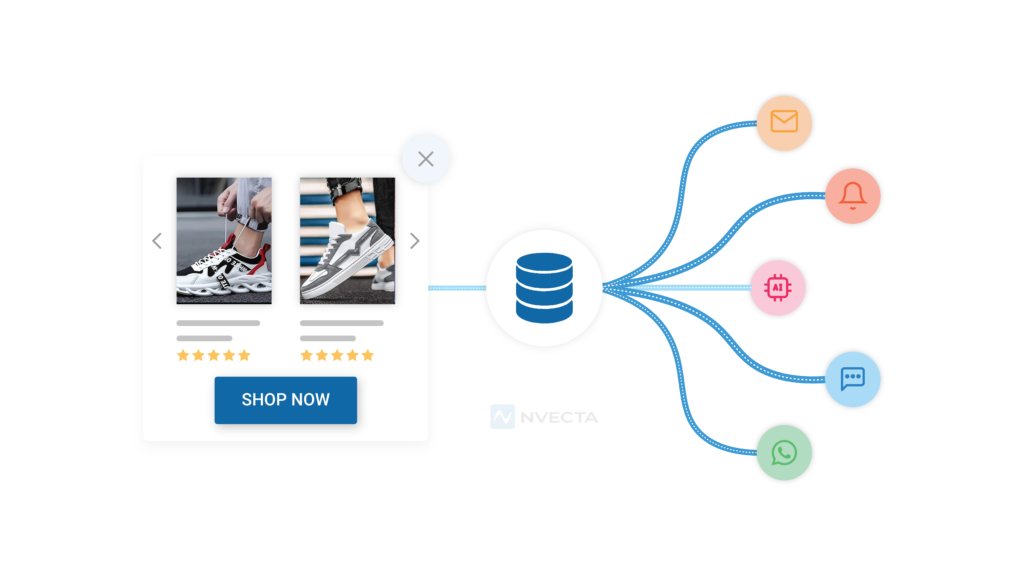
Think of a CDP as the one place where everything you know about a customer actually lives together. Website visits, app activity, past purchases, which emails they opened, SMS replies, ad clicks, support conversations all of it stitched into a single profile that updates the moment something new happens. No more jumping between five different tools to piece together who someone is. That unified view makes every touchpoint smarter, from personalized campaigns all the way down to a Shopify order confirmation email that recommends products based on what they actually bought, not what you guessed they might like.
That sounds simple. It isn’t, because the same customer might browse on mobile, add to cart on desktop, complete checkout from an email link, and email support from a different address. Without identity resolution, those four touchpoints look like four different people. Your retention segments are wrong before they even reach the messaging layer.
Worth being clear on what a CDP isn’t. A CRM manages relationships and is mostly used by sales and support teams for known contacts. Marketing automation tools send messages but rely on whatever data the CDP feeds them. Analytics platforms tell you what happened but don’t activate anything. The CDP sits underneath all of these as the data layer that makes them actually work together.
Ecommerce brands adopt platforms like Nvecta because the alternative is hiring engineers to build all this from scratch and maintain it forever. Most brands don’t have that kind of engineering capacity, and even the ones that do usually have better things to put their engineers on.
The Identity Resolution Foundation (Why Most Brands Fail Here)

Repeat purchases don’t come from more data. They come from being able to recognize the same customer across moments. Which customers are likely to buy again? Who is quietly drifting away? And who just signed up and needs a totally different message than someone on their fifth order?
Most ecommerce teams can’t answer those questions cleanly because their data is fragmented. A typical journey looks something like this. A shopper visits the site on their phone, scrolls through three product pages, leaves. Two days later they sign up for email on a laptop. A week after that they convert through a paid Instagram ad. After the order arrives, they message support with a sizing question. Each of those moments is meaningful, but they typically live in completely separate systems with no easy way to tie them together.
Nvecta handles this stitching automatically. Identifiers like email, device ID, and customer ID get linked into a single profile that stays consistent over time. As customers interact with the brand, that profile updates with both historical context and what’s happening right now.
This unified view changes what teams can actually do. Instead of guessing why someone converted or disappeared, you can see how browsing patterns lead to purchases, how engagement shifts after checkout, and how customer value builds across multiple orders. Decisions stop being based on assumptions.
Once everything is connected, segmentation gets sharper, targeting gets more accurate, and messaging starts feeling timely instead of intrusive. That clarity is what allows brands to move past one-off transactions and start building actual repeat-purchase patterns.
The 5-Stage Repeat Purchase Lifecycle
The most useful way to think about repeat purchases is as a lifecycle, not a campaign. Every customer is at one of five stages. The right tactic depends entirely on which stage they’re in, and getting this wrong is usually why retention efforts feel inconsistent.
| Stage | Who They Are | CDP Tactic | Goal |
|---|---|---|---|
| 1. First-time buyer | Days 0-30 post-purchase | Onboarding flow, education content, second-purchase nudge | Convert to second purchase. About 30% of first-time buyers never come back. |
| 2. Repeat customer | 2nd to 4th purchase | RFM-based segments, cross-sell, accessory recommendations | Build cadence. Lifecycle messaging delivers 2-3x email revenue per recipient. |
| 3. Loyal advocate | 5+ purchases or VIP threshold | Exclusive access, early-bird sales, referral incentives | Retain and amplify. Sephora’s Beauty Insider members account for ~80% of annual sales. |
| 4. At-risk | Engagement dropping, no churn yet | Predictive scoring, automated win-back triggers | Re-engage before they fully lapse. Catches the drop-off early. |
| 5. Lapsed | No purchase in N days (varies by category) | High-discount win-back, suppression from acquisition ads | Convert back or stop spending ad money on them. |
Stage 1: First-time buyer (the highest-leverage stage)
Roughly 30% of first-time ecommerce buyers never return. That single stat explains why the first 30 days post-purchase matter more than almost anything else you do. Most brands get this stage wrong by treating it like a confirmation flow plus a generic discount code.
What works better is using the CDP to know what they bought, then building messaging around that specific product. A skincare buyer needs a different onboarding than a candle buyer needs a different onboarding than a running shoe buyer. The CDP makes this kind of targeting practical instead of theoretical.
Stage 2: Repeat customer (where the real revenue lives)
Once someone has bought twice, the relationship shifts. The job here is RFM-based segmentation (recency, frequency, monetary value), cross-sell flows tied to actual purchase history, and accessory or replenishment recommendations that fit what they already own.
Klaviyo published a case study on Ruffwear, the dog gear brand. They used CDP-driven RFM segmentation to send personalized re-engagement to customers in their “Needs Attention” segment. The result over 6 months: discount rate dropped 10% year over year while overall revenue grew 9%. Better targeting meant they could discount less and still grow. That kind of margin recovery is exactly the case for retention work.
Stage 3: Loyal advocate (the 80/20 customer)
Loyalty programs work because the math is real. Sephora’s Beauty Insider program members reportedly account for around 80% of the brand’s annual sales. That isn’t a personalization play. It’s a structural advantage from identifying high-value customers and giving them exclusive access, early product drops, and points-based rewards that make returning feel like a benefit instead of a transaction.
The CDP makes this work by identifying who actually qualifies as a loyal customer (5+ purchases, high LTV, high engagement). Without unified data, most “VIP” segments are just whoever opened the last email.
Stage 4: At-risk (catch them before they lapse)
This stage is where predictive analytics earn their keep. The CDP tracks behavior signals (declining open rates, skipped reorder windows, reduced site visits) and flags customers whose patterns suggest they’re heading toward churn. Win-back flows trigger automatically before they actually lapse, which is much cheaper than reactivating someone who already left.
Nextbase, the dash cam company, used a CDP-integrated approach to personalize on-site content for repeat buyers using a group membership API. Instead of showing the same hero product to every visitor, they showed tailored recommendations based on previous purchases. The kind of customer-first defense against drift that most brands just don’t have visibility to do.
Stage 5: Lapsed (decide whether to win back or move on)
Once a customer has fully gone quiet (no purchase in 6 to 18 months depending on category), the cost-benefit changes. Aggressive win-back campaigns work for some. Others are gone for good. The CDP helps you decide which is which by scoring lapsed customers on historical value, last-touch recency, and cohort behavior.
Equally important: stop running paid ads to people who’ve gone quiet but won’t come back. Suppression lists pushed from the CDP into Google Ads, Meta, and TikTok prevent spending acquisition budget on customers who’ve already churned out.
Personalization That Actually Drives Returns
Personalization gets talked about as a feature. For ecommerce retention, it’s really about relevance. When customers feel a brand actually understands their preferences and timing, they come back. When they feel like every brand sends them the same generic discount blast, they tune out.
The problem with most ecommerce messaging isn’t volume. It’s relevance. Campaigns get sent without context for what the customer has done or what they might need next. When every shopper gets the same message regardless of history, engagement fades fast.
Nvecta lets brands respond to actual customer behavior. Browsing patterns, purchase history, and engagement signals shape what each person sees. Communication starts feeling like a continuation of an ongoing relationship rather than a megaphone.
Practically, this shows up in things like recommendations based on real interest rather than generic popularity, email content that adjusts as customers move from first purchase to repeat buyer, and on-site experiences that surface products aligned with what someone has already shown interest in. The post-purchase window is where this matters most. Thoughtful follow-ups help customers get more value from what they bought and introduce related products in a way that feels natural rather than pushy.
When personalization is done well, it stops feeling like marketing. It feels useful. That’s what keeps customers engaged long after their first purchase.
Smarter Segmentation That Updates Itself
Most ecommerce segmentation is still rule-based. Age, location, last purchase date. Those signals are useful but they don’t tell the full story. Customers change quickly. Interest shifts, habits move, intent isn’t static. Static segments stop reflecting what’s actually happening within weeks.
Nvecta takes a different approach by letting customer behavior drive segment membership. As people browse, buy, or stop engaging, their profiles update automatically. Segments adjust without manual rebuilding.
This makes meaningful patterns easier to spot. A recent first-time buyer gets treated differently from someone on their fifth order. A customer whose engagement is slowing gets identified before they fully disengage. Each situation calls for different messaging and different timing, and the CDP makes those distinctions visible.
Because segmentation updates automatically, you’re not locked into fixed campaign calendars. Customers can be reached when behavior signals suggest it makes sense, rather than when the next scheduled blast happens to go out. That flexibility is what turns segmentation from a theoretical concept into something operationally useful.
The Paid Media Suppression Angle (Half the Value Most Brands Miss)
Most repeat-purchase strategies focus on email and SMS. That’s only half the value of a CDP for retention. The other half is on the paid media side, and it’s the half most ecommerce teams completely overlook.
Two specific levers, both worth real money.
Suppression. Stop running ads to people who already converted yesterday. Sounds obvious. Most brands don’t do it because their ad platform has no way to know who converted. A CDP pushes “already a customer” lists directly into Google Ads, Meta, and TikTok automatically. Typical CAC reduction from suppression alone runs 10-20%. For some retail clients we’ve worked with, the number has been higher because their suppression hygiene was that bad to begin with.
LTV-based lookalikes. Feed ad platforms a clean list of your highest-value customers as the seed audience, not just “people who clicked an ad.” Lookalikes built from LTV-weighted seeds perform meaningfully better than ones built from generic event audiences. Meta and Google can’t generate this data themselves. The lift only happens if it comes from your side, and that requires a CDP that actually knows what customer LTV is.
For most mid-market ecommerce brands, the suppression angle alone justifies the cost of the CDP. The retention work on top is bonus revenue.
Vertical-Specific Repeat Purchase Patterns
The general framework above applies across ecommerce. The specifics differ a lot by category. Here’s where teams in different verticals get the most leverage from a CDP.
| Vertical | Where the CDP Earns Its Keep | Specific Use Case |
|---|---|---|
| Fashion | Seasonal cycles, complete-the-outfit recommendations | Fall jacket buyer gets autumn boots and accessories within 30 days |
| Beauty | Replenishment timing, routine completion | Foundation buyer gets concealer recommendation; serum gets reorder reminder at week 6 |
| Pet supplies | Consumable reorder cadence (food, treats, litter) | Dog food reorder reminder timed to typical bag duration based on breed and weight |
| Electronics | Accessory and upgrade paths | Laptop buyer gets case, charger, and stand recs; upgrade nudge at year 3 |
| Home decor | Seasonal refresh + cross-room expansion | Living room buyer gets bedroom recs in next category drop |
| Health & wellness | Subscription nudges, supplement stacking | Single-purchase customer offered subscription at second order with discount |
The pattern across verticals is the same: the CDP knows what they bought and when, predicts what they’ll need next, and triggers the message at the right moment. The execution differs by category but the underlying capability is identical.
Activating Data Across Channels
Customers interact with brands through email, SMS, paid ads, social platforms, and the website itself. Without a centralized data layer, these channels run independently, which leads to inconsistent messaging and missed coordination.
Nvecta works as the central hub feeding unified customer data into every downstream tool. The same customer understanding informs every interaction regardless of which channel happens to be the touchpoint. So a customer who just bought yesterday gets excluded from acquisition ads, included in a relevant cross-sell email, and shown a personalized homepage message when they return to the site, all coordinated from the same profile.
Real-time activation is especially important for ecommerce. Restock alerts, replenishment reminders, and time-sensitive offers significantly increase repeat purchases when delivered at the right moment. Send the restock alert two days late and you’ve lost the sale to a competitor who got there first.
Common Failure Modes
For balance, here are the four ways CDP-driven retention strategies typically go wrong. Worth knowing before you build out a program.
- Skipping data hygiene first. If your customer records are dirty (typos, duplicate accounts, mismatched identifiers), no amount of CDP magic fixes the resulting segments. Identity resolution depends on clean inputs. Most stalled implementations are stuck here.
- Discount-code dependency. When every retention email is “10% off,” customers learn to wait for the discount before buying anything. Margins erode and retention rates look healthy on a spreadsheet while profit drops. Discounts work as one tool in a mix, not as the whole strategy.
- One-size-fits-all win-back campaigns. A customer who lapsed last week and one who lapsed two years ago need completely different messaging. Treating them as one segment is the biggest reason win-back open rates are so bad across the industry.
- Treating the CDP as a campaign tool only. The predictive scoring and audience suppression layers are usually where the highest ROI lives. Teams that only use the CDP to send better emails are leaving most of the value untouched.
When You Don’t Need a CDP for Repeat Purchases (Yet)
Honest take: not every ecommerce brand needs a CDP. Some shouldn’t have one yet.
If you’re under 10,000 customers and running mostly through one channel (email-only or Shopify-built-in flows), the basic segmentation in your email tool will do most of what a CDP would. Adding a CDP at this stage means paying $50K+ a year for capability you can’t fully use yet. The money is better spent on creative, product, or paid acquisition until your data volume catches up.
The honest threshold: once you cross around 50,000 customers, three or more active channels (email, SMS, paid, web), and you’re seeing the cost of fragmented data show up in your campaign performance, that’s when a CDP starts paying back. Below that, basic email tooling is fine. Save the CDP investment for when you actually have the data complexity that requires it.
Measuring What Matters for Retention
Driving repeat purchases doesn’t end when a campaign goes out. What matters just as much is understanding what happened afterward. Without clear feedback, it’s hard to know which efforts are actually moving the needle.
Nvecta makes feedback easier with NPS forms you can embed on your site without writing code. Basic retention metrics get more useful in this context too. How often customers return, how frequently they purchase, and how their value changes over time tell a clearer story when those numbers reflect complete customer journeys instead of fragmented snapshots.
This visibility lets teams slow down and assess what’s working. They can see how different audiences respond to specific messages, whether personalization changes behavior, and how timing affects engagement. Adjustments become informed instead of reactive.
Over time, this approach helps brands refine their retention work based on real customer behavior rather than assumptions or gut instinct.
Best Practices for Ecommerce Brands Using Nvecta
Teams get the most out of Nvecta when they treat it as a support system rather than a magic fix. It works best when there’s a clear sense of what the business is trying to improve, instead of rushing to use every capability at once.
Often, the right starting point is a single recurring problem. Maybe customers buy once and never return. Or long-time buyers are slowly disengaging. Or acquisition costs are killing margins because suppression lists never got built. When the problem is clearly understood, the data becomes easier to work with because it has context.
There’s also a balance to strike around complexity. It’s tempting to build very detailed segments and highly customized messaging, but that approach can become hard to manage over time. Customers feel that inconsistency too. Nvecta is most helpful when it brings structure and keeps things aligned, rather than adding layers.
How customer data gets handled plays a big role in retention as well. People are more aware of how their information is used, and expectations are higher. Consistent and respectful data practices build trust over time. Nvecta makes this easier by keeping customer information organized and accessible without losing control over how it’s used.
Conclusion
Repeat purchases aren’t a nice-to-have metric anymore. They’re a core driver of sustainable growth, profitability, and long-term customer relationships in a paid media environment that keeps getting more expensive.
CDPs do the heavy lifting on repeat purchases by unifying data, powering personalization, sharpening segmentation, and coordinating experiences across channels. They let brands move from reactive campaigns to proactive customer-first strategies. As ecommerce keeps evolving, brands that invest in understanding and serving existing customers will be much better positioned than the ones still chasing first-time buyers exclusively. With the right CDP in place, retention becomes a real strategic advantage rather than an afterthought.
If you want to see how Nvecta helps ecommerce brands turn customer data into repeat purchases, we’re happy to walk through your current stack and show you where the wins are. Even if the answer is “you’re not ready yet,” we’ll tell you that honestly.
Frequently Asked Questions
How do CDPs increase repeat purchases?
By unifying customer data across channels and triggering the right campaign at the right lifecycle moment. The big drivers: behavior-based segmentation that updates in real time, predictive scoring that catches at-risk customers before they lapse, and paid media suppression that stops you from re-acquiring people who already bought. Together, those tend to lift repeat purchase rate 15-30% over 12 months for mid-market ecommerce brands.
What’s the average repeat purchase rate for ecommerce brands?
Industry average sits around 25-35% for established brands across most ecommerce verticals. Top quartile performers hit 50%+. Subscription-driven and consumable categories (pet food, supplements, beauty replenishment) tend to land higher. Fashion and electronics tend lower. The number that matters is your trajectory, not the benchmark.
How long until a CDP improves retention measurably?
For ecommerce specifically: visible suppression-list ROI in 4-8 weeks (CAC drops once existing customers stop seeing acquisition ads). Lifecycle messaging lift in 8-16 weeks. Full retention rate impact on cohorts in 6-9 months because you need at least one repeat-purchase cycle to measure properly.
What’s the best CDP for mid-size ecommerce brands?
Depends on your engineering capacity and which marketing tools you’re already using. The honest answer is that the “best” CDP varies by team profile. Hybrid CDPs (warehouse-native with packaged-style activation) tend to fit mid-size ecommerce brands better than either pure composable or pure packaged options. We cover the full comparison in our customer data platform guide.
How is a CDP different from an email tool for retention?
Email tools send campaigns. CDPs decide who should get which campaign by maintaining the unified customer profile underneath. The email tool is the activation layer. The CDP is the data layer that makes activation actually targeted instead of mostly random.
Can a CDP reduce ad spend?
Yes, mostly through suppression. Pushing customer lists to Google Ads, Meta, and TikTok to exclude already-converted customers from acquisition campaigns typically reduces wasted ad spend by 10-20%. For some brands the number is much higher, depending on how badly their suppression hygiene was working before.
What ecommerce verticals get the most value from a CDP?
Replenishment-driven categories (pet supplies, beauty, supplements, household consumables) get the fastest ROI because timing-based reorder flows are easy to set up and convert well. Fashion and home decor benefit from the cross-sell and seasonal angles. Electronics gets value from accessory paths and upgrade nudges. Lowest immediate value: low-frequency, high-consideration purchases (mattresses, appliances) where the repeat cycle is just too long.
