













 Email
Email SMS
SMS Whatsapp
 Web Push
 App Push
 Audience Sync for Ads
 Popups
 Channel A/B Testing
  Control groups Analysis
 Frequency Capping
 Funnel Analysis
 Cohort Analysis
 RFM Analysis
 Signup Forms
 Surveys
 NPS
NPS Landing pages personalization
  Website A/B Testing
  PWA/TWA
 Heatmaps
 Session Recording
 Wix
Wix Shopify
 Magento
 Woocommerce
 eCommerce D2C
  Mutual Funds
 Insurance
 Lending
  Recipes
  Knowledgebase
 Developer Docs
 Product Updates
 App Marketplace
 Academy
 Ebooks
 Case Studies
 Blog
Blog Templates
 Afreen Sheikh
📌 Quick Answer: CDP vs Marketing Automation
A Customer Data Platform (CDP) is a centralised system that collects, unifies, and maintains customer data from all sources — websites, apps, CRM, offline — into a single, continuously updated profile. A Marketing Automation platform executes and optimises marketing campaigns across email, SMS, WhatsApp, and push notifications, using data stored within or fed into it. The core difference: CDP is the data foundation — it tells you who your customer is. Marketing automation is the execution engine — it decides what to send them, on which channel, and when. Most growing businesses need both working together to deliver personalised experiences at scale.
CDP vs Marketing Automation: Quick Comparison
| Comparison Area | Customer Data Platform (CDP) | Marketing Automation |
|---|---|---|
| Primary purpose | Collect, unify, and maintain customer data from all sources into a single profile | Execute and automate marketing campaigns across channels |
| Data ownership | Owns and manages the data layer — the single source of truth for customer profiles | Acts on data fed into it; does not own or unify cross-source data |
| Who uses it | Data, marketing, and product teams who need a unified view of every customer | Marketing teams who need to plan, execute, and measure campaigns efficiently |
| Key output | Unified customer profiles, real-time segments, identity resolution, predictive insights | Automated workflows, campaign reports, triggered messages, lead nurturing sequences |
| Works best when | Data is fragmented across multiple systems and personalisation is breaking down | Data is clean and centralised, and the priority is scaling campaign execution |
Today, marketing success is all about how well a brand understands its customers. Single-channel marketing campaigns are no longer sufficient to meet changing customer expectations. Customers often switch channels such as websites, applications, WhatsApp, emails, SMS, and so on. They want a consistent and personalised experience across all channels.
Thus, customer data has become integral to any business’s growth. To achieve this, companies need to employ smarter means to use customer data.
Customer data platforms and marketing automation play a key role in improving customer experience by bringing customer data together, enabling real-time personalization, and ensuring consistent interactions across all touchpoints. Customer Data Platform use cases include audience segmentation, personalized campaigns, customer journey management, predictive analytics, omnichannel engagement, churn reduction, and gaining real-time customer insights for better business decisions.
Although both solutions are used to improve customer engagement, they function differently.
Sometimes, using one instead of another can lead to poor personalisation and ineffective campaigns that may affect business growth.
To use the best marketing tool for your business needs, it is important to understand the difference between a customer data platform and marketing automation.
This is where understanding customer data platforms versus marketing automation becomes essential for making the right strategic decision.
In this blog, we will explore how both tools work and break down the differences in the CDP vs Marketing Automation debate—ultimately helping you answer the question: should I choose a CDP over marketing automation and find the best solution for your marketing needs.
What is a Customer Data Platform?
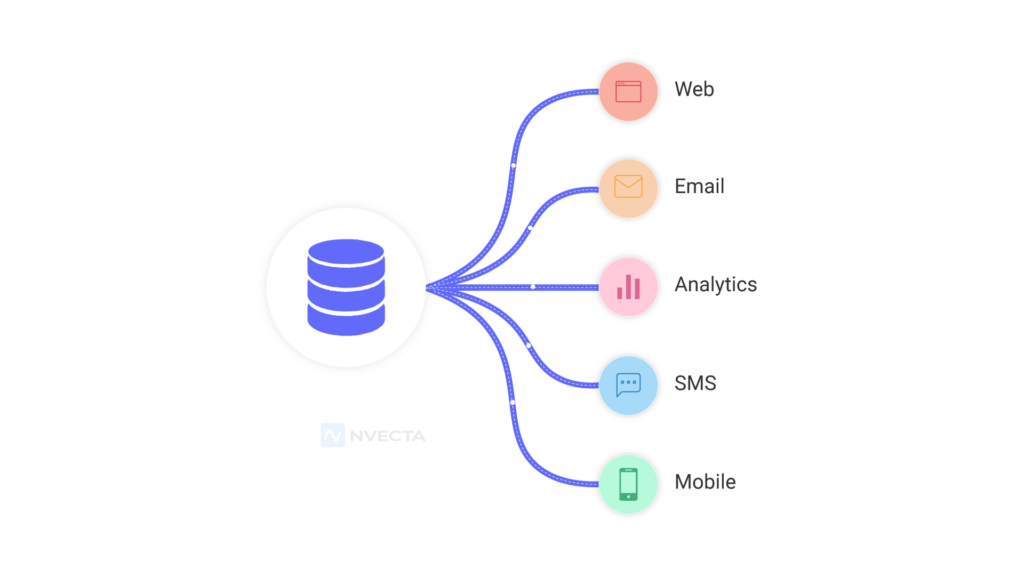
A customer data platform(CDP) is a centralised software technology that brings customer data together from multiple sources into a single, continuously updated profile. It helps marketing teams track users and trigger the required actions to boost revenue.
For businesses exploring understanding ecommerce customer data platforms, CDPs play a critical role in creating unified customer views that power personalised experiences across every touchpoint.
At its core, CDP focuses on identity resolution by connecting fragmented customer data across websites, mobile apps, CRM records, email and offline systems into a single unified customer view.
Such a view enables marketers to understand customer behaviour preferences and engagement patterns over time.
It also simplifies marketing operations by connecting and activating data across tools. With features such as real-time updates, segmentation, and seamless integration, CDP helps teams deliver more connected and personalised experiences across the entire customer journey.
Core Capabilities Customer Data Platform
A Customer Data Platform offers several features for managing raw customer data. This helps the business gain insights and trigger actions.
Unified Customer Profiles
The Customer Data Platform integrates data from different sources and creates a single customer profile. This profile is constantly updated according to the events happening in the business.
First-Party Data Collection
The CDP collects first-party data, i.e., data collected directly from the customer. This includes website events, app data, purchase history, and customer preferences. This data is collected in a privacy-friendly manner.
Identity Resolution
The CDP uses identity resolution to merge anonymous and known identities through predictive and inductive matching.
This helps create a single, comprehensive customer profile with all the information previously stored across multiple systems.
Advanced Segmentation
The Customer Data Platform helps the business create complex segments based on behaviour, history, predictions, etc. This helps the business understand customers and can be tested for performance.
Data Activation Across Channels
The CDP will send information to email marketing tools, SMS tools, ad networks, and personalisation engines. This ensures that messages are consistent and relevant across all channels.
A Customer Data Platform (CDP) is used by various industries such as e-commerce, retail, SaaS, BFSI, travel, media, and more, where organisations require a unified view of customers to provide personalised, data-driven experiences over multiple channels.
What Is Marketing Automation?
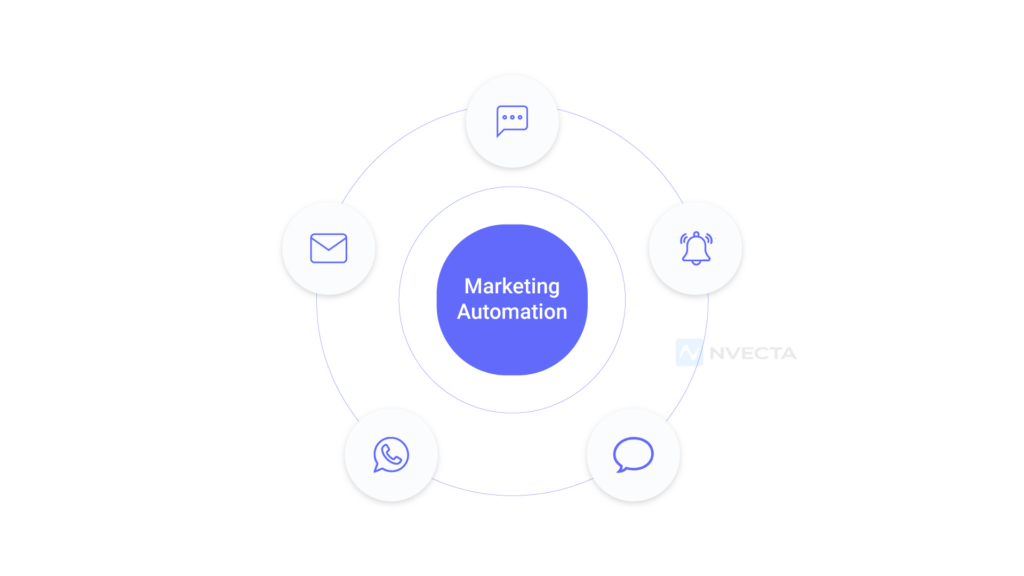
Marketing Automation is technology used to execute and optimise marketing campaigns for channels such as email, SMS, Whatsapp, push notifications, and in-app messaging.
The main goal of marketing automation is to minimise manual work by automating processes and delivering messages to customers at the right time, based on predetermined conditions.
Unlike Customer Data Platforms (CDPs), marketing automation tools do not focus on data unification.
Rather, they perform actions on data that is stored within the system and shared across other tools. Marketing automation has strong capabilities in campaign execution and management.
Marketing automation is used for many different activities, such as customer onboarding and lead nurturing. When used for automation, activities are streamlined and manual effort is reduced for every interaction.
Key Features of Marketing Automation
Marketing automation has the following features, which are helpful in planning, executing, and measuring the campaigns in the business. They are as follows:
Campaign Management
Marketing automation facilitates campaign creation, scheduling, and management from a single platform.
This helps businesses maintain consistency across channels such as email, SMS, and push notifications while saving time and effort.
Workflow Automation
Automated workflows are triggered by predefined actions or conditions, such as sign-ups, purchases, or periods of inactivity. This enables timely communication without manual follow-ups.
Email and Messaging Tools
It offers ready-to-use templates and built-in content editors, making it easy to design and send emails, SMS, WhatsApp messages, and push notifications. These tools support the creative, quick launch of campaigns while maintaining brand consistency.
Rule-Based Segmentation
Segments are created based on fixed conditions, such as age, location or past actions. In many cases, these segments require manual updates as customer behaviour changes.
Performance Reporting
Marketing automation provides campaign-level reports, including open rates, click-through rates, and conversions. These insights help businesses evaluate campaign performance and improve future messaging.
Marketing automation is used by businesses of all sizes, including e-commerce, SaaS, B2B, retail, and service companies, to automate messaging experience and communicate with customers more efficiently.
CDP vs Marketing Automation: Key Differences
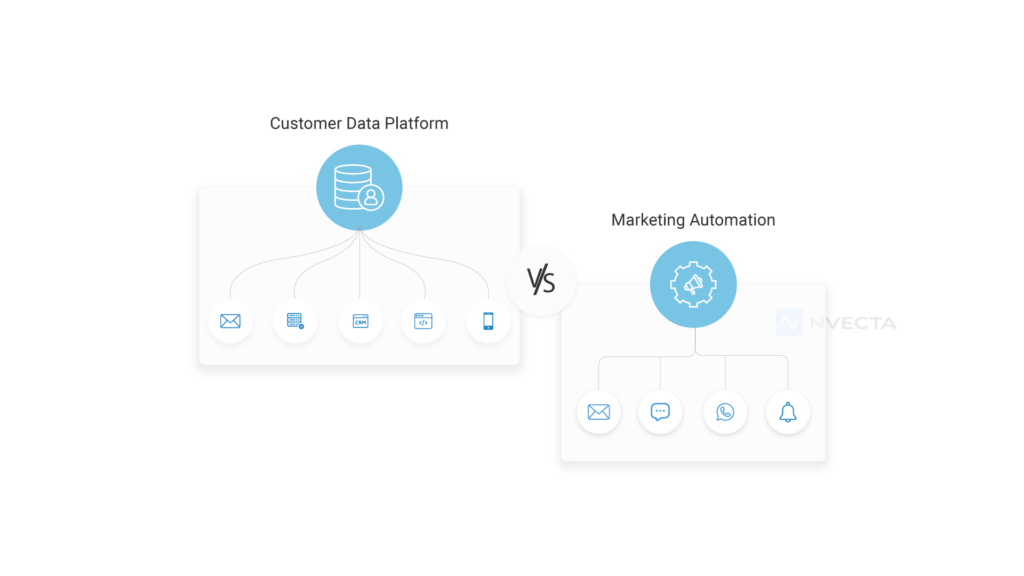
While CDPs and Marketing Automation platforms are often used together, they serve different functions—understanding the differences between CDPs and marketing automation is key to using each effectively within your stack. Therefore, it is important to understand their key differences so that businesses can choose the right solution.
Data Collection and Integration
They collect and organise data from various sources, such as websites, CRM systems, mobile apps, and payment platforms.
It continuously processes large volumes of customer data to build unified customer profiles. As a result, marketers gain a detailed, live-updated view of their customers.
Marketing Automation
Marketing automation tools do not collect data from sources; rather, they capture campaign analytics such as email opens, clicks, or message delivery.
For better customer analysis, external tools can be utilised for optimising performance. While they are viable for running campaigns, they are not capable of managing large-scale data integration across systems.
Personalization Capabilities
They support hyper-personalisation by utilising real-time updates about customer behaviour, their previous interactions and advanced predictive insights.
It facilitates consistent personalised messaging across channels such as email, websites, WhatsApp, SMS, and mobile apps.
When business is sent tailored messages, communication feels more relevant and personal, enhancing engagement.
Marketing Automation
Personalisation is limited to predefined fields such as name, age, location, or last action. Advanced personalisation often relies on data from external systems. Such basic personalisation usually works well for executing generic campaigns across multiple touch points.
Real Time Data Processing
CDP processes customer interaction data in real time and updates customer profiles /segments instantly.
With this, marketers can quickly respond to customer actions, such as price-checking or cart abandonment. Real-time processing helps engage customers at the right moment, when their interest is highest.
Marketing Automation
In Marketing automation, data is processed in batches or with a time delay. It means customer updates may not get reflected immediately in campaign results.
This can limit responsiveness, where quick action could have been beneficial. It is well-suited for planned campaigning but lacks real-time engagement.
Insights and Actionability
They are capable of generating actionable insights by advanced customer profile and interaction analysis using machine learning technology.
This supports marketers with data-driven decision-making, identifying behaviour patterns, predicting future actions and understanding customer intent.
Further, these insights are used to optimise strategies and improve personalisation. CDPs focus on why customers behave a certain way, not just what they did.
Marketing Automation
Insights in marketing automation are mostly campaign-focused and performance-driven. Reports contain Metrics such as opens, clicks, and conversions.
These insights help measure campaign success, but they limit visibility into customer behaviour.
Data Retention
CDPs
CDPs are built to store data for the long term and maintain detailed records of historical customer data.
This allows marketers to analyse customer behaviour patterns over time. Data retention helps deepen understanding of customer journeys, lifetime value, and predictive model development. It further supports accurate segmentation and personalisation.
Marketing Automation
In marketing automation, data retention is usually limited to recent campaign interactions or performance metrics—unlike broader customer data strategies, which highlights the differences between CDP and marketing clouds, where CDPs are designed to store long-term, unified customer profiles while marketing clouds focus more on short-term activation and engagement data.
Previous data is open, a guide or removed from the systems. Limited data retention works fine for short-term campaign tracking, but there is no long-term performance analysis.
CDP vs Marketing Automation: A Quick Comparison
| Feature | Customer Data Platform | Marketing Automation |
|---|---|---|
| Core Purpose | Data unification and intelligence | Campaign execution |
| Data Sources | Multiple online and offline systems | Limited engagement data |
| Personalization Depth | Advanced and real-time | Basic and rule-based |
| Real Time Processing | Yes | Often limited |
| Data Retention | Long term | Short to medium term |
CDP vs Marketing Automation: Which Solution Fits Your Business Needs?
The choice between a customer data platform and a marketing automation solution depends on factors such as business size, objectives and where your business stands.
If businesses struggle to manage fragmented customer data, a CDP can help by centralising data and building unified customer profiles that enable personalised, consistent engagement across channels.
Business wants to focus more on running campaigns effectively marketing automation is the better fit. Its automated workflows deliver messages that scale with minimal manual effort, helping businesses Increase Customer Engagement while improving operational consistency and overall interaction quality.
However, as a business grows, customer interactions become complex. Relying on a single solution can create limitations. Then comes a point where business requires both strong data insights and campaign execution.
CDP vs marketing automation — statistics that make the case in 2026
The business case for both tools is well-supported by data. These figures help quantify the value each delivers — and why combining them outperforms either tool in isolation.
- 91% of CDP users say real-time customer data is essential for creating relevant customer experiences — confirming that data freshness is not a nice-to-have but a requirement for personalisation that actually works (Tealium 2024).
- Marketing automation delivers an average 34% revenue increase for businesses that deploy it — demonstrating its direct impact on bottom-line results when campaigns are properly automated and sequenced (Salesforce).
- 47% of marketing spend is wasted due to fragmented data systems and broken attribution — the exact problem a CDP solves by creating a single, trusted source of customer truth that every tool and team draws from.
- Companies using CDP and marketing automation together consistently report stronger campaign conversion rates versus using either tool independently — because the CDP provides accurate, real-time audience segments while the automation layer executes on them at scale.
These numbers reflect why the CDP vs marketing automation question is increasingly answered with “both” rather than “either” — particularly for businesses managing multiple channels, high customer volumes, or complex personalisation requirements.
CDP vs CRM vs Marketing Automation — how all three differ
One of the most common sources of confusion in martech evaluation is distinguishing between a CDP, a CRM, and a marketing automation platform — three tools that appear similar but solve fundamentally different problems. Here is a clear breakdown:
| Comparison Area | CDP | CRM | Marketing Automation |
|---|---|---|---|
| Primary function | Unify customer data from all sources into real-time profiles | Manage known customer and prospect relationships for sales teams | Execute and automate marketing campaigns and workflows |
| Data focus | All customer data — behavioural, transactional, anonymous, and known | Known contacts, deals, and sales interactions | Campaign engagement data — opens, clicks, conversions |
| Typical user | Marketing, data, and product teams | Sales and account management teams | Marketing and growth teams |
| Key output | Unified profiles, segments, identity resolution | Pipeline management, contact records, deal tracking | Automated journeys, campaign reports, triggered messages |
In practice, these three tools are not alternatives — they are complementary layers of a modern marketing stack. The CRM manages the relationship with known sales prospects. The CDP unifies customer data from every touchpoint — including anonymous users — into a complete profile. Marketing automation uses that profile data to execute the right message at the right moment. The challenge for most growing businesses is that deploying all three separately creates fragmentation. Platforms like NVECTA solve this by combining CDP and marketing automation in one place, reducing the integration overhead while keeping the distinct functions of each tool intact.
Do you need both a CDP and marketing automation?
The right answer depends on where your business is today and where it needs to go. Here is a practical guide to help you decide.
Choose CDP first when:
- Customer data is fragmented across multiple disconnected systems (CRM, e-commerce platform, mobile app, offline data) and your team cannot get a reliable view of any individual customer
- Personalisation is breaking down — campaigns feel generic because they are based on incomplete or stale data
- Identity resolution is a problem — the same customer appears as multiple profiles across systems
- You need real-time segmentation that reflects what a customer did in the last hour, not the last week
Choose Marketing Automation first when:
- Your customer data is reasonably clean and centralised — you just need to act on it more efficiently and at greater scale
- You are focused primarily on a single channel (email or SMS) and need to automate sequences, drip campaigns, and triggered responses
- Your team’s bottleneck is execution speed rather than data quality — campaigns are well-designed but take too long to deploy manually
Use both when:
You need personalised, data-driven campaigns delivered at scale across multiple channels — email, SMS, WhatsApp, push, and web — based on real-time customer behaviour. This is the most common requirement for mid-size and growing businesses operating across more than one channel.
The CDP provides the accurate, real-time audience data; marketing automation executes on it without manual intervention at every step.
Businesses evaluating platforms for this setup often begin by Choosing between Klaviyo and Segment for your business to understand whether they need stronger campaign automation, deeper customer data infrastructure, or both.
NVECTA combines both into one platform, removing the integration overhead of running two separate systems while preserving the full capability of each.
Why CDP and Marketing Automation Deliver Better Results Together
From business point of view, customer data only becomes available when it is actually put to use. A CDP organises and maintains accurate customer records, while marketing automation uses the data to run campaigns and send messages automatically.
When both work together, your data stays up to date and your messaging stays relevant. This helps businesses to deliver connected communication and engage customers based on real behaviour and preferences.
Together they enable faster responses, enhance personalisation and consistent experience across channels, ultimately strengthening customer relationships and supporting long-term growth.
How This Combination Improves Marketing Outcomes
The following outcomes that a business can expect from using both CDP and marketing automation-
More Relevant Engagement
With accurate, up-to-date customer profiles from the CDP, marketing automation can deliver messages that reflect current behaviour rather than outdated data.
Faster Response to Customer Behaviour
making it easier for businesses to respond at the right moment and support building a multi-step customer journey automation strategy across email, SMS, WhatsApp, push notifications, and web interactions. This helps brands deliver timely, personalised experiences throughout the entire customer lifecycle.
Consistent Experiences Across Channels
With CDP as the data foundation and marketing automation as the execution layer, the messaging space aligned across all the channels.
Reduced Data Silos
The CDP resolves the scattered data problem, and marketing automation simplifies campaign planning and execution. This eliminates disconnected systems and improves efficiency.
When building a data-driven strategic execution marketing strategy, it’s important to see how different platforms work together rather than in isolation. This is especially true when Customer Data Platform, Customer Relationship Management, and Data Management Platform are used in combination.
To get a clearer picture of how these systems complement each other, it helps to add this anchor understanding the roles of CDP, CRM, and DMP—so you can better map how customer data flows across acquisition, engagement, and retention efforts.
A customer repeatedly browses a product category. A CDP captures this behaviour in real time and then marketing automation quickly triggers a personalised email or notification to engage.
NVECTA: All-in-One Platform Combining CDP and Marketing Automation
NVECTA connects customer data to effective campaign execution on one platform, helping teams turn customer insights into meaningful interactions without switching between multiple tools to manage disconnected systems.
NVECTA CDP Features
Below are the powerful CDP features that NVECTA offers to businesses to build a strong data foundation-
Unified Customer Profiles
It offers a centralised customer view, ensuring all teams and campaigns rely on one accurate data, improving decision making and enabling more relevant and thoughtful communication.
Real Time Data Collection
Live customer interactions are captured and activated immediately, allowing businesses to respond in the moment and keep engagement timely and impactful.
Advanced Audience Segmentation
Dynamic segments update automatically based on behaviour and preferences, making it easier to target the right audience without manual adjustments.
Identity Resolution Across Touchpoints
Identity resolution recognises customer profiles across devices in channels, merging them into one single identity, allowing businesses to deliver a consistent experience.
Privacy First Data Management
Customer data is collected with proper consent and managed responsibly, helping businesses to deliver a personalised experience while maintaining transparency and respecting customers’ expectations.
NVECTA Marketing Automation Capabilities
Below are NVECTA’S smart marketing automation solutions, which help businesses in automating workflows-
Cross-Channel Campaign Execution
Deliver coordinated campaigns across multiple channels like email, SMS, WhatsApp, push, and web from one single system. By using unified customer insights to align communication and be consistent across every channel.
Behaviour-Based Journey Automation
Automatic journeys are triggered by real-time customer signals such as browsing behaviour, inactivity or purchases. This ensures every message is based on captured customer behaviour rather than fixed rules.
Personalised Messaging at Scale
Messages adapt naturally to each customer using unified profile and behaviour insights, allowing businesses to deliver relevant communication to larger audiences without increasing manual efforts.
Lifecycle Campaign Management
Manage onboarding, retention, re-engagement and loyalty campaigns using a single data layer, ensuring every stage of the customer journey stays connected and consistent.
Performance Tracking and Optimisation
Analyse campaign performance using insights from interacted data, enabling teams to identify trends, optimise strategies and continuously improve engagement outcomes.
Final Thoughts
Whether to choose a CDP or marketing automation depends on what your business needs at a particular point of time. Individually, both serve distinct purposes, but together they form a stronger marketing approach. Utilising a platform that provides both systems helps brands understand and respond to customers in a natural, timely manner.
NVECTA integrates both functionalities into one platform, making it easier to manage data and execute effective campaigns. This results in improved engagement, stronger relationships and more consistent experiences at scale.
Explore NVECTA’S data-driven engagement to see how CDP and marketing automation work together to deliver effective customer experiences. Request a demo now.
Frequently Asked Questions
