














 Email
Email SMS
SMS Whatsapp
 Web Push
 App Push
 Audience Sync for Ads
 Popups
 Channel A/B Testing
  Control groups Analysis
 Frequency Capping
 Funnel Analysis
 Cohort Analysis
 RFM Analysis
 Signup Forms
 Surveys
 NPS
NPS Landing pages personalization
  Website A/B Testing
  PWA/TWA
 Heatmaps
 Session Recording
 Wix
Wix Shopify
 Magento
 Woocommerce
 eCommerce D2C
  Mutual Funds
 Insurance
 Lending
  Recipes
  Knowledgebase
 Developer Docs
 Product Updates
 App Marketplace
 Academy
 Ebooks
 Case Studies
 Blog
Blog Templates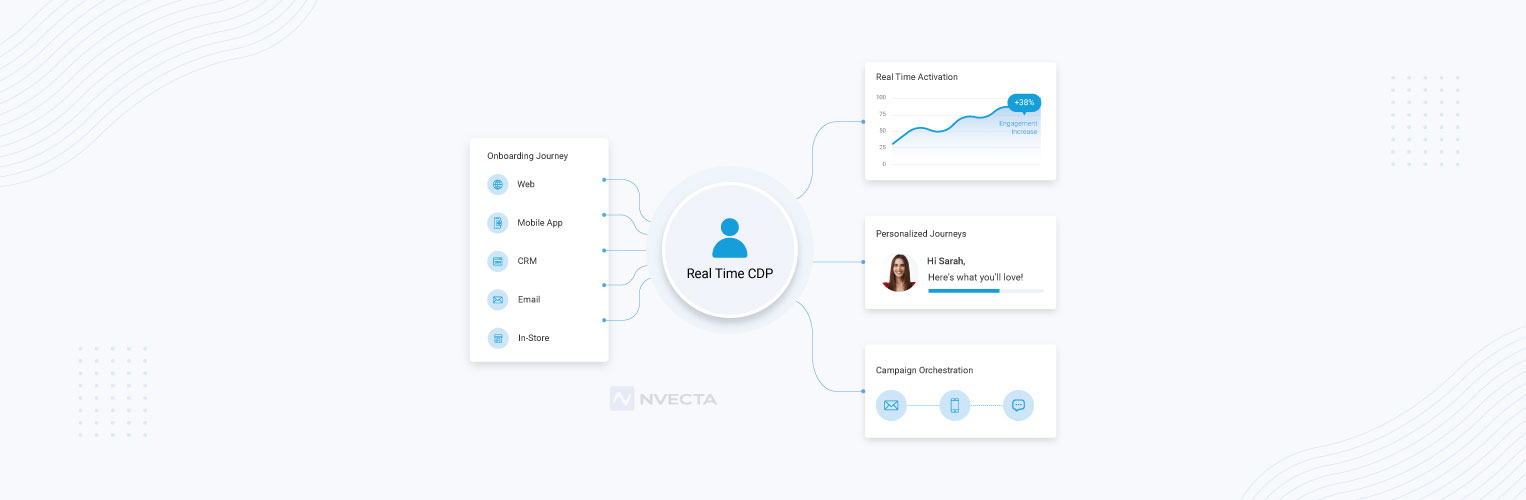
 Aparupa Saha
Quick Answer
A real-time CDP is a Customer Data Platform that processes customer data within milliseconds to seconds — collecting events from every channel, resolving identities, updating profiles, and triggering personalised responses the moment a customer acts, rather than waiting for overnight batch jobs. The CDP market is projected to reach $28.2B by 2028 at a 39.9% CAGR, driven by the shift to first-party data, AI agents entering production, and rising customer expectations for real-time relevance.
Real-Time CDP — 2026 Market Statistics
The business case for a real-time CDP has never been clearer. Here is what the current market data shows.
- $28.2B CDP market by 2028 at a 39.9% compound annual growth rate — making it one of the fastest-growing categories in enterprise software. The shift from batch data systems to real-time activation infrastructure is the primary driver (CDP.com market analysis, 2026).
- 4x higher conversion rates from first-party data strategies compared to third-party approaches. As third-party cookies lose relevance across browsers and regulatory environments, organisations with a real-time first-party data foundation have a structural advantage over those still reliant on external audience data (Tealium, 2026).
- 85% of publishers expect first-party data importance to keep growing through 2026 and beyond — a signal that the shift is permanent, not cyclical. A real-time CDP is the infrastructure that makes first-party data operationally useful rather than just strategically desirable (Tealium, 2026).
- 40% of enterprise applications will include task-specific AI agents by the end of 2026 — up from less than 5% in 2025 (Gartner, via CDP.com). These agents require real-time unified customer profiles to make good decisions in seconds. A batch-processing CDP cannot serve an AI agent that needs to act now.
- 2x–3x match rate improvement achieved by U.S. Bank after unifying its identity strategy through a real-time CDP integrated with paid media activation. The same programme eliminated point-by-point integration complexity and strengthened privacy and governance controls (LiveRamp / Adobe, 2026).
Real-Time CDP vs Batch CDP — Key Differences
Not all CDPs are real-time. Many platforms process data in scheduled batches — typically overnight or every few hours — and describe themselves as CDPs. The distinction matters enormously for use cases where timing is the difference between a conversion and a missed opportunity.
| Dimension | Real-Time CDP | Batch CDP |
|---|---|---|
| Response time | Milliseconds to seconds — responds as the customer acts | Hours to days — responds at the next scheduled job run |
| Profile freshness | Continuously updated with every new event or interaction | Stale between batch runs — data reflects past state, not present |
| Segment membership | Updates instantly when a customer meets or exits a rule — always current | Updates at the next batch cycle — a converted customer may stay in an abandoned cart segment for hours |
| Primary use cases | Cart abandonment recovery, session personalisation, churn prevention, real-time loyalty, AI agent decisioning | Monthly reporting, offline campaign planning, historical analysis, periodic audience refreshes |
| AI agent compatibility | Native — AI agents can query profiles and trigger actions in real time | Limited — agents cannot act on data that hasn’t been refreshed yet |
| Identity resolution | Anonymous-to-known stitching happens in real time during the session | Stitching happens at the next batch run — anonymous session data may never connect to the known profile |
| Infrastructure model | Event streaming (Kafka-style) — built for continuous throughput | ETL pipelines and scheduled jobs — built for volume, not velocity |
The practical test: if a customer abandons a cart at 11pm and your CDP runs its next batch job at 3am, the recovery message arrives after the customer has forgotten the intent, moved on to a competitor, or simply gone to sleep. A real-time CDP sends the recovery message within minutes of the abandonment — while the intent is still live. That timing difference is measurable in conversion rate terms, and it compounds across every time-sensitive use case your team runs.
Real-Time CDP Use Cases — Where Milliseconds Matter
The most valuable real-time CDP use cases are those where the window of opportunity closes quickly. Here are five scenarios where real-time processing is directly responsible for the outcome.
1. Cart Abandonment — In the Moment, Not the Morning
A customer browses a category across three sessions, adds a product to cart on the fourth visit, and exits without purchasing. A real-time CDP captures the abandonment signal within seconds. The customer’s profile updates immediately — they enter the abandoned cart segment, exit the “browsing” segment, and trigger an automated response. A personalised WhatsApp message or email goes out within minutes, referencing the exact product left behind, while the purchase intent is still active. A batch CDP sends this message the next morning, when the customer may have already purchased elsewhere or simply lost interest.
2. Session-Level Personalisation
An anonymous visitor’s third session in a product category triggers a real-time update to their profile. The CDP identifies the behavioural pattern — repeated visits to the same category — and pushes a personalised homepage banner within the same session. No page reload. No human campaign decision. The personalisation happens automatically because the profile is live, the segment rule is watching, and the activation fires as the trigger condition is met. With a batch system, this signal would not be acted on until the next scheduled job — likely after the session has ended.
3. Churn Prevention — Before the Relationship Breaks
A customer’s engagement score drops below a defined threshold — fewer logins, reduced purchase frequency, a support ticket left unresolved. A real-time CDP moves them into the at-risk segment the moment the computed attribute crosses the threshold. A retention journey begins immediately: a proactive outreach from customer success, a targeted offer, or a re-engagement campaign. In a batch environment, the score recalculates at the next job, which may be 24 hours later. By that time, the at-risk customer may have already decided to leave. The difference between real-time and batch here is not a matter of efficiency — it is a matter of whether the intervention happens at all.
4. Real-Time Loyalty — Instant Recognition
A customer completes a purchase that moves them to a new loyalty tier. With a real-time CDP, their profile updates instantly — they exit the previous tier segment and enter the new one. A congratulatory message goes out while they are still on the confirmation page. The in-app experience updates to reflect their new status on their next visit. The next morning’s email newsletter already addresses them at the correct tier. With batch processing, the customer reaches out to confirm their tier upgrade, creating unnecessary support load and undermining the loyalty programme’s emotional impact.
5. Cross-Device Journey Continuity
A customer researches a product on their phone during the commute, then opens a laptop at home. The real-time CDP has already resolved the cross-device identity — the same profile is active on both devices. When the customer arrives at the website on their laptop, the homepage reflects the category they were browsing on mobile. The cart they started on their phone is populated. The journey continues, not restarts. With a batch CDP, identity stitching happens at the next job run — the desktop session appears anonymous, the phone session is unconnected, and the experience feels like starting from scratch.
Why Real-Time CDPs Matter More in 2026 Than Ever Before
Three structural shifts in 2025–2026 have made real-time CDP capability a requirement rather than a differentiator.
Third-party cookies are effectively gone. Safari and Firefox have blocked them by default for years. Chrome’s on-again-off-again deprecation has pushed most serious organisations to stop building on third-party data. The companies that built personalisation on external audience data are rebuilding from scratch. First-party data — the kind a real-time CDP collects, unifies, and activates — is the only reliable signal for personalisation at scale in 2026. Organisations without a real-time first-party data infrastructure are competing blind.
AI agents need real-time data to function. Gartner projects that 40% of enterprise applications will include task-specific AI agents by end of 2026, up from less than 5% in 2025. These agents make decisions autonomously — churn prevention, real-time offer optimisation, personalised content selection. But an AI agent making a churn decision needs the complete customer picture right now: recent purchase behaviour, support ticket history, engagement trends, consent status. A batch CDP that refreshes overnight cannot serve an agent that needs to act in seconds. The CDP has become the data infrastructure layer that determines whether your AI investments produce results or guesses.
Customer expectations have permanently shifted. A message that arrives six hours after a customer abandoned a cart is not personalisation — it is a reminder that a brand failed to respond when the moment was live. Real-time relevance is no longer a premium experience; it is the baseline that informed customers expect. The organisations closing the gap between “customer acts” and “brand responds” are the ones consistently winning on conversion and retention metrics.
In today’s world, customer data is more than abundant. However, the struggle to organise this data is real for most organisations. Data collected across multiple sources, such as websites, apps, stores, and service channels, sit idly in separate systems, managed by different teams and refreshed on different schedules. By the time insights reach the people and tools that need them, the moment to act has often passed.
A Real-Time Customer Data Platform changes that dynamic. It connects data from every source into a single customer view that updates continuously, giving teams the ability to respond to customer behaviour as it happens rather than hours or days later.
At NVECTA, we’ve built a Real-Time CDP designed to unify customer data, resolve identities, and activate insights instantly. From ingesting data across touchpoints to powering real-time segmentation and activation, NVECTA enables organisations to deliver consistent, personalised experiences at scale. This blog covers the fundamentals: what a Real-Time CDP is, how it works, and what separates a strong platform from a weak one.
What Is a Real-Time CDP?
A Customer Data Platform is software that collects customer data from multiple sources, builds unified profiles from that data, and makes those profiles available to other systems and teams.
The real-time element means the platform processes and updates that data within milliseconds to seconds, rather than through scheduled overnight jobs.
This is worth distinguishing from technologies that are often grouped with CDPs.
A CRM is built to manage relationships and track sales activity. It holds records for known customers but is not designed to ingest continuous streams of behavioural data from across every channel.
A DMP, or Data Management Platform, handles anonymous audience data primarily for advertising purposes.
It does not build the kind of persistent, identity-linked profiles that a CDP does, and it relies heavily on third-party data that is becoming increasingly restricted.
A Data Warehouse is designed for storage and analysis at scale. It is a powerful tool for historical reporting and data science, but activating data from a warehouse in real time requires significant additional engineering.
A Real-Time CDP combines elements of all three in a way that is accessible to marketing and customer experience teams, not just data engineers.
It collects first-party data, resolves customer identities across devices and channels, and pushes unified profiles to the tools that need them when they are relevant.
How Does a Real-Time CDP Work?
The platform operates as a connected pipeline with five distinct stages.
1. Data Ingestion
A CDP pulls in data from every customer touchpoint, such as websites, mobile applications, point-of-sale systems, call centres, email platforms, loyalty programmes, and connected third-party sources, all of which feed into the platform.
Data ingestion can happen via live streaming connections or via scheduled syncs as well.
2. Identity Resolution
A single customer often leaves traces across many systems under different identifiers. They might browse anonymously, make a purchase with an email address, and contact support with a phone number.
Thus, it becomes important to organise this fragmented data through identity resolution. Identity resolution is the process of connecting those traces into one profile. Deterministic matching links records where identifiers are an exact match.
Probabilistic matching fills in the gaps using behavioural signals and statistical inference, linking anonymous activity to known profiles when a direct identifier is unavailable.
3. Profile Enrichment and Computation
Once a profile exists, a CDP continues to build on it. Events are turned into computed attributes: how recently a customer purchased, how frequently they engage, what categories they show affinity towards, and how likely they are to churn. These values refresh with every new data point rather than being recalculated in a nightly job. Predictive scoring models can also run within a CDP, adding propensity signals directly to each profile in real time.
4. Segmentation
Teams tend to define audiences based on their profile attributes, behavioural rules, or combinations of both. Because profiles update in real time, segment membership does too.
A customer who completes a purchase immediately exits the abandoned cart segment.
A customer engagement score that drops below a defined threshold automatically enters the at-risk segment without anyone needing to trigger a manual refresh, helping teams maintain an always-current audience and proactively increase customer engagement.
5. Activation and Orchestration
Profiles and segment memberships are pushed to the systems that act on them. Advertising platforms, email and SMS tools, on-site personalisation engines, customer service platforms, and internal APIs all receive updated data in real time.
Activation can fire automatically in response to a specific event or run on a defined schedule. The CDP becomes the connective layer that keeps every channel working from the same version of the customer.
Key Benefits of a Real-Time CDP
A Single View of Every Customer
When data from every channel feeds into one unified customer profile, the fragmentation that causes inconsistent customer experiences disappears.
Every team, whether in marketing, product, or support, works from the same picture. Decisions made in one channel are immediately visible to all others.
Relevance at the Right Moment
The practical value of real-time data is that it enables organisations to act at the right moment. A personalised message sent within minutes of an abandoned cart converts at a higher rate than one sent the following morning.
Real-time profiles make that timing possible without manual intervention.
Audiences That Reflect Reality
Static segment lists go stale quickly. In a real-time CDP, audiences shift as customers do. Someone who qualifies for an offer based on their browsing behaviour is added to the relevant segment the moment they meet the criteria.
Someone who no longer qualifies is removed just as quickly. Campaigns are always working with accurate data.
Privacy and Consent Handled Centrally
Managing consent for a large audience is complex. A CDP simplifies this by holding consent preferences in one place and immediately conveying them to every connected system.
An opt-out captured on a website reaches the email platform, the ad network, and the personalisation engine within seconds, reducing compliance risk and manual coordination.
More from Existing Ad Spend
Retargeting a customer who purchased yesterday wastes budget and frustrates them. A real-time CDP removes converted customers from campaigns as soon as the transaction completes.
Audiences built on rich first-party behavioural data also tend to outperform those built on third-party lists, particularly as cookie-based targeting continues to lose ground.
Consistency Across Every Touchpoint
Since data is synced in real time, a customer who visits the website, then receives an email, feels like they are dealing with one organisation that knows them.
When every channel draws from the same live profile, that consistency becomes a realistic operational outcome rather than an aspiration.
Real-World Use Cases
Abandoned cart recovery: A customer adds items to their cart, but they leave without purchasing. Within minutes, a personalised message is sent through the most appropriate channel, with content that reflects exactly what they left behind.
Churn prevention: Customers showing reduced engagement or early signs of departure are automatically recognised and moved into retention customer journeys before the relationship deteriorates further.
Website personalisation: Homepage content, product recommendations, and promotional banners shift in real time based on the customer’s needs, without requiring a page reload or a manual campaign setup.
Loyalty programme integration: Points and tier statuses update across every channel the moment a transaction occurs, so customers always see an accurate picture regardless of where they check.
Paid media suppression: Customers who have already converted are removed from retargeting audiences immediately, cutting wasteful spend and avoiding the frustration of being retargeted with a product they have already purchased.
Account-based marketing: In B2B contexts, communication from multiple contacts within the same company is tracked at the account level, allowing sales and marketing teams to coordinate outreach based on collective engagement signals.
Consent management: Opt-out preferences captured through any channel are distributed to every connected tool in real time, with a documented trail that supports regulatory compliance.
What to Look for When Evaluating a Real-Time CDP
The Underlying Architecture
Platforms that claim real-time capabilities are not all built the same way. Some run frequent batch jobs and call it real-time.
Others are genuinely built on streaming infrastructure that processes events as they arrive. Ask vendors to explain their architecture clearly, provide latency benchmarks, and share SLAs that reflect actual performance under load, not best-case conditions.
How Quickly Profiles and Segments Update
Profile update latency is the metric that matters most in practice. Leading platforms update profiles and segment memberships in under 500 milliseconds.
If a vendor cannot give a straight answer on this, or if the answer is measured in minutes rather than milliseconds, the platform is unlikely to support genuinely real-time use cases.
Identity Resolution Depth
The quality of the unified profile depends entirely on how well the platform connects data from different sources.
Look closely at how the platform handles anonymous-to-known stitching, what probabilistic signals it uses, and what match rates it achieves in environments with data volumes and channel mixes similar to your own.
Privacy and Governance Capabilities
Privacy is not a feature you can bolt on later. Look for a platform with built-in consent management that pushes opt-out signals to every connected system straight away.
Regional data residency support and a solid audit trail are also non-negotiable, particularly given where global privacy regulation is heading.
Integration with Your Existing Stack
A CDP should fit around the tools you already use, not the other way around. Check that it can connect to your core platforms without heavy custom development, write data back to your warehouse, and expose profiles via open APIs.
If the platform requires you to restructure your data model to suit its own schema, that is a red flag worth taking seriously.
Performance at Peak Load
Normal operating conditions rarely expose a platform’s weaknesses. Ask vendors how the system performs during high-traffic periods like major campaign launches or seasonal peaks, and what happens to latency when event volumes spike sharply.
Vendor-provided benchmarks are a starting point, but speaking to reference customers who have run the platform at your scale will tell you far more.
Real-Time CDP with NVECTA
At NVECTA, we provide a Real-Time CDP that unifies customer data, resolves identities, and enables real-time activation, helping organisations turn data into measurable outcomes.
We start by understanding where you are today. That means looking at your existing data sources, how your customer identities are currently being resolved, and where the gaps are.
From there, we help you evaluate platforms based on what actually matters for your business, not just a feature checklist.
During implementation, we focus on getting the foundations right because early decisions around data ingestion, identity rules, and consent management tend to have long-term consequences.
Post-launch, we continue working with your teams to expand use cases and make sure the platform keeps delivering as your needs grow.
The Bottom Line
A Real-Time CDP has moved from a competitive advantage to a foundational requirement for organisations that want to operate with any degree of customer intelligence. The deprecation of third-party cookies, tightening privacy regulations, and rising customer expectations around relevance have collectively made the case for a first-party data infrastructure that actually works in real time.
The organisations seeing the most value are not necessarily those with the most sophisticated technology. They are the ones who treated their CDP implementation as a business programme rather than a technical project, invested in clean data foundations, and built the internal capability to act on what the platform surfaces.
At NVECTA, we provide a Real-Time CDP designed to unify customer data, resolve identities, and enable real-time activation across every channel. The platform brings together data from all touchpoints into a single, continuously updated customer profile, powering dynamic segmentation and instant activation. Whether teams are building their customer data foundation or scaling existing use cases, NVECTA enables them to move faster, act on live insights, and deliver consistent, personalised experiences at every interaction.
Frequently Asked Questions
What is a real-time CDP?
A real-time CDP is a Customer Data Platform that processes customer data within milliseconds to seconds. It collects events from every channel (websites, apps, email, POS, call centres), resolves customer identities across devices and systems, updates unified profiles continuously, and triggers personalised activation in the moment the customer acts — rather than waiting for overnight or hourly batch jobs. The “real-time” element means the platform can respond to a cart abandonment, a churn signal, or a loyalty milestone within seconds of the triggering event, while the customer is still engaged.
How is a real-time CDP different from a batch CDP?
A real-time CDP processes data within milliseconds to seconds using event streaming infrastructure. Profiles update continuously, segment membership changes instantly when a customer meets or exits a rule, and activation fires immediately. A batch CDP runs scheduled jobs (often overnight or every few hours) — profiles are stale between runs, a converted customer may stay in an abandoned cart segment for hours, and time-sensitive use cases like cart abandonment recovery or churn prevention lose the window of opportunity by the time the next job runs.
What are the main real-time CDP use cases?
The highest-value real-time CDP use cases are those where timing is critical: cart abandonment recovery (message within minutes of exit while intent is live), session-level personalisation (adapting content within the same browsing session), churn prevention (triggering retention outreach the moment an engagement score drops), real-time loyalty programme updates (tier recognition while the customer is still on the confirmation page), cross-device journey continuity (stitching mobile and desktop sessions in real time), paid media suppression (removing converted customers from campaigns instantly), and consent propagation (distributing opt-out signals to every connected tool within seconds).
Why does real-time matter for customer data platforms in 2026?
Three forces have made real-time a requirement rather than a differentiator in 2026: third-party cookies are effectively gone, making real-time first-party data the only reliable personalisation signal; AI agents are entering production at scale (Gartner projects 40% of enterprise apps will include AI agents by end of 2026) and they need real-time unified profiles to make good decisions in seconds; and customer expectations have permanently shifted — messages that arrive hours after a customer action feel irrelevant and damage brand trust rather than building it.
How does NVECTA deliver real-time CDP capabilities?
NVECTA’s Real-Time CDP processes events from websites, apps, email, POS, loyalty programmes, and call centres through a streaming ingestion layer that updates unified customer profiles within milliseconds. Identity resolution connects anonymous sessions to known profiles in real time using deterministic and probabilistic matching. Dynamic segmentation updates audience membership instantly as profile attributes change. Activation pushes profile updates and segment memberships to email, SMS, WhatsApp, push notifications, on-site personalisation, and advertising platforms in real time — with no manual refresh required. Marketing teams can build, test, and optimise segments and journeys without engineering support.
