













 Email
Email SMS
SMS Whatsapp
 Web Push
 App Push
 Audience Sync for Ads
 Popups
 Channel A/B Testing
  Control groups Analysis
 Frequency Capping
 Funnel Analysis
 Cohort Analysis
 RFM Analysis
 Signup Forms
 Surveys
 NPS
NPS Landing pages personalization
  Website A/B Testing
  PWA/TWA
 Heatmaps
 Session Recording
 Wix
Wix Shopify
 Magento
 Woocommerce
 eCommerce D2C
  Mutual Funds
 Insurance
 Lending
  Recipes
  Knowledgebase
 Developer Docs
 Product Updates
 App Marketplace
 Academy
 Ebooks
 Case Studies
 Blog
Blog Templates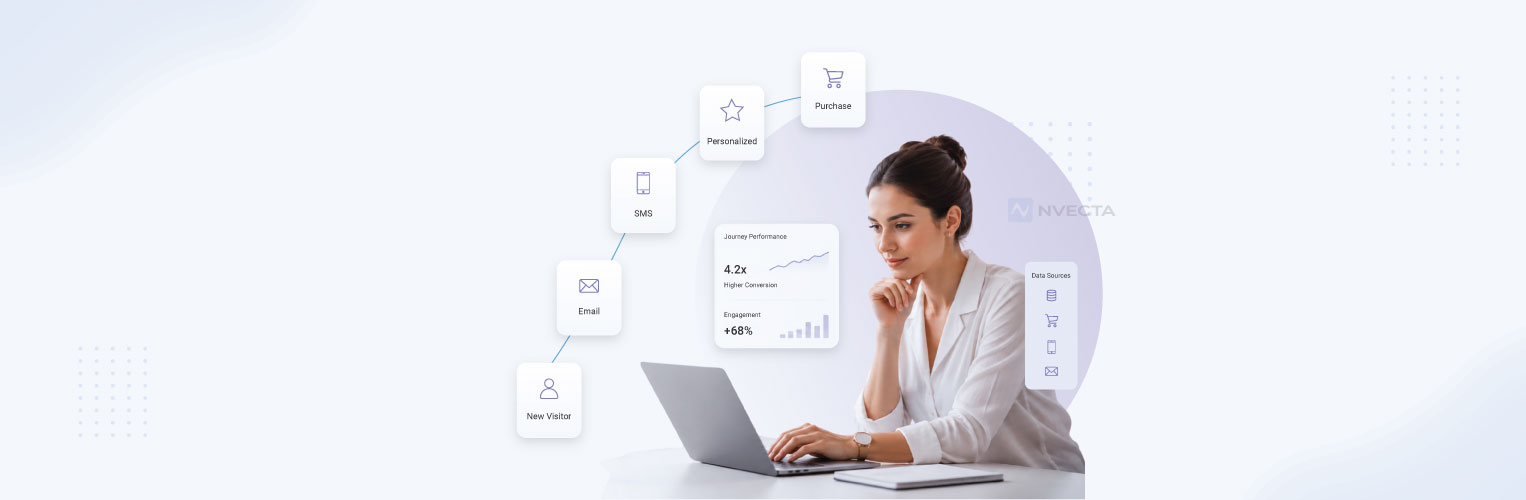
 Afreen Sheikh
Quick Answer
A multi-step customer journey is the structured, data-driven sequence of interactions a business orchestrates to guide a customer from first awareness through purchase, retention, and loyalty — using a CDP to unify behavioural data and marketing automation to trigger the right message at each stage across every channel. Brands using journey-stage automation with a CDP see up to 34% faster time-to-conversion and 28% better cross-channel attribution accuracy compared to batch campaign approaches.
What is a Multi-Step Customer Journey?
A multi-step customer journey is the complete, step-by-step process a person follows from the moment they discover a brand to becoming a loyal customer.
The journey starts through a series of interactions over websites, emails, social media, mobile apps and other touchpoints. Every interaction adds more information and progresses the customer journey.
A well-designed customer journey aligns with customers’ changing needs. Brands can easily guide customers forward by delivering relevant content, timely reminders and behaviour-based recommendations. This creates a smoother experience and speeds up decision-making.
A multi-step journey strengthens brand relationships and drives higher conversion rates, stronger retention, and growth.
Multi-Step Customer Journey Statistics — 2026
The impact of well-built multi-step journeys is measurable. Here is what the 2026 research shows across brands that have combined CDP data unification with journey-stage automation a clear example of how CDPs enhance data activation strategies by turning fragmented customer signals into coordinated, real-time engagement across every touchpoint.
- 34% reduction in time to conversion for teams using journey-stage automation that responds to real-time behavioural signals rather than batch campaign rules. AI-driven trigger sequencing adapts content and cadence to individual engagement velocity, not fixed timelines (DigitalApplied, 2026).
- 28% improvement in cross-channel attribution accuracy for teams using CDPs with AI-powered identity resolution, compared to siloed analytics tools. When every touchpoint is connected to one profile, attribution reflects what actually happened — not just the last click (DigitalApplied, 2026).
- 60–70% of prospects disengage at the consideration-to-decision transition — the most critical drop-off point in the multi-step journey. The cause is consistently misaligned content, delayed follow-up, or channel switching without continuity. A CDP solves the continuity problem; automation solves the timing problem (DigitalApplied, 2026).
- 104% increase in first purchases achieved by Remix, a large retail brand, after building a three-step automated email journey powered by CDP data to educate new leads and guide them to their first transaction (Insider, 2025).
- 80% open rate and 5x ROI from WhatsApp journey automation used by Picniq, a family travel platform, to recover browser abandoners and generate repeat customers — built on unified customer data feeding the right message at the right moment (Insider, 2025).
- 8% revenue uplift achieved by Kiwi.com, a global travel-tech company, from AI-powered journey orchestration that unified channels, customer data, and campaigns into one consolidated automation solution (Bloomreach/Kiwi.com, 2026).
Journey Orchestration vs Marketing Automation — The Difference
These two terms appear together constantly in marketing technology discussions, but they describe meaningfully different capabilities — and understanding the distinction changes how you build journeys.
Marketing automation follows predefined, rule-based workflows. It treats customers in the same behavioural segment the same way — send email A if someone signed up, send email B three days later, send email C if they opened. It is structured, campaign-focused, and efficient for predictable communication sequences.
Journey orchestration is adaptive. It uses real-time data and AI to dynamically determine the optimal next step for each individual customer based on their behaviour as it happens — not as a batch rule decided at campaign setup.
A customer who visits three product pages, adds one to cart, and then views the checkout but exits gets a different next-step than a customer who browses once and never returns. Orchestration reads the signal and responds to the individual. Automation sends everyone down the same branching tree.
A CDP is what makes orchestration genuinely possible. Without a unified, real-time customer profile, the orchestration layer is making decisions with incomplete information. With a CDP underneath, every response is grounded in the full picture of who that customer is and what they have done across every channel — not just what happened in the last email campaign.
In practice, most teams start with automation and graduate to orchestration as their data maturity and CDP capability grows. Both are valuable — but orchestration is where the biggest conversion and retention gains come from.
CDP vs CRM vs marketing automation: who does what
These three get mixed up constantly, partly because they overlap. Here’s the short version.
A CRM stores what you know about a customer from direct relationships: contact details, deal history, support tickets, sales notes. It’s built around the people your team deals with, often by hand.
A CDP pulls behavioural data from everywhere (web, app, email, purchases) and stitches it into one live profile per person. It’s built for scale and updates on its own.
Marketing automation is the action layer. It takes the data and actually sends the message, fires the trigger, and moves the person to the next step.
| Tool | What it does | Built for |
|---|---|---|
| CRM | Stores sales and support history | People your team talks to directly |
| CDP | Unifies behavioural data into one profile | Real-time data at scale |
| Marketing automation | Sends the message and runs the workflow | Acting on the data |
Simplest way to remember it: the CRM is your sales memory, the CDP is your data brain, and automation is the hands that do the work. Most mature setups use all three, with the CDP feeding the other two.
Multi-Step Customer Journey Examples — 3 Industries
The mechanics of a multi-step journey may vary across industries, but the core process remains the same: a CDP brings customer data together, automation triggers the next action, and the customer receives the right message at the right time through the right channel.
This approach also strengthens Cross-Channel marketing by creating a seamless experience across email, SMS, mobile apps, websites, and social media. Here is how it works in three different contexts.
Ecommerce — Cart Abandonment to Loyalty
A shopper browses a product category across three sessions, adds an item to cart on the fourth visit, and leaves without purchasing. The CDP identifies this as a high-intent abandonment signal — not a casual browse.
Within 30 minutes, an automated WhatsApp message with the specific product and a time-limited incentive goes out. The customer converts.
Three days later, a post-purchase onboarding sequence begins. Sixty days after delivery, a repeat purchase prompt is triggered based on the product category and average repurchase window in that segment.
This is the journey Picniq built — and it produced an 80% WhatsApp open rate and 5x ROI. The CDP is what connects the browsing sessions, the cart signal, and the purchase history into one profile that automation can act on.
SaaS — Trial to Paid to Retention
A new trial user signs up and immediately enters a CDP-powered onboarding journey. Day one brings a welcome email with the three actions most correlated with conversion.
Day three, the CDP detects that the user has not completed one of those actions and triggers an in-app nudge with a short video. Day seven, usage data shows the user is engaged — a trial-to-paid conversion prompt goes out with social proof relevant to their industry segment.
Day 14, if they have not converted, a human-assisted outreach is triggered for the sales team. Post-purchase, the retention journey begins: feature adoption tips, quarterly business review invitations, and a churn-risk alert at 30-day inactivity that triggers an automated re-engagement sequence.
Remix built a three-step version of this for new lead nurturing and achieved a 104% increase in first purchases in a single quarter. The CDP is what made the segmentation and timing possible at scale.
Travel — Booking Intent to Post-Trip Win-Back
A traveller searches for flights to a destination across two devices over three days. The CDP resolves the cross-device identity and identifies this as active consideration.
On day four, a personalised email with price alert and hotel pairing goes out. The traveller visits the booking page and abandons — the CDP captures the signal and triggers a retargeting ad within the hour plus an SMS the following morning.
The traveller books directly. Pre-trip: relevant add-on offers (seat upgrade, airport transfer) based on past booking history. In-trip: push notifications with destination tips.
Post-trip: a win-back sequence triggers 45 days after return, referencing the specific trip taken and suggesting the next logical destination based on past travel patterns.
Kiwi.com built a version of this orchestration and achieved an 8% revenue uplift. The multi-step structure — not any individual campaign — is what drives that kind of compound result.
In today’s digital world, customers are highly informed. Every purchase decision is based on strong awareness. They shop across multiple channels, compare prices, read reviews, wait for discounts, and return again and again before making the right choice.
Businesses that succeed are the ones that guide buyers step by step throughout the customer journey. From the first interaction to post-purchase follow-ups, every interaction matters and must feel relevant and personalised.
This is where understanding the differences between CDP and marketing automation becomes essential, helping businesses engage customers effectively through a technology-driven, well-structured approach.
CDP unifies customer data from multiple sources, whereas automation tools use that data to trigger the right message at the right time across channels. This helps brands in delivering personalised experiences that guide customers at every stage of the lifecycle.
In this blog, we will discuss how to build an effective multi-step customer journey using CDP and automation.
How B2B and B2C journeys differ
The examples above are mostly B2C, where one person decides quickly and emotion plays a big part. A traveller books a flight in an afternoon. A shopper grabs a discount before it expires.
B2B works differently. The journey is longer, sometimes months, and the decision rarely sits with one person. You’re nurturing a finance lead, a technical evaluator, and the manager who signs off, often at the same time. The content is heavier too: case studies, ROI breakdowns, and product comparisons rather than flash sales.
So a B2B journey leans on slow, useful nurturing and lead scoring, while B2C leans on speed, timing, and incentives. Same framework, different pace. If you sell to businesses, build for patience. If you sell to consumers, build for the moment.
Single-step vs multi-step: what’s the actual difference?
Most marketing still runs on single-step thinking. You send one email, run one ad, fire one promo, and hope it lands. If it doesn’t, that contact is gone.
A multi-step journey assumes the opposite. One message rarely closes a sale. People need a few nudges, in the right order, before they act. So instead of a single send, you build a connected sequence where each step depends on what the person did in the last one.
Quick way to tell them apart: if your follow-up is the same for everyone no matter how they responded, that’s single-step. If the next message changes based on whether they opened, clicked, bought, or went quiet, you’re running a multi-step journey.
Key Stages of Multi-Step Customer Journey
Awareness stage
This stage involves exploring a brand through ads, social media, and search. They are simply viewing products or services and learning what all things a brand offers and how it is better than others.
With clear messaging and helpful content, a brand can create a strong first impression that captures people’s attention and encourages them to explore the brand further.
Consideration Stage
Here, customers begin their research seriously by comparing different options, reading reviews, exploring features, checking prices, and reviewing detailed product information to check whether it meets their needs.
This stage is important for building trust and supporting informed decision-making.
Conversion Stage
At this stage, the customers’ focus shifts to taking action, such as making a purchase, signing up or requesting a demo.
They still have some doubts. Simple processes, clear call to actions, timely reminders, and encourage them to complete the transaction smoothly.
Retention Stage
Once they become your customers, they expect value and a positive experience. Regular updates on boarding guidance product tips and support help them use the product effectively.
Engaging them consistently improves customer satisfaction, reduces Churn, and increases the likelihood that customers interact with the brand.
Loyalty Stage
With time, satisfied customers develop trust and an emotional connection with the brand. At this stage, they keep returning, making repeat purchases, and may also recommend it to others.
Engaging them with loyalty rewards, exclusive offers, strengthening relationships and turning customers into long-term value.
What to actually measure at each stage
“Test, measure, improve” is easy to say and useless until you know what to look at. Different stages need different numbers.
In the awareness stage, watch reach and new visitors. You’re just checking whether people are finding you at all.
In consideration, engagement is the signal: time on page, return visits, email opens and clicks. These tell you who’s seriously weighing you up.
At conversion, the obvious metric is conversion rate, but also keep an eye on cart abandonment and checkout drop-off. That 60–70% consideration-to-decision leak shows up right here.
For retention, track repeat purchase rate and churn. A customer who bought once and vanished is a different problem from one who keeps coming back.
For loyalty, look at customer lifetime value, referral rate, and how many people respond to your win-back campaigns.
Pick two or three numbers per stage. Tracking forty metrics is the same as tracking none.
Understanding the Role of CDP in Journey Building
Customer Data Platforms are a smart solution for brands to build and manage data throughout multi-step customer journeys. They unify data from multiple interaction channels, such as websites, emails, social media, and mobile apps, to form a single, unified profile for each customer.
For businesses evaluating different approaches to customer data activation, comparing reverse ETL with customer data platforms can help clarify how unified profiles, identity resolution, and real-time engagement capabilities differ across modern data infrastructure strategies.
These profiles are updated in real time as customer preferences shift, giving brands a clear and complete view of how people interact with their brand.
Marketers can access advanced analytics and insights to understand their customers’ real behavioural patterns. They see what customers browse, what they are interested in, how often they engage and where they are in their journey.
This helps engage customers instantly with helpful messages, recommendations, and reminders that align with their intent.
CDPs also have dynamic segmentation and predictive triggers. Segmentation creates different segments based on customers’ behaviour, preferences, purchase history or engagement levels.
These segments update automatically as customers perform an action. Predictive triggers use smart intelligence to predict future customer behaviour and trigger relevant actions that engage them in advance.
CDP is a single, reliable solution that powers your marketing strategies with data-driven engagement and guides customers effectively at every stage of the lifecycle.
Is Collecting All this Data Even Legal?
Fair question, and one most CDP articles skip. Unifying data across email, web, app, and purchase history only works if you’ve collected it with consent.
A few things that matter here. Get a clear opt-in before you track and message someone; a pre-ticked box doesn’t count under GDPR. Keep a record of what each person agreed to, and make it easy for them to change their mind. Honour deletion requests too: if someone asks to be forgotten, the CDP should be able to wipe their profile across every connected channel, not just one.
There’s also a practical reason to care. Third-party cookies are on their way out, so first-party data (the stuff customers hand you directly) is becoming the only reliable foundation anyway.
A good CDP makes this easier because consent lives on the same profile as the behavioural data. But the tool won’t make you compliant on its own. That part is on you.
Understanding the Role of Automation in Building an Effective Customer Journey
Marketing automation is a software technology that allows businesses to manage communication automatically based on predefined rules and real-time customer behaviour.
The system tracks activities such as sign-ups, page visits, purchases, and inactivity duration, and sends the right messages at the right time to engage them.
Marketing teams can stay connected with large audiences and deliver consistent, personalised engagement without manual effort.
Automation plays a significant role in building effective customer journeys by delivering relevant communication at every stage of the lifecycle.
New customers require guidance and clarity, while existing customers require useful offers, discounts, support and personalised experiences.
Automated workflows refine customer communication wherever they are in their journey. For example, a new visitor may receive a welcome email, while a customer who is interested in a product may receive similar product recommendations or reviews.
Such an interaction strengthens engagement. Automation facilitates communication across multiple channels.
It sends messages to customers over their preferred channels. Email, mobile notifications, and in-app messages work together to deliver messages on time.
Thus, continuous, consistent engagement builds stronger multi-step customer journeys and improves business outcomes.
Powering a Multi-Step Customer Journey with CDP and Automation
Building a successful Multi-Step journey depends on insights and meaningful actions. Both CDP and automation tools work together to connect data, communication, and timing, transforming every interaction into a purposeful experience throughout the journey.
Unified Customer View Across All Stages
A full understanding of each customer helps in effective engagement. A CDP consolidates data from all communication channels into a single profile.
Automation utilises this unified view to deliver messages that align with customers’ current stage. This helps interactions feel consistent and well-informed throughout the journey.
Multichannel vs omnichannel
These two words get used like they mean the same thing. They don’t. Multichannel just means you show up on several channels. Omnichannel means those channels share the same customer context, so someone who clicked an email and then opened your app picks up where they left off.
A real multi-step journey needs the omnichannel version. Separate channels that don’t talk to each other will end up contradicting each other.
Real-Time Tracking of Customer Behaviour
Customer interest is evident in ongoing day-to-day activity patterns. Every activity, such as page visits, repeated searches, and inactivity are captured by CDP immediately.
Automation then responds to such behaviour with timely messages, keeping customers engaged when their interest levels are high, and decisions can be made.
Personalised Messages for Every Customer
Every customer expects an experience that reflects their needs and preferences. The CDP builds smart audience segments based on behaviour, interests, and engagement levels, while automation delivers tailored content to each segment in line with their expectations.
Businesses that invest in strategies for effective omnichannel personalization with CDPs can deliver more consistent, relevant experiences across email, mobile, web, WhatsApp, and in-app channels, improving engagement and long-term customer retention.
Automated Lead Nurturing and Follow-Ups
Every potential buyer needs ongoing guidance before making their purchase decision.
Automation sends a structured series of helpful messages to guide them wherever they are in their customer journey, and CDP insights ensure those messages stay relevant without frustrating them.
Strong Retention and Loyalty Building
To retain customers, engagement should continue even after making a purchase. CDP tracks customer satisfaction, and automation sends loyalty rewards, offers, and discounts to long-time customers or those who return frequently.
Valuing your customers and staying connected with them benefits the business in the long term.
Step-by-Step Framework to Build a Multi-Step Customer Journey
Building a strong journey requires a clear, systematic plan. Every step must guide customers forward while fulfilling their expectations.
CDP and automation tools help streamline the process. Let us see the step-by-step framework-
Define Clear Goals
Businesses are required to define clear goals for what they want customers to do at each stage, such as making a purchase or signing up. This helps shape good messages, timing, and success metrics for the entire journey.
Map Customer Touchpoints
Map all the places where customers interact with your brand. By understanding these touchpoints, a connected experience can be delivered.
Segment your Audience Using Data
Create customer groups based on their interests, activity or lifecycle stage. It is essential for relevant communication.
Design Automated Workflows
Create sequences that respond to customer actions, such as welcome messages, reminders or follow-up. Automation helps communicate at the right moment without manual effort.
Personalised Content and Timing
Now is the time to personalise content using insights to craft useful messages and send them at the best time. Delivering the right message at the right time increases engagement.
Test, Measure, and Improve
Track and analyse how customers react to your campaigns and adjust strategies based on real results. Make continuous improvements to create effective journeys and keep them aligned with changing behaviour patterns.
Where these journeys usually go wrong
Most multi-step journeys don’t fail because of bad strategy. They fail because of small, fixable mistakes.
The most common one is sending too much. A new signup who gets five emails in three days unsubscribes faster than one who gets two. More touches isn’t more engagement.
Timing is the next culprit. A cart-abandonment message that lands two days late has missed the moment. The intent was 30 minutes ago.
Then there’s channel fatigue. Hitting the same person on email, SMS, push, and WhatsApp at once feels like being chased, not helped.
And the quiet killer: messages that don’t match what the person just did. If someone bought yesterday and gets a “still thinking about it?” email today, the journey is running on stale data. Usually that means your channels aren’t talking to each other.
How NVECTA CDP and Automation Tools Enable Seamless Multi-Step Customer Journeys
NVECTA is a powerful customer engagement platform with advanced capabilities for managing customer data and automating workflows.
It helps businesses understand customer behaviour and respond quickly with the right message. This approach guides customers smoothly through every step of the journey from discovery to long-term loyalty.
A Complete View of Every Customer in One Place
NVECTA combines all data from a brand’s website, apps, campaign, purchases and interactions to create a single view of each customer.
Businesses gain a clearer picture of customers’ behaviour preferences and their progress along the journey, leading to more thoughtful communication.
Acting on Customer Interest at the Right Moment
Customers often show their intentions through small actions. NVECTA CDP tracks these signals in real time and automatically sends helpful messages, reminders, and suggestions when customer interest is fresh.
Personalised Communication Fits Each Customer
Delivering an effective engagement requires communication that reflects individual customer needs.
NVECTA has smart segmentation that groups customers based on their interests, behaviour, and lifecycle stage.
This ensures each segment receives tailored content that aligns with their level of interest in the product or service.
Consistent Communication Across Every Channel
As customers interact with brands across multiple channels, such as email, mobile notifications, websites, and apps, NVECTA connects and coordinates interactions across these channels so that each message feels like a continuation of a previous interaction.
This helps in delivering consistent communication aligned with the overall customer journey.
Guiding Prospects with Timely and Helpful Follow-Ups
Potential customers require continuous engagement before conversion. NVECTA automatically delivers helpful forward development and useful information that guides prospective customers’ progress through the decision-making process.
Strengthening Relationships After the Purchase
The customer journey continues even after a purchase. NVECTA keeps customers engaged with product updates, feedback requests, and loyalty programs that strengthen long-term relationships.
Insights That Help Move Every Step of the Journey
Every message or interaction provides useful insight. NVECTA analytics help businesses see into engagement patterns and campaign effectiveness, enabling them to refine messaging, targeting, and workflows that create a better experience over time.
Where to start if you don’t have a CDP yet
You don’t need a full CDP on day one. Plenty of teams start with the automation they already have and one clean data source, usually email plus website behaviour.
Build one journey first. Cart abandonment or a welcome sequence are good candidates because the trigger is obvious and the payoff is quick. Get that working, measure it, then add a channel. A realistic first journey takes a couple of weeks to set up, not months.
The CDP becomes worth it once you’re juggling more channels and data sources than a single tool can keep straight. That’s the upgrade point, not the starting line.
Wrap up
To build an effective multi-step customer journey, businesses have to move beyond isolated campaigns.
They have to prefer an effective platform with smart CDP features and automation capabilities to deliver personalised communication at every stage. It will support your marketing goals and long-term business growth without any manual efforts.
Explore how NVECTA powers multi-step customer journeys with CDP and automation. Schedule a demo now.
New to CDPs? Understand how they collect, unify, and activate customer data before building your journey: What Is a Customer Data Platform (CDP)? — Complete Guide
Want to go deeper on journey orchestration specifically? See how NVECTA orchestrates real-time customer journeys across every channel: Customer Journey Optimisation — How to Improve Every Stage
Frequently Asked Questions
What is a multi-step customer journey?
A multi-step customer journey is the structured, data-driven sequence of interactions a business orchestrates to guide a customer from first awareness through purchase, retention, and loyalty. It spans multiple channels (email, SMS, in-app, web, push) and uses a Customer Data Platform to unify customer behaviour data, with marketing automation triggering the right message at each stage based on what the customer actually does — not just which segment they belong to.
How does a CDP support multi-step customer journeys?
A CDP supports multi-step journeys by unifying customer data from every touchpoint — website, app, email, CRM, purchase history, call centre — into a single persistent profile that updates in real time. This unified profile is what marketing automation reads before deciding what message to send, to whom, at what time, on which channel. Without a CDP, automation systems work from incomplete or siloed data, which leads to irrelevant messages, missed triggers, and the 60–70% consideration-to-decision drop-off that fragmented journeys cause.
What is the difference between journey orchestration and marketing automation?
Marketing automation follows predefined, rule-based workflows — everyone in the same segment receives the same sequence. Journey orchestration uses real-time data and AI to dynamically determine the optimal next step for each individual based on their actual behaviour as it happens. Orchestration is adaptive and personalised; automation is structured and campaign-focused. A CDP is what makes true orchestration possible by providing the real-time unified profile that the orchestration layer reads before deciding what to do next.
What are the stages of a multi-step customer journey?
The five core stages of a multi-step customer journey are: Awareness (first discovery through ads, social, and search), Consideration (research, comparisons, and intent signals), Conversion (the purchase or sign-up decision), Retention (onboarding, product adoption, and ongoing value delivery), and Loyalty (repeat purchases, referrals, and long-term brand relationship). Each stage requires different content, channels, and timing — which is why a CDP and automation layer are needed to manage the transitions between stages in real time at scale.
How does NVECTA help build automated customer journeys?
NVECTA combines a Customer Data Platform with omnichannel marketing automation in one platform. It unifies customer data from websites, apps, emails, purchases, and support interactions into a single real-time profile. It then uses dynamic segmentation, predictive triggers, and a journey builder to orchestrate personalised communication across email, SMS, WhatsApp, push notifications, and in-app messaging — all from one place. Marketing teams can build, test, and optimise multi-step journeys without engineering support, and use NVECTA analytics to identify where customers drop off and improve each stage.
