














 Email
Email SMS
SMS Whatsapp
 Web Push
 App Push
 Audience Sync for Ads
 Popups
 Channel A/B Testing
  Control groups Analysis
 Frequency Capping
 Funnel Analysis
 Cohort Analysis
 RFM Analysis
 Signup Forms
 Surveys
 NPS
NPS Landing pages personalization
  Website A/B Testing
  PWA/TWA
 Heatmaps
 Session Recording
 Wix
Wix Shopify
 Magento
 Woocommerce
 eCommerce D2C
  Mutual Funds
 Insurance
 Lending
  Recipes
  Knowledgebase
 Developer Docs
 Product Updates
 App Marketplace
 Academy
 Ebooks
 Case Studies
 Blog
Blog Templates
 Aparupa Saha
Here is something nobody tells you when you are starting out in marketing: the tools are the easy part. Picking them, paying for them, and getting the logins sorted takes an afternoon. Getting them to actually work together? That takes months. Sometimes longer.
Most marketing teams I have come across are not under-tooled. They are over-tooled and under-connected. This is not a fringe problem. In one industry survey, only around a third of marketers said they were actually using their martech stack to its full capability. The tools are there. The value mostly is not.
There is a CRM over here, an email platform over there, analytics in three different places, and somewhere in the middle a spreadsheet that someone built six months ago to make sense of all of it. Sound familiar?
That is the problem a marketing stack is supposed to fix. Not by adding more tools, but by being intentional about which ones you use and how they talk to each other. Platforms like NVECTA, a customer data platform designed to unify customer data across your entire stack, are increasingly what separates teams that have figured this out from those still fighting their own tech.
So what actually goes into a marketing stack, and how do you build one that holds up? Let us get into it.
What Is a Marketing Stack?
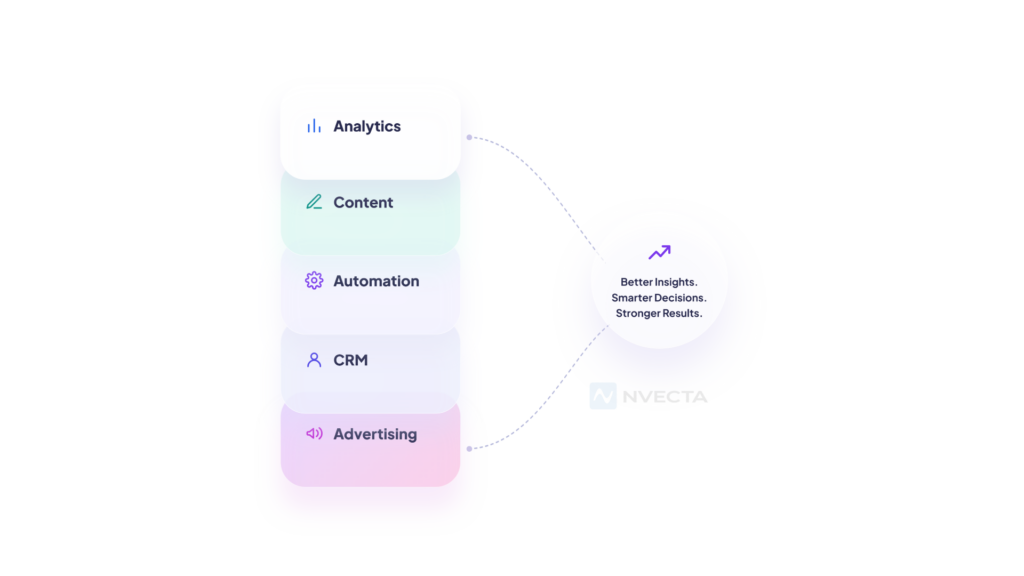
A marketing stack is the complete set of software tools a marketing team uses to plan, run, and measure their work. It covers everything from how you manage customer relationships with Contact Management Software to how you send emails, publish content, run ads, and track what is actually working.
You will also hear it called a martech stack or marketing technology stack. Same thing, different shorthand.
The reason it is called a “stack” is that the tools are meant to layer on top of each other, with data flowing between them. Your CRM informs your email segmentation.
Your analytics feed back into your ad targeting. Your customer data platform spans it all, ensuring every tool works from the same customer data. When that flow works, everything gets faster and smarter. When it does not, you end up with conflicting numbers, duplicated effort, and campaigns built on guesswork.
In a market where personalisation and speed are table stakes, a well-connected marketing stack is not a nice-to-have. It is the difference between marketing that compounds and marketing that just costs money.
How a Marketing Stack Actually Works
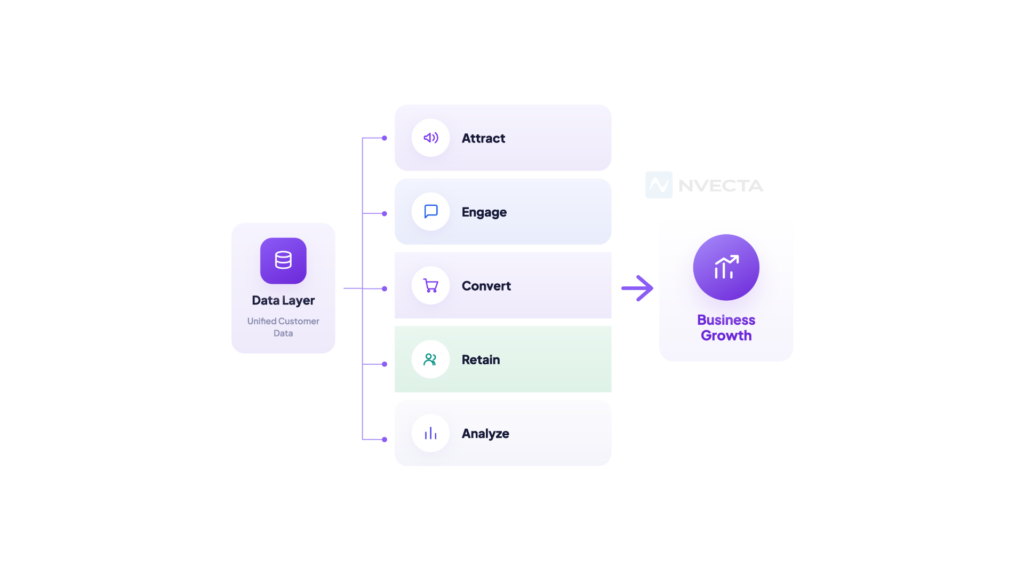
The word “stack” makes it sound static, like shelves. It is closer to plumbing. The whole point is that something moves through it.
Here is what that looks like in practice. Someone lands on your website, and that visit gets logged by your analytics. They fill in a form, and those details drop into your CRM. An enrichment tool checks the record and fills in what is missing.
Your automation platform watches the person’s behaviour, and once they cross a certain score, it hands them off to sales or drops them into a nurture sequence. Nobody exports a spreadsheet. Nobody copies an email address by hand.
The thing that makes all of this possible is integration, usually through APIs and webhooks that let one tool trigger an action in another. When those connections are solid, the stack runs quietly in the background.
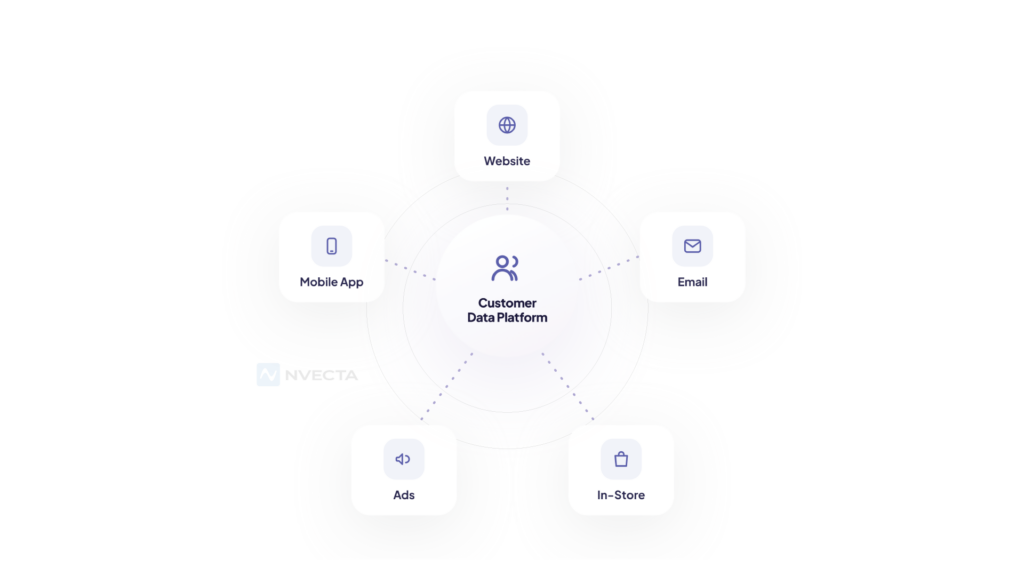
When they are not, every handoff becomes a manual job someone has to remember to do. This is also where a CDP earns its place, sitting underneath everything and making sure each tool is reading from the same customer record rather than its own private copy.
Core Components of a Marketing Stack
There is no universal stack that works for every business. But there are tools that appear in almost every mature marketing setup, each doing a specific job. Here is what those typically look like.
| Component | Function | Example Tools |
| CRM | Manage customer relationships and track pipeline activity | HubSpot, Salesforce |
| Email Marketing | Run nurture sequences and direct campaigns | Mailchimp, Klaviyo |
| CMS | Publish and manage website and blog content | WordPress, Webflow |
| Analytics and Reporting | Measure campaign performance and understand user behaviour | Google Analytics, Mixpanel |
| SEO and Paid Ads | Drive traffic through search and paid channels | SEMrush, Google Ads |
| Social Media Management | Plan, schedule, and monitor social content | Hootsuite, Buffer |
| Marketing Automation | Trigger workflows and automate repetitive campaign tasks | Marketo, ActiveCampaign |
| CDP | Collect, unify, and activate customer data across all tools | NVECTA |
The table above makes it look clean and sequential. In reality, it is messier. Tools overlap. Teams argue about ownership. Someone bought a platform two years ago that nobody uses anymore, but it is still connected to three other things, so nobody wants to touch it.
The point is not to have every category covered. The point is to have the right tools for your specific goals, integrated tightly enough that data moves between them without you having to move it manually.
Attribution Models
One part of analytics worth calling out on its own is attribution, which is how you work out what actually earned the sale. There are three common approaches. First-touch gives all the credit to whatever brought someone in the door.
Last-touch credits the final interaction before they bought. Multi-touch spreads the credit across everything in between. For short B2C purchases, a simpler model often does the job.
For long B2B cycles with a buying committee, multi-touch is usually the only honest picture, because a single deal can involve a dozen touchpoints over six months.
B2B vs B2C Marketing Stacks: How They Differ
This distinction matters more than most people give it credit for. A B2B marketing team and a B2C marketing team can be using some of the same platforms and still need completely different stacks underneath.
| Factor | B2B Stack | B2C Stack |
| Primary Goal | Pipeline generation and account-based marketing | Volume-driven sales and customer retention |
| Sales Cycle | Long, involving multiple stakeholders | Short, often a single decision-maker |
| Key Tools | CRM, LinkedIn Ads, intent data, sales automation | Email, social ads, loyalty programs, retargeting |
| Data Focus | Account and company-level behaviour | Individual customer actions and purchase patterns |
| Content Strategy | Case studies, whitepapers, webinars, demos | Product content, user-generated content, social proof |
A B2B marketer is playing a long game. They are tracking which companies are showing intent, nurturing contacts across a six-month sales cycle, and trying to influence a buying committee of five people.
A B2C marketer is often thinking about this week’s campaign, this weekend’s promotion, and what it takes to get someone who looked at a product page to come back and buy.
Different timelines. Different motivations. Different tools.
What a Real Stack Looks Like
Enough theory. Here are two stacks stripped down to what the tools actually do.
A B2B SaaS stack might run a CRM like HubSpot or Salesforce as the backbone, Marketo for automation and lead nurturing, an enrichment and intent layer to spot which accounts are in-market, GA4 for behaviour, an attribution tool to tie campaigns back to pipeline, and a CDP like NVECTA holding it all together so every tool works from one version of the account.
A B2C ecommerce stack looks different because the job is different. You might see Klaviyo for email and SMS, Shopify as the commerce and content layer,
Meta and Google Ads for acquisition and retargeting, a loyalty or reviews tool for retention, and again a CDP underneath, unifying what each shopper has browsed and bought so the messaging reflects it.
Notice that the categories overlap but the priorities do not. The B2B stack is built to identify and nurture accounts over months. The B2C stack is built to move volume and bring people back. Same shelf, different contents.
How to Build a Marketing Stack: Step by Step
The mistake most teams make when building a stack is starting with the tools. They see a competitor using a certain platform, or they get a good demo from a vendor, and suddenly that tool is in the budget before anyone has asked whether it actually fits.
Start the other way around.
Step 1: Get clear on what you are trying to achieve: Not in a vague “grow revenue” way. Specifically. Are you trying to reduce churn? Generate more qualified leads? Improve email conversion rates? The answer changes, which tools belong in your stack.
Step 2: Audit what you already have: Before you spend anything, know what you are working with. Most teams discover tools nobody remembers buying, overlapping functionality across two platforms, and integrations that broke months ago. This audit usually saves money on its own.
Step 3: Identify where things are breaking down: Look for the friction points. Where is data getting lost? Where are people doing manual work that should be automated? Where does your team lose visibility into the customer journey? Those gaps tell you what to add.
Step 4: Choose tools based on integration, not just features: A tool with impressive features but poor integration capability will cost you more in the long run than a simpler tool that connects cleanly to everything else. Always ask how a new tool talks to your existing stack before you commit. This is also where the suite-versus-best-of-breed question comes up, and there is no universal right answer.
Step 5: Integration architecture: The cleanest way to think about integration is a hub-and-spoke setup. You pick one system as the central source of truth, usually your CRM, a data warehouse, or a CDP, and every other tool reads from and writes back to it. That beats wiring every tool directly to every other tool, which turns into a tangle that breaks the moment you add or remove anything. A couple of practical points here: favour real-time syncing over nightly batch updates where you can, because stale data quietly poisons everything downstream, and lean towards tools with open APIs so you are never locked into one vendor when a better option shows up.
Step 6: Build in a review cycle: Your stack should evolve as your business does. Set a regular rhythm, quarterly works well, to review what is being used, what is delivering value, and what needs to go.
Common Mistakes to Avoid When Building a Stack
A few patterns recur with teams that are struggling with their stack.
Buying tools without a clear owner: Every platform in your stack needs someone responsible for it. Not just in terms of admin access, but someone who understands what it is supposed to do and whether it is doing it. Without that, tools get underused, data goes stale, and you end up paying for something that nobody trusts.
Chasing features over fit: The most sophisticated tool is not always the right one. If your team cannot use it properly or it does not integrate with what you already have, the features are irrelevant.
Ignoring data quality: A stack with poor data hygiene produces poor results regardless of how good the individual tools are. If the same customer exists in your CRM three times, each with a different email address, your personalisation is broken before it starts.
Data hygiene:The fix is not glamorous, but it works. Enrich and check records at the point they enter your system, not months later. Run deduplication rules so the same person does not exist three times over. Keep field formats consistent so “United Kingdom”, “UK” and “U.K.” are treated as one thing. And audit for decay on a schedule, because contact data goes stale on its own whether you touch it or not. Clean data is a habit, not a one-off cleanup.
The Future of Marketing Stacks
A few things are genuinely changing how marketers think about their stacks right now.
AI is getting embedded into the tools themselves, not as a separate add-on but as a core part of how they work. Smarter segmentation, predictive scoring, and automated content variations, these are becoming standard features rather than premium upgrades.
Teams that know how to use them will operate at a speed that teams relying on manual processes simply cannot match. Consolidation is also happening across the industry.
The pitch from many vendors right now is that you can do more with fewer tools. For most teams, a leaner stack that is deeply integrated beats a sprawling one held together with manual exports and crossed fingers.
And first-party data has gone from a best practice to a necessity. With third-party cookies essentially gone, the customer data you collect directly is the only data you can fully trust. Your ability to collect it, unify it, and activate it across your stack is now one of the most important capabilities you can build.
AI Depth
It goes further than smarter features, though. AI agents are starting to handle work that used to sit with people, such as enriching records, scoring leads, and routing them, running quietly against your data layer rather than waiting for someone to press a button.
Predictive scoring is getting better at flagging who is likely to convert before they raise a hand. And generative tools are making it realistic to produce dozens of content variations for testing without a proportional increase in effort.
Many marketing teams also rely on AI tools for LinkedIn to adapt ideas into platform-specific posts, making it easier to maintain a consistent publishing cadence alongside other campaigns
The teams that pull ahead will be the ones whose data is clean and unified enough for these tools to actually trust, which loops right back to the point about first-party data.
Conclusion
A marketing stack is not a shopping list. It is a system, and like any system, its value comes from how the parts work together rather than how impressive each individual piece looks on paper.
The teams that get the most out of their stack are not necessarily the ones with the biggest budgets or the most tools. They are the ones who know exactly what each tool is supposed to do, how it connects to everything else, and what good looks like.
That last part is where data becomes everything. And it is where most stacks quietly fall apart. The CRM has one version of the customer. The email platform has another. The ad platform is targeting based on something else entirely. Nobody agrees on the numbers, and campaigns get built on instinct because nobody fully trusts the data.
NVECTA exists to fix that. As a customer data platform built for marketing teams that take their data seriously, NVECTA brings together customer information from across your entire stack and builds a single, unified view that every tool can work from. Better segmentation, campaigns that actually reflect what your customers have done and where they are in their journey, and reporting you can stand behind when someone asks why you made the decisions you made.
If your stack is generating data but not generating clarity, that is where to start. Take a look at what NVECTA can do for how your tools work together.
FAQs
What is a marketing stack?
A marketing stack is the collection of software tools a marketing team uses to execute campaigns, manage customer data, track performance, and automate workflows. It typically includes a CRM, email platform, CMS, analytics tools, and a CDP, though the exact combination varies by business type and goals.
What is the difference between a marketing stack and a martech stack?
Nothing, practically speaking. Martech stack is shorthand for marketing technology stack. Both refer to the same thing: the set of tools your marketing team relies on to do its work. The terms are used interchangeably across the industry.
What tools should every marketing stack include?
At a baseline, most teams need a CRM for managing customer relationships, an email marketing platform, a CMS for content, an analytics tool for performance tracking, and a CDP to unify data across everything else. From there, the stack grows based on whether your focus is SEO, paid media, social, automation, or some combination.
How is a B2B marketing stack different from a B2C one?
B2B stacks are built around longer sales cycles and multiple decision-makers. They tend to rely heavily on CRMs, account-based marketing tools, and intent data. B2C stacks prioritise speed and volume, leaning into email automation, social advertising, and loyalty or retention tools. The underlying platforms can overlap, but the configuration and priorities look quite different.
What is a CDP, and why does it matter in a marketing stack?
A Customer Data Platform collects and unifies customer data from across all the tools in your stack into a single customer profile. It solves the problem of fragmented data, where your CRM, email platform, website analytics, and ad platforms all hold different pieces of information about the same person. A CDP brings it together so your team and your tools are all working from the same picture.
How does NVECTA help with a marketing stack?
NVECTA is a CDP that connects to the tools already in your stack and consolidates the customer data they generate into unified profiles. This means your segmentation is based on complete data, your campaigns reflect the full customer journey, and your team is not stitching together reports from five different sources to understand what is happening. It is the connective layer that makes the rest of your stack more effective.
Should I use one all-in-one platform or several specialised tools?
It depends on your team’s size and resources. Smaller teams usually do better with an all-in-one suite, because there is far less integration to manage and maintain. Larger teams with dedicated operations people can get more out of best-of-breed tools, picking the strongest option for each job and connecting them properly. The trap to avoid is buying specialised tools you do not have the resources to integrate or run.
How much does a marketing stack cost?
More than the subscription line suggests. The real cost of any tool includes implementation, training, the time your team spends managing it, and the effort to integrate it with everything else. A cheaper tool that nobody can connect or use properly often costs more in the long run than a pricier one that fits cleanly. Before buying anything, it helps to set a clear target for what return would justify the spend.
