














 Email
Email SMS
SMS Whatsapp
 Web Push
 App Push
 Audience Sync for Ads
 Popups
 Channel A/B Testing
  Control groups Analysis
 Frequency Capping
 Funnel Analysis
 Cohort Analysis
 RFM Analysis
 Signup Forms
 Surveys
 NPS
NPS Landing pages personalization
  Website A/B Testing
  PWA/TWA
 Heatmaps
 Session Recording
 Wix
Wix Shopify
 Magento
 Woocommerce
 eCommerce D2C
  Mutual Funds
 Insurance
 Lending
  Recipes
  Knowledgebase
 Developer Docs
 Product Updates
 App Marketplace
 Academy
 Ebooks
 Case Studies
 Blog
Blog Templates
 Afreen Sheikh
An identity graph is the data structure that connects a customer’s scattered data across channels, devices and touchpoints into one resolved identity, built through two methods: deterministic matching, which links exact identifiers, and probabilistic matching, which estimates connections from behaviour.
The challenge comes when businesses have to decide which model is more appropriate for them. Deterministic matching links customer data with more precision and accuracy. Probabilistic matching links data using predictive algorithms instead of exact identifiers.
Businesses mostly use a blend of both approaches. The resolved identity graph also needs both methods working together: deterministic matching for certainty, and probabilistic matching for reach.
This blog covers-
- What is an identity graph?
- The working, advantages, and limitations of deterministic and probabilistic methods
- How NVECTA CDP uses both approaches to build accurate graphs
What Is an Identity Graph
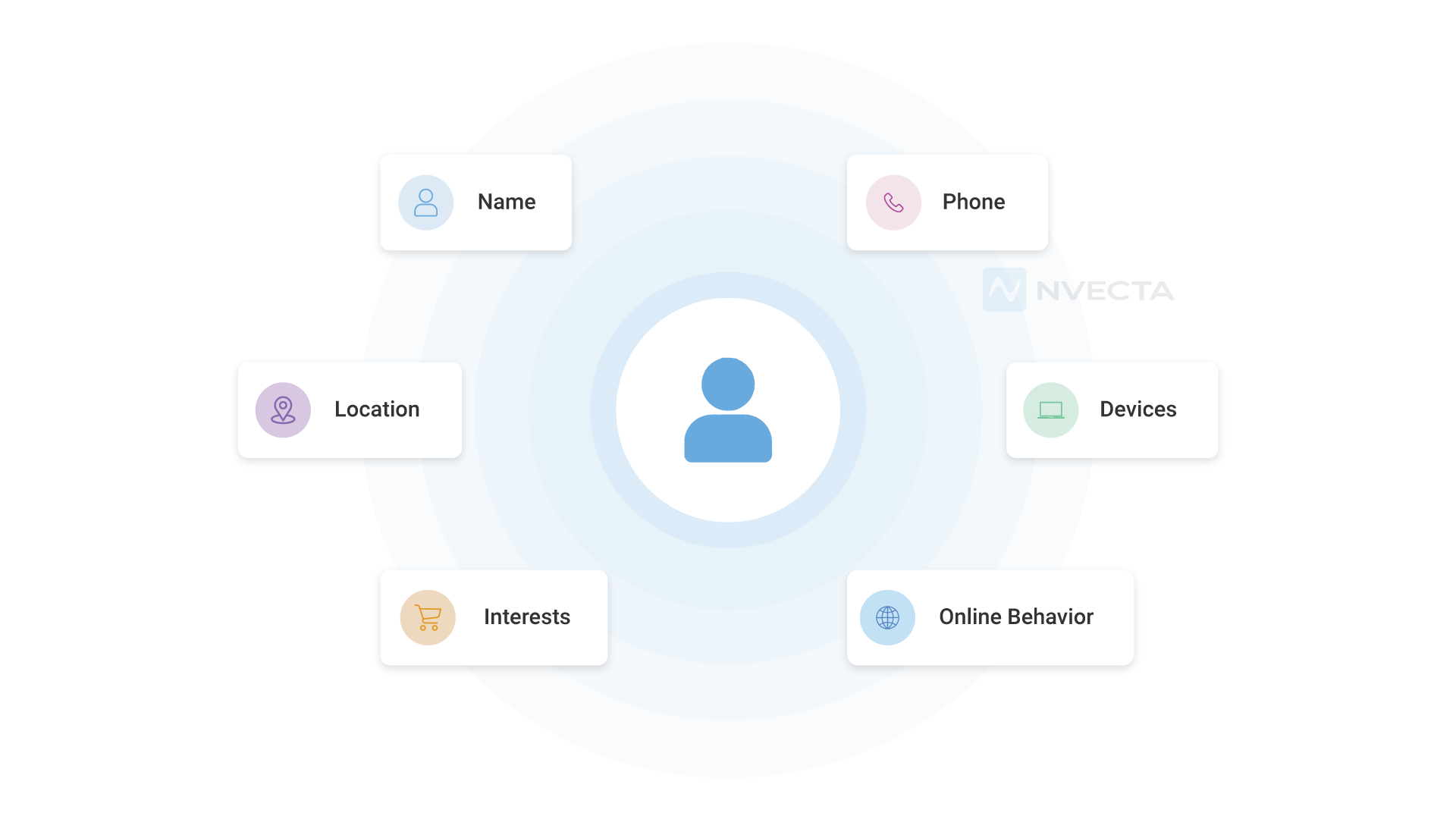
An identity graph is the structure that links every identifier a business collects about one customer- an email from signup, a device ID from the app, a loyalty number from a store visit- into a single resolved identity every system can use.
Nodes and Edges in an Identity Graph
Each identifier a business captures becomes a node: an email from a signup form, a cookie ID from the website, a card number from a till. None of these nodes means anything on their own.
An edge is the connection between two nodes, and it carries a weight based on how that link was made. A login ties an email to a device with full confidence. A shared billing address ties two orders with less certainty. The graph stores the connection and that confidence level together, not just a yes or no.
Identity Graph vs Customer Profile
A system generates identity-resolved customer profiles by reading the graph and collecting every node it finds for one person, then presenting that as a single record with a name, purchase history, and preferences.
Change a connection in the graph, and the profile changes with it. This is also why two teams can see different profiles from the same underlying data: if one team’s matching rules link a record the other team’s rules leave out, the profile each team sees will differ, even though the raw data behind both is identical.
What Is Deterministic Matching
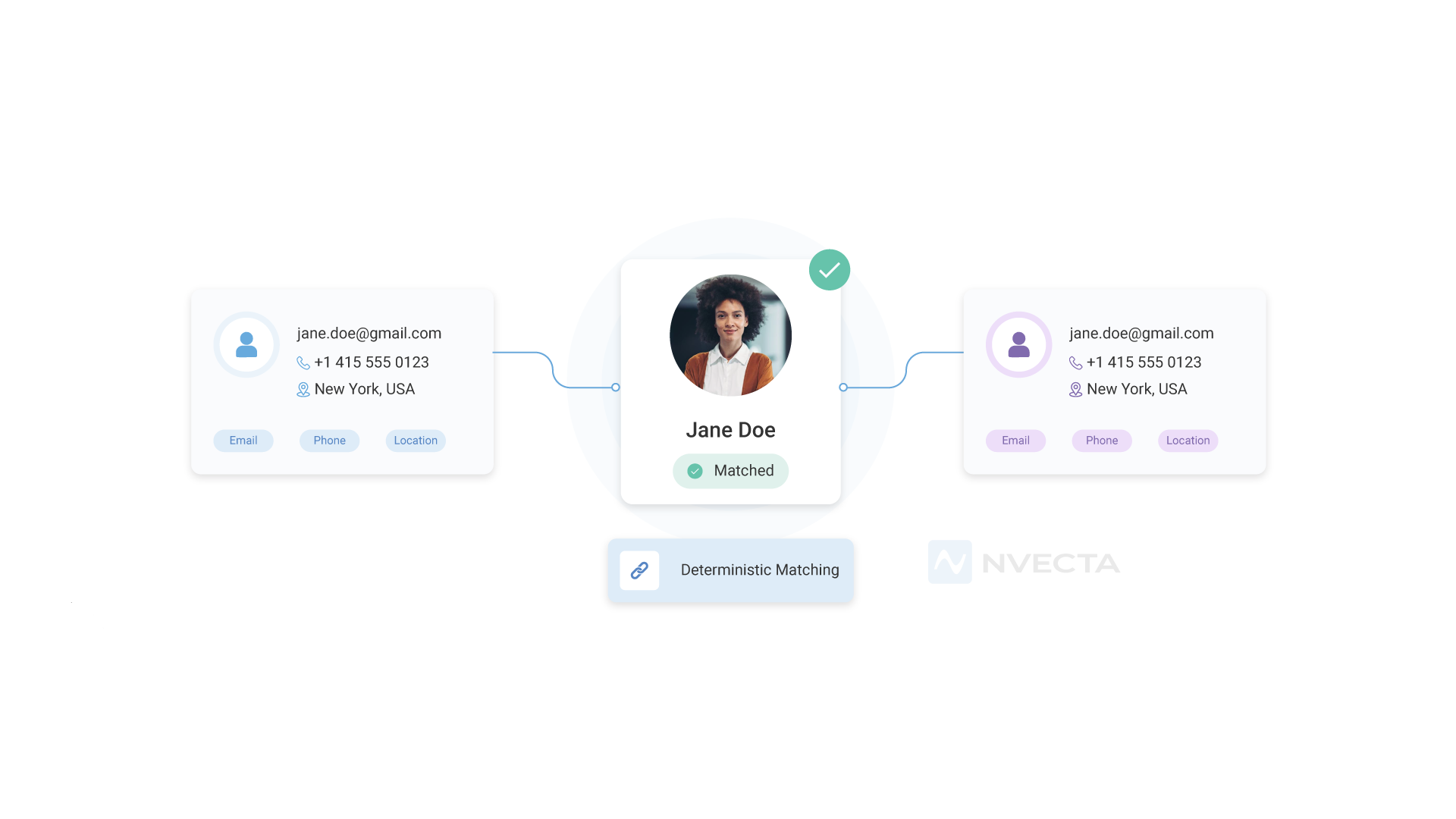
Deterministic matching links two records only when a shared identifier matches exactly: an email address, phone number, or account ID captured directly from a customer. There’s no scoring involved; a value either matches character for character or the records stay unconnected.
How Deterministic Matching Works
Deterministic matching runs in a fixed sequence, checking one identifier at a time until it finds a confirmed link between two systems.
Step 1: Identify a Trusted Identifier
The system looks for identifiers a customer gave directly to the business, an email used at checkout, a phone number given to support, an account ID created at signup.
Step 2: Compare Records Across Systems
It reads that identifier from two separate records, say a CRM entry and a website login, and checks whether the values are identical, letter for letter.
Step 3: Confirm or Reject the Link
A full match ties the two records into one identity immediately. Anything less- a missing digit, a different domain- keeps the records apart.
Step 4: Use the Match as an Anchor
Once confirmed, that link becomes a fixed point. Every other matching method treats it as ground truth and builds new connections around it.
Advantages of Deterministic Matching
- The match is exact, so greater accuracy is achieved.
- Every connection traces back to a specific identifier, which makes audits simple.
- Regulated industries like finance and healthcare rely on it, since a decision-maker can explain exactly why two records were linked.
- It builds trust with customers, since the platform only acts on confirmed identity.
Limitations of Deterministic Matching
- It misses any customer who hasn’t shared a matching identifier yet, so coverage stays limited.
- A typo in an email or phone number, or an outdated value breaks the match completely, even when it’s clearly the same person.
- A work email used at signup and a personal email used at checkout carry no shared identifier, even for the same person.
- A shared device or shared broadband connection can carry two different people’s activity under what looks like one identifier.
What Is Probabilistic Matching
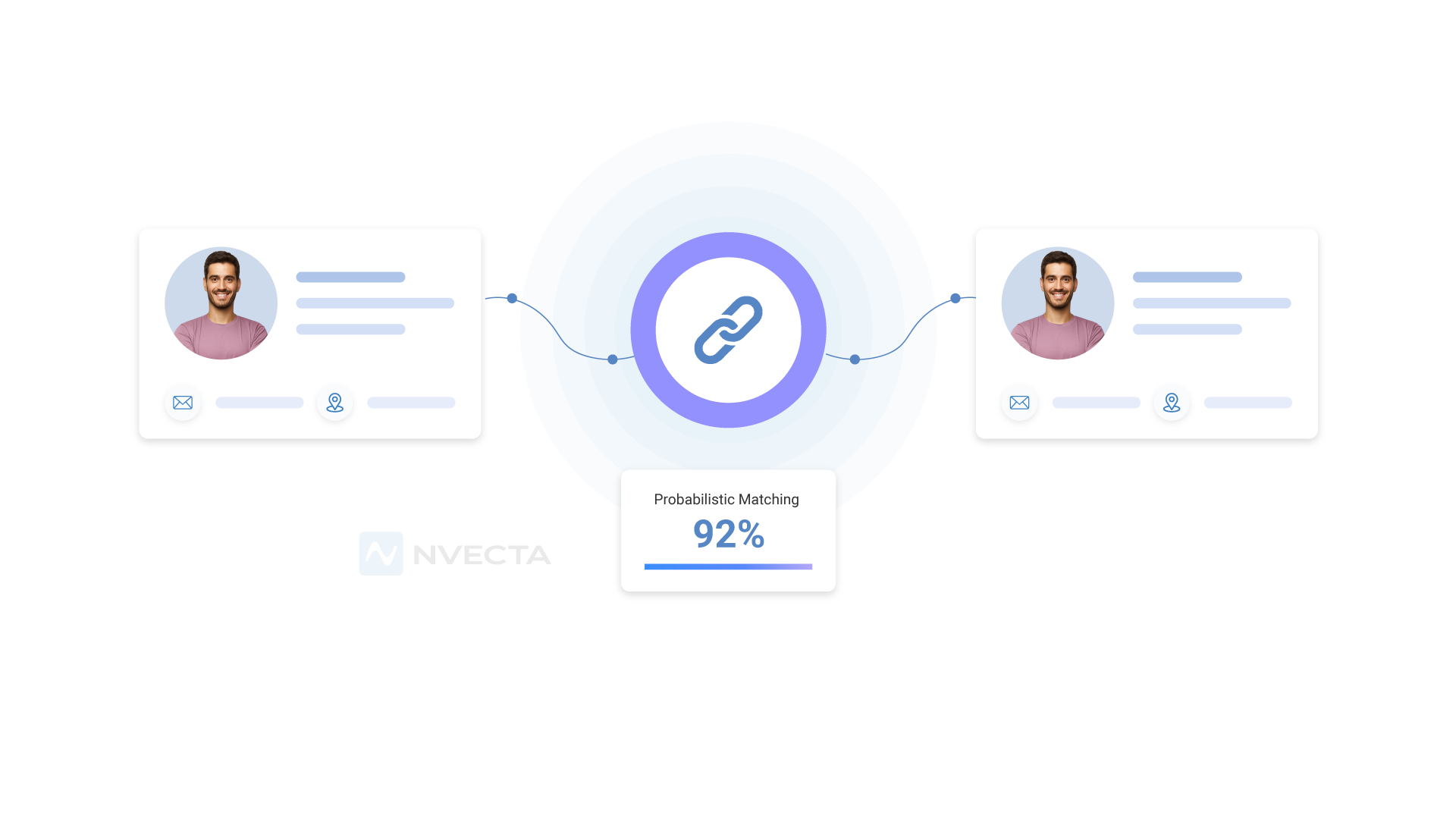
Probabilistic matching links two records when several signals together suggest they belong to the same person, even though no single identifier proves it. The system weighs signals using predictive algorithms such as device use, timing, and location, then assigns a score to the possible connection.
How Probabilistic Matching Works
Probabilistic matching runs as a scoring process rather than a fixed check, and it adapts as soon as new data comes in.
Step 1: Collect Signals Where No Exact Identifier Exists
When two records share no identifier, the system gathers what it does have: session timing, pages viewed, device type, general location.
Step 2: Weigh Each Signal Against the Others
No single signal proves a match on its own. The model weighs them together, giving more weight to rarer, more specific patterns and less to common ones.
Step 3: Assign a Score
The combined signals produce a score, usually between zero and one, showing how likely the two records belong to the same person. Most probabilistic systems use a tiered scoring system, not just one cutoff. See these scores assigned to actions.
0.90 and above — Auto-merge
0.70 to 0.89 — Review before merge
Below 0.70 — Keep separate
Thresholds can vary across businesses.
Step 4: Apply a Threshold and Keep Learning
Only scores above a set threshold create a link. The system refines that threshold over time, as confirmed matches show which signal patterns actually hold up.
Advantages of Probabilistic Matching
- It connects sessions where no login or identifier exists, recovering customer data that deterministic matching misses.
- It keeps learning as new behaviour comes in, so match quality can improve over time.
- It handles messy, incomplete data without breaking the whole process.
- It extends reach into the early stages of a customer journey, before someone signs up or logs in.
Limitations of Probabilistic Matching
- A low-quality signal can produce a confident-sounding score that’s still wrong.
- Two people sharing a device can get merged into one identity by mistake.
Deterministic vs Probabilistic Matching: Key Differences
The difference sits in what each method needs before it links two records. Deterministic matching needs one identifier to match exactly. Probabilistic matching needs enough related signals pointing in the same direction, even without a shared identifier.
A glance-
| Factor | Deterministic Matching | Probabilistic Matching |
| Output | Exact match, yes or no | Confidence score |
| Data needed | Complete, exact identifiers | Behavioural and contextual signals |
| Accuracy | Very high when data is clean | Varies with signal quality |
| Auditability | Easy to trace and explain | Needs documented thresholds |
| Best use | Compliance, known customer actions | Anonymous sessions, early funnel data |
| Regulatory fit | Straightforward under GDPR and CCPA | Needs stronger consent documentation |
| Scalability | Limited by identifier coverage | Scales across incomplete data |
Which One Is More Accurate?
Deterministic matching creates stronger identity links because it uses confirmed identifiers such as email or customer ID. Probabilistic matching connects more identities because it also uses multiple signals when no confirmed identifier exists.
How Deterministic and Probabilistic Matching Work Together
Deterministic matching sets the anchor points, the records you can trust without question. Probabilistic matching builds around those anchors, connecting touchpoints that share no exact identifier but clearly belong to the same person.
Together, these methods support cross-channel identity resolution across customer touchpoints.
Where Transitive Matching works
Some identity graphs add a third layer called transitive matching. If record A matches record B, and record B matches record C, the system can connect A to C without a direct connection between them.
This turns isolated matches into a connected web. It also carries risk, since one weak link can merge unrelated records into the same identity.
Why One Graph Isn’t Always Enough
Different teams need different levels of certainty from the same data. Compliance needs proof before acting on a record, while marketing can work with a reasonable estimate to grow reach.
A single graph tuned for one team usually fails the other. The fix is a shared foundation of resolved identity, with separate graphs layered on top, each tuned to what a team actually needs.
Identity Graph Matching by Industry Use Case
The right mix of deterministic and probabilistic matching changes depending on the business model you operate in. An ecommerce, retail, SaaS, subscription-based, or BFSI business holds different data, so the balance looks different for each one.
Ecommerce and Retail
- Deterministic matching recognises a returning shopper the moment they log in or check out with a saved email.
- Probabilistic matching picks up browsing that happens before that, product views, cart activity, and repeat visits from an anonymous device.
- Together, they let a retailer trigger a cart recovery email to a known customer and still catch a shopper who came back to look at the same product twice.
SaaS and Subscription-Based
- Deterministic matching ties activity to a signup email or account ID from day one, when data volume is small and a wrong match carries higher stakes.
- Probabilistic matching connects related accounts as usage builds up across free trials, multiple logins, and team seats.
- This mix helps a business spot which free users behave like a paying account before they ever convert.
- It also links usage across devices for the same subscriber, so churn signals don’t get missed on a device the account isn’t logged into.
BFSI
- Deterministic matching carries most of the weight here, tying records together through account numbers, PAN, and verified contact details.
- Probabilistic matching adds a second layer, flagging accounts that behave like the same customer without a confirmed identifier, useful for fraud checks.
- Every match needs a clear audit trail, since regulators expect a business to explain exactly why two records were linked.
- A wrong match carries real cost here, a missed fraud signal or an incorrect account merge, so thresholds stay tighter than in other industries.
Privacy, Compliance, and Data Governance in Identity Resolution
Every identity match carries a privacy cost, and the method used changes what a business owes its customers. Deterministic matching relies on data customers gave directly, while probabilistic matching infers a connection they never confirmed.
Consent and Regulatory Fit for Each Method
Deterministic matching works on data a customer gave you directly, an email at signup, a phone number on an account. That makes consent straightforward under GDPR and CCPA.
Probabilistic matching infers a connection the customer never explicitly confirmed, which means the model’s decisions need documentation. As third-party cookies phase out, first-party behavioural data carries more of that responsibility.
A Data Governance Checklist Before You Match
- Confirm the legal basis for using each identifier before it enters the graph.
- Set a retention window and delete identifiers that fall outside it.
- Log every match decision so you can trace why two records got linked.
- Document the threshold used for probabilistic matches and review it on a schedule.
How NVECTA Builds Identity Graphs: AI-Powered Hybrid Matching
NVECTA is an AI-powered customer data platform that uses identity graphs to unify a business’s customer data into one resolved profile. Deterministic and probabilistic matching are the two methods working underneath that resolution; exact identifiers confirm the anchors, and scored signals extend the graph around them.
Real-Time Customer Data for Identity Matching
NVECTA CDP works with live customer data. A match reflects what a customer is doing right now, which matters for precise targeting and personalisation.
Deterministic Matching for Confirmed Identifiers
NVECTA confirms exact identifiers- an email, a phone number, an account ID- as trusted anchors. These anchors give every other match a solid foundation to build on.
Probabilistic Matching for Behavioural Signals
NVECTA uses a predictive model to score behaviour, timing, and device use to connect records that share no exact identifier. It learns from a business’s own customers to spot patterns that signal a likely match and build more accurate identity connections.
Review for High Confidence Matches
NVECTA sends borderline scores to a review step before any merge happens. This paves the way for more accurate records.
Configurable Match Sensitivity by Industry
Match sensitivity can shift by industry. A bank can set a tighter bar for certainty; a retailer can set a looser one for reach, both inside the same engine.
Continuous Identity Graph Updates
NVECTA rechecks connections every time new customer events arrive. A customer’s first login connects back to months of earlier activity the moment it happens.
Warehouse Native Identity Resolution
Every match stays traceable, since resolution happens inside a business’s own warehouse. Teams can see why two records were linked, without a separate vendor system in between.
One Identity Graph for Every Team
One resolved graph serves every team. A support agent, a marketer, and a finance analyst each work from the same identity for their own decision needs.
Conclusion
Without a unified, organised view, businesses struggle to understand their customers. A reliable platform needs an identity graph built on deterministic and probabilistic matching. It should process scattered customer data, connect related identities, and build one trusted profile for each customer.
NVECTA CDP combines both approaches to build that graph by confirming identifiers first and scoring behaviour around them, inside a business’s own warehouse.
See how a stronger identity graph turns data into one trusted view with NVECTA. Schedule a demo now.
Frequently Asked Questions
What is the difference between deterministic and probabilistic matching?
Deterministic matching links records through an exact identifier, such as an email address, phone number, customer ID, or system IDs. That gives a clear identity link. Probabilistic matching uses behaviour and context when no exact identifier exists. It weighs several signals and gives each match a score.
Is an identity graph the same as a customer profile?
No. An identity graph maps links between identifiers across customer data. A customer profile brings those linked records into one view. So, profile quality depends on how well the identity graph connects those records.
Can deterministic and probabilistic matching be used together?
Yes. Most identity graphs need both methods. Deterministic matching creates trusted identity links. Probabilistic matching adds links when direct identifiers are missing. NVECTA brings both methods into one identity process, so strong matches and broader identity coverage work together.
What is the difference between an identity graph and identity resolution?
Identity resolution is a process that matches records of a single customer scattered over multiple channels, devices, and touchpoints to create one unified trusted view. An identity graph shows those connections. It maps how known and anonymous identifiers relate and gives each match a confidence level when needed.
Do I need an identity graph if I already have a CDP?
Yes. An identity graph gives a CDP its identity structure. Without one, one customer may appear as separate records across different channels. That leaves customer data fragmented and gives teams an incomplete view of customer activity.
Which matching method is better for compliance?
Deterministic matching tends to work better for compliance, since every match has a verified identifier behind it, which makes it easy to review later. Probabilistic matching can still play a part, but only with clear rules, confidence limits, and an audit trail in place before it affects anything compliance-sensitive.
