



 Email
 SMS
 Whatsapp
 Web Push
 App Push
 Audience Sync for Ads
 Popups
 Channel A/B Testing
 Control groups Analysis
 Frequency Capping
 Funnel Analysis
 Cohort Analysis
 RFM Analysis
 Signup Forms
 Surveys
 NPS
 Landing pages personalization
 Website A/B Testing
 PWA/TWA
 Heatmaps
 Session Recording
 Wix
 Shopify
 Magento
 Woocommerce
 eCommerce D2C
 Mutual Funds
 Insurance
 Lending
 Recipes
 Knowledgebase
 Developer Docs
 Product Updates
 App Marketplace
 Academy
 Ebooks
 Case Studies
 Blog
 Templates
 Jack Harry
Ask your SEO agency how your brand shows up in ChatGPT and watch what happens. Most will pull up a rank tracker, point to a few page-one positions, and tell you the AI answers will follow. Sometimes that’s true. Often it isn’t, and the gap between “we rank” and “AI recommends us” is where a lot of companies are quietly losing deals in 2026.
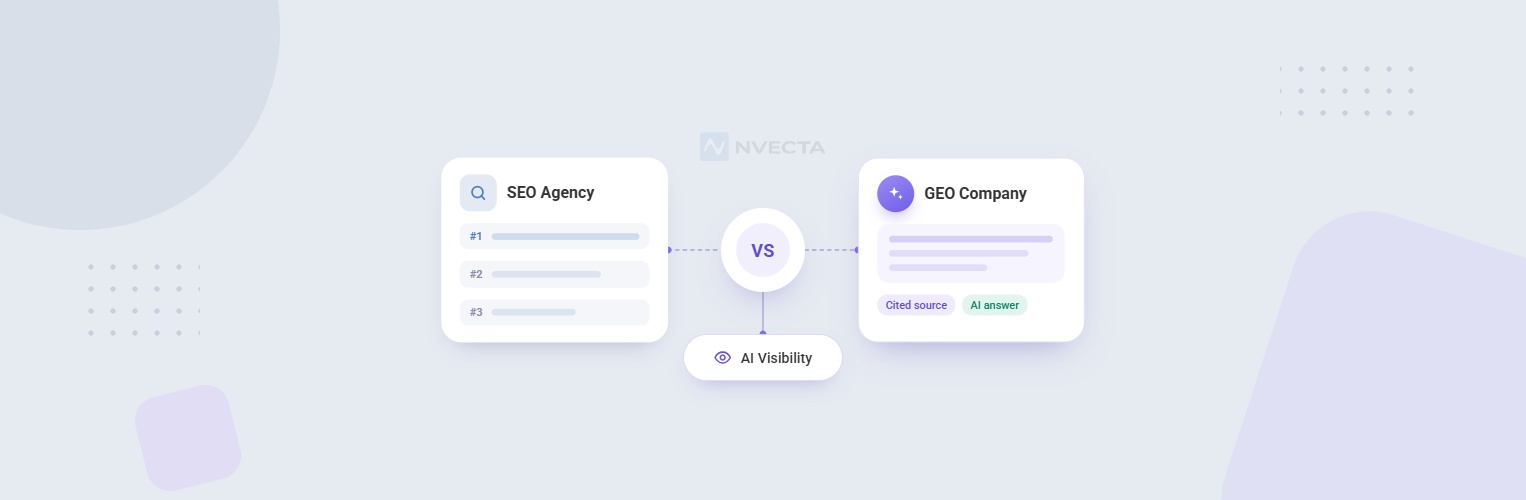
A generative engine optimization company shapes how AI systems like ChatGPT, Gemini, Perplexity, and Google’s AI Overviews describe, cite, and recommend a brand. Where an SEO agency works to rank your pages, a GEO firm works on the sources AI models trust, the facts they repeat about you, and whether your name appears in the answer at all.
So who should own AI visibility? Our position: a generative engine optimization company should own it, and your SEO agency should stay on as the technical foundation underneath. Here’s why, and how to split the work so nobody falls through the cracks.
What does a generative engine optimization company actually do?
The work looks different from SEO because the target is different. An SEO agency optimizes for a list of ten blue links. A GEO firm optimizes for a single synthesized answer that may cite five sources, none of which are yours.
In practice, that means a GEO engagement usually covers:
- Running the prompts buyers actually type (“best reputation firm for a healthcare company,” “is [brand] legit?”) across several AI platforms and recording what comes back
- Tracing every claim in those answers to the source the model pulled it from
- Fixing or replacing the sources that carry outdated, negative, or flat-out wrong information
- Earning coverage in the publications, directories, review platforms, and reference sites that AI models cite most
- Structuring your own content so it’s easy for a model to extract and quote
Notice how little of that list involves your website. That’s the point.
Why ranking on Google no longer guarantees AI visibility
For years, a good SEO agency could promise that page-one rankings meant visibility. AI answers broke that promise in two ways.
First, fewer people click through. SparkToro’s analysis of Similarweb clickstream data found that 68% of U.S. Google searches ended without a click from January through April 2026, up from about 60% in 2024. Ahrefs, studying 300,000 keywords, found that the number-one result loses 58% of its clicks on average when an AI Overview sits above it. You can hold the top spot and still watch traffic drain away.
Second, and this is the part SEO agencies tend to underplay, AI assistants often cite pages that don’t rank at all. In an Ahrefs study of 15,000 long-tail prompts, only about 12% of URLs cited by ChatGPT, Gemini, and Copilot appeared in Google’s top 10 for the same query. ChatGPT’s in-text citations matched the top 10 just 8% of the time. Perplexity tracked Google more closely at roughly 29%.
Google’s own AI Overviews are the exception. Ahrefs found that about 76% of AI Overview citations come from top-10 pages, which is why SEO still matters a great deal there. (Worth noting: that overlap study was published in August 2025, and the AI platforms update their retrieval constantly, so treat the exact percentages as directional.)
Put those findings together, and the picture is clear. Ranking well helps you inside Google’s AI features. It does very little to guarantee you show up when a buyer asks ChatGPT for a shortlist.
What a good SEO agency does well (and should keep doing)
None of this makes your SEO agency obsolete. Strong technical SEO is the floor every AI visibility strategy stands on.
AI crawlers need to reach and read your pages. If your site leans on JavaScript that never renders for bots, your best content is invisible to models no matter how well it’s written. Your SEO agency is the right team to handle:
- Crawlability and rendering: making sure GPTBot, PerplexityBot, Google-Extended, and other AI crawlers can actually fetch and read your content
- Site architecture: clean internal linking, sensible URL structures, and pages that answer one question well instead of five questions badly
- Structured content: clear headings, definitions near the top of pages, and FAQ sections that make extraction easy
- Google rankings: still the main input for AI Overviews and AI Mode, and still a major source of traffic and leads
If your SEO agency does those four things well, keep them. Just don’t expect them to fix what happens off your site.
Where SEO agencies run out of road
Here’s the uncomfortable math for anyone who thinks AI visibility is an SEO deliverable. Muck Rack’s Generative Pulse research analyzed more than 25 million links cited by ChatGPT, Claude, and Gemini and found that 84% of AI citations in its May 2026 edition came from earned media: journalism, research, government sources, encyclopedic sites, and third-party content. Paid and advertorial content accounted for 0.3%.
Your own blog falls outside that 84%. So does most of what a typical SEO retainer produces.
AI models discount what a brand says about itself and lean on what others say about it. That pushes the work into territory most SEO agencies don’t staff for:
- Digital PR and journalist relationships: Getting quoted in the trade publications and news outlets models cite takes media relations, not link building.
- Review and directory management: When a model answers “is this company trustworthy?”, it often summarizes reviews from G2, Clutch, Trustpilot, Google, and Reddit threads.
- Narrative control: If an old lawsuit, a layoff story, or a single angry forum post is the most-cited source about you, no amount of on-page optimization will change what the model says. Someone has to build better sources or address the bad one.
- Entity accuracy: Wrong founding dates, a former CEO still listed as current, a discontinued product described as your main offer. Models repeat these errors until the underlying sources change.
That last category matters more than it sounds. An Idea Grove survey of 1,000 U.S. consumers, published in April 2026, found that 42% of Americans already use ChatGPT for brand research, and 98% verify an AI-recommended brand before buying. Forty-five percent go straight to Google, and 18% head directly to review sites. AI visibility and reputation are now the same problem viewed from two angles.
Generative engine optimization company vs. SEO agency: side by side
| SEO agency | Generative engine optimization company | |
|---|---|---|
| Primary goal | Rank pages in search results | Get cited and recommended in AI answers |
| Main battleground | Your website | The sources AI models trust about you |
| Core skills | Technical SEO, content, link building | Digital PR, reputation management, prompt testing, source analysis |
| Key metric | Rankings, organic traffic | Brand mentions, citation share, sentiment in AI answers |
| What it can’t fix alone | A negative or inaccurate story on third-party sites | A site AI crawlers can’t render |
So who should own AI visibility?
Ownership should sit with whoever controls the most important inputs. For most brands, that’s the sources outside your website, which puts a generative engine optimization company in the driver’s seat.
The exceptions are real, though, and worth being honest about:
- You’re a local business with a simple reputation: If your buyers mostly search Google and you have no reputation problems, your SEO agency can probably handle AI Overviews on its own. Strong Google Business Profile work and local rankings will do most of the lifting.
- You sell B2B or high-consideration services: Buyers ask ChatGPT and Perplexity for shortlists. A GEO firm should own it, because those platforms barely overlap with Google’s top 10.
- You have a reputation issue anywhere in search: A GEO firm with reputation management experience should own it, full stop. Models amplify whatever negative source is most authoritative, and an SEO retainer isn’t built to suppress or replace those sources.
- You’re an executive or public-facing founder: AI answers about people pull heavily from news coverage, bios, and Wikipedia-style sources. That’s PR and reputation work, not on-page optimization.
This is the gap firms like NetReputation were built around. Reputation management firms have spent years working on the exact sources AI models now cite (news coverage, review platforms, profiles, and third-party articles), so the move into GEO was a short one. An SEO agency moving into GEO has a much longer walk.
How to split the work without a turf war
The best setups we’ve seen treat AI visibility as a relay rather than a competition. Here’s a clean division of labor:
- The GEO firm sets the agenda: It runs monthly prompt testing across ChatGPT, Gemini, Perplexity, Copilot, and Google AI Mode, then identifies which sources are shaping the answers and which ones need work.
- The SEO agency fixes the foundation: It handles crawlability, rendering, schema where it’s useful, page structure, and the on-site content the GEO audit flags as missing.
- The GEO firm handles the off-site work: Digital PR, review generation, directory cleanup, correcting factual errors at the source, and suppressing or outweighing harmful content.
- Both report against the same prompts: Pick 20 to 50 buyer-intent prompts and track mention rate, citation sources, and sentiment monthly. Rankings stay on the SEO report, but they stop being the headline number.
That fourth step is where most companies fall down. Without a fixed prompt set tracked over time, AI visibility turns into anecdote. Someone screenshots a good ChatGPT answer, someone else screenshots a bad one, and nobody knows which is the trend. Ongoing AI visibility monitoring for brands solves this by running the same prompts on a schedule and tracing every answer back to its sources, so you can see what changed and why.
Questions to ask before you hire either one
Whether you’re evaluating a new generative engine optimization company or pressing your current SEO agency on its AI plans, these questions separate the real operators from the rebrands:
- Prompt coverage: Which prompts will you track, and on which platforms? A vague answer means they haven’t built a process. Expect a named prompt set and at least four platforms.
- Source tracing: How do you trace an AI answer back to its sources? If they can’t show you which pages a model relied on, they can’t tell you what to fix.
- Off-site fixes: What do you do when the problem is a third-party page? Listen for PR, review management, content removal, or suppression. “We’ll publish more blog posts” is the wrong answer.
- Guarantees: Do you promise specific AI wording? Anyone who says yes is overpromising. Models change weekly. Credible firms promise process and measurement, not exact output.
- Collaboration: How will you work with our SEO team? A good GEO firm will want your SEO agency involved, not replaced.
Frequently asked questions
Is generative engine optimization just SEO with a new name?
No. SEO targets rankings on your own pages, while generative engine optimization targets what AI models say about you, which depends mostly on third-party sources. They share technical foundations like crawlability and clear structure, but GEO relies far more on digital PR, review management, and source correction than a typical SEO retainer does.
Can my SEO agency handle AI visibility on its own?
Sometimes, if your buyers mainly use Google and your reputation is clean, since Google’s AI Overviews pull heavily from top-ranking pages. For brands whose buyers use ChatGPT or Perplexity, or brands with any negative coverage, an SEO agency alone usually can’t control the off-site sources those platforms cite.
How do you measure AI visibility?
Pick a fixed set of buyer-intent prompts and run them monthly across ChatGPT, Gemini, Perplexity, Copilot, and Google AI Mode. Track how often your brand is mentioned, which sources the answers cite, whether the facts are accurate, and whether the tone is positive, neutral, or negative compared with previous months.
How long does generative engine optimization take to show results?
Fixing technical issues and on-site structure can show up within weeks, especially in Google’s AI features. Changing what ChatGPT or Gemini says about a brand usually takes several months, because it depends on earning new third-party coverage and on models re-crawling or retraining on updated sources.
What should a generative engine optimization company cost?
Pricing varies widely based on scope. Monitoring-only engagements cost less than full programs that include digital PR, review management, and content remediation. Be wary of flat packages promising guaranteed AI placements, since no firm controls model output. Ask for a scope tied to specific prompts and measurable citation goals.
