













 Email
Email SMS
SMS Whatsapp
 Web Push
 App Push
 Audience Sync for Ads
 Popups
 Channel A/B Testing
  Control groups Analysis
 Frequency Capping
 Funnel Analysis
 Cohort Analysis
 RFM Analysis
 Signup Forms
 Surveys
 NPS
NPS Landing pages personalization
  Website A/B Testing
  PWA/TWA
 Heatmaps
 Session Recording
 Wix
Wix Shopify
 Magento
 Woocommerce
 eCommerce D2C
  Mutual Funds
 Insurance
 Lending
  Recipes
  Knowledgebase
 Developer Docs
 Product Updates
 App Marketplace
 Academy
 Ebooks
 Case Studies
 Blog
Blog Templates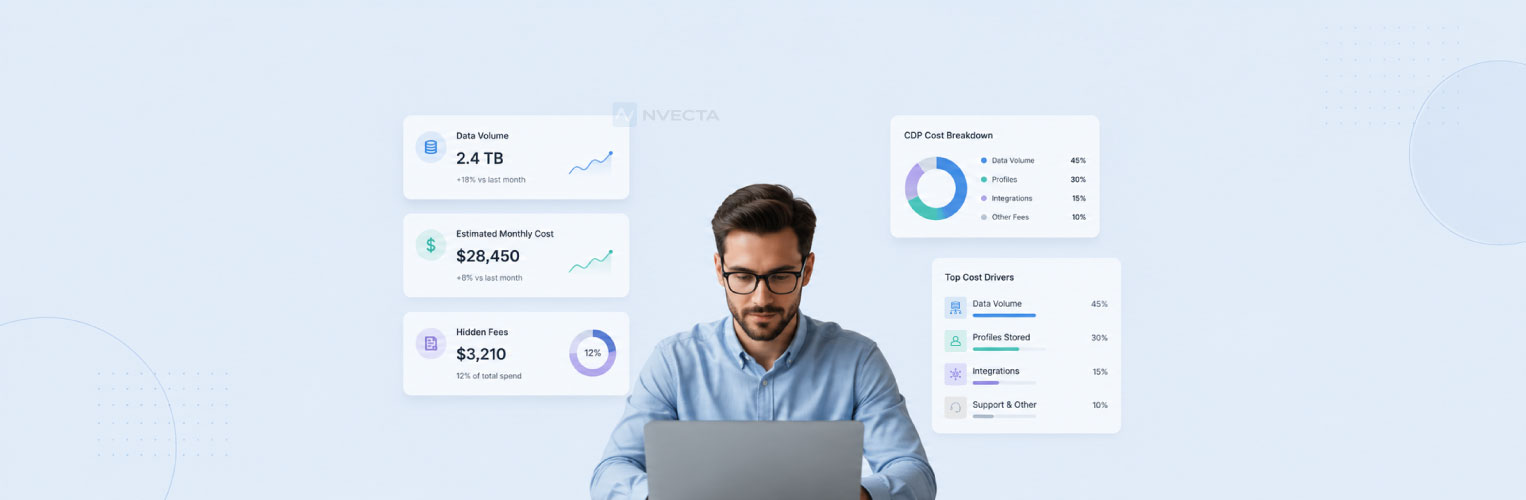
 Afreen Sheikh
Customer data is no longer just a marketing asset. In 2026, it has become the basis of how brands acquire customers, personalise their experiences, and build long-term loyalty. From targeted marketing campaigns to real-time customer engagement, almost every customer interaction depends on how effectively businesses collect and use data.
This growing dependence on data has made Customer Data Platforms, or CDPs, a critical part of the marketing and customer experience stack. CDPs help businesses unify data, create a single customer view, and use that data for driving revenue and growth.
However, before investing in a CDP, almost every business asks the same question:
Last updated: May 2026 | Verified against vendor pricing pages and current contracts
How we research pricing: We pulled the prices below from each vendor’s public pricing page where available, supplemented with G2 and Capterra reviews from the past 12 months and conversations with practitioners managing live CDP contracts. Where vendors do not publish prices, we cite ranges sourced from public RFP responses and analyst reports. Always confirm with the vendor directly before signing.
How Much Does a CDP Actually Cost?
The answer isn’t straightforward. Customer data platform pricing varies widely depending on factors such as data volume, features, integrations and long-term usage.
Many organizations focus only on the base subscription cost and overlook hidden fees that appear after implementation. These hidden fees can quickly add up, leading to unexpected expenses and budget overruns.
In this comprehensive guide, we will explain:
- What a Customer Data Platform is and why it matters
- How CDP pricing models work
- How data volume directly affects CDP cost
- Hidden fees most CDP vendors do not highlight
- A realistic breakdown of total CDP cost
- How to choose the right CDP for your budget
By the end of this blog, you will have a clear and realistic understanding of how much a CDP costs and how to plan your investment without surprises.
What Is a Customer Data Platform?
A Customer Data Platform is a centralised system that collects, unifies, and activates customer data from multiple sources in one place.
A CDP typically gathers data from:
- Websites and mobile applications
- CRM systems
- Email and marketing automation tools
- Advertising platforms
- Customer support and helpdesk software
- Offline sources such as POS systems or call centers
All this data is merged into a single, unified customer profile that updates in real time—forming an ideal customer profile that evolves with every interaction. This dynamic profile gives businesses a complete, up-to-date view of each customer, capturing behavior, preferences, and interactions across every channel, enabling more personalized and effective engagement.
Unlike CRMs, which mainly focus on sales interactions, or data warehouses, which require heavy technical management, CDPs are designed for marketing, growth, and customer experience teams.
They allow non-technical users to segment audiences, trigger campaigns, and personalize experiences without depending heavily on engineering teams.
This powerful capability is also what makes customer data platform costs more complex than many other marketing tools.
CDP Pricing Models Explained: A Complete 2026 Breakdown
Most CDP vendors fall into one of five pricing models. Knowing which one a vendor uses tells you more about your real cost than the headline number on their pricing page.
1. Per Monthly Tracked User (MTU): You pay for every unique user the platform processes data about each month. Used by Segment, mParticle, and most packaged CDPs. Predictable until you hit a viral spike and suddenly your MTU count doubles.
2. Per Active Profile: Similar to MTU but counts stored profiles instead of monthly visitors. Klaviyo, Bloomreach, and BlueConic use variations of this. The catch: profiles often include people who unsubscribed years ago unless you actively suppress them.
3. Per Event Volume: You pay based on the number of data events ingested or processed. Treasure Data and some enterprise CDPs work this way. Costs scale with engagement, so a high-frequency app can outpace a high-traffic ecommerce site.
4. Per Data Source / Destination: Some vendors charge a flat platform fee plus add-ons for each connector. Hightouch, Census, and other reverse ETL tools follow this. You pay only for what you use, but power users with 30 or more destinations can rack up significant connector fees.
5. Flat-Fee Enterprise: Custom contracts negotiated annually. Tealium AudienceStream, ActionIQ, Treasure Data, and most enterprise CDPs sit here. The good: predictable budget. The bad: no public pricing, long sales cycles, and discounts depend on your negotiating leverage.
A growing number of vendors mix two or three models. For example, you might pay a base platform fee plus per-MTU overages plus per-connector fees. Always ask a vendor to walk you through three years of projected billing before signing.
Overview of Customer Data Platform Pricing
When evaluating a Customer Data Platform, pricing is just as important as the technology itself. Customer data platform pricing varies widely because every business manages data differently. Factors such as company size, data complexity, usage volume, and long-term growth plans all directly influence the total cost.
A CDP designed for a small marketing team will naturally cost less than a platform built for enterprise-level personalisation and real-time customer engagement.
How CDP Pricing Tiers Are Structured
Most CDP vendors use tiered pricing models. Each tier includes a different combination of features, data limits, scalability, and support.
Entry-level tiers focus on core data collection and basic customer profiles, while higher tiers unlock advanced segmentation, integrations, AI-driven personalisation, and workflow automation.
The goal is not simply to choose the cheapest tier, but to select one that meets current business needs while remaining flexible for future growth.
Why Understanding CDP Cost Scalability Matters
CDP costs rarely stay static. As customer data grows, more teams rely on the platform, and engagement increases, pricing often rises. Understanding how costs scale over time allows businesses to avoid paying for unused capacity or facing sudden budget surprises.
Planning for scalability ensures that a CDP remains cost-effective in the long run.
How CDP Pricing Changes by Business Size
Customer data platform pricing depends largely on business size, use case, and technical complexity. While most vendors do not publish fixed prices, CDPs generally fall into predictable pricing ranges.
CDP Pricing for Small and Growing Businesses
Small businesses typically start with foundational CDP plans. These entry-level options focus on essential capabilities such as data collection, basic identity resolution, and limited data ingestion.
Pricing at this stage is designed to be affordable while helping teams build a unified view of customer data. However, these plans often come with limits on features and maximum data usage.
Customer Data Platform Costs for Mid-Market Companies
As companies grow, their data needs become more complex. Mid-market organisations require advanced segmentation, multiple integrations, higher event volumes, and access for multiple teams.
At this stage, customer data platform costs increase to support larger-scale use cases. Pricing can become less predictable if data growth is not closely monitored.
Enterprise CDP Pricing for Large Organizations
Enterprise CDPs are almost always custom-priced. Large organisations often need real-time data processing, omnichannel journey orchestration, and deep personalisation at scale.
At this level, costs reflect not only platform access but also the ability to manage complex customer intelligence across multiple departments and regions.
How Business Growth Impacts Long-Term CDP Costs
Across all business sizes, CDP pricing grows alongside data maturity and platform usage. Choosing a scalable platform is quite an important decision for managing long-term costs effectively.
A platform that fits today’s needs but cannot scale for future growth may quickly become a costly limitation.
Real CDP Cost Examples by Company Size (2026)
Headline pricing rarely reflects what you actually pay. Here are three realistic scenarios based on real contracts we have seen in 2026:
Small Business / SMB Scenario
- Profile: 50,000 monthly tracked users, 5 data sources (Shopify, web, email, ads, CRM), 5 destinations
- Typical CDP cost: $500 to $2,000 per month
- Common picks: Hightouch (~$800/mo), Lytics starter (~$1,200/mo), Nvecta SMB tier
- What you skip: real-time decisioning, dedicated CSM, advanced ML
- Implementation: $5K to $15K one-time
Mid-Market Scenario
- Profile: 500,000 MTU, 12 data sources, 20 destinations, 3 marketing teams
- Typical CDP cost: $3,000 to $8,000 per month
- Common picks: Bloomreach Engagement, BlueConic, mParticle mid-tier
- Adds: real-time activation, identity resolution, basic ML
- Implementation: $25K to $75K plus 4 to 6 months
Enterprise Scenario
- Profile: 5M MTU, 30+ sources, 50+ destinations, multiple business units, multi-region
- Typical CDP cost: $15,000 to $50,000+ per month
- Common picks: Tealium AudienceStream, Segment Business, ActionIQ, Treasure Data
- Adds: dedicated infrastructure, custom SLAs, in-house CSM, AI/ML toolkit
- Implementation: $100K to $500K plus 6 to 18 months
These ranges include platform license only. Add 30% to 60% for total cost of ownership once you factor in implementation, integration engineering, and internal headcount. The TCO section below shows the math.
Understanding the Most Common CDP Pricing Models
Subscription-Based CDP Pricing
The subscription-based model charges a fixed monthly or annual fee. Pricing depends on features, data limits, and support tiers.
This model offers predictable costs, ongoing updates, and vendor support, making it a popular choice for growing businesses with stable data usage.
Usage-Based CDP Pricing Based on Data Volume
Usage-based pricing ties cost directly to the amount of data the CDP processes. This may include the number of customer profiles, events, or data storage.
While flexible, costs can rise rapidly as engagement and traffic increase, making careful forecasting essential.
Perpetual License CDP Pricing for On-Premise Deployment
Perpetual licensing involves a one-time payment and is usually used for on-premise deployments. It appeals to organizations that require full control over their data environment.
However, this model typically involves higher upfront investment and ongoing maintenance costs.
Choosing the Right CDP Pricing Model for Your Business
Selecting the right pricing model is crucial for managing long-term CDP costs. Businesses should consider current usage, growth projections, and team requirements.
When pricing aligns with business goals and data strategy, a Customer Data Platform becomes a scalable, sustainable investment rather than a financial burden.
CDP Vendor Pricing Comparison Chart (2026)
Below is a side-by-side look at the leading CDPs by pricing model, starting cost, and typical fit. Most enterprise CDPs do not publish prices on their websites. Ranges shown are based on G2 reviews, public RFPs, and conversations with current users.
| Vendor | Pricing Model | Starting Price | Free Tier | Best For |
|---|---|---|---|---|
| Nvecta | Tiered + custom | Accessible SMB pricing | Available | SMB to enterprise omnichannel |
| Segment | Per MTU | $120/mo (Team plan) | Up to 1,000 visitors/mo | Engineering-led teams, B2B SaaS |
| Tealium AudienceStream | Custom annual | ~$25K/year | None | Enterprise omnichannel |
| mParticle | Per MTU | Custom (~$50K+/yr) | Under 1M user actions | Mobile-first brands |
| Treasure Data | Custom | $150K+/year | None | Enterprise data-heavy use cases |
| Bloomreach Engagement | Custom | ~$5K/mo | None | Ecommerce personalization |
| BlueConic | Per profile tier | ~$2K/mo | None | Mid-market marketing teams |
| ActionIQ | Custom annual | ~$100K+/year | None | Large B2C enterprises |
| Hightouch (composable) | Per destination | Free, $350/mo Pro | Yes | Composable CDP setups |
| Lytics | Custom | ~$1K to $10K/mo | None | Mid-market with ML needs |
Pricing reflects publicly listed plans and reported contracts as of May 2026. Most enterprise CDPs require custom quotes based on data volume, integrations, and contract length. Always request a tailored quote.
Composable CDP vs Packaged CDP: Cost Comparison
A composable CDP uses your existing data warehouse (Snowflake, BigQuery, Databricks, Redshift) as the central data store, with separate tools handling identity resolution, segmentation, and activation. A packaged CDP bundles all of these into a single vendor product.
The cost trade-off is real and often misunderstood.
Packaged CDP at 500K MTU:
- Vendor license: $4,000 to $8,000/mo
- Implementation: $25K to $75K one-time
- Internal headcount: 1 marketing ops FTE
- Total year-1 TCO: ~$120K to $200K
Composable CDP at 500K MTU:
- Warehouse compute (Snowflake, ~5TB active data): $1,500 to $3,000/mo
- Reverse ETL tool (Hightouch or Census): $800 to $2,000/mo
- Identity resolution (often via dbt + warehouse): negligible incremental cost
- Activation orchestration: included in reverse ETL or marketing tool
- Internal headcount: 0.5 data engineer + 0.5 marketing ops
- Total year-1 TCO: ~$80K to $140K
Composable can run 30% to 40% cheaper at scale, but only if you already have a data warehouse and at least one data engineer who can keep models updated. If you have to build the warehouse from scratch or hire data engineering for this project, the math flips.
A few hybrid models have emerged in 2026: some packaged vendors now offer warehouse-native deployments, and some reverse ETL tools have added identity resolution and segmentation. The line between composable and packaged is fading, but the cost question still comes down to whether you have data engineering in-house.
Key Factors That Affect Customer Data Platform Costs
A Customer Data Platform is not just a one-time investment. The real cost builds over time. Several factors influence how much you actually pay. Knowing them early helps you plan better and avoid budget surprises.
Data Volume and Storage
More data means higher costs. Most CDPs charge based on customer profiles or events processed. Large datasets increase pricing quickly. Fast-growing businesses feel this impact more. A scalable platform helps manage future costs.
Users and Customer Profiles
Some CDPs charge per user. Others focus on the number of profiles stored. Costs rise as teams expand. Marketing, sales, and support teams all need access. Poor planning leads to higher bills. Choosing shared access plans helps control spending.
Features and Integrations
Features directly affect pricing. Basic plans cover core needs like segmentation. Advanced plans include AI insights and predictions. Real-time personalisation also adds cost.
Integrations matter too. Connecting older tools takes more effort. Custom systems increase setup costs. Reviewing your tech stack helps avoid surprises.
Customization and Support
Every business has unique needs. Some require custom dashboards. Others need advanced workflows or dedicated support. These options cost more. For large teams, they are often necessary. They ensure stability and long-term performance.
Customer Data Platform costs depend on many factors. Data size and users matter the most. Features, integrations and support also influence pricing. Clear planning helps control spending. The right CDP delivers value over time.
Hidden and Additional Customer Data Platform Costs
Customer Data Platform pricing may look simple at first. However, many businesses overlook hidden and additional costs. These expenses can increase total customer data platform costs over time. Planning for them early helps avoid budget issues later. Here are a few hidden and additional costs that may incur.
Implementation and Onboarding Costs
Most CDPs require setup support. This includes data configuration and user training. These services are usually not included in base pricing. Implementation fees can be high and must be considered upfront.
Data Migration and Integration Costs
Migrating data from existing systems is complex. It involves data mapping and validation. Custom integrations or APIs increase customer data platform costs. Aligning CDP adoption with data modernisation can reduce effort and cost.
API Usage and Overage Fees
APIs connect the CDP with marketing and analytics tools. High API usage can lead to overage charges. Real-time data syncing increases this risk. Usage limits should be clarified before signing a contract.
Maintenance and Upgrade Costs
Some CDPs charge extra for custom features. Self-hosted setups require ongoing maintenance. Security updates and system scaling add to long-term costs. These expenses are often outside standard pricing.
Hidden and additional costs can impact CDP ROI. Understanding them early helps control customer data platform costs. Smart planning leads to a scalable and cost-effective CDP strategy.
Itemized Hidden Cost Breakdown (Real 2026 Ranges)
The categories above describe the kinds of hidden costs you should expect. Below is what they actually look like in dollars based on contracts we have seen this year:
- Implementation services: $10K to $200K one-time. Smaller vendors offer flat fees ($10K to $30K). Enterprise vendors quote based on scope ($50K to $200K+). Some waive this if you commit to multi-year contracts.
- Data modeling and schema design: $5K to $50K. Often billed separately from implementation. Required if your data is not already in a clean, well-defined structure.
- Integration engineering per source: $2K to $30K. Pre-built connectors are usually free. Custom integrations to legacy systems can run $20K+. Salesforce, Shopify, and Stripe are typically free; old ERP or proprietary systems are not.
- Training: $1K to $10K per cohort. Some vendors include basic training. Advanced certification or admin training is usually paid.
- Data warehouse storage (composable setups): $500 to $5,000/mo. Snowflake or BigQuery costs depend on data volume and query frequency, and if your stack runs on AWS, AWS cost optimization platforms can help catch idle compute before it inflates the bill. Plan for compute costs to grow 20% to 30% year over year as you add use cases.
- Additional connectors: $200 to $2,000/mo each. Some vendors charge per active destination beyond the included tier (Segment is one example).
- Professional services retainer: $3,000 to $15,000/mo. For ongoing strategic guidance, custom workflows, or campaign builds. Optional but commonly bought.
- Customer success manager upgrade: $1,000 to $5,000/mo. Standard support is usually included; named CSM access is often a paid upgrade.
- Dedicated IP for email activation: $150 to $300/mo. If your CDP connects to email and you need deliverability isolation.
- API overage charges: Variable. Most vendors include a generous API allowance, but high-frequency real-time use cases can trigger overages of $1,000 to $10,000/mo.
CDP Total Cost of Ownership (TCO) Formula
The headline license number rarely reflects what a CDP actually costs you. Use this formula instead:
TCO = License + Implementation + Integration Engineering + Internal FTE + Ongoing Maintenance + Opportunity Cost
Year 1 example (mid-market company, packaged CDP):
- License: $5,000/mo × 12 = $60,000
- Implementation: $50,000 (one-time)
- Integration engineering: $30,000 (12 sources, mix of free and custom)
- Internal FTE: 1 marketing ops + 0.5 analyst = $120,000
- Ongoing maintenance: $5,000
- Year-1 TCO: ~$265,000
Year 3 (same setup, list grows 50%):
- License: $7,500/mo × 12 = $90,000
- Implementation: $0
- Integration engineering: $10,000 (new sources only)
- Internal FTE: 1 marketing ops + 0.5 analyst = $130,000 (with raises)
- Ongoing maintenance: $8,000
- Year-3 TCO: ~$238,000
Across three years, the implementation cost spreads out but license costs rise. Most companies underestimate years 2 and 3 because they assume their data volume will stay flat. It rarely does.
Also factor in opportunity cost: the time your team spends managing the CDP instead of running campaigns. This is real even if it never appears on a budget line.
How to Choose the Right Customer Data Platform for Your Budget
Choosing a Customer Data Platform is about balancing cost with long-term value. Many CDPs offer flexible pricing, but it is important to evaluate how customer data platform costs grow as your business scales.
Match Your Needs With Pricing Tiers
Start by defining your data goals. These may include real-time personalisation, audience segmentation, or omnichannel engagement. After defining goals, compare these needs with the pricing tiers offered by different CDP vendors.
Some CDPs offer low entry prices but limited scalability. Others include advanced features that you may not need yet. This can increase costs without adding value. Reviewing a customer data platform cost model which helps narrow down options that fit your use case.
Also consider data volume, number of users, integrations, and support levels. Paying only for what supports real business requirements keeps costs under control.
Questions to Ask CDP Vendors
Before signing a contract, clarify pricing details. Ask direct questions such as:
- Is onboarding and integration included in the base price
- What are the API usage limits before extra charges apply
- How does customer support differ across pricing plans
- What happens to your data if you stop using the platform
These questions help uncover hidden costs. They also provide clarity on renewals, upgrades, and service commitments.
Plan for Flexible Implementation
Look for vendors that support gradual implementation. This lets you adopt the CDP step by step. Gradual implementation helps in managing budgets and lowers risk.
Aligning your CDP with your data improvement plans helps teams work better together and avoids unnecessary costs over time.
The right CDP should fit your current budget while supporting your business as it grows. Clear needs and open pricing make the choice easier and stress-free.
How to Reduce Your CDP Costs
A few practical levers that have actually saved money for the teams we work with:
- Clean stale profiles monthly. If you bill per profile or MTU, every unsubscribed or bounced contact you keep is a recurring cost. A monthly suppression job often pays for itself in week one.
- Negotiate annual contracts. Most vendors discount 10% to 20% for annual prepay. A few will go to 25% if you commit to multi-year. Always ask.
- Suppress unused destinations. If a connector is active but you stopped using it last quarter, deactivate it. Some vendors charge per destination.
- Request volume discounts at MTU thresholds. Vendors quietly offer better per-MTU rates above 1M, 5M, and 10M MTUs. Ask before you cross the threshold, not after.
- Evaluate composable alternatives if you have data engineering. If your data is already in Snowflake or BigQuery, a composable setup with Hightouch or Census often costs 30% to 40% less than a packaged CDP at the same scale.
- Audit unused premium features quarterly. AI add-ons, dedicated CSMs, premium connectors. Cut what you are not using.
- Consolidate vendors where the CDP overlaps with marketing automation, ESP, or analytics tools. A platform that covers two or three of these jobs (like Nvecta) often costs less than buying separate point solutions.
Key Trends Influencing Customer Data Platform Pricing in 2026
Customer Data Platform costs keep on changing as they have to meet the changing business needs. Businesses want the latest advanced features to meet higher customer expectations. In 2026, two big factors affecting CDP pricing are AI and data privacy rules.
AI and Automation
AI is now an important part of modern CDPs. Tools like predictive analytics, automated customer journeys, and real-time personalisation make work easier and faster for teams.
These features usually come with higher-tier plans or as add-ons, which can increase initial costs. Still, AI can save time, reduce manual work, and help you reach the right customers more effectively, making it a smart investment for long-term growth.
Data Privacy and Compliance
Data privacy is another big factor affecting CDP costs. Laws like GDPR and CCPA mean platforms need to manage customer consent and keep data secure. Some vendors charge extra for these tools, which can add to your long-term costs.
Choosing a CDP that includes privacy features from the start can save money and headaches later, while keeping your business compliant with the latest regulations.
In 2026, customer data platform costs are driven by AI capabilities and compliance requirements. Businesses that plan for these trends early can better control pricing and maximise long-term value.
Final Thoughts
Customer data platform costs go far beyond a subscription fee. Understanding pricing models, data volume impact, and hidden fees allows businesses to make smarter decisions.
The right CDP is not the cheapest one. It is the platform that delivers measurable value without unexpected costs.
If you are evaluating CDPs and want clarity on pricing, data volume, and long-term investment, Nvecta can help you make an informed and confident choice.
FaQs
How much does a CDP cost in 2026?
SMB CDPs start around $500 to $2,000 per month. Mid-market platforms typically run $3,000 to $8,000 per month. Enterprise CDPs are almost always custom-priced and can range from $15,000 to $50,000+ per month. Total cost of ownership including implementation and internal staff is usually 1.5x to 2x the license fee.
What pricing models do CDPs use?
The five common models are: per Monthly Tracked User (MTU), per active profile, per event volume, per data source / destination, and flat-fee enterprise contracts. Many vendors mix two or more models. Always ask for a three-year billing projection before signing.
Is there a free CDP?
Hightouch and Segment offer limited free tiers. Hightouch’s free plan covers basic reverse ETL with limits. Segment’s free tier covers up to 1,000 visitors per month. Both are useful for prototyping but rarely sufficient for production use.
What is the cheapest CDP for a small business?
Hightouch (composable approach) at around $350 to $800 per month is often the most affordable for SMBs with engineering resources. For non-technical SMBs, packaged options like Lytics starter, BlueConic SMB, or Nvecta often start in the $1,000 to $2,000 per month range.
What does CDP implementation cost?
Implementation ranges from $10,000 for SMB self-serve setups to $200,000+ for enterprise rollouts. Mid-market implementations typically run $25,000 to $75,000 plus 4 to 6 months. Some vendors waive implementation fees for multi-year contracts.
What hidden CDP costs should I watch for?
Common hidden costs include: implementation services, data modeling, custom integration engineering, training, additional connector fees, professional services retainers, premium support upgrades, dedicated IP fees, and API overage charges. Ask vendors for a fully loaded year-1 quote, not just the license.
How do I calculate CDP total cost of ownership?
TCO = License + Implementation + Integration Engineering + Internal FTE + Ongoing Maintenance + Opportunity Cost. Most teams underestimate internal FTE and integration costs. Plan year-1 TCO at 1.5x to 2x the license fee, and budget for 20% to 30% growth in years 2 and 3 as your data volume increases.
Composable CDP vs packaged CDP — which is cheaper?
At scale, composable CDPs (warehouse + reverse ETL) typically run 30% to 40% cheaper than packaged CDPs. But this only holds if you already have a data warehouse and at least one data engineer. If you have to build those from scratch, packaged is usually cheaper.
How does data volume affect CDP pricing?
Most CDPs charge based on customer profiles, MTUs, or event volume. As your data grows, costs grow proportionally. A 2x increase in profile count can mean a 1.5x to 2x increase in monthly bill, depending on the tier you are in. Active list cleaning is one of the simplest cost controls.
How can Nvecta help me evaluate CDP costs?
Nvecta works with brands across SMB to enterprise scales and offers tiered pricing that grows with your data. Schedule a demo to walk through your data sources, expected volume, and use cases, and get a quote tailored to what you actually need.
