














 Email
Email SMS
SMS Whatsapp
 Web Push
 App Push
 Audience Sync for Ads
 Popups
 Channel A/B Testing
  Control groups Analysis
 Frequency Capping
 Funnel Analysis
 Cohort Analysis
 RFM Analysis
 Signup Forms
 Surveys
 NPS
NPS Landing pages personalization
  Website A/B Testing
  PWA/TWA
 Heatmaps
 Session Recording
 Wix
Wix Shopify
 Magento
 Woocommerce
 eCommerce D2C
  Mutual Funds
 Insurance
 Lending
  Recipes
  Knowledgebase
 Developer Docs
 Product Updates
 App Marketplace
 Academy
 Ebooks
 Case Studies
 Blog
Blog Templates
 Aparupa Saha
Quick answer: A CDP collects and unifies your customer data. A Marketing Cloud is what you use to actually send messages, run campaigns, and reach people. Different jobs. Most teams end up with both eventually. If you can only afford one right now, pick the one that fixes whatever is hurting you most.
CDP vs Marketing Cloud: Why Everyone’s Confused (Including Your Vendors)
So your CEO walks into your office and says, “We need to invest in our marketing tech stack. I was reading about CDPs. We should get one of those.”
Or maybe it’s your boss. Or a consultant. Or you saw a LinkedIn post about it. Or maybe someone mentioned platforms like NVECTA, and now you’re trying to figure out where that even fits.
The demos all kind of blend together. The terminology is vague. Every vendor claims to do everything. And everyone around you seems to be nodding along while secretly having no idea what’s happening.
Sound about right?
Here’s the thing. CDPs and Marketing Clouds are very different tools solving very different problems. The way they’re sold? Total chaos. After a while everything starts to sound the same.
The simplest way to think about it: a CDP is built to collect, unify, and organize customer data from all over the place into a single, usable profile. A Marketing Cloud is the platform you use to actually act on that data. Run campaigns. Send emails. Build journeys. Manage ads. The two work together. They are not the same thing.
If you’re still fuzzy on where the line really sits, this breakdown of CDP vs Marketing Cloud helps make it much clearer without all the usual jargon. We’ll also look at how the big-name Marketing Clouds (Salesforce, Adobe, HubSpot) actually fit, since that’s where most of the real-world confusion lives.
The 60-Second Comparison
| CDP | Marketing Cloud | |
|---|---|---|
| Primary job | Unify and resolve customer data | Execute campaigns across channels |
| Data scope | All customer data, all sources | Mostly campaign and engagement data |
| Real-time updates | Yes. That’s the whole point. | Sometimes. Depends on the tool. |
| Identity resolution | Native, core feature | Limited or absent |
| Built for | Data and marketing teams | Marketing campaign teams |
| Example tools | Nvecta, Segment, Tealium, mParticle | Salesforce Marketing Cloud, Adobe Experience Cloud, HubSpot Marketing Hub |
What’s Actually Happening in Your Marketing Right Now
Your customers interact with you everywhere. They see your ads. Get your emails. Visit your website. Buy something. Call support. Scroll your social feeds.
Each of those touchpoints? Tracked somewhere. Your email tool knows they opened a mail. Your ad platform knows they clicked an ad. Your website knows they bought something. Your support system knows they called in with a problem.
But here’s the problem nobody talks about openly: none of those systems talk to each other.
So you’ve got your email marketer who thinks this person is cold and unengaged. Your paid ads person thinks they’re super interested. Your support team thinks they’re annoyed. Your sales guy has no idea where they are in the journey. Everyone’s working from a different version of the truth.
And your customer? They feel the weirdness. They get marketing emails for stuff they already bought. They see ads for things they looked at once. They have to repeat their story to different departments. It sucks for them. It’s inefficient for you.
Where These Two Tools Come In
Two types of tools exist to fix this nightmare.
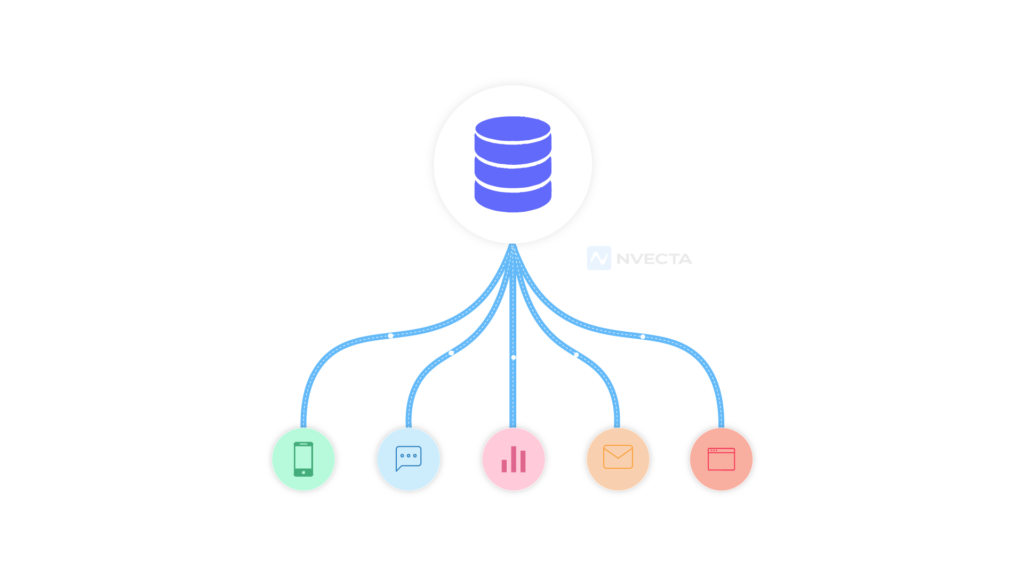
A CDP is basically the person who collects all the puzzle pieces.
It goes to your email tool and says, “Hey, I need to know everything you know about this customer.” Then it goes to your ad platform, your website, your support system, your CRM, everywhere, and says the same thing. It gathers all that information and puts it in one place. One unified customer profile.
Now someone actually has the full picture. Now you know that Sarah opened your email last week, clicked through to your website, bought something three days ago, but then emailed support yesterday with a question. You see the whole story.
A Marketing Cloud is the person who actually does stuff with that information.
Once you know the full picture, you need to take action. Send messages. Run campaigns. Automate workflows. Reach people across email, SMS, push notifications, ads, whatever. That’s what a Marketing Cloud does. It’s the execution layer. It’s where the actual marketing happens.
The Confusing Part
Fundamentally, they’re doing different jobs. One is about gathering and unifying. One is about acting and executing.
Think of it like this. A CDP is the librarian who organises all the books. A Marketing Cloud is the person who checks out the books and uses them to actually build something.
You probably need both. Or at least, most decent-sized marketing operations do. But they’re not the same thing, and pretending they are will get you into trouble.
What We’re Actually Going to Cover
I’m going to break down what each of these actually does. No fluff. No marketing jargon. Just what they do and why it matters.
You’re going to understand whether you actually need one, both, or neither of these tools. What each one is really good at (and what it’s not). How to figure out which one you should buy first. Whether they’ll work together or fight with each other. What questions to ask vendors so they stop bullshitting you. And specifically how the big Marketing Clouds (Salesforce, Adobe, HubSpot) fit into all of this, because that’s the part most blog posts skip.
What Is a Customer Data Platform (CDP)?
Imagine you’re trying to understand a customer. You check your email tool: 12 opens, 3 clicks. Seems mildly interested.
Then analytics: 47 site visits. Spent 15 minutes on pricing. Looked at case studies six times. Actually, they’re very interested.
But wait, they bought two months ago. So those email metrics don’t matter much. They’re a customer.
Oh, and they called support last week with a problem. So maybe they’re frustrated.
All this information is scattered across different systems (CRM tools, analytics dashboards, email platforms, support logs) and as a result, teams are often working with fragmented views of the same customer.
Nobody’s really connecting the dots in a meaningful way. That’s exactly what a customer data platform is designed to solve.
By bringing these disconnected data points together into a single, coherent profile, it lets businesses better understand behaviour, personalise interactions, and make smarter decisions.
If you’re looking to dive deeper into this space, it’s worth reading about understanding customer data platforms in marketing and how they’re reshaping modern customer engagement strategies.
Platforms like NVECTA gather all that fragmented data and create one complete picture of who the person actually is.
How It Works
A CDP pulls data from everywhere. Your email tool, website, payment system, support tickets, app, whatever. Then it figures out which pieces of data belong to the same person. That’s the hard part. “sarah@gmail.com” from email, “Sarah Smith” from payments, “Sarah S.” from support. All the same person.
Once it figures that out, it cleans up the mess (names have typos, phone numbers are formatted differently) and creates one unified profile. Now Sarah’s complete history is in one place.
Finally, it makes those profiles available to your other tools so they actually have accurate information about who the customer is.
What’s In These Profiles
First-party data. Stuff you own and collected directly from customer interactions.
Behavioural data: what they visited, clicked, or downloaded on your site or app.
Demographic data: age, location, company, things like that.
Transactional data: what they bought, when, and for how much.
Engagement data: emails opened, links clicked, surveys answered.
Who Uses It
Marketers obviously. But also data teams (they get a clean source instead of building their own pipelines), analytics teams (they see the complete journey instead of isolated events), product teams (they understand how different customers use features), and customer success teams (they see the full history).
The key thing: a CDP isn’t where you send campaigns or do marketing. It’s the foundation. It’s the data layer that makes sure everything else has accurate, complete information.
What Is a Marketing Cloud?
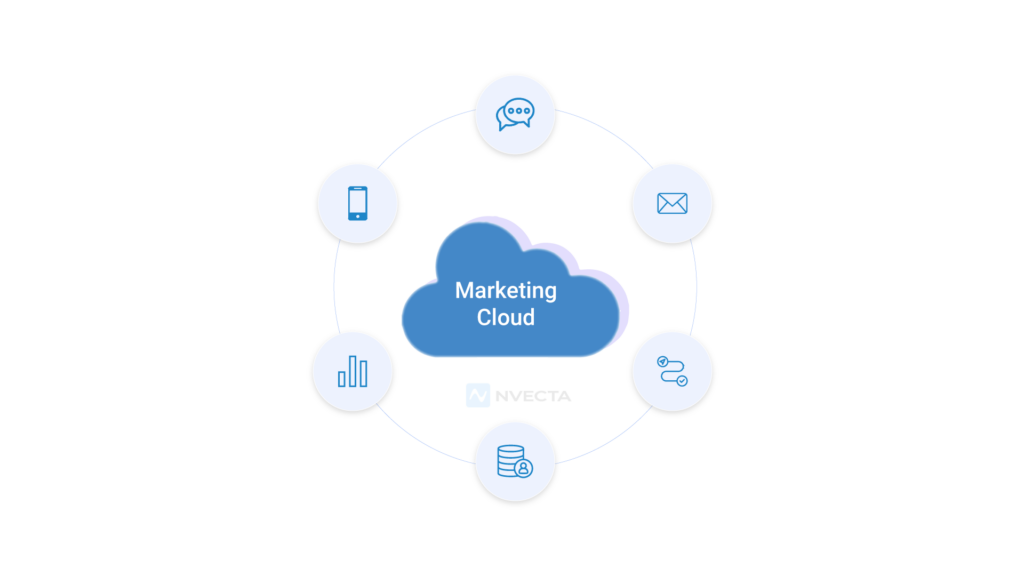
A Marketing Cloud is the tool where you actually do marketing. It’s where campaigns live. Where you send emails. Where you run ads. Where you automate customer journeys.
If a CDP is about understanding who your customer is, a Marketing Cloud is about reaching them and getting them to do something.
When people say “Marketing Cloud,” they usually mean one of these: Salesforce Marketing Cloud, Adobe Experience Cloud, Oracle Marketing Cloud,
HubSpot Marketing Hub. Each is a suite of tools bundled together, sold as one platform, run by marketing teams. Each comes with its own opinions about how marketing should work, and each has some kind of CDP attached to it (which is where things get really confusing, but we’ll get to Salesforce in a bit).
What It Actually Does
A Marketing Cloud is the execution engine. It takes that complete customer profile from your CDP (or any other data source) and asks: “Okay, now what do I do with this information?”
You want to send an email? Marketing Cloud does that. You want to send an SMS to people who abandoned their cart? It does that. You want to run a retargeting ad campaign to people who visited your pricing page? It does that. You want to build an automated workflow where people get a welcome series when they sign up, then move into nurture campaigns, then get targeted based on their behaviour? It does that.
A Marketing Cloud is about moving people through journeys and campaigns. It’s about orchestration. It turns insights into actual messages that reach actual customers across all the different channels they hang out on.
The Channels It Touches
Most Marketing Clouds let you send messages across multiple channels from one place.
Email is usually the foundation. It’s where most of the volume comes from and where most campaigns live.
SMS and push notifications for mobile-first messaging. When you need to reach someone urgently or on their phone.
Paid ads across Google, Facebook, Instagram, and LinkedIn. Running audiences and campaigns directly from the platform.
Social media marketing. Scheduling posts, managing organic presence, community management.
Web personalisation. Changing what someone sees on your website based on who they are.
Analytics and reporting. Seeing what actually worked and what didn’t.
The whole point is that you don’t have to log into five different platforms to run a campaign. You do it all from one place.
Who Actually Uses This
Digital marketers who are sending campaigns. Campaign managers running the day-to-day. Growth teams trying to acquire and retain customers. Lifecycle marketers automating the journey from first touch to repeat customer.
These are the people actually hitting send on emails, launching campaigns, monitoring performance, and iterating on what works.
It’s not a data management tool. It’s not where you clean or organise data. It’s where you use data to actually reach and influence people. It’s about output, not input.
CDP vs Marketing Cloud: Core Differences Explained
The Core Thing
A CDP is asking: “Who is this person and what do we actually know about them?”
A Marketing Cloud is asking: “How do I reach them and get them to do something?”
That’s it. One’s about knowing. One’s about doing.
Data Stuff
CDPs care obsessively about data. They grab it from everywhere, clean up the mess, figure out which records are for the same person, and keep one version of the truth about each customer.
Marketing Clouds don’t really care about data the same way. They assume the data is already clean and ready. They just want to use it to send messages. If you feed them garbage data, they’ll send garbage campaigns.
Speed
CDPs are fast. Someone browses your site. The CDP sees it. Their profile updates. Done.
Marketing Clouds can send fast messages too, but only if the data is actually current. You can’t send a triggered message if you don’t know what they just did.
Segmentation
CDPs let you build complicated segments. “People who bought last month AND looked at pricing last week AND ignored our last three emails.” You can get really specific because they have the full picture.
Marketing Clouds do segmentation for campaigns. “Email people who signed up last week.” “Run ads to people who visited the pricing page.” More straightforward stuff.
Personalisation
CDPs unlock real personalisation because they know the whole story about each person.
Marketing Clouds do basic personalisation. Name in the email. Show the products they looked at. That kind of thing. They’re limited by what data they actually have access to.
Multi-Channel Stuff
Marketing Clouds are good at this. Build one campaign, send it across email, SMS, push, whatever, all from the same place. Very useful.
CDPs don’t send campaigns. They just make sure every channel has good data. CDP = the fuel. Marketing Cloud = the engine. You need both.
How They Connect
CDPs are like connectors. They plug into everything. Your CRM, your email tool, your ad platforms, your analytics, whatever. They don’t care what else you’re using.
Marketing Clouds are more like all-in-one boxes. Email is built in. Automation is built in. Ad stuff is built in. If they don’t have what you need, you’re kind of stuck. Less flexible overall.
Salesforce Marketing Cloud and Data Cloud: The Confusion Deserves Its Own Section
If you’ve ever tried to figure out what Salesforce actually sells in this space, you know the pain. Here’s the short version of the chaos.
Quick history. Salesforce’s CDP launched in 2020 as Customer 360 Audiences. Then they renamed it Salesforce CDP. Then Customer Data Cloud. Then Genie Customer Data Cloud (yes, really). Then just Data Cloud. As of October 2025, it’s now Data 360. That’s six names in six years. If you’ve been confused, that’s why.
Now layer the Marketing Cloud side on top. When Salesforce says “Marketing Cloud,” they actually mean a family of separate products. Marketing Cloud Engagement is the email and journey piece (used to be ExactTarget). Marketing Cloud Personalization is the web personalisation piece (used to be Interaction Studio). There’s also Marketing Cloud Account Engagement for B2B (used to be Pardot). And Marketing Cloud Intelligence for analytics (used to be Datorama). All of these were separate companies Salesforce bought and rebranded. They don’t run on the same underlying tech, and they each need their own license. So when someone says “we use Salesforce Marketing Cloud,” it could mean a lot of different things.
So Is Data Cloud a CDP or Part of Marketing Cloud?
Honestly? Both. Data 360 is sold as Salesforce’s CDP. But it’s also pitched as the data foundation for the rest of the Salesforce stack — Marketing Cloud, Sales Cloud, Service Cloud, the new Agentforce stuff. So it’s a CDP that mostly lives inside Salesforce world.
If you already use Marketing Cloud Engagement and you want unified profiles, Data 360 is the easy answer. Integrations are deep, data flows between products without you wiring much together. Just expect the bill to grow.
The Catch
A complaint that comes up a lot on G2: even if you’re already paying for Sales Cloud, Service Cloud, or Marketing Cloud, Data 360 is its own separate license. Pricing is also famously hard to pin down. The list price uses credits — you buy credits and spend them across ingestion, unification, segmentation, activation. Extra credits cost roughly $500 per 100,000. Implementation services usually push the total into six figures for any mid-market deployment.
Then there’s the lock-in piece, which Salesforce reps will not lead with. The more customer data you embed inside Data 360, the harder it gets to swap any other tool later. If you ever want to move off Marketing Cloud, your CDP comes with you. Worth knowing before you sign anything.
When a Standalone CDP Makes More Sense
If you’re not all-in on Salesforce — or if you want to mix tools (Klaviyo for email, Meta for paid, Braze for mobile, whatever) — a standalone CDP like NVECTA makes more sense. The CDP sits in the middle and feeds whichever activation tools you actually use. Including Salesforce Marketing Cloud, if that happens to be in your stack. You’re just not committing your customer data to a single vendor’s roadmap.
Adobe Experience Cloud and HubSpot: Briefer Versions of the Same Story
Adobe Experience Cloud + Adobe Real-Time CDP
Adobe is basically the same setup as Salesforce, just more enterprise. Adobe Experience Cloud is the suite (Campaign, Target, Analytics, Journey Optimizer — each doing different jobs). Adobe Real-Time CDP is the data layer underneath all of it.
The honest truth about Adobe: it’s powerful, but also kind of a pain. Implementations run long. Pricing is opaque and high. The whole thing assumes you have a real data ops team that knows what they’re doing. If you’re a Fortune 500 with a fifty-person marketing tech team, sure, Adobe makes sense. If you’re a 200-person company trying to get unified data working, you’d probably hate it. I’ve watched mid-market teams sign with Adobe because the brand felt safe and then spend two years still trying to get the implementation done.
HubSpot Marketing Hub
HubSpot is a different beast. It’s a Marketing Cloud, sort of, but it doesn’t really have a CDP underneath. It uses its own contact database — which works fine until it doesn’t. The point where most teams notice is when they start pulling in product analytics, mobile app events, transactional data from a separate ecommerce stack. HubSpot wasn’t built for that. Its contact model starts to feel cramped pretty fast.
What usually ends up happening: teams outgrow HubSpot’s data layer well before they outgrow its email and automation tools. So they keep HubSpot for the journeys and emails (which are genuinely good) and add a real CDP alongside to handle the unified profile work. That’s a totally reasonable setup, and a lot of growing companies end up there.
How CDPs and Marketing Clouds Work Together
Here’s the thing nobody tells you. You’re probably going to end up using both. And that’s actually fine.
How It Actually Works
A customer does something. They visit your site, click an email, download something, whatever. That data goes into your CDP.
The CDP cleans it up and figures out which customer it belongs to. Then it updates their profile with all the new information.
Now you want to run a campaign to people who match a certain profile. The CDP finds those people and sends that list to your Marketing Cloud.
Your Marketing Cloud grabs that list and sends them emails, SMS, ads, whatever you set up.
They interact with various touchpoints (opening an email, clicking on an ad), and all of that activity feeds back into the CDP, strengthening the foundation of Customer Engagement.
The CDP updates their profile again. So the next time you segment, you’re working with fresher data. The next campaign is smarter. And it keeps cycling.
It’s a loop. Data comes in, gets organised, gets used to run campaigns, and the results feed back in to make the next campaign better.
Why This Actually Works
The combination fixes what either one can’t do alone.
A CDP alone just sits there organising data. Nothing actually reaches your customers. You have perfect profiles but no way to use them at scale.
A Marketing Cloud alone sends campaigns to whatever data it can access. Usually stale data, incomplete data. Campaigns feel generic and miss opportunities.
Together? The CDP makes sure the Marketing Cloud always has the best possible information. The Marketing Cloud makes sure the insights from the CDP actually turn into revenue.
You get segmentation that’s actually accurate because the CDP has the complete picture. You get personalisation that actually matters because the Marketing Cloud knows the real story about each customer. You activate campaigns faster because you’re not sitting around trying to figure out who people are. You get better analytics because the CDP tracks everything that happened across every touchpoint.
The Real Benefit
Honestly, the biggest benefit is consistency. Every channel has the same understanding of who the customer is. Email knows they’re a repeat customer. Ads know it. SMS knows it. The messaging stays consistent. You’re not confusing people by sending different messages to the same person across different channels.
And the feedback loop means you get smarter over time. Not just on paper, but in actual performance. Campaigns work better because they’re targeted better. Retention is better because people feel understood. The whole thing compounds.
When Do You Actually Need a CDP?
Not every company needs a CDP. Some are fine without one. But if any of this sounds familiar, you probably do.
Your Data Is All Over the Place
Right now, you have customer data scattered across systems. Some in email. Some in your CRM. Some in analytics. Some in the payment system. Some in your app. Nobody has the complete picture.
You want to send a smart campaign, but you have to manually pull data from three different tools and piece it together. It’s a mess. That’s when a CDP saves you time and money. It gathers it all automatically and keeps it in one place.
You Have No Idea Who Your Customers Actually Are
You can’t tell if the person who visited your site last Tuesday, opened an email on Wednesday, and bought something on Thursday is the same person. Or three different people. You literally don’t know.
This becomes a problem fast. You end up sending duplicate campaigns. You can’t track the real customer journey. You think someone’s cold when they’re actually about to buy. A CDP solves this by matching people across all the different ways they interact with you.
You Want Personalisation That Doesn’t Suck
Right now, your personalisation probably sucks. You put someone’s first name in an email and call it a day. Or you show them products they looked at once three months ago.
A CDP lets you actually personalise. You know they bought two weeks ago, so you send them relevant follow-up content instead of product education. You know they’ve engaged with three of your emails but ignored two, so you adjust the frequency. You know they visited pricing three times but never bought, so you send them something different. Real personalisation based on what you actually know about them.
Third-Party Cookies Are Going Away
Look, cookies are basically done. Chrome is phasing them out. Safari already killed them. Everyone else is following. Your old way of tracking and targeting is dying.
The companies winning right now are the ones who own their data. First-party data. Stuff your actual customers gave you, or you collected from their behaviour on your properties. A CDP is how you maximise that data and make sure you’re using it responsibly. Good personalisation doesn’t require tracking pixels. It just requires knowing your own customers.
When Do You Need a Marketing Cloud?
Honestly? When you stop having time to manage everything manually.
You’re Using Way Too Many Tools
You’ve got email, SMS, ads, and push notifications all in different places. Every time you want to run a campaign, you’re jumping between five platforms. It’s annoying, and it’s slow.
A Marketing Cloud lets you do everything from one place. That’s pretty much it.
Your Campaigns Need to Run Automatically
You can’t manually send every email. You need stuff to just happen.
New signup gets a welcome email automatically. Nobody engages for three weeks; they get a re-engagement email automatically. Someone looks at your pricing page, and they get a targeted ad automatically. That’s what this does.
You Actually Want to Know If This Stuff Works
Right now, you have no idea. You’re checking email open rates in one tool, ad clicks in another, conversions in a third. It’s scattered everywhere.
A Marketing Cloud puts it all in one place so you can actually see what’s making money and what’s not.
CDP vs Marketing Cloud: Which One Should You Actually Buy First?
Honest answer? It depends on what’s broken right now.
A Few Quick Scenarios
Pick the one closest to where you actually are.
Your data is everywhere and nobody has the full picture. Start with the CDP. Honestly, this is where most teams should start. If you skip the data layer and buy the Marketing Cloud first, you’ll just be running campaigns on top of garbage data, and the Marketing Cloud becomes the thing everyone blames when results are bad.
Your data is mostly unified already, but you can’t run a coordinated campaign across email, SMS, push, and ads to save your life. Marketing Cloud, or expand whatever one you have. The data layer isn’t your problem. The orchestration is.
You’re a new growth team, starting fresh, no major commitments yet. Get the CDP first, trust me on this. Trying to retrofit clean data into an established Marketing Cloud later is a nightmare. The order really matters here.
You’re enterprise, regulated, big customer base. You probably need both. The actual question isn’t which one — it’s whether to consolidate everything inside Salesforce or Adobe (the suite play) or run a separate best-of-breed CDP next to whichever Marketing Cloud you’ve inherited. Most teams I’ve watched go through this end up regretting full-suite consolidation a few years in. The lock-in starts to bite.
The Money and People Thing
A CDP costs money and requires some technical know-how. You need people who understand data to set it up right and integrate it with everything else.
A Marketing Cloud costs money too, but it’s more about marketing operations. You need people who can run campaigns and think strategically about journeys and automation.
Bigger teams with the budget and expertise usually end up buying both. They can handle the complexity, and they get value from both.
Smaller teams? Start with whichever problem is killing you right now. Fix that first. Then add the other one when you have breathing room.
Final Thoughts: Finding the Right Fit for Your Stack with NVECTA
The CDP vs Marketing Cloud debate isn’t really a debate. They’re not competitors. They do different jobs.
A CDP helps you understand who your customers actually are. A Marketing Cloud helps you reach them and get them to do something.
The companies that win aren’t the ones chasing the shiniest technology. They’re the ones who actually understand what they need and buy accordingly.
If you’re looking at platforms like NVECTA , the real question isn’t whether it’s labelled a CDP or a Marketing Cloud. The real question is whether it solves your data problem, your execution problem, or both. The strongest platforms today connect unified customer data with multi-channel activation, so you’re not forced to choose between understanding your customers and actually reaching them.
Maybe you need a CDP first because your data is a mess and you can’t even segment properly. Start there.
Maybe you need a Marketing Cloud first because you’re manually managing campaigns across five platforms and you just need consolidation. Start there.
Maybe you need both because you’re big enough and complex enough that you can’t do it any other way.
The point is to figure out what your actual problem is before you spend money on a solution. Don’t buy a CDP because it’s trendy. Don’t buy a Marketing Cloud because your competitor has one. Buy the tool that solves the specific problem you’re facing right now.
Most companies end up needing both eventually. But the order matters. The timing matters. Your strategy matters more than the technology.
If you’re evaluating your stack and want clarity on whether you need a CDP, a Marketing Cloud, or a platform like NVECTA that connects both, start by mapping your current gaps. Then book a conversation and see what solving the right problem actually looks like.
Frequently Asked Questions
What is the difference between a CDP and a Marketing Cloud?
Different jobs. A CDP collects and unifies all your customer data into one profile. A Marketing Cloud uses that data to actually send messages, run campaigns, and run journeys. Data layer vs. execution layer. Most teams of any real size end up with both.
Is Salesforce Data Cloud a CDP or a Marketing Cloud?
CDP. It’s been renamed Data 360 as of October 2025, but it’s the same product. Marketing Cloud is the separate execution suite — Engagement for email, Personalization for web, Account Engagement for B2B. Different products, different licenses, even though Salesforce sells them as one big happy family.
Do I need a CDP if I already have Salesforce Marketing Cloud?
Depends. If everything you have is already in the Salesforce ecosystem, you might be okay with what Marketing Cloud gives you. But the second you’ve got data living outside Salesforce — Klaviyo, Shopify, Segment, your own product, whatever — Marketing Cloud alone gets thin. A lot of teams in that spot add a CDP like NVECTA next to Marketing Cloud instead of paying for Data 360. Costs less, fewer suite-tax issues, more flexibility.
What’s the difference between CDP and marketing automation?
Marketing automation is a narrower thing than Marketing Cloud — usually email sequences, lead nurturing, lifecycle workflows. The CDP unifies the data. Marketing automation acts on it. There’s a longer breakdown in our guide on CDP vs marketing automation.
What does “CDP cloud marketing” mean?
No formal definition. People use it loosely to mean a CDP that connects nicely with cloud marketing tools. Sometimes they mean the CDP module that lives inside a bigger Marketing Cloud suite (like Data 360 inside Salesforce). Sometimes they just mean “a CDP that pushes data to marketing tools.” It’s vendor-marketing-speak more than a real category.
Can a Marketing Cloud replace a CDP?
Usually not. Unless your data is small and pretty much already lives inside that Marketing Cloud, in which case maybe. The CDPs that come bundled with the big Marketing Clouds (Salesforce Data Cloud, Adobe Real-Time CDP) are real CDPs, no question — but they’re built for their own world. If you’ve got a multi-vendor stack, a standalone CDP is going to give you more flexibility and avoid the lock-in that suite CDPs tend to create.
What are some CDP alternatives to Salesforce Data Cloud?
A few worth looking at: NVECTA, Segment, Tealium, mParticle, Treasure Data, Bloomreach Discovery. Each does this differently — different identity resolution, different real-time guarantees, different pricing models. NVECTA in particular is built for real-time profiles, no-code activation, and works with whichever Marketing Cloud you already have rather than trying to replace it.
