














 Email
Email SMS
SMS Whatsapp
 Web Push
 App Push
 Audience Sync for Ads
 Popups
 Channel A/B Testing
  Control groups Analysis
 Frequency Capping
 Funnel Analysis
 Cohort Analysis
 RFM Analysis
 Signup Forms
 Surveys
 NPS
NPS Landing pages personalization
  Website A/B Testing
  PWA/TWA
 Heatmaps
 Session Recording
 Wix
Wix Shopify
 Magento
 Woocommerce
 eCommerce D2C
  Mutual Funds
 Insurance
 Lending
  Recipes
  Knowledgebase
 Developer Docs
 Product Updates
 App Marketplace
 Academy
 Ebooks
 Case Studies
 Blog
Blog Templates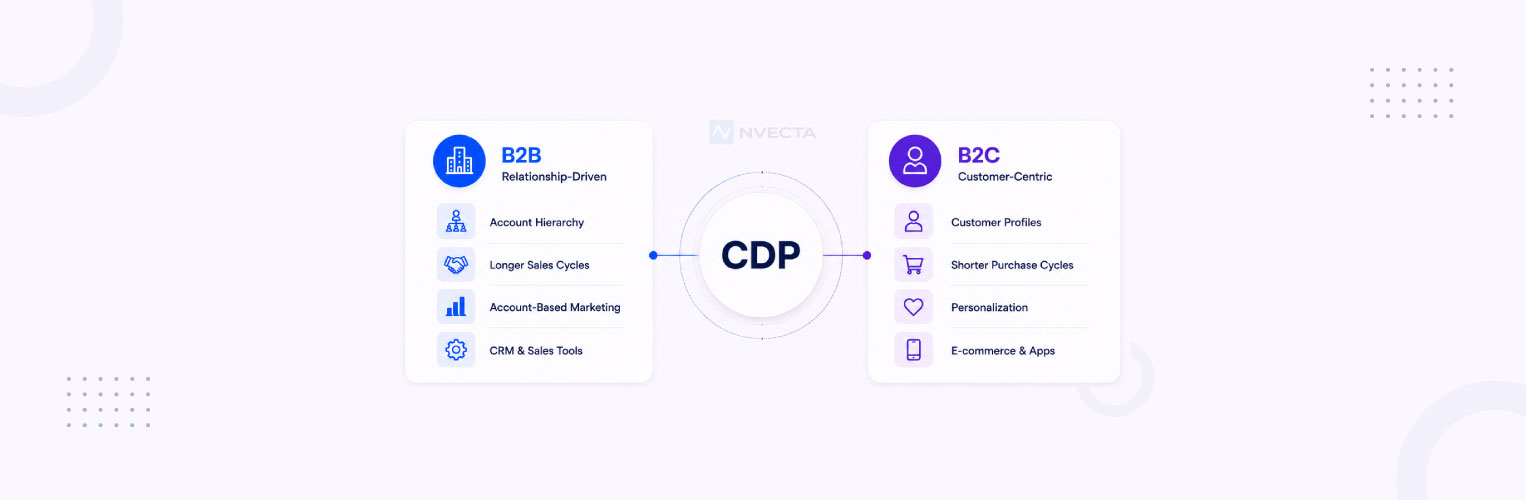
 Aparupa Saha
Most CDP buying decisions go sideways for the same reason. A B2B SaaS team buys a platform built for retail, or a fast-growing DTC brand picks one designed for enterprise sales. The vendor demos look great. Six months in, the team is fighting the tool instead of using it.
The CDP for B2B vs B2C question is not marketing semantics. It changes the architecture, the data model, the integrations, and almost every use case the platform can support out of the box. If you skip this comparison before buying, you’ll likely pay for it twice, once at signing and once during the rip-and-replace.
This guide breaks down the real differences, with examples, a comparison table, and a clear answer to whether one CDP can actually serve both motions. NVECTA gets a mention where it fits, but the goal here is clarity, not selling.
Quick answer
A B2B CDP organizes data around accounts, where many contacts roll up to one company, and connects tightly to sales tools like Salesforce and Outreach.
A B2C CDP organizes data around individuals, stitches identity across devices and channels, and connects to high-volume activation tools like Klaviyo, Braze, and ad platforms. The unit of identity is the core difference, and it changes everything else.
TL;DR
- B2B CDPs treat accounts as the primary identity. B2C CDPs treat individuals as the primary identity.
- B2B CDPs handle low event volume but rich firmographic and intent data. B2C CDPs handle massive event volume but fewer external attributes.
- B2B activation is mostly into sales tools and ad audiences. B2C activation is mostly into email, SMS, push, on-site personalization, and ad platforms.
- Hybrid CDPs exist, but most teams get better outcomes from a platform built for their primary motion.
- Buying the wrong category is the second most common reason CDP projects fail. The first is poor data hygiene.
[Insert Image: simple diagram comparing B2B account-level identity vs B2C individual-level identity]
What is a CDP
A customer data platform collects customer data from every source, ties it to a single identity per customer, and makes that unified profile available to other tools in real time.
The CDP Institute keeps the strict definition. For our purposes here, a CDP is the layer that turns scattered customer interactions into one usable record.
Whether that record is a person or a company is exactly the question that splits B2B from B2C.
The Core Difference: Who is the “Customer”?
In B2C, the customer is a person. Anjali Sharma buys running shoes on her phone, browses on her laptop, opens an email on her tablet, and shows up at the store with a paper coupon.
Your CDP has to recognize all four of those touches as one Anjali.
In B2B, the customer is a company. Ten people from Acme Corp visit the pricing page across three months. Two attend a webinar.
One downloads a whitepaper from a personal Gmail. The CFO replies to an outbound email. Your CDP has to roll all of that up to “Acme Corp is in market,” and also keep the individual contacts separate for sales.
That sounds like a small distinction. It is not. The data model, the identity graph, the integrations, the segmentation logic, and the activation patterns are all different downstream of that one choice.
Architecture Differences Between B2B and B2C CDPs (CDP for B2B vs B2C)
Identity Resolution
B2C identity resolution is mostly about stitching anonymous and known IDs across devices. The platform watches a cookie, an email, a mobile ad ID, and a logged-in user ID, and works out that they all belong to one person.
Probabilistic matching plays a role at the edges. Deterministic matching, when someone logs in, is the gold path.
B2B identity resolution has to do all of that and roll multiple individuals up to a parent account, and sometimes to a parent of the parent.
If Acme Corp has three subsidiaries and you sell to all of them, the CDP needs to model that hierarchy.
It also has to enrich anonymous traffic with reverse IP lookups so you can attribute pricing-page visits to a company even before anyone fills out a form.
| Capability | B2B CDP | B2C CDP |
|---|---|---|
| Primary identity | Account, with contacts beneath it | Individual, with devices beneath them |
| Hierarchy support | Account, parent account, subsidiaries | Usually none, or household at most |
| Anonymous resolution | Reverse IP and IP-to-company lookups | Cookies, fingerprinting, login matching |
| Contact unification | Email, LinkedIn, phone, role | Email, phone, mobile ID, cookie, customer ID |
Data Sources and Enrichment
B2C CDPs ingest behavior at scale. Page views, app sessions, product views, cart events, transactions, email opens, ad impressions. The volume is enormous, often billions of events per month for a mid-sized retailer.
B2B CDPs ingest fewer events but rely heavily on third-party enrichment. Firmographic data from ZoomInfo or Clearbit.
Intent signals from Bombora, G2, or 6sense. Technographic data showing what stack the prospect already uses.
The CDP has to normalize all of these external feeds and join them to the account, which is a different engineering job than processing a flood of behavioral events.
[Insert Screenshot: example of a B2B account profile showing firmographics, intent score, and contact list]
Event Volume and Processing
This is where the architectures diverge most. A B2C CDP for a large retailer might process 10 billion events a month.
The platform needs streaming infrastructure, fast reads at the profile level, and sub-second activation. Cost models scale with event volume.
A B2B CDP for a SaaS company processes maybe 50 million events a month, sometimes much less.
The platform optimizes for richer joins, smarter segmentation across firmographics and behavior, and tight loops with the CRM. Cost models often scale with the number of accounts or contacts, not raw events.
If you pick a B2C CDP and your real workload is B2B, you’ll pay for throughput you don’t need. Pick a B2B CDP for a B2C workload and you’ll hit volume limits in your first quarter.
Activation and Integrations
B2C activation is broad and fast. The CDP pushes audiences to Meta, TikTok, and Google Ads. It triggers cart abandonment emails through Klaviyo or Braze.
It feeds on-site personalization engines. It sends push notifications. Real time matters because the user is in session right now.
B2B activation is narrower and slower, but more revenue-dense. The CDP feeds Salesforce or HubSpot with account intent signals.
It hands prioritized accounts to Outreach or Salesloft sequences. It builds LinkedIn matched audiences for ABM ads. It might write a Slack alert when a target account hits the pricing page.
Real time matters here too, but the unit of action is “the SDR sees this in their queue tomorrow morning,” not “the page personalizes in 200 milliseconds.”
| Activation surface | B2B CDP | B2C CDP |
|---|---|---|
| Sales tools | Salesforce, HubSpot, Outreach, Salesloft, Gong | Rare |
| Ad platforms | LinkedIn Ads, Google Ads (matched audiences) | Meta, TikTok, Google, Snap, Reddit |
| Messaging | Email via Marketo or HubSpot | Email, SMS, push, in-app via Klaviyo, Braze, Iterable |
| Personalization | Pricing page intent, sales play triggers | On-site product, recommendations, lifecycle |
| Common alerting | Slack alerts to SDRs and AEs | Rarely used the same way |
[Insert GIF: short loop of a Slack alert firing for a B2B target account]
B2B CDP Use Cases that Actually Move Revenue
A few use cases drive most of the value in B2B. The rest are nice to have.
- Account prioritization for sales. Score every account on fit and intent, hand the top 50 to your SDRs every Monday.
- Sales play triggers. When five people from one account visit the integration page, fire a Slack alert to the AE.
- ABM ad targeting. Push high-fit accounts to LinkedIn matched audiences and run sequenced creative.
- Churn risk identification. Watch product usage drop and flag accounts to customer success before renewal.
- Pipeline acceleration. Identify late-stage accounts where the buying committee has gone quiet and trigger executive outreach.
If your CDP can’t do these five, it’s not pulling its weight in B2B.
B2C CDP Use Cases that Actually Move Revenue
The B2C playbook is older and the use cases are well-trodden, but the ROI is real.
- Cart and browse abandonment. Recover sessions that didn’t convert, in real time, across email, SMS, and on-site.
- Lifecycle marketing. Welcome series, post-purchase, winback. Triggered off real behavior, not generic time delays.
- Personalized recommendations. Use unified behavior to show what the customer actually wants, not what’s on promotion.
- Loyalty and tier acceleration. Move customers up tiers with the right nudge at the right moment.
- Predictive churn and LTV. Spend retention budget where it pays back, not on customers who were leaving anyway.
Most B2C CDP buyers start with cart abandonment and lifecycle, then expand. That’s the right order. It’s the easiest to prove value and the hardest to argue with.
[Insert Video: 60-second walkthrough of a triggered cart abandonment flow]
Best CDPs by Business Model
A practical shortlist as of 2026. Not exhaustive, but a good starting set.
| Platform | Best fit | Strengths | Worth knowing |
|---|---|---|---|
| 6sense | B2B with ABM focus | Strong intent signals, account scoring | Heavy enterprise pricing |
| Demandbase | B2B with ABM focus | Account-based ads and analytics | Implementation can stretch |
| HubSpot Smart CRM | SMB and mid-market B2B | Tight CRM and marketing union | Less flexibility at enterprise scale |
| NVECTA | Mid-market B2B and hybrid B2C/B2B | Account and individual identity in one model, fast onboarding | Newer, but moving quickly on hybrid use cases |
| Bloomreach | B2C ecommerce | Strong personalization, content tools | Pricing scales with engagement |
| Klaviyo CDP | DTC and ecommerce | Tight email and SMS native experience | Lighter on enterprise B2C scale |
| Insider | Mid to large B2C | Strong web and app personalization | Crowded UI, learning curve |
| Segment | Engineering-led teams, either model | Mature SDKs, big integration catalog | Pricing scales fast at high volume |
| Adobe Real-Time CDP | Enterprise, separate B2B and B2C editions | Tight Adobe stack tie-in | Only worth it on Adobe |
| Salesforce Data Cloud | Salesforce-heavy B2B or B2C | Native to the CRM | Implementation is a project |
If you sell to companies, start at the top of the table. If you sell to people, start in the middle. If you do both, the hybrid options are the ones to look at.
Common Mistakes When Picking a CDP for your Model
A few patterns repeat themselves enough that they’re worth flagging.
- Choosing on price first. CDPs are sticky once data flows in. Ripping one out is a six-month project.
- Letting the IT team pick alone. Architecture matters, but use case fit matters more, and that’s a marketing call.
- Buying a B2C CDP for a PLG SaaS company. PLG looks like B2C from the outside, but the buying motion is still B2B once a deal moves upmarket.
- Ignoring the activation side. A CDP that ingests beautifully but can’t push to your three top channels is half a tool.
- Underestimating the data work. The platform is maybe 30% of the project. The other 70% is schema, identity rules, consent, and getting the team to actually use it.
Can one CDP Serve Both B2B and B2C?
For most companies, no. For some, yes.
The “yes” cases are usually mid-market hybrids: a SaaS company with a self-serve PLG funnel that also has an enterprise sales motion, or a marketplace with both buyer and seller sides.
In those cases, you need a platform that models accounts and individuals natively, without one being a hack on top of the other.
Pure B2B and pure B2C teams almost always do better with a specialized CDP. The “one tool for everything” pitch sounds efficient, but it usually means compromising the architecture for whichever motion is smaller.
NVECTA is one of the platforms built specifically for the hybrid case, which is why it shows up in both rows of the comparison table above.
[Insert Image: Venn diagram showing B2B-only, B2C-only, and the hybrid overlap]
Quick Summary and Key Takeaways
- B2B vs B2C is the first architectural question, not the last.
- B2B = account identity, sales tool integration, firmographic enrichment.
- B2C = individual identity, real-time activation, behavioral scale.
- Hybrid models exist but are rarer than vendors suggest.
- Pick the category that matches your dominant motion, not the one with the prettiest demo.
Pick a CDP that Matches your Motion
If you’ve read this far, you probably already know whether your company is account-led, individual-led, or sitting awkwardly between the two.
NVECTA is built for teams that need both identity models in one platform—supporting seamless customer journeys without forcing one to act like the other.
Onboarding is in weeks, identity resolution handles accounts and individuals natively, and the activation surface covers Salesforce on the B2B side and Klaviyo, Braze, and Meta on the B2C side.
Book a 30-minute working session with the NVECTA team and we’ll map your current motion, show you exactly how a hybrid identity model would handle your data, and tell you honestly if a more specialized tool would be a better fit. The goal is to save you the rip-and-replace, not to win a logo.
FAQs
What is the main difference between a B2B and a B2C CDP?
The main difference is the unit of identity. A B2B CDP treats accounts as the primary record and rolls multiple contacts up to each account. A B2C CDP treats individuals as the primary record and stitches multiple devices and channels to each person. That choice shapes the data model, integrations, and use cases.
Do B2B companies actually need a CDP?
Yes, especially if you have more than 200 target accounts, run ABM, or struggle to align sales and marketing on which accounts are in market. A B2B CDP scores accounts, surfaces intent, and feeds your sales team prioritized lists. NVECTA and similar account-aware platforms make this work without a six-month build.
Can one CDP handle both B2B and B2C use cases?
Sometimes, but not always well. Hybrid models work for SaaS companies with a self-serve plus enterprise motion, or marketplaces with two-sided users. Pure B2B or pure B2C teams almost always get better results from a specialized platform. Hybrid CDPs like NVECTA are designed for the genuinely mixed case.
Why is real-time activation more critical in B2C?
Because the buying window is short. A B2C customer makes a purchase decision in minutes, sometimes seconds. If the cart abandonment email arrives a day late, the sale is gone. B2B buying cycles run weeks or months, so a Slack alert tomorrow morning still works. Speed matters in both, but the threshold is different.
What integrations should a B2B CDP support out of the box?
At minimum, Salesforce or HubSpot CRM, Outreach or Salesloft for sales engagement, LinkedIn Ads for ABM, and Slack for sales alerts. Bonus points for Gong, 6sense or Bombora for intent, and ZoomInfo or Clearbit for firmographic enrichment. If a vendor can’t tick those, they are not a serious B2B CDP.
