














 Email
Email SMS
SMS Whatsapp
 Web Push
 App Push
 Audience Sync for Ads
 Popups
 Channel A/B Testing
  Control groups Analysis
 Frequency Capping
 Funnel Analysis
 Cohort Analysis
 RFM Analysis
 Signup Forms
 Surveys
 NPS
NPS Landing pages personalization
  Website A/B Testing
  PWA/TWA
 Heatmaps
 Session Recording
 Wix
Wix Shopify
 Magento
 Woocommerce
 eCommerce D2C
  Mutual Funds
 Insurance
 Lending
  Recipes
  Knowledgebase
 Developer Docs
 Product Updates
 App Marketplace
 Academy
 Ebooks
 Case Studies
 Blog
Blog Templates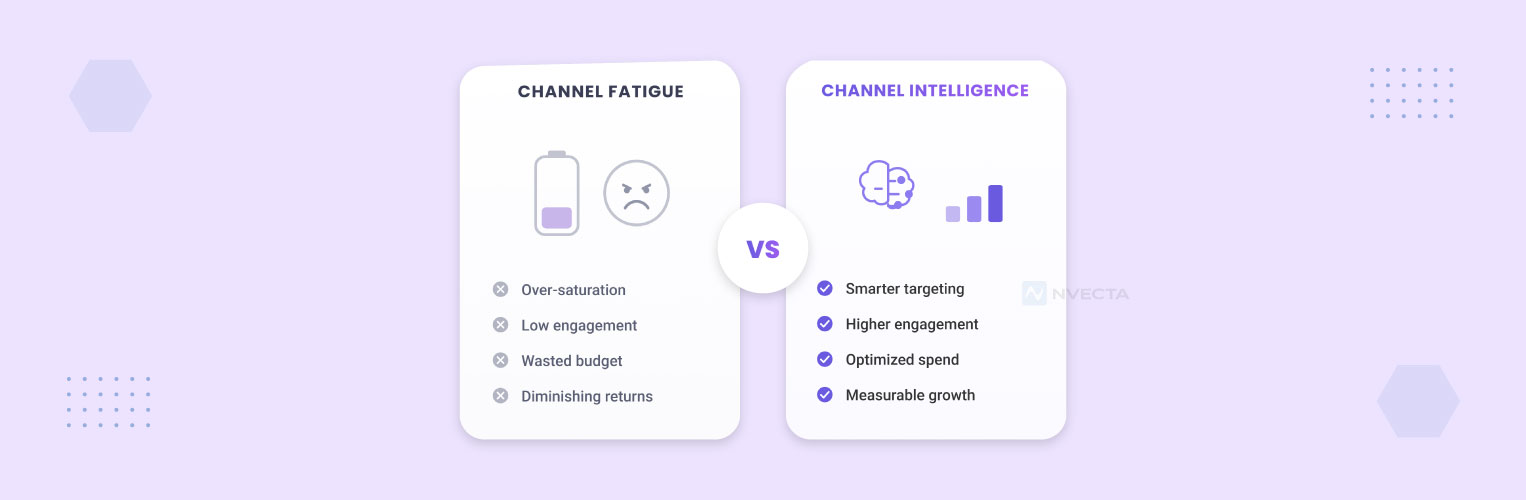
 Aparupa Saha
A customer buys something. Twenty minutes later, they get an SMS about the thing they just bought. Then a push notification. Then, the next morning, an email with a discount.
Nobody planned that experience. It just happened because the email team, the SMS tool, and the push platform weren’t talking to each other. The customer, meanwhile, has already muted notifications from that brand.
This is channel fatigue. Not a strategy. Not a choice. Just the natural output of a marketing stack that treats every channel as its own independent universe.
Channel intelligence is the way out. It’s not about sending less, though sometimes it means that. It’s about making every send decision based on something real: what this customer did, when they were last active, which channel they actually respond to, and whether this message will feel like a useful nudge or just more noise.
NVECTA was built to make that kind of precision possible — turning the whole channel fatigue vs channel intelligence trade-off into an operational default rather than a constant judgement call. It uses agentic AI and a unified customer data layer that connects behaviour to action in real time, without requiring a team of engineers to set it up
What is Channel Fatigue?
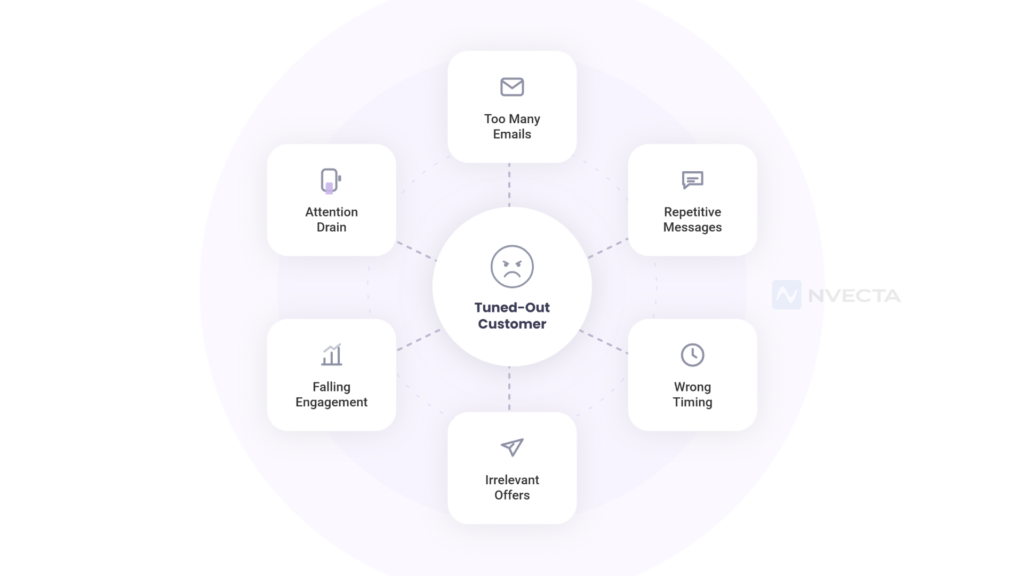
Channel fatigue is when a customer gets so many brand messages across email, SMS, and push that the communication stops feeling useful and starts feeling like noise.
It usually isn’t one bad campaign. It builds up over time when each channel runs on its own, with no shared view of how often a person has already been contacted this week.
Then engagement quietly drops. People stop opening, some unsubscribe, and a few mark messages as spam, which hurts deliverability for everyone on the list.
What is Channel Intelligence?
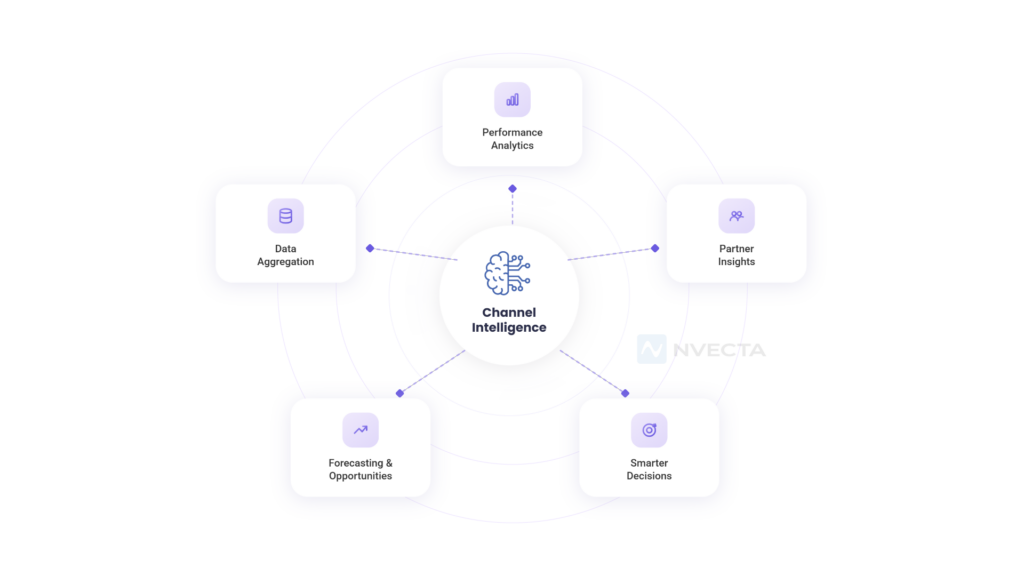
Channel intelligence is deciding every send from a live behavioural signal instead of a campaign calendar. When to message, which channel to use, what to say, whether to send at all: each call is based on what the customer just did and how they usually respond.
It runs on a unified, real-time profile, so channels are aware of each other and stop piling on. The point isn’t sending less, though sometimes it is. It’s sending the message at a moment the customer actually wants to read it.
What Does Channel Fatigue Look Like From the Customer’s Side?
Customers rarely complain about channel fatigue out loud. They just stop engaging. Or they unsubscribe. Or they mark something as spam, which is much worse than an unsubscribe because it affects deliverability across your entire list.
The experience that creates this isn’t usually one bad campaign. It’s a pattern. Same offer, multiple channels, two days in a row. A re-engagement email to someone who purchased three days ago. A win-back sequence firing for a customer who’s been opening every message, just not buying.
From the brand side, these things feel like thorough coverage. From the customer side, they feel like spam.
Some specific patterns worth checking in your own program:
- Customers who’ve bought in the last 30 days are still in the same nurture flow as cold leads from six months ago
- Your most loyal segment has a higher unsubscribe rate than your least active one
- The same promotional message goes out across email, SMS, and push within a 24-hour window
- Journey exit conditions are based on time delays rather than behavioural signals
- You have no frequency cap that accounts for how many total messages someone received across all channels this week
If two or more of those are true, channel fatigue is already a problem, even if the metrics haven’t yet surfaced.
Channel Fatigue vs Channel Intelligence: Side by Side
| Dimension | Channel Fatigue | Channel Intelligence |
| Root cause | Campaigns built around send schedules, not customer signals | Every send decision is tied to a live behavioural data point |
| Customer experience | Repetitive, irrelevant, easy to ignore or block | Timely enough that the customer actually wants to read it |
| What drives frequency | Volume targets set by the marketing team | Predicted engagement likelihood per customer, per hour |
| Channel selection logic | Use every channel available, simultaneously | The channel this specific customer responds to most |
| What happens over time | Opt-outs climb, deliverability degrades, revenue drops | Audience longevity grows, revenue per contact rises |
| Who benefits short-term | The team is hitting send targets | The customer, and eventually the brand’s bottom line |
What Channel Fatigue Looks Like in Practice
Three common scenarios, and what changes once channel intelligence is running.
1. The Post-Purchase Pile-On.
Someone buys a pair of running shoes. Within an hour they get an order-confirmation email, an SMS with the same tracking link, and a push notification asking them to rate their “experience” before the box has even shipped.
The next morning, a promo email offers 15% off the shoes they just paid full price for. None of these is wrong on its own. Together it reads as spam. With channel intelligence, the confirmation goes out once, on the channel this customer actually opens.
The discount waits until they’ve received and used the product, and it’s for a complementary item, not the thing they already own.
2. The Onboarding Drip that Ignores What You Did
A new user signs up for a SaaS trial and finishes setup in the first ten minutes. The seven-day onboarding sequence keeps firing anyway: day two, “here’s how to get started” (already done), day three, “still need help setting up?” (no). By day four they’ve muted the emails.
Channel intelligence reads the setup-complete signal and skips those steps, moving straight to the messages that matter for someone who’s already active.
3. The Win-Back Sent to Someone Who Never Left
A customer opens every email but hasn’t bought in 60 days, so a win-back flow tags them “lapsed” and hits them with a heavy “we miss you” discount across email and SMS.
They were engaged the whole time, just not ready to buy, and now they’ve learned to wait for the discount. Channel intelligence separates “not opening” from “not buying,” and holds the aggressive win-back for people who have genuinely gone cold.
Why Do Brands Keep Making the Same Mistake?
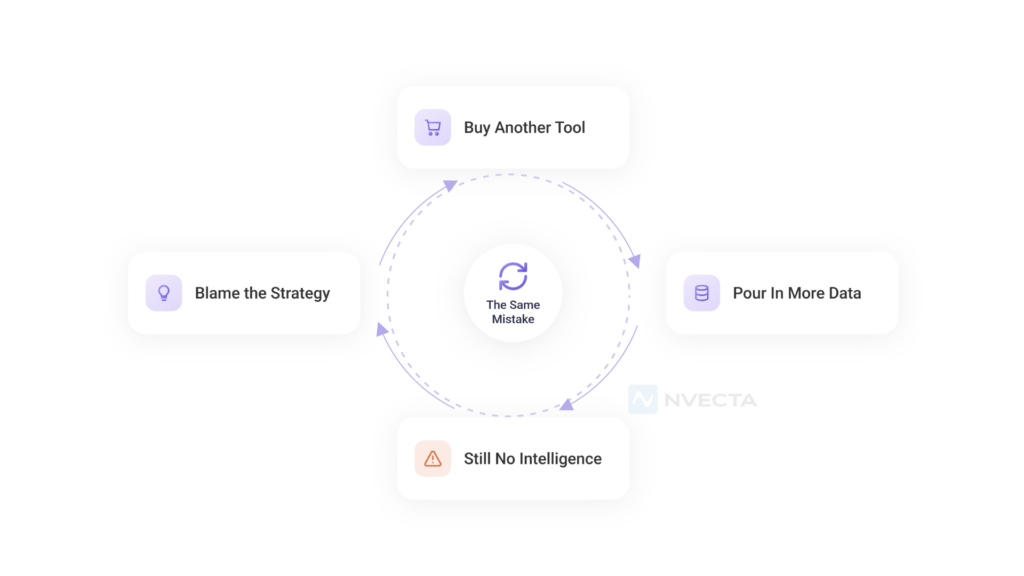
Volume works. In the short term, sending more leads to more conversions because you’re catching more people at the right moment, just by sheer reach.
Attribution models reinforce this because they credit the last touchpoint, not the quality of the relationship that made someone receptive in the first place.
So teams hit their send targets, celebrate the revenue bump, and don’t notice the slow rot underneath: the gradually declining open rates, the audience shrinkage, the deliverability issues that start as a small flag and become a serious problem six months later.
There’s also an infrastructure issue. Most brands have different teams managing different channels, often with different tools, different KPIs, and different ideas of what ‘good’ looks like.
Nobody has a complete picture of how many times a specific customer was contacted this week. So each channel looks fine in isolation, while the combined experience is overwhelming.
Channel intelligence requires a shared view of the customer. That’s not a campaign management problem. That’s a data architecture problem, and it’s the reason a customer data platform is the foundation, not just another tool in the stack.
What Channel Intelligence Actually Requires to Work
There’s a version of ‘channel intelligence’ that’s just a different name for send-time optimisation, or frequency capping. Those things help. But real channel intelligence runs deeper than that.
A unified behavioural profile per customer: Not a profile that updates nightly from a batch job. One that reflects what happened 10 minutes ago. If someone browses three product pages and adds one to the cart, that signal should be shaping the next outreach decision before they close the tab.
Real-time cross-channel coordination: When a customer converts via email, the SMS should be notified. When they open a push notification, the in-app message doesn’t need to restate the same thing. Channels should be aware of each other, or you’re not doing orchestration, you’re doing parallel broadcasting.
Suppression logic that’s predictive, not reactive: Waiting for someone to unsubscribe before pulling back is too late. Intelligent systems detect soft disengagement, declining open rates, and reducing session length and adjust before the relationship breaks.
A feedback loop that actually improves decisions: Channel intelligence isn’t a one-time configuration. It needs to be updated based on what’s working: which channels, which send times, which message types are generating the best response for which customer segments. Without this loop, you’re not being intelligent. You’re just being systematic about the same thing.
The Signals That Make Smarter Channel Decisions Possible
| Signal Category | What It Tracks | Delivery Impact |
| Engagement recency | Last open, last click, last app session | Suppresses sends during cold or dormant windows |
| Channel affinity | Conversion rate by channel, historically | Routes new messages through the customer’s best-performing channel |
| In-session behaviour | What pages they browsed, how long, what they skipped | Fires contextual follow-ups based on what actually caught their attention |
| Purchase signals | Recency, order value, category preference, return rate | Shapes offer type, product recommendation, and messaging tone |
| Soft disengagement | Opens without clicks, fading session length, no replies | Catches the drop-off early, adjusts frequency before the unsubscribe |
How to Tell If Your Program Has a Fatigue Problem Right Now
The symptoms are usually there. They just get explained away.
Declining open rates get blamed on deliverability. Rising unsubscribes get blamed on list quality. Flat conversion rates get blamed on offer fatigue, meaning the discounts aren’t deep enough, not that the communication itself is the problem.
A more honest audit looks at behaviour patterns rather than surface metrics.
Pull your unsubscribe data and segment it: Who’s opting out? If it’s recent purchasers, your post-purchase sequences are the problem. If it’s high-value customers, something in your retention flows is misfiring. The segment tells you more than the rate does.
Count how many channels hit the same customer within a 48-hour window: If the answer is 3 or more and no conversion event triggers suppression, that’s the core issue.
Look at opens without clicks across your most-engaged segment: If people who were clicking six months ago are now only opening, that’s a content or frequency problem, not a deliverability problem.
Map your journey logic and highlight every step that is time-delay-only: Any step that fires purely on time, with no behavioural condition, is a potential source of noise injection. How many of those do you have?
The Real Cost of Channel Fatigue on Revenue
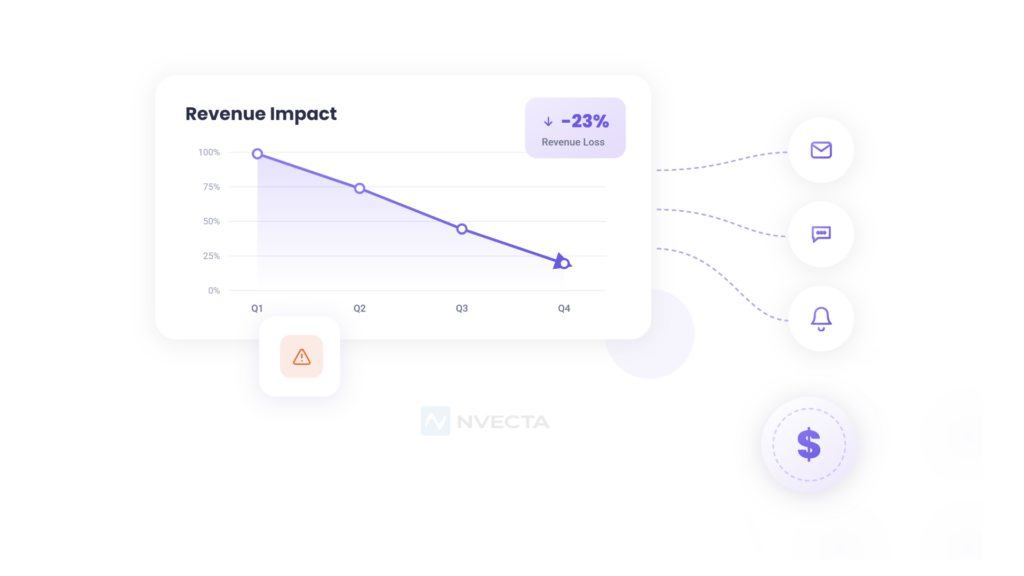
Opt-outs are the visible cost. The invisible cost is bigger.
Every customer who disengages quietly, who doesn’t unsubscribe but just stops opening, is a lost revenue opportunity that doesn’t show up in any report. They’re still on your list. They’re counted in your audience size. But they’re gone in any meaningful sense.
There’s also a reacquisition cost problem. Earning back an opt-out customer almost always costs more than retaining them would have. You’ve lost the channel permission. You may have to spend on paid media to reach them again, or offer a deeper discount to re-earn trust.
And then there’s the deliverability spiral. Consistent high complaint rates and low engagement tell ISPs and mobile carriers that your messages aren’t wanted. Inbox placement drops. The customers who would have engaged with your best campaigns never see them.
Brands that shift from volume-based to signal-based marketing tend to see improvements in open rates within the first 30 to 60 days. Not because the messages are better, though they should be. Because the noise that was burying the good messages gets removed.
How NVECTA Addresses Channel Fatigue at the Platform Level
NVECTA doesn’t treat channel intelligence as a campaign feature. It’s built into the way the customer data platform, automation engine, and AI layer interact.
| NVECTA Capability | What It Actually Does | Which Fatigue Problem Does It Fix |
| Unified Customer Profile | Merges all identity and behavioural data across sessions and devices in real time | No more duplicate sends to the same person across disconnected systems |
| Predictive Send-Time Optimisation | Scores each customer’s engagement probability by time of day | Stops mass blasts going out at 10 am because that’s when someone scheduled them |
| AI Co-Marketer | Recommends channel, cadence, and content changes based on performance patterns | Removes the guesswork that leads teams to overbuild on underperforming channels |
| Cross-Channel Suppression | Automatically pauses redundant sends when a customer converts or engages elsewhere | Prevents the pile-on: email goes out, then SMS, then push, for something already done |
| Agentic AI Journeys | Rewrites journey paths in real time using live behavioural signals | Replaces rigid drip sequences with something that actually responds to what the customer does |
The AI Co-Marketer sits across all of this and gives marketers a clear read on what’s driving fatigue and where the next opportunity for improvement is. It’s not a dashboard that tells you what happened. It’s a working layer that tells you what to do differently.
Where to Start If You’re Dealing With This Right Now
You don’t need a full platform migration to start reducing fatigue. The highest-impact interventions, in rough order of difficulty:
- Set a cross-channel frequency cap per customer, not per campaign. Five emails in a week from five different journeys are still five emails.
- Add behavioural exit conditions to every active journey. A customer who buys on day two of a seven-day flow should not receive days three through seven.
- Implement cross-channel suppression so that a conversion on one channel pauses the same message on others. This alone eliminates the most common fatigue complaint.
- Run send-time optimisation at the individual level rather than sending to your entire list at the same time. Engagement windows vary significantly across customers.
- Audit your post-purchase sequences specifically. These are the highest-risk flows for fatigue because customers are most sensitive to over-communication right after a transaction.
Each of these can be tackled incrementally. The goal isn’t to perfect everything at once. It’s time to start making decisions based on what individual customers are doing, rather than what the campaign calendar says is next.
Conclusion
Channel fatigue is a data problem wearing a marketing costume. When you don’t have a clear, current picture of what each customer is doing and how they’ve been responding, the default is to broadcast. And broadcasting feels productive right up until the audience stops listening.
Channel intelligence replaces that default with something better: decisions made from real signals, in real time, that account for what a person actually needs to hear and where they’re most likely to respond. It’s not complicated in theory. It’s hard in practice because it requires data infrastructure that most brands are still building.
NVECTA brings that infrastructure together. The unified customer profile keeps behavioural data up to date across every touchpoint. The marketing automation engine enforces suppression and frequency logic without manual intervention. The Agentic AI Journeys respond to what customers do, not just what day of the journey they’re on. And the AI Co-Marketer keeps the whole system accountable by continuously surfacing what’s working and what’s creating noise. The result isn’t just better open rates. It’s a marketing program customers don’t want to escape.
Frequently Asked Questions
What is channel fatigue, and why does it happen?
Channel fatigue occurs when customers receive so many brand messages across email, SMS, push notifications, and other channels that the communication stops feeling relevant and starts feeling intrusive. It’s usually not the result of a single bad campaign. It builds up over time when marketing teams operate each channel independently, without a shared view of how often a specific customer has been contacted or what they’ve actually done in response. The result is a pattern of over-communication that erodes engagement, drives opt-outs, and quietly reduces revenue.
How is channel intelligence different from just sending fewer messages?
Reducing volume is one outcome of channel intelligence, but it’s not its definition. Channel intelligence means using behavioural data to make better decisions about when to send, which channel to use, what to say, and when to suppress outreach entirely. A customer who just browsed your site for 20 minutes and added something to the cart might benefit from a timely follow-up. A customer who hasn’t opened anything in 45 days probably shouldn’t get a high-frequency push campaign. The distinction is whether you’re making those calls based on data or based on a campaign schedule.
What signals matter most for reducing channel fatigue?
The most useful signals are engagement recency (when the customer last responded to any message), channel affinity (which channel they’ve historically converted through), session behaviour (what they browsed and how recently), and soft disengagement indicators like opens without clicks or declining session frequency. Together, these signals let you make per-customer decisions about timing, channel, and whether to send at all, rather than applying the same logic to your entire list.
Can a brand recover from channel fatigue once it’s set in?
Yes, but recovery takes longer than prevention. The first step is stopping the behaviour that caused the problem, which usually means implementing cross-channel suppression, frequency caps, and behavioural exit conditions on active journeys. After that, a re-permission or re-engagement campaign can help identify which disengaged customers still want to hear from you and on which channel. The customers who don’t respond should be removed from active outreach rather than pushed harder, which is a common mistake. Inbox placement and engagement rates typically begin recovering within 60 to 90 days of consistent behaviour change.
Is channel intelligence only possible with a CDP?
Not strictly, but a CDP makes it significantly more practical. The core requirement for channel intelligence is a unified, real-time view of each customer’s behaviour across all channels and touchpoints. Without that, you can’t make coordinated decisions. Some brands try to approximate this with point-to-point integrations between their existing tools, but those setups are brittle, often suffer from data latency, and break down as the channel mix grows. A CDP that centralises behavioural data and exposes it to downstream tools is a much more stable foundation.
How does NVECTA specifically help with channel intelligence?
NVECTA’s platform integrates customer data, journey automation, and AI decisioning into a single system. The CDP layer unifies identity and behaviour across devices and sessions in real time, so every channel has access to the same current picture of each customer. The automation engine applies cross-channel suppression and frequency logic automatically, without requiring manual rules for every scenario. The Agentic AI Journeys adjust in real time based on what customers actually do, rather than executing a fixed sequence regardless of behaviour. And the AI Co-Marketer provides ongoing recommendations on where channel decisions are creating fatigue and where there’s room to improve. The goal is a program in which every message that reaches a customer has a data-backed reason for being there.
