













 Email
Email SMS
SMS Whatsapp
 Web Push
 App Push
 Audience Sync for Ads
 Popups
 Channel A/B Testing
  Control groups Analysis
 Frequency Capping
 Funnel Analysis
 Cohort Analysis
 RFM Analysis
 Signup Forms
 Surveys
 NPS
NPS Landing pages personalization
  Website A/B Testing
  PWA/TWA
 Heatmaps
 Session Recording
 Wix
Wix Shopify
 Magento
 Woocommerce
 eCommerce D2C
  Mutual Funds
 Insurance
 Lending
  Recipes
  Knowledgebase
 Developer Docs
 Product Updates
 App Marketplace
 Academy
 Ebooks
 Case Studies
 Blog
Blog Templates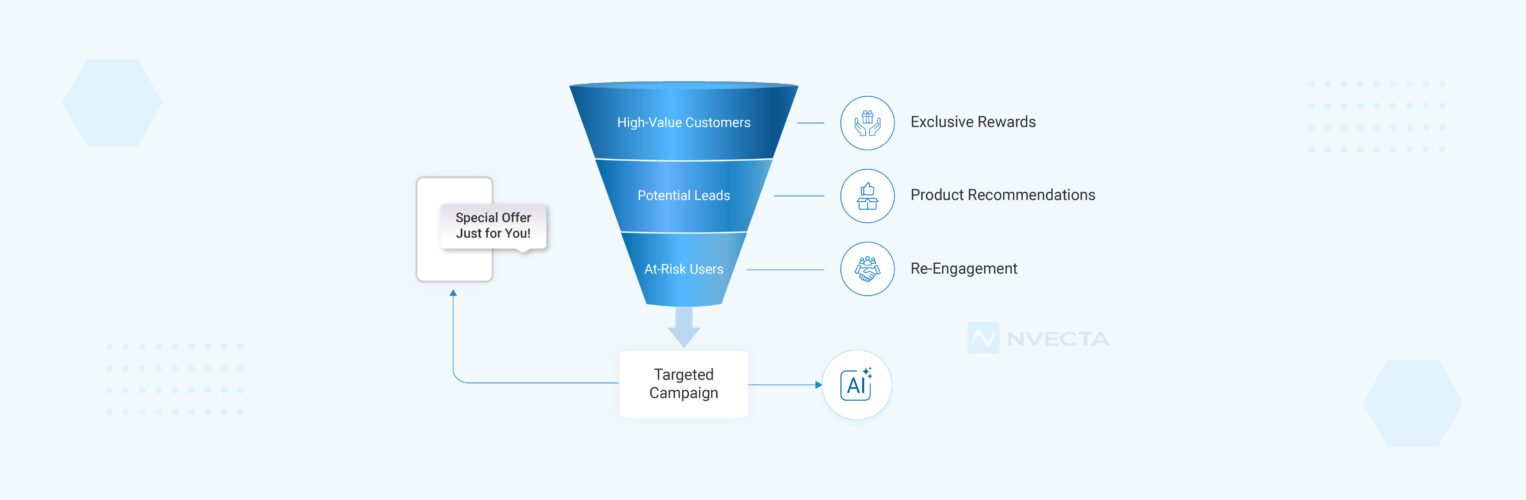
 Afreen Sheikh
To engage customers in 2026, brands need to shift from reactive to predictive marketing. Today, the competitive market requires smarter and forward-looking tools to process customer data efficiently.
Generic messages or static segmentation are not enough to keep customers engaged over multiple touchpoints. To stay ahead, brands must evaluate their customers’ expectations and preferences in advance to personalise experiences.
Predictive segmentation is a powerful CDP feature that supports businesses to move beyond demographics and past behaviour to predict what customers will do next. It involves the utilisation of predictive intelligence and data patterns so that brands can build excellent customer journeys that feel relevant, timely and personalised.
In this guide, we will cover-
- The key features, benefits, and use cases of predictive segmentation
- How predictive segmentation works and differs from traditional segmentation
- How NVECTA supports predictive segmentation for smarter customer engagement
What Is Predictive Segmentation?
Predictive segmentation is an AI-driven feature that utilises customers’ historical data and behavioural patterns to predict their future actions.
It involves grouping customers based on how they are expected to respond. This helps in identifying customers who are more likely to take action.
Predictive segmentation is an advanced form of segmentation that does not rely on traditional fixed rules such as age, location, or previous purchases.
It rather uses statistical models and machine learning algorithms to recognise specific patterns that marketers may not easily recognise.
For example, two customers might look similar on the basis of demographics, but on accessing their behaviour, we will get different outcomes.
One might show early signs of churn, while the other may be likely to convert again. Predictive segmentation helps marketers identify these differences and act accordingly.
Predictive segmentation further plays an important role in personalisation. For businesses that have a large customer base or whose customer data is likely to expand and grow, it becomes nearly impossible to customise the experience for each customer.
Such a feature automates tasks by continuously analysing data and grouping customers into meaningful segments that show present and future needs.
Features of Predictive Segmentation
Unlike traditional segmentation, predictive segmentation is:
- Dynamic and real-time—adjusting as customer behaviour changes
- Behaviour driven—not limited to demographics or static rules
- Focus on customer intent—help predict purchase, churn, or engagement patterns.
Predictive segmentation assesses every action, like purchase frequency, browsing behaviour, engagement levels, time spent on a page, and channel interactions. These small signs help in recognising customers who are likely to convert, churn, or disengage.
Why Traditional Segmentation Is No Longer Enough
Traditional customer segmentation has long been used to manage customer segments and plan marketing campaigns.
It did well when customer journeys were more predictable, and channels were limited. It helped group audiences and send targeted messages at scale.
But today customers use multiple channels to interact with brands and their behaiour changes quickly, thus these outdated methods fail to catch true customer intent.
Let’s see the drawbacks in detail-
Static and Rigid
Traditional segments are created relying on fixed, defined rules. Such segments do not update in real time as per the changing customer behaviour.
These segments remain static unless manual changes are made. This leads to ineffective engagement as you work with outdated assumptions.
Backward Looking
This method mainly relies on historical customer data, such as past purchases or previous activity. It gives an idea of what the customer did earlier, but it lacks when the marketer needs to understand what they are likely to do next.
Broad and Generic
Customers grouped into the same segment often have different purposes, interests, buying patterns and readiness levels.
Sending the same message to all customers in a broad segment reduces relevancy and affects personalisation efforts.
Manual and Time-Consuming
Rule-based segmentation demands continuous monitoring, testing, and updating by marketing teams. As data sources and touchpoints increase, managing these rules becomes more complex and less efficient.
Lack of Predictive Intelligence
Traditional segmentation lacks advanced intelligence and cannot identify early signs of churn, declining interest, or upcoming purchase intent. Without predictive understanding, brands often miss the opportunity to engage customers at the right time.
When customer journeys expand, these drawbacks lead to delayed engagement and the loss of growth prospects.
How Predictive Segmentation Works
Predictive segmentation is a well-structured process- it begins with collecting customer data, finding behavioural patterns, and using predictive models to predict future actions. Such insights help businesses create dynamic customer segments and deliver more relevant experiences throughout the customer journey.
Predictive segmentation combines customer data, predictive analytics, and machine learning to understand what customers are likely to do next. Rather than relying only on past actions, it continuously evaluates changing behaviour and updates customer segments accordingly.
The process typically involves the following steps:
Collecting Customer Data Across Channels
The first step is gathering customer data from different touchpoints.
This may include:
- Website activity
- Mobile app interactions
- Purchase history
- Email engagement
- Customer support interactions
Bringing data together from multiple channels helps create a more complete view of each customer.
Identifying Behavioural Patterns
Once customer data is collected, the system begins identifying patterns and trends.
It looks at factors such as:
- Browsing behavior
- Purchase frequency
- Engagement levels
- Product interests
- Channel preferences
These insights help businesses understand how customers interact with their brand and what actions may follow.
Applying AI and Predictive Models
Predictive models then analyse customer behaviour to estimate future actions.
These models help identify customers who are likely to:
- Make a purchase
- Become inactive
- Respond to an offer
- Upgrade a subscription
- Return to the website
This allows businesses to move from reactive marketing to more proactive engagement.
Creating Dynamic Customer Segments
Based on predicted behaviour, customers are grouped into meaningful segments.
Unlike traditional audience groups, these segments are not fixed. They continuously update as customer behaviour changes.
For example, a customer showing strong purchase intent may automatically move into a high-conversion segment, while a declining customer may be placed into a retention-focused segment.
Activating Personalised Customer Journeys
The final step is turning insights into action.
Businesses can use predictive segments to deliver:
- Personalized recommendations
- Timely offers
- Retention campaigns
- Product suggestions
- Automated customer journeys
This helps ensure that customers receive relevant communication based on their current needs and likely future actions.
As customer behavior changes, predictive segments update automatically. This allows businesses to stay aligned with customer intent and create more personalised experiences at every stage of the journey.
Predictive Segmentation vs Traditional Segmentation
Customer segmentation has always been an important part of modern marketing practices. It helps a brand to organised audience and deliver relevant communication.
But today customer journeys have become complex as customers switch to multiple channels and devices while interacting with brands.As a result, historical data is often not enough to understand customer intent.
This is where predictive segmentation creates a significant advantage.
Let us look at a comparative table to understand both the approaches-
| Aspect | Traditional Segmentation | Predictive Segmentation |
|---|---|---|
| Customer Understanding | Focuses on who the customers are | Focuses on what customers are likely to do next |
| Data Used | Demographics, location, and past purchases | Historical behaviour, real-time interactions, and predictive signals |
| Customer Intent | Difficult to identify accurately | Helps uncover purchase, churn, and engagement intent |
| Segment Updates | Requires manual updates | Continuously evolves as customer behaviour changes |
| Personalization | Same message for broad customer groups | Tailored experiences based on predicted needs and actions |
| Marketing Approach | Reactive and based on past activity | Proactive and based on future opportunities |
| Customer Journey Impact | Limited ability to adapt to changing behaviour | Supports more relevant and timely customer journeys |
| Business Outcome | Improved audience targeting | Higher engagement, retention, and conversions |
Benefits of Predictive Segmentation Across the Customer Journey
Predictive segmentation helps brands create effective customer journeys that feel personal rather than mechanical.
Instead of treating all customers the same and relying solely on past actions, it analyses behavioural patterns to predict what customers are likely to do next.
Such a predictive feature helps brands respond with the right message at the right time and on the right channel.
This results in more natural and relevant customer journeys. Below are some simple ways predictive segmentation improves customer journeys.-
Reaching Customers at the Right Moment
Predictive segmentation works in real- time and updates customer behaviour and preferences instantly.
Brands can reach customers at the right moment, i.e., when their interest is highest or rising. This helps induce a purchase decision and reduce the risk of the message being ignored.
Personalisation that Aligns with Customer Intent
Every time, there is no need to send a single message to all customers. Predictive segmentation helps in sending personalised messages to different segments based on what customers are likely to do next.
When brands understand customers’ intent, communication feels more connected and helpful. For instance, a customer who browses a product should be sent a message of product details or a review, while another customer who is likely to make a purchase should be sent a special offer or reminder.
Smarter Onboarding Experiences
Interaction at the beginning of a journey often affects whether a customer stays or leaves. Predictive segmentation monitors those new customer interactions with the product and then optimises onboarding journeys accordingly.
Customer journeys that move quickly can advance quickly, while others receive extra guidance to reduce confusion and drop-offs.
Preventing Churn Before it Happens
Customers rarely leave suddenly. Predictive segmentation points out early signs that may reduce engagement or shorten customer visits. With such predictions, brands can take positive steps to retain customers, such as special offers, reminders,etc before they disengage completely.
Prioritising High-Value Relationships
With time, every brand acquires loyal customers and is of long-term value. The predictive feature recognises these customers so brands can offer special discounts and rewards. Such kind of personlaized experience builds long-term relationships.
Consistent Experiences Across Channels
Customers use multiple channels to search brand and frequently switch between them. Predictive segmentation recommends the right message for the right channel and helps maintain consistency.
This eliminates the chances of disconnected communication and delivers a smoother experience.
Stronger Retention and Better Conversions
Predictive segmentation helps in delivering continuous, relevant, and timely messaging, fostering stronger customer retention.
Such predictive marketing increases the likelihood of positive responses, leading to higher conversions and customer satisfaction.
Predictive Segmentation Use Cases and Real-World Examples
Predictive segmentation is used across industries to improve customer engagement, reduce drop-offs, and boost conversions.
Knowing what customers are likely to do next helps many industries identify potential buyers.
Here are some common industry-specific examples of how predictive segmentation works in the real world-
eCommerce
In eCommerce, customer intent shifts quickly. Predictive segmentation helps brands respond before interest fades. Here are a few ways it simplifies eCommerce journeys-
- Anticipating repeat purchases- by pointing out frequent customers and motivating them to return
- Personalised recommendation of products- by displaying products based on browsing and purchase behaviour
- Lowering cart abandonment by timely reminders, offers and discounts to customers
Banking and Finance
Banking customers generally manage their finances through both digital and traditional touchpoints. Below are a few ways in which predictive analytics features can help banks improve communication and build trust.
- Tracking transactional patterns and account activity to find out customers’ requirements
- Delivering timely offers and alerts for financial guidance based on the customers’ usage trends and behaviour.
Healthcare
Patients interact with healthcare providers through apps, portals, and in-person visits. Here are a few ways predictive insights help improve patient engagement and continuity of care.
- Predicting appointment drop-offs by monitoring engagement and interaction patterns.
- Sending personalised reminders, follow-ups, or health tips to support better patient outcomes.
Subscription and SaaS
Subscription and SaaS businesses rely mainly on customer retention and long-term engagement. Here are a few ways in which predictive segmentation helps these businesses-
- Recognising early churn risks by monitoring reduced customer logins or lesser usage before the customer cancels.
- Triggering retention campaigns for engaging at-risk customers along with offers, messages, etc
- Targeting active customers for upselling opportunities for add-ons and upgrades.
Travel and Hospitality
Booking decisions are time-consuming because customers explore options and compare them before making a choice. Predictive segmentation helps the travel industry in multiple ways-
- Personalising destination recommendations by tracking browsing history and past travel interests
- anticipating booking intention by tracking destination views and repeat searches
- Sending well-timed offers and reminders to customers when interest is highest
Education and EdTech
Students or learners show strong sign about engagement and intent. Their interaction with content depicts where they may need stimulation or extra support. Thus, Education and edtech can reap benefits from predictive segmentation in any way-
- Recommendations of courses as per the learners’ behaviour and interest
- Offering discounted courses to re-engage learners who are likely to drop off
The above example shows how various industries can utilise predictive segmentation to improve customer engagement and retention.
How NVECTA Enables Predictive Segmentation
NVECTA CDP has a powerful predictive segmentation feature that helps multiple businesses to foresee what their customers are likely to do next and take timely actions for the same.
It removes the space for any kind of guesswork as its real-time behaviour tracking fosters better engagement choices.
Such advanced insights promote actions across channels, helping businesses reduce drop-offs and increase conversions.
Identify High-Intent Users
NVECTA tracks customers’ browsing behaviour, engagement levels, and action frequency to find customers who are close to converting.
With such advanced tracking, brands can easily send timely reminders, offers, or personalised messages before their interest drops and the moment is missed
Predict Customer Churn and strengthen Retention
As there is continuous monitoring of customer behaviour, it is easy to predict declining activity and reduced engagement.
NVECTA identifies such customers who may be uninterested in the product or service. Automated journeys or win-back campaigns are used to re-engage such customers before churn actually happens.
Create smarter segments using RFM analysis
NVECTA uses RFM data to classify Customers into meaningful segments. This is finding loyal customers, frequent buyers, and returning customers, supporting accurate predictive targeting.
Powered by Unified Customer Data
NVECTA’s predictive segmentation works alongside unified customer data platform capabilities. It brings together customer data from multiple touchpoints to create a complete customer view, helping businesses build more accurate segments and make better engagement decisions.
Continuous Learning Through Real-Time Behaviour Tracking
As a brand’s customer base expands, NVECTA processes customer data, tracks new events, and continuously learns from customer behaviour to improve predictions. This helps businesses stay aligned with changing customer needs and engagement patterns.
Turning Predictions into Action Across Channels
NVECTA helps businesses turn predictive insights into timely actions across channels. By supporting personalised communication, retention campaigns, and targeted engagement, it helps reduce drop-offs, improve conversions, and create more relevant customer experiences.
Conclusion
Predictive segmentation is a powerful tool that helps you stay ahead of others. This approach helps brands in building efficient journeys that genuinely feel customer-centric. It transforms brands’ customer data into actionable insights, leading to improved conversions, revenues and customer engagement.
NVECTA CDP empowers brands to use intelligent engagement to build deeper customer relationships.
Try NVECTA predictive segmentation to power smarter customer journeys. Book your demo now.
FAQs
What is the main purpose of predictive segmentation?
The main purpose of predictive segmentation is to help businesses understand what customers are likely to do next. By analyzing customer behavior, engagement patterns, and historical data, businesses can create more personalized customer journeys, improve targeting, and make marketing efforts more effective.
How does predictive segmentation improve customer journeys?
Predictive segmentation helps businesses deliver the right message at the right time. Instead of treating all customers the same, it identifies customer intent and future behavior, making it easier to personalize communication, improve engagement, and create more relevant experiences across every touchpoint.
What data is used in predictive segmentation?
Predictive segmentation uses a combination of customer data, including website activity, purchase history, email engagement, mobile app interactions, and channel preferences. AI and predictive analytics analyze these signals to identify patterns and forecast future customer actions.
What is the difference between predictive segmentation and traditional segmentation?
Traditional segmentation focuses on past customer actions and fixed attributes such as demographics or location. Predictive segmentation goes a step further by using AI and machine learning to anticipate future behavior, helping businesses engage customers more proactively and accurately.
Which industries benefit most from predictive segmentation?
Predictive segmentation can benefit almost any industry that collects customer data. It is commonly used in eCommerce, banking, healthcare, SaaS, travel, hospitality, and education to improve personalization, reduce churn, increase retention, and drive higher conversions.
Why is a Customer Data Platform important for predictive segmentation?
A Customer Data Platform (CDP) helps unify customer information from multiple channels into a single profile. This gives predictive models a more complete view of customer behavior, leading to more accurate segmentation, better insights, and more effective customer journey orchestration.
How does NVECTA support predictive segmentation?
NVECTA combines unified customer profiles, real-time behavior tracking, predictive analytics, and RFM-based segmentation to help businesses identify customer intent and act on it quickly. This enables brands to create more personalized experiences, improve retention, and increase conversions.
