














 Email
Email SMS
SMS Whatsapp
 Web Push
 App Push
 Audience Sync for Ads
 Popups
 Channel A/B Testing
  Control groups Analysis
 Frequency Capping
 Funnel Analysis
 Cohort Analysis
 RFM Analysis
 Signup Forms
 Surveys
 NPS
NPS Landing pages personalization
  Website A/B Testing
  PWA/TWA
 Heatmaps
 Session Recording
 Wix
Wix Shopify
 Magento
 Woocommerce
 eCommerce D2C
  Mutual Funds
 Insurance
 Lending
  Recipes
  Knowledgebase
 Developer Docs
 Product Updates
 App Marketplace
 Academy
 Ebooks
 Case Studies
 Blog
Blog Templates
 Afreen Sheikh
Effective use of customer data is now crucial for business growth and marketing success. Every interaction offers valuable insights into customer behaviour; it could be a website visit, an email click, a product purchase, or a mobile app session. However, when these interactions span different systems, businesses struggle to unify them and create a single customer view that reflects the entire customer journey.
Businesses use various tools to manage customer data, such as marketing platforms for direct campaigns, CRM systems for contact records, analytics tools for monitoring behaviour, and support platforms for storing customer conversations. While each system offers valuable insights and functions independently, teams only see parts of the customer journey.
The single customer view addresses this challenge by integrating data from all interactions into one complete profile. Such a connected and comprehensive view provides a clearer understanding of customers, enabling the delivery of relevant experiences.
In this blog, we will explore what a single customer view is, the data behind it, how it works, and how Nvecta’s one customer view helps businesses grow.
Quick Definition: What Is SCV?
SCV stands for Single Customer View. It is a unified profile of every interaction a customer has had with your brand across every channel and system, presented as a single record. The SCV combines identity, behavioral, transactional, engagement, and support data into one continuously updated view of each customer.
Understanding Single Customer View
A single customer view is a centralised, unified profile that consolidates data from all channels through which customers engagement with your brand.
It brings everything together from multiple sources to create one accurate and reliable profile.
This unified profile is a well-structured single customer profile that includes multiple types of customer data, such as-
- Personal identity information
- Contact details and demographics
- Purchase and transaction history
- Website and app behaviour
- Marketing engagement data
- Customer support interactions
- Product usage activity
Connecting these data points gives marketers a full view of the customer journey rather than scattered snapshots from each tool. The result is sharper insight into behaviour, preferences, and engagement patterns, which then feeds straight into smarter customer segmentation so each group gets messaging tuned to how they actually buy.
This 360-degree customer view enables multiple teams across organisations to make better decisions based on shared customer insights.
For example, marketing teams can assess campaign engagement, product teams can monitor how customers use their products or services, and support teams can quickly understand past interactions.
This consolidated view eliminates inconsistencies, as every team works with the same unified dataset for operations and decision-making.
SCV vs CDP vs MDM vs Golden Record: Clearing Up the Confusion
These four terms get mixed up in almost every conversation about customer data. They are related but not the same. Here is the difference in plain language:
| Term | What It Is | Who Owns It | Primary Use |
|---|---|---|---|
| SCV (Single Customer View) | The unified output. One record per customer that combines every interaction. | Marketing, CX, Customer Success | Personalization, engagement, reporting |
| CDP (Customer Data Platform) | The platform that creates and maintains the SCV. | Marketing Tech, Growth | Building and powering the SCV for activation |
| MDM (Master Data Management) | The governance discipline that ensures data quality across the organization. | IT, Data Governance | Data accuracy, compliance, system of record |
| Golden Record | The single authoritative master record for an entity (customer, product, account). | IT, Data Governance | Source of truth across enterprise systems |
A simpler way to remember it: a CDP is the tool, MDM is the practice, the Golden Record is the master version, and the SCV is what marketing and CX teams actually see and use day to day. You can have an SCV without a formal MDM program, and you can have MDM without a CDP. Most modern teams end up with some combination depending on company size and data maturity.
An SCV is also distinct from a CRM. A CRM is built around sales relationships and contact records. An SCV is built around the customer’s full journey across every channel, including anonymous behaviour before they ever became a known contact.
Types Of Customer Data Included In A Single Customer View
A single customer view profile combines different types of customer data to create a comprehensive profile for each individual.
When multiple data sources are connected, businesses can gain a clear understanding of who their customers are, how they behave, and how they interact with the brand across channels.
Identity Data
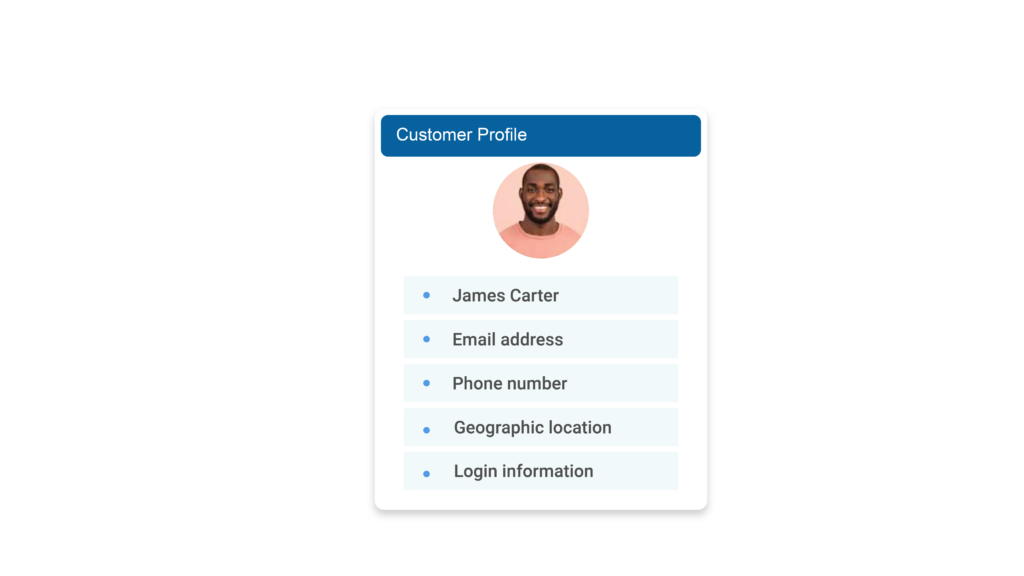
This data is the foundation of a single customer view, which helps businesses to identify individual customers across systems and devices. Identity attributes include the following-
- Name
- Email address
- Phone number
- Geographic location
- Login information
These details enable identity resolution by linking customer records across platforms and recognising the same person across all the interaction platforms.
Behavioural Data
Behavioural data shows how customers engage with digital platforms such as websites and mobile applications.
Typical behavioural data includes-
- Website visits
- Product or service page viewing
- Search queries
- Click pattern
- Scrolling patterns
- Mobile app usage activity
This information helps businesses understand what customers are interested in and predict possible future actions.
Transactional Data
Transactional data offers information on what customers buy and how they engage with your product or service.
It includes-
- Purchase history
- order values
- Subscription activity
- Abandon carts
- Refunds and product returns
When this data is combined with behavioural data, it becomes easy to understand purchase patterns and identify high-value customers.
Engagement Data
Engagement data reveals how customers respond to communication across different channels and marketing campaigns.
It includes interaction such as-
- Email opens and clicks
- SMS responses
- Push notification engagement
- Advertising interactions
- Campaign conversions
Such insights help marketers to see which message works best and later optimise campaigns to deliver more relevant communication.
Customer Support Data
This data includes conversations and interactions customers have with support teams.
It includes-
- Support tickets
- Chat conversations
- Customer feedback submissions
- Product complaints
- Service resolutions
Combining the support data provides a better understanding of customer issues and experiences and, later, delivers more responsive and personalised services.
How a Single Customer View Is Created Step by Step
A single customer view is created through a series of steps that unify customer data from different tools and connect it to individual customer profiles.
Below are the steps involved in organising customer data into a single customer view-
Data Collection
The first step in building a single customer view is to collect customer data from every relevant system the business uses to interact with its customers.
Common data sources used for interaction are CRM platforms, marketing automation tools, website and mobile applications, E-Commerce systems, analytics platforms, and customer support software.
Each of these provides important information that helps in creating a more complete picture of a customer.
Data Integration
After collecting, customer data must be standardised and integrated into a unified environment. It involves extracting data from different systems, transforming it into consistent formats, and loading it into a central data infrastructure.
The purpose of this step is to ensure that customer information from various tools integrates smoothly.
Identity Resolution
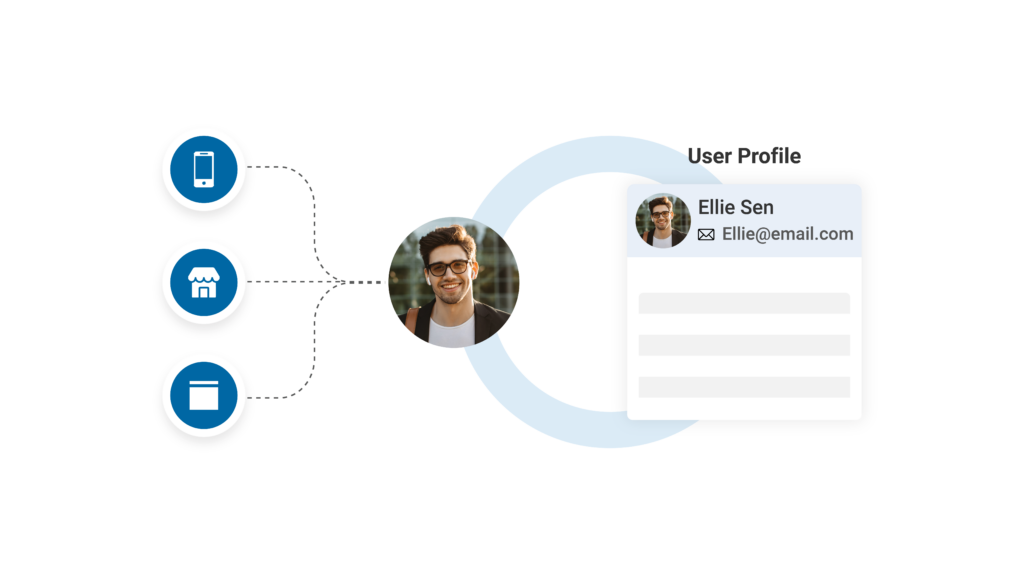
Identity resolution consolidates multiple data records belonging to the same customer. Customers often engage with brands through different devices, emails, or channels.
Identity resolution links these interactions so they are seen under a single customer profile. Modern platforms use various matching techniques to accurately link customer identities across systems, improving accuracy.
Profile Unification
Once the identities are linked, all related customer data and interactions are merged into a single customer profile.
This unified record now contains the full history of customer interactions, behaviours, and transactions with the brand.
Real-Time Updates
As customer behaviour changes constantly, the unified customer profile updates continuously with new activity.
For example, when a customer visits a website, opens an email, or makes a purchase, their profile automatically updates.
Real-time updates enable marketers to trigger actions quickly and deliver more relevant customer experiences.
Single Customer View Architecture: The 5-Layer Model
Behind every working SCV sits a five-layer architecture. The diagram below shows how raw customer data flows from disconnected sources into a unified profile that drives activation across every channel.
Each layer has a specific job. If any layer is weak, the SCV produces incomplete or inaccurate profiles, and downstream personalization suffers. Here is what each layer does in practice:
- Data Ingestion: Pulls raw events and records from every system that touches a customer. The bigger the source list, the richer the profile, but also the more complex the integration.
- Identity Resolution: Matches records that belong to the same person. This is the hardest layer to get right. A single customer may show up as 5 different records before resolution.
- Profile Unification: Merges resolved records into one profile per customer with a full history. Updates continuously as new events arrive.
- Enrichment & Intelligence: Adds calculated attributes like predicted lifetime value, churn risk, propensity to buy, and segment membership.
- Activation Channels: Sends the unified profile data out to email tools, ad platforms, web personalization engines, support systems, and other downstream channels where customer experience actually happens.
Identity Resolution: How the SCV Knows Who’s Who
Identity resolution is the layer that makes or breaks an SCV. Without accurate matching, your profiles are fragments, and personalization fires at the wrong person. Three methods are used in production today, usually in combination:
Deterministic matching: Direct matches on shared identifiers like email address, phone number, or customer ID. Highest accuracy, lowest reach. If a customer signs in with the same email everywhere, deterministic matching picks them up cleanly.
Probabilistic matching: Inferred matches based on signals like device fingerprint, IP address, behavior patterns, or geographic proximity. Lower accuracy than deterministic, but works for anonymous visitors who never signed in. Useful for stitching pre-login sessions to known profiles after eventual registration.
Graph-based identity: Builds a relationship graph between identifiers (cookies, device IDs, emails, phone numbers, customer IDs). When a new identifier appears alongside an existing one, the graph links them. This handles complex situations like shared devices, household-level identity, or customers who switch emails.
Most modern SCV platforms use a hybrid approach: deterministic where possible, probabilistic for anonymous traffic, and graph-based for stitching everything together. The trade-off is always between accuracy (false matches hurt trust) and reach (no match means no profile).
What are the benefits of using a Single Customer View?
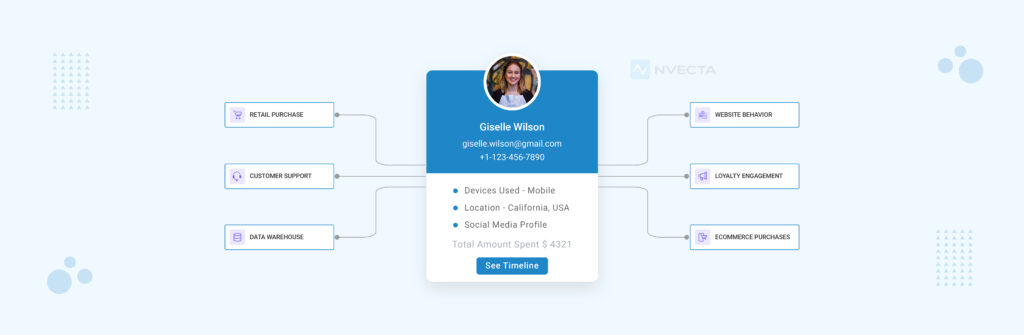
Implementing a single customer view provides businesses with a stronger foundation for better customer engagement, data-driven decision making and long-term business growth.
When all customer data is connected and available in one place, teams can gain deeper insights into customers’ behaviour, preferences, and engagement across the entire journey.
Below are some key benefits of implementing a single customer view-
Better Customer Understanding
When customer information is centralised, businesses can understand how customers move from discovery to purchase and beyond.
Games can quickly identify what customers are interested in, how they interact with products, and when they disengage.
Personalised Marketing at Scale
Customers want communication that reflects their interests and preferences. Single customer view allows marketing teams to create campaigns that feel more personal and timely. This makes marketing messages more engaging and improves overall campaign performance.
Enhanced Customer Experience
When businesses understand a customer’s complete history and behaviour patterns, interactions become more natural and efficient.
With a single customer view, teams can respond quickly with the right context. This reduces friction and fosters a more positive customer experience.
More Effective Customer Segmentation
With access to advanced insights, marketers can create precise segments by understanding customer behaviour and engagement patterns.
With a unified customer view, marketers can launch relevant targeted campaigns tailored for each segment and deliver highly personalised engagement.
More Accurate Data Reporting
When customer data is unified, the business can avoid inconsistencies that often appear in reports.
One customer view provides a single source of information for analysis and planning. Every team gets access to structured insights to support confident decision-making.
Quantified Business Impact (What Brands Actually See)
The benefits above describe the directional outcomes. Here is what they look like in numbers, based on industry studies and real customer reports from 2025-2026:
- 25% to 30% lift in personalization-driven conversion rates after consolidating fragmented profiles
- 40% reduction in customer service handle time when agents see the full customer history at the start of a conversation
- 15% to 25% increase in retention from churn-prediction segments built on unified data
- 30% to 50% reduction in marketing waste from suppressing existing customers from new acquisition campaigns
- 2x to 3x faster segment creation when teams work from one source of truth instead of pulling lists from four tools
Numbers vary by industry and starting maturity. Companies coming from fragmented spreadsheets see bigger lifts than those coming from a half-built CRM.
Single Customer View Use Cases by Industry
SCV looks different in every industry because the channels, data sources, and customer behaviours differ. Here is how five sectors put SCV to work in 2026:
1. Retail and Ecommerce
Retail brands use SCV to connect online browsing, in-store purchases, loyalty program activity, and customer service interactions into one profile. A shopper who browses on mobile, abandons a cart, then walks into a physical store gets recognized as the same person. This unlocks abandoned cart recovery, cross-channel inventory routing, loyalty-tier-aware campaigns, and post-purchase service that knows what the customer just bought. Retailers report 20% to 30% higher AOV when SCV-driven personalization is layered onto checkout.
2. Banking and Financial Services
Banks use SCV to combine product holdings, transaction patterns, branch visits, app usage, and customer service tickets. A unified view enables cross-product offers (someone with a checking account who just received a salary increase becomes a credit card prospect), fraud detection (unusual behavior compared to the customer’s normal pattern triggers a review), and regulatory reporting that requires a single source of truth per customer relationship.
3. Telecom
Telecom providers use SCV for household-level segmentation, churn prediction, and bundled offer targeting. A single household may have multiple lines, devices, and services, but should be treated as one relationship. SCV enables this by linking accounts at the household level, then layering usage data, network experience metrics, and service history. Churn prediction models built on SCV typically catch 60% to 70% of likely churners 30 days before they cancel.
4. Insurance
Insurers use SCV for 360-degree underwriting views, claims experience improvement, and policy renewal targeting. A single customer often holds multiple policies (auto, home, life), each managed in a different system. SCV unifies these into one relationship view, enabling personalized renewal offers, cross-sell recommendations based on life events, and faster claims handling because agents see the full policy history immediately.
5. Gaming and Mobile Apps
Gaming and mobile app companies use SCV to track player lifetime value, in-game behavior, monetization patterns, and re-engagement opportunities. Players often switch devices, play across platforms (mobile, console, web), and have wildly different engagement patterns. SCV unifies all this so studios can identify high-LTV players for VIP treatment, predict churn before it happens, and trigger re-engagement campaigns the moment a player goes quiet.
How to Build a Single Customer View: A Practical 7-Step Guide
The earlier section explained the technical steps a CDP runs to create an SCV. This section is the project plan for the team building or buying that capability. Most successful SCV implementations follow some version of these seven steps:
- Step 1 — Inventory your data sources. Map every system that creates or stores customer data. Web, app, CRM, email, ads, support, POS, finance, loyalty. List which fields each system holds and which fields overlap. This map shapes everything that follows.
- Step 2 — Define your identity resolution rules. Decide which identifiers count as primary keys (usually email, phone, customer ID). Decide what to do with conflicts (most recent wins, source-priority wins, manual review). Document these rules before any code gets written.
- Step 3 — Choose your platform: build or buy. Build means warehouse + reverse ETL + custom identity logic. Buy means a packaged CDP. Build is cheaper at scale if you have data engineering. Buy is faster to value if you do not.
- Step 4 — Set up identity stitching. Connect data sources, configure your matching rules, run a test batch on historical data. Expect to find duplicates and missing matches; iterate until match rates are above 85%.
- Step 5 — Build the unified profile schema. Decide what fields the SCV holds, in what format, with what update cadence. Get sign-off from marketing, CX, support, and analytics — they will all use it differently.
- Step 6 — Connect activation channels. Pipe the SCV out to email, SMS, ads, web personalization, and support tools. Activation is where the SCV starts paying back its build cost.
- Step 7 — Establish governance. Define who can change schema, who handles data quality issues, how often you audit identity match rates. SCVs degrade without active maintenance.
Most teams underestimate steps 1 and 2. The temptation is to start at step 3 with vendor evaluations. The work in steps 1 and 2 is what determines whether the eventual platform actually solves your problem.
Best Single Customer View Tools and Platforms in 2026
SCV is delivered through Customer Data Platforms and a few adjacent tools. Below is a snapshot of the leading options in 2026, with the contexts they fit best:
| Platform | Type | Identity Resolution | Best For | Starting Price |
|---|---|---|---|---|
| Nvecta | Packaged CDP | Hybrid (deterministic + probabilistic) | SMB to enterprise omnichannel teams | Accessible SMB tier |
| Tealium AudienceStream | Packaged CDP | Hybrid + graph | Large enterprise, omnichannel | ~$25K/year |
| Segment | Packaged CDP | Deterministic (email-based) | Engineering-led B2B SaaS | $120/mo (Team) |
| Treasure Data | Enterprise CDP | Graph-based | Enterprise, retail, automotive | $150K+/year |
| mParticle | Packaged CDP | Hybrid | Mobile-first brands | Custom (~$50K+/yr) |
| Bloomreach Engagement | Packaged CDP | Deterministic | Ecommerce personalization | ~$5K/mo |
| BlueConic | Packaged CDP | Hybrid | Mid-market marketing | ~$2K/mo |
| ActionIQ | Enterprise CDP | Graph-based | Large B2C, complex orgs | $100K+/year |
| Hightouch (composable) | Reverse ETL | Warehouse-based | Composable SCV setups | Free, $350/mo Pro |
| Lytics | Packaged CDP | Hybrid + ML | Mid-market with ML needs | ~$1K to $10K/mo |
Most enterprise SCV platforms do not publish prices. Ranges shown are based on G2 reviews and contracts visible in the public domain as of May 2026. Always request a custom quote.
SCV Implementation Cost and Timeline
SCV implementations vary widely in cost and timeline depending on company size, data complexity, and whether you build or buy. Three realistic scenarios:
SMB / Small Business
- Profile: Under 100K customer profiles, 5 to 7 data sources, 1 to 2 marketing users
- Platform cost: $500 to $3,000 per month
- Implementation: 4 to 8 weeks, often self-serve or with light vendor support ($5K to $15K)
- Internal team: 0.5 to 1 FTE managing setup and ongoing operations
Mid-Market
- Profile: 100K to 1M profiles, 10 to 15 data sources, 3 to 5 marketing users, multiple teams
- Platform cost: $3,000 to $15,000 per month
- Implementation: 3 to 6 months with vendor professional services ($25K to $75K)
- Internal team: 1 to 2 FTE plus part-time data engineering
Enterprise
- Profile: 1M+ profiles, 20+ data sources, multiple business units, multi-region compliance
- Platform cost: $25,000+ per month
- Implementation: 6 to 18 months with system integrator ($100K to $500K+)
- Internal team: Dedicated SCV team (3 to 8 people: data engineers, analysts, marketing ops)
Across all sizes, the cost components are similar: platform license, identity resolution and integration work, ongoing data engineering, and the internal team needed to keep the SCV current. Plan for total year-1 cost to run 1.5x to 2x the platform license alone.
How Nvecta’s one customer view connects all your customer data
Nvecta is a powerful customer data platform that has advanced data handling capabilities to help businesses utilise customer data effectively.
Its intelligent data structure is equipped to handle large volumes of customer data and enables teams to work with organised, connected information that supports smarter decisions and better engagement strategies.
Create a Unified View of Every Customer
It gathers customer information from various tools into a single structured profile. This unified record allows teams to quickly access customers’ identity information and activity history in a single place.
Monitor Engagement Across All Channels
It organises every customer interaction, from website visits to campaign engagement and support conversations.
It links these interactions into a unified timeline, allowing teams to easily see how various channels influence the overall journey and understand how customers engage with their brand.
Track Customer Behaviour in Real-Time
Nvecta captures key customer actions, such as clicks, searches, product views, and visits, in real time across digital platforms.
These insights help teams analyse engagement patterns and identify app opportunities to enhance the customer experience.
Create Smarter Audience Segments and Deliver a Personalised Experience
It helps teams group customers by behavioural signals, interests, and activity levels. This enables businesses to personalise communication strategies and deliver relevant marketing messages that meet customer expectations.
Journey And Automation Triggering
Nvecta enables businesses to create automated workflows that respond to specific customer actions. When a customer performs certain activities, these workflows automatically trigger the next step in their journey.
This helps ensure smooth engagement throughout the lifecycle by maintaining consistent communication with customers.
Identity Resolution
Nvecta intelligently matches identity signals to recognise the same customer across different devices, accounts, and channels, maintaining a consistent customer profile. As a result, teams gain a clearer, more accurate view of each customer’s activity.
Customer Analytics And Insights
Nvecta offers built-in analytics to help businesses interpret customer activity, including engagement patterns and action trends.
These insights make it easier to understand what customers care about and discover opportunities to improve experiences.
Data Exportation And Integration
Nvecta has flexible integration and data export capabilities with a wide range of marketing tools, analytics systems and data warehouses.
This allows a smoother flow of data into unified customer profiles and, later, supports teams in working with consistent, reliable data.
Wrap Up
Managing customer data is a complex task, especially for expanding businesses with a growing customer base. With a unified approach, they can simplify marketing efforts and work with structured, connected information that supports better targeting and smarter decision-making.
To build a reliable customer data foundation, it is important to choose the right platform that aligns with your business goals.
Explore Nvecta’s single customer view to make customer data more actionable and accessible across teams. Book your demo now.
Single Customer View FAQs
What does SCV stand for?
SCV stands for Single Customer View. It refers to a unified profile of every interaction a customer has had with your brand across every channel, presented as one record.
What is the difference between SCV and CDP?
SCV is the output. CDP is the platform that creates it. A Customer Data Platform unifies data from multiple sources and produces a Single Customer View as its core deliverable. You can think of the SCV as what you see in the dashboard, and the CDP as the system running underneath.
How is a Single Customer View different from a CRM?
A CRM is built around sales relationships and contact records. An SCV is built around the customer’s full journey across every channel, including anonymous behaviour before they ever became a known contact. CRMs typically only contain known, named contacts. An SCV captures both anonymous and known activity and stitches them together when identity becomes known.
Which industries benefit most from SCV?
Retail, banking, telecom, insurance, and gaming see the highest impact because they have multiple channels, complex customer journeys, and direct revenue tied to personalization. Any industry with more than three customer touchpoints and meaningful repeat-purchase or lifetime-value dynamics will see returns from SCV.
What are the main challenges of building a Single Customer View?
The hardest parts are identity resolution (matching records that belong to the same person across systems), data quality (cleaning inconsistencies before unification), and ongoing governance (keeping schemas and rules current as the business evolves). Most failed SCV projects fail at identity resolution or governance, not platform selection.
How long does it take to build a Single Customer View?
SMB implementations using packaged platforms can go live in 4 to 8 weeks. Mid-market implementations typically take 3 to 6 months. Enterprise rollouts with complex data sources and compliance requirements run 6 to 18 months. Build-from-scratch (composable) approaches typically take longer than packaged platforms but can be more flexible long term.
How much does a Single Customer View cost?
SMB SCV platforms run $500 to $3,000 per month. Mid-market platforms run $3,000 to $15,000 per month. Enterprise SCV platforms typically start at $25,000 per month and require custom quotes. Add 50% to 100% for implementation, integration engineering, and internal team costs.
What is identity resolution in SCV?
Identity resolution is the process of matching multiple records that belong to the same customer across different systems and devices. The three common methods are deterministic matching (exact identifiers like email), probabilistic matching (inferred from behaviour patterns), and graph-based identity (linking identifiers through relationship graphs). Most modern SCVs use a hybrid of all three.
Can a Single Customer View be GDPR compliant?
Yes, but it requires careful design. The SCV needs consent management, the right to erasure (deletion of all profile data on request), data residency controls (especially for EU data), and audit logs for regulatory inspection. Most modern SCV platforms ship with these features, but configuration is on the customer.
What is the best Single Customer View platform?
The best SCV platform depends on your size, channels, and existing tech stack. Nvecta works well for SMB to enterprise teams that want omnichannel activation alongside the unified profile. Tealium and Treasure Data are strong picks for large enterprise. Segment fits engineering-led B2B SaaS. Hightouch suits teams with a data warehouse already in place.
