














 Email
Email SMS
SMS Whatsapp
 Web Push
 App Push
 Audience Sync for Ads
 Popups
 Channel A/B Testing
  Control groups Analysis
 Frequency Capping
 Funnel Analysis
 Cohort Analysis
 RFM Analysis
 Signup Forms
 Surveys
 NPS
NPS Landing pages personalization
  Website A/B Testing
  PWA/TWA
 Heatmaps
 Session Recording
 Wix
Wix Shopify
 Magento
 Woocommerce
 eCommerce D2C
  Mutual Funds
 Insurance
 Lending
  Recipes
  Knowledgebase
 Developer Docs
 Product Updates
 App Marketplace
 Academy
 Ebooks
 Case Studies
 Blog
Blog Templates
 Afreen Sheikh
SMS marketing is still one of the fastest and most reliable ways to reach customers. A text message arrives on a person’s phone and is read almost immediately. Most brands still rely on basic bulk messaging that does not really connect with today’s customer expectations.
Customers know what personalisation feels like, and they do really connect well with brands that deliver relevant content. Brands have to upgrade their marketing efforts to upscale engagement. Every communication must reflect customer preferences, and this can only be achieved with the help of customer data platforms. A CDP processes customer data and tracks customer activity and preferences to deliver personalised SMS that feel relevant and well-timed.
In this blog, we will explore how brands can enhance their SMS marketing with a CDP to drive better engagement and results. We will also see how NVECTA CDP enables SMS campaigns with its smart features.
What is SMS Marketing?
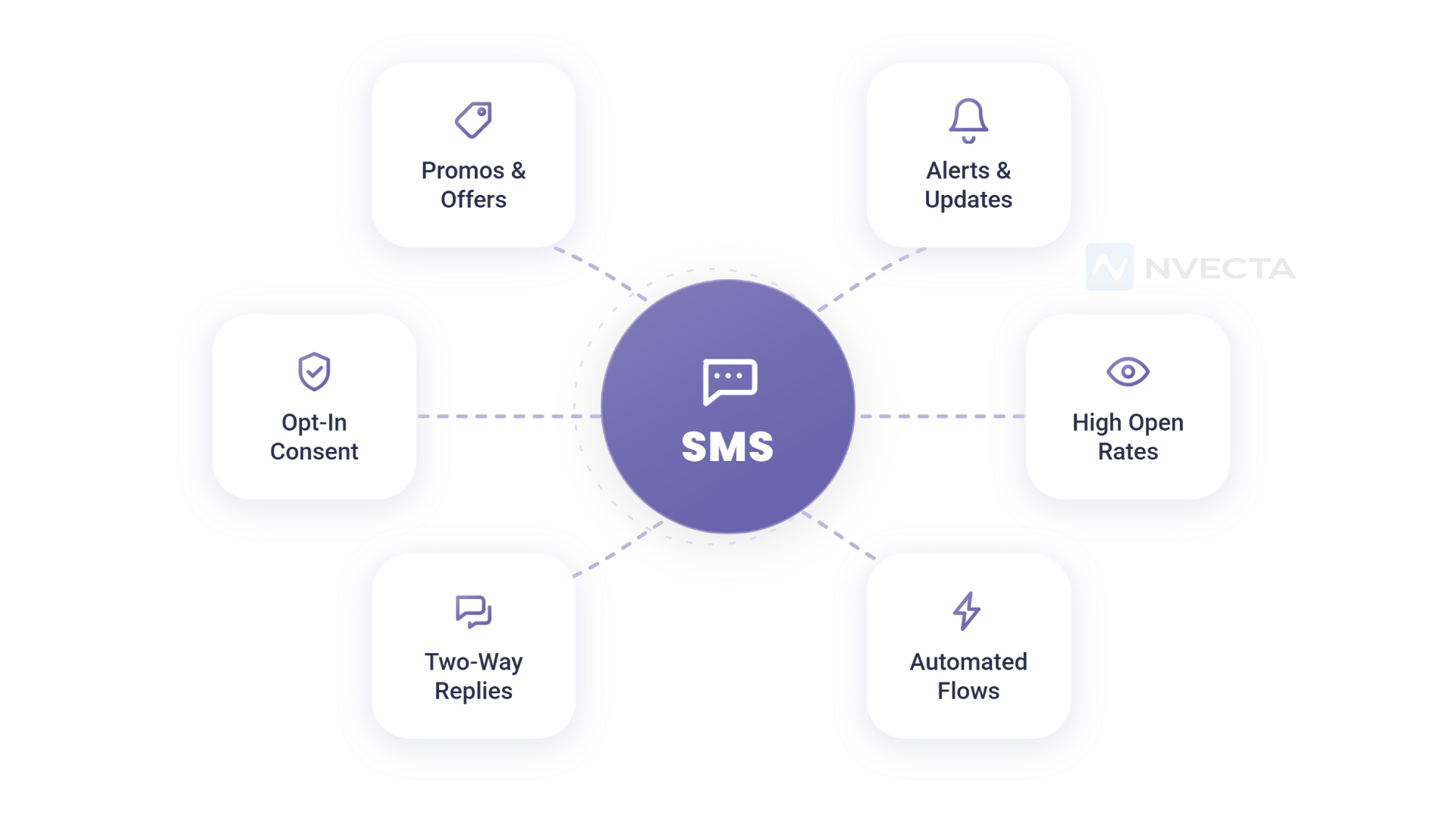
SMS marketing is the practice of sending promotional, transactional or conversational text messages to customers who have actively opted in to hear from your brand.
These messages include offers, discounts, flash sale alerts, shipping updates, loyalty rewards, reminders and important notifications.
SMS is a direct communication channel that brands use to market their products or services and engage customers.
Since messages appear directly on the mobile phone there easy to notice and do not require any intermediary app.
Moreover, customers receive SMS even without an internet connection. Also, they are concise with only the relevant information, and customers are more likely to take action.
CDP facilitates SMS marketing through campaigns that send the right messages at the right time.
Why SMS Marketing Delivers Higher Engagement
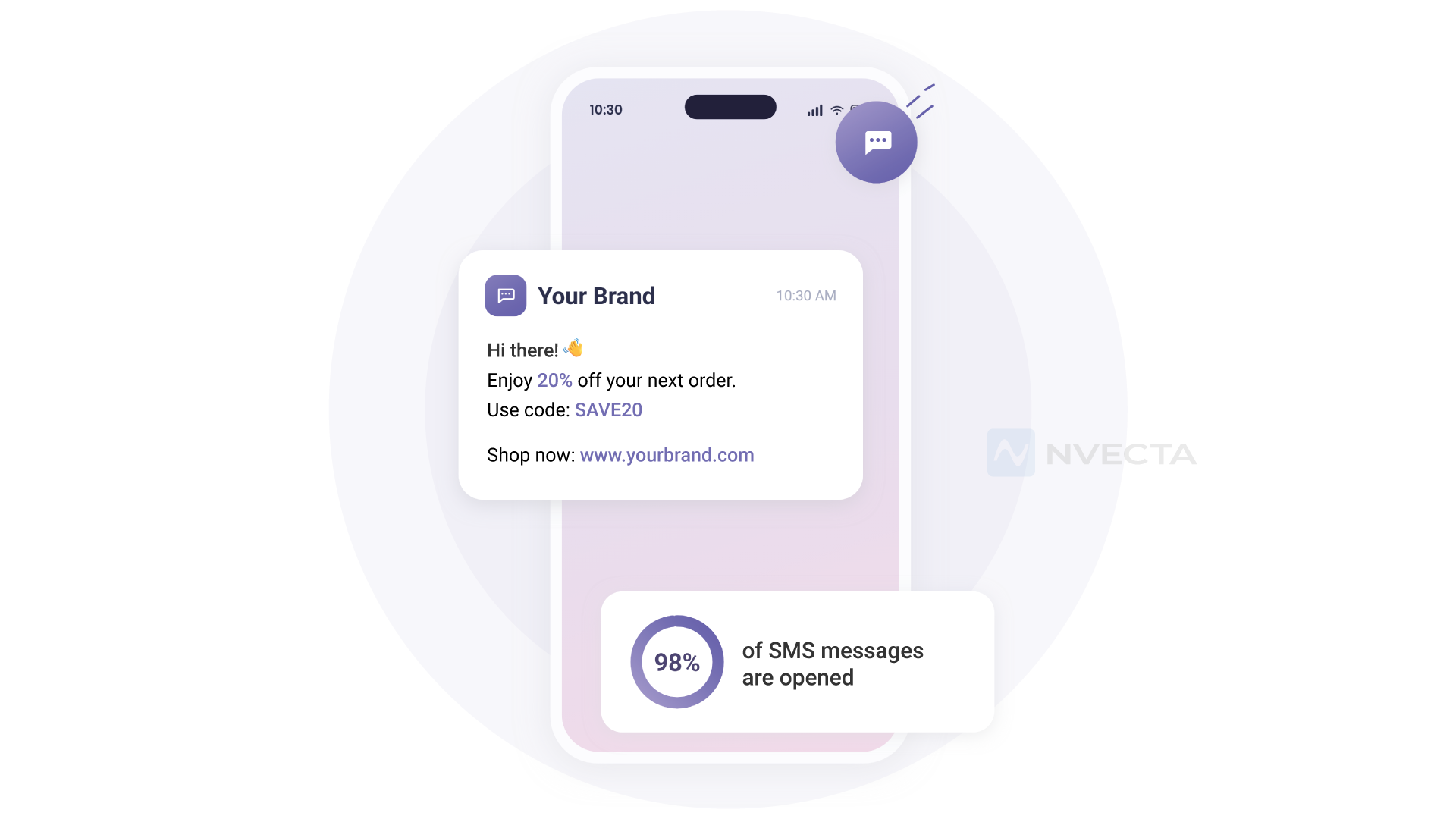
SMS marketing delivers stronger engagement as messages appear in a space where user actively checks and respond. This increases the likelihood of being noticed.
Further, there is no algorithm or visibility filter-every message is delivered and seen without being ranked or suppressed.
Also, SMS has a very simple format, with the full message visible at once, so users can read and understand it in seconds.
With minimal interaction, brands can deliver a natural and smooth experience that leads to consistent engagement.
How CDP Supports SMS Marketing
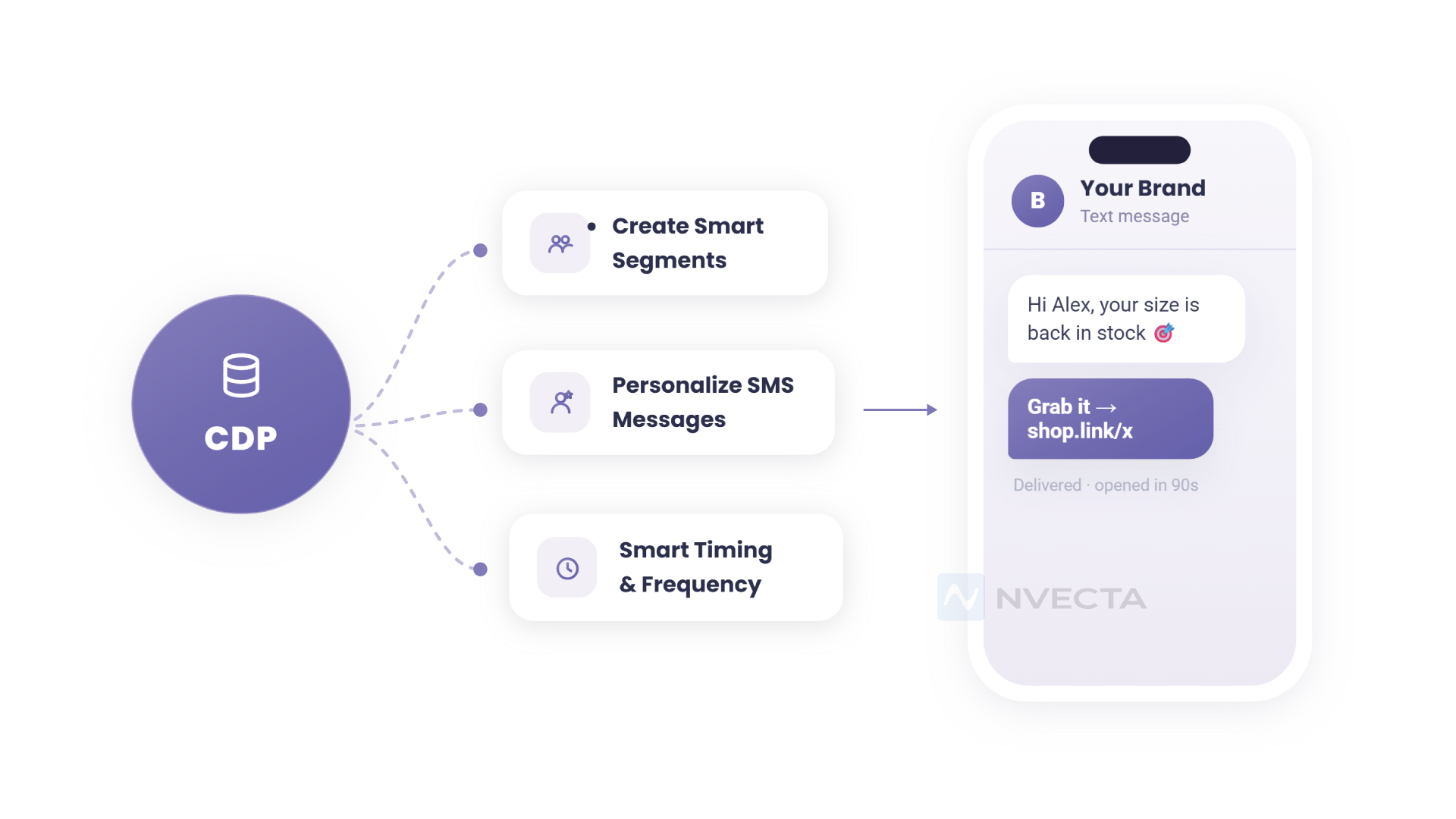
Marketing efforts give positive results when there is a clear understanding of customer behaviour. Merely working with guesswork and sending messages in bulk are obsolete methods.
A customer data platform is a system that collects customer data from different sources, such as websites, mobile apps, transactions, and past interactions, and processes it to create single, unified customer profiles.
CDPs connect data and interactions to create real-time updating profiles. This provides a complete, usable view of each customer to guide marketing decisions.
These profiles serve as a foundation for planning effective marketing campaigns.
SMS can be sent based on what the user has recently done, such as viewing the product, completing a purchase or reduced engagement.
For example, if a customer frequently visits your website, this activity is tracked by CDP and updated in the customer profiles. Brands can trigger an SMS with a discount offer to encourage customers to take action.
SMS marketing with a CDP helps brands to send messages that match the current user behaviour. And when you value user behaviour, they are more likely to take action.
CDP manages the timing and consistency of messages. Generic SMS marketing sends unnecessary messages that may irritate users or be easily ignored.
With CDPs, brands can control SMS frequency and send it at the right time.
With this, customers receive connected, meaningful communication. SMS shifts from a simple communication channel to a more responsive one.
Benefits of SMS Marketing with a CDP
Here are the benefits of using a CDP for SMS marketing:
| Benefit | How CDP Enables It |
|---|---|
| Relevant Messaging | Aligns every SMS with actual customer behaviour, delivering messages users are likely to notice, understand, and respond to. |
| Better Timing of Communication | Triggers messages based on real-time user activity and behavioural signals, reaching users when they are most likely to engage and take action. |
| Consistent Experience Across Channels | Connects customer profiles with all communication channels, integrating SMS, email, and others to deliver a smoother, unified experience. |
| Personalised Experiences | Uses behavioural context from past and present interactions to customise messages based on what users have explored or engaged with. |
| Higher Engagement and Conversions | Enables well-timed, behaviour-aligned messages that feel useful and relevant, naturally improving engagement and conversion rates. |
How to Build Personalised Text Campaigns at Scale
Building personalised SMS campaigns at scale requires a structured approach in which brands use advanced CDP features to create campaigns that are relevant, timely, and aligned with the customer’s intent.
Here is a step-by-step process that enables the creation of personalised text campaigns-
Unified Customer Data Across Touchpoints
The first step is to bring all customer data into one place so you can clearly see how users interact with your brand across channels.
CDP brings customer data from multiple touchpoints into a single platform. It creates unified customer profiles that show real customer activity.
Create Behaviour-Driven Audience Segments
Another step is to segment your audience based on behavioural signals/actions such as browsing activity, purchase frequency, and engagement patterns.
This makes it easier to send targeted messages that align with user behaviour.
Define Clear Message Triggers Based on Actions
Define triggers based on real user actions, such as cart abandonment, frequent product views, purchase completion inactivity, sign-ups or subscriptions, etc. Here, you need to decide clearly when to send a message based on activity.
Each trigger must include clear conditions, such as event type, time delay, and eligibility rules, to avoid duplicate or irrelevant messages.
For example, SMS can be sent 4 hours after cart abandonment only if the purchase is not completed. This ensures messages are timely, contextual and purposeful.
Write Behaviour-Driven SMS Content
Craft SMS content that aligns with user activity and intent. Messages should reference the recent action to catch their attention.
For example, SMS content can refer to the product the user recently viewed. Such product-specific content will perform better than a general discount offer.
Campaign Automation at Scale
Set up automated workflows that manage text campaign execution. It automates sending personalised messages to large audience segments without manual efforts.
It includes predefined workflows and rules that handle message sequencing, frequency control, and journey coordination.
For example, use a follow-up message after purchase and a separate re-engagement message later, all without overlap and with no manual effort.
This ensures that campaigns scale efficiently while maintaining consistency, control and structured communication flow.
Timing and Frequency Optimisation
Once segments, triggers, and automated workflows are set up, you are required to manage when and how often messages are sent.
Sending messages at the right moment improves response times, and controlling frequency ensures users are not overwhelmed or annoyed by repeated messages.
Continuous Performance Optimisation
Now is the time to monitor campaign performance using metrics such as engagement, response patterns, and conversions to evaluate effectiveness.
Such insights should be used to improve targeting content and timing for current and future campaigns.
Types of SMS Campaigns you can run with a CDP
CDP facilitates multiple types of SMS campaigns that brands can utilise to meet their business goals, such as improving conversions, engagement, retention, and customer experiences.
Each campaign service has a clear purpose and is driven by customer actions and preferences, or by the journey stage, making SMS more relevant, timely, and effective.
Behavioural Trigger Campaigns
These campaigns send messages when the user takes specific actions, such as browsing or price-comparing.
Here, messages are triggered when users’ interest is high, helping them to move forward in decision-making. Communication feels helpful instead of promotional or annoying.
Transactional and service updates
This campaign sends messages once an action is taken or completed. Campaigns are triggered after events such as purchases, bookings, or service requests.
They help keep users informed and up to date, strengthening trust and improving the overall experience.
Targeted Promotional Campaigns
These campaigns are driven by user preferences and past interactions, where messages are triggered when there is an opportunity to send a relevant offer.
The promotion aligns with users’ interests, making communication more useful and increasing the likelihood of conversion.
Re-Engagement Campaigns
These campaigns are used to engage users who have reduced or stopped interacting with a brand.
The messages are triggered after a defined period of inactivity. They aim to reconnect with users by reintroducing the brand with a relevant message that encourages them to return without pressuring them.
Lifecycle-Based Campaigns
These campaigns are triggered at different stages of the customer journey. A new user may get an onboarding campaign, while an existing customer may receive an offer or discount campaign.
Communication changes based on the user’s relationship with the brand and their stage in the journey. This keeps communication relevant and prevents repeated messaging.
Cross-Sell and Upsell Campaigns
These campaigns are triggered after a purchase or interaction and focus on extending value by recommending complementary/connected products or upgrades.
Every suggestion is based on what the user has already chosen or bought. This improves user experience and the chance of additional purchases.
Event and time-based campaigns
These campaigns are triggered at specific times such as anniversaries, birthdays or seasonal events.
Messages align with these moments, making communication feel appropriate and timely. Users are likely to respond to these messages as they match their current context.
Key Metrics for Measuring SMS Marketing Success
It is important for brands to examine metrics that evaluate the performance of SMS campaigns. Tracking the right metrics will help you to understand how customers respond to your communication, whether it needs improvement, and whether you have achieved the required outcomes.
Delivery Rate
Delivery rate shows the percentage of messages successfully delivered to users. A low delivery rate indicates technical issues, while a high rate means your messages are consistent and reach users on time.
Open rate
Open rate measures how many users have actually read the message. If it’s low, it means users are ignoring your messages; if it’s high, it indicates strong visibility and attention, increasing the chances of engagement and further action.
Click-Through Rate (CTR)
CTR measures how many users click links in the message. A low CTR indicates a poor call to action or a lack of relevance, which limits engagement. A higher rate shows strong user interest.
Conversion Rate
The conversion rate indicates the percentage of users who completed a desired action after receiving a message. A low conversion rate means users are not converting, while a high rate means your campaigns are effective enough.
Opt-Out Rate
Uptout read shows how many users have unsubscribed from your messages. A high opt-out rate suggests users are easily irritated or annoyed by your messaging, while a low rate indicates a well-managed messaging strategy.
Response Rate
Response rate tells how many users reply or interact directly with your messages. A higher rate indicates low engagement, while a lower rate indicates active user interaction.
ROI (Return on Investment)
ROI measures the revenue generated compared to the cost of SMS campaigns. A low ROI indicates poor campaign performance, while a high ROI shows that campaigns are delivering better returns.
How does NVECTA CDP Support SMS Marketing?
NVECTA is an AI-driven CDP that helps brands to launch personalised SMS campaigns. It organises customer data to create one customer view and track their activity in real time.
Its advanced insights help brands upgrade SMS marketing from basic messaging to highly personalised messages that drive engagement, improve conversion rates, and support overall business outcomes.
360° Customer View
NVECTA combines customer data from multiple sources to create customer profiles. These profiles update in real time, providing a foundation for a better understanding of customer behaviour.
They are used to send accurate, aligned messages based on customer activity and preferences.
Real-Time Data
NVECTA tracks every user activity and interaction across channels and continuously updates the data.
This real-time data ensures better SMS campaigns that trigger messages based on live user behaviour.
Behaviour-Based Segmentation
NVECTA segments users based on signals such as product views, past purchase frequency, and interaction history.
This enables SMS campaigns to target users based on their current intent, ensuring communication aligns with their expectations.
Event Trigger Messaging
NVECTA provides trigger-based waste messaging, where SMS campaigns are triggered by specific events such as product views, purchases, or inactivity.
With this, brands do not have to rely on generic campaigns or messaging; every message is aligned with meaningful user interaction.
Campaign Automation at Scale
NVECTA automates SMS campaigns across large audiences by managing workflows, message sequences, and delivery rules.
Every campaign can scale without losing relevance and deliver consistent communication across large user bases.
Cross-Channel Coordination
NVECTA supports cross-channel coordination, synchronising SMS campaigns with other communication channels.
This ensures consistent messaging across all channels, delivering a communication that feels connected and seamless.
Performance tracking
NVECTA provides advanced insights into SMS campaign performance, helping brands to evaluate what works and adjust future messaging strategies.
It allows brands to optimise targeting, timing and content that enhance engagement.
Conclusion
SMS remains one of the most effective ways to connect with users and maintain consistent engagement. Brands use CDP to upgrade their SMS marketing, messaging becomes more relevant, better time and more aligned with user preferences. It further improves overall user experience and increases business outcomes.
NVECTA CDP takes a brand’s SMS marketing to the next level with advanced automation and AI-driven capabilities. Brands can run smarter, responsive SMS that deliver measurable results.
Run personalised SMS campaigns that drive higher engagement and results with NVECTA.
FAQs
1. What is SMS marketing with a CDP?
SMS marketing with a CDP is the practice of using a customer data platform to send personalised, behaviour-driven text messages to customers. A CDP unifies customer data from multiple sources to ensure every SMS is relevant, timely, and aligned with individual preferences.
2. How does a CDP improve SMS marketing?
A CDP collects and processes customer data from multiple touchpoints to create unified profiles. These profiles help brands trigger messages based on real-time user behaviour, segment audiences accurately, and deliver personalised SMS that drive better engagement and conversions.
3. What types of SMS campaigns can be run with a CDP?
With a CDP, brands can run behavioural trigger campaigns, transactional updates, targeted promotional campaigns, re-engagement campaigns, lifecycle-based campaigns, cross-sell and upsell campaigns, and event or time-based campaigns.
4. How does a CDP help with SMS personalisation at scale?
A CDP automates workflows, manages audience segmentation, and sets behaviour-based triggers, allowing brands to send personalised messages to large audiences without manual effort, while maintaining relevance and consistency.
5. What metrics should brands track for SMS marketing success?
Brands should monitor delivery rate, open rate, click-through rate, conversion rate, opt-out rate, response rate, and ROI to evaluate campaign performance and identify areas for improvement.
6. What is the difference between bulk SMS and CDP-driven SMS marketing?
Bulk SMS sends the same generic message to all users regardless of their behaviour or preferences. CDP-driven SMS marketing uses real-time data and behavioural signals to send relevant, personalised messages to the right user at the right time.
7. How does NVECTA CDP support SMS marketing?
NVECTA CDP supports SMS marketing with features such as a 360° customer view, real-time data tracking, behaviour-based segmentation, event trigger messaging, campaign automation, cross-channel coordination, and performance tracking to help brands run smarter, more effective SMS campaigns.
