














 Email
Email SMS
SMS Whatsapp
 Web Push
 App Push
 Audience Sync for Ads
 Popups
 Channel A/B Testing
  Control groups Analysis
 Frequency Capping
 Funnel Analysis
 Cohort Analysis
 RFM Analysis
 Signup Forms
 Surveys
 NPS
NPS Landing pages personalization
  Website A/B Testing
  PWA/TWA
 Heatmaps
 Session Recording
 Wix
Wix Shopify
 Magento
 Woocommerce
 eCommerce D2C
  Mutual Funds
 Insurance
 Lending
  Recipes
  Knowledgebase
 Developer Docs
 Product Updates
 App Marketplace
 Academy
 Ebooks
 Case Studies
 Blog
Blog Templates
 Stella
Quick answer: A welcome email is the first message a brand sends to a new subscriber, customer, or trial user. According to Litmus, welcome emails average 50-86% open rates, which is 3-4x higher than typical marketing emails. The best welcome emails arrive within 1 hour of signup, include a single clear CTA, and feel personal rather than templated. This guide covers 17 proven templates plus subject lines, design rules, and the AI-driven approaches winning in 2026.
Email marketing has become one of the highest-ROI channels for businesses looking to lift leads and sales. The first impression really is the last impression, which is why a welcome email matters so much. It sets the tone for the entire customer relationship and earns the highest open rate of any campaign type.
According to industry research, welcome emails average an open rate of 91.43% and a click-through rate of 26.9%. That’s roughly 4x higher than any other form of marketing email. The first communication between a company and a customer is what makes or breaks the relationship downstream, so getting it right pays off across the entire funnel.
This blog walks through 17 effective welcome email templates you can copy, customize, and ship today. Beyond the templates, we’ll also cover subject lines, design best practices, timing benchmarks, real brand examples, and the AI-driven approaches winning in 2026.
What is a Welcome Email?
The welcome email is the first formal communication between a business and its customer after they’ve signed up for an account, used a service, or taken any free or paid membership. It’s the digital equivalent of a handshake, and the impression it creates lasts longer than most brands realize.
Welcome emails have the highest open rate of 91.43% and a click-through rate of 26.90%, which is 4x higher than any other form of marketing email. Here are the reasons why this single message punches so far above its weight:
- It introduces your brand to new subscribers and customers properly.
- It shows customers they matter and aren’t just another email address in the list.
- It guides customers toward new products, special offers, and useful content.
- It reinforces the value of what they just signed up for.
- It opens a two-way channel where customers feel comfortable replying with questions.
Why Welcome Emails Matter in 2026
The numbers behind welcome emails are genuinely striking. Litmus reports that welcome emails average 50-86% open rates, which is 3-4x higher than typical marketing emails. Mailchimp data shows welcome emails generate 4x higher open rates and 5x higher click rates than promotional broadcasts. Omnisend found that welcome series generate 320% more revenue per email than other promotional emails. And research from Invesp shows that 75% of subscribers expect a welcome email immediately after signing up.
The takeaway is simple: this is the single most engaged moment in the entire customer relationship. Brands that invest in this moment win disproportionately. Brands that send a generic auto-reply or skip the welcome entirely lose subscribers who could have become long-term customers. The setup work pays for itself within weeks, and the compounding effect on retention runs for years.
Strong welcome emails pair naturally with broader marketing automation infrastructure that handles the rest of the customer lifecycle once the welcome moment is done its job.
Benefits of Using Welcome Emails
A welcome email is the first formal communication with your customers, which means it carries outsized weight. It helps you grab attention before competitors do and start building the relationship on the right foot. For businesses scaling their training processes, AI training video creation tools can pair nicely with welcome flows to onboard customers faster. Here are the six benefits worth focusing on:
- Increase customer engagement: Welcome emails lift engagement because they typically include CTAs, helpful guides, and product tutorials right when interest is highest. Welcome emails with personalized subject lines and quality content drive far higher increase customer engagement than newsletters. The data shows they’re 86% more effective.
- Time-saving at scale: Welcome emails save hours of manual work when properly automated. Businesses can send personalized welcome sequences to thousands of new subscribers without lifting a finger after the initial setup. Customers get consistent attention, and your team gets back to higher-value work.
- Lower spam complaints and unsubscribes: Inboxes are crowded, and unfamiliar senders get marked as spam quickly. A welcoming first message with a friendly tone, useful content, and clear CTAs reduces the chance of the message landing in spam. It also lowers the unsubscribe rate, because customers see a brand that values them rather than one that just blasts promotions.
- Better customer retention: Welcome emails build trust early, which is the foundation of customer loyalty. A personalized subject line like “Welcome, John” signals that the customer matters, not just their wallet. That feeling is what turns one-time buyers into repeat customers.
- Increased sales: Welcome emails are one of the best moments to introduce products that match the customer’s interests. Include links to your top offers, mention a launch discount, or surface a popular bundle. Customers are in a high-engagement window, which means conversion rates often hit 5-15% on welcome promotional CTAs.
- Feedback collection: Welcome emails are also an underrated channel for collecting feedback. Add a short link to a one-question survey or a single-tap CSAT poll about their signup experience. The responses tell you what’s working and what’s confusing before bigger problems develop.
Welcome Email Anatomy (5 Components That Matter)
Every high-converting welcome email contains the same five components. Skipping any of them tends to flatten performance. Here’s what each one needs to do:
- Subject line: Specific, personal, and value-led. “Welcome to [brand], [name]” works better than “Thanks for joining” because it feels addressed rather than generic.
- Opening hook: Reference where the subscriber signed up from. “Glad you found us through the holiday gift guide” is more memorable than “Welcome to our newsletter.”
- Value statement: Tell the subscriber exactly what they’re going to get. Tips, discounts, exclusive content, product updates — whatever it is, name it clearly.
- Single clear CTA: One action, not five. The classic mistake is asking the subscriber to follow on social, download an app, browse products, and reply with feedback all in one email. Pick one and lean into it.
- Sender signature: A real human name and ideally a photo. “From the team at [brand]” reads as a corporate auto-reply. “From [Name], CEO” earns 2-3x higher reply rates.
When to Send Welcome Emails (Timing Benchmarks for 2026)
Timing matters almost as much as content. The first welcome email should arrive within 1 hour of signup at the latest. GetResponse research shows that welcome emails sent within 1 hour have 3x higher engagement than delayed ones. For inbound leads who actually filled out a form requesting information, the window tightens further: respond within 5 minutes and you’ll multiply your contact rate compared to even a 30-minute delay.
Day-of-week patterns are real too. Tuesday and Wednesday consistently deliver the highest open rates, with Monday afternoons and Friday mornings performing slightly worse. The best time-of-day window is 9-11 AM in the recipient’s local timezone, when people are clearing inboxes but haven’t yet been buried by mid-day meeting overflow. Solid customer journey orchestration tools can adjust send times per recipient automatically based on past engagement patterns rather than relying on bulk averages.
For a welcome series rather than a single welcome email, the standard spacing is Day 1 (welcome), Day 3 (brand story or social proof), Day 7 (product or content showcase), and Day 14 (first conversion ask). Spreading the sequence across two weeks gives subscribers time to read and act without feeling buried.
17 Best Welcome Email Templates
The welcome email is what builds early trust and help in growing your sales. A great welcome email is well-written, targeted to the specific signup context, and respects the subscriber’s time. Below are the 17 best templates organized by use case, with copy-paste starting points you can customize in minutes.
1. Welcome Email for The Free Gift Card
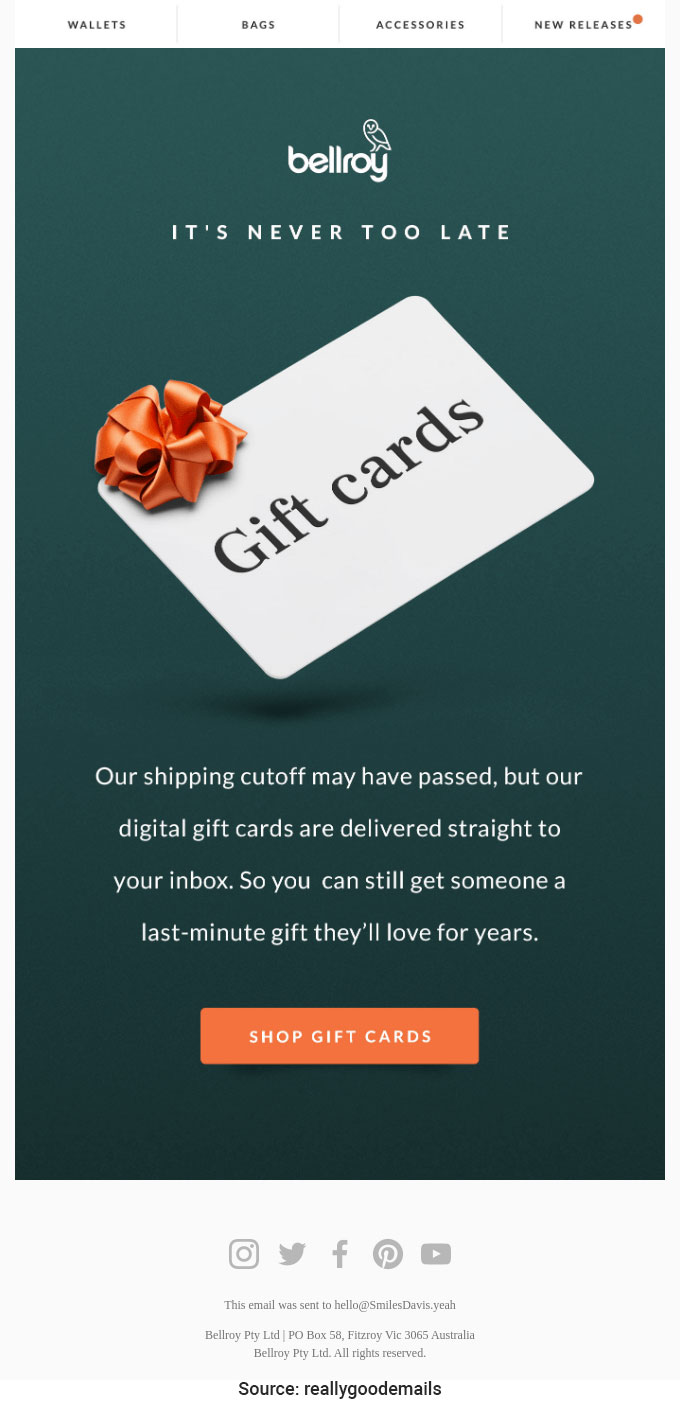
This template works best when you want to give new subscribers a reason to stick around from the very first email. Offering a gift card instead of a percentage discount might seem like a small difference, but it changes how people feel about the offer entirely. A discount still feels like you’re being sold to. A gift card feels like someone just handed you free money. That psychological shift is why gift cards consistently pull better conversion numbers. Many of the best opt in email examples out there use this exact approach — lead with something that feels generous, not salesy.
Hi [name],
Thanks for signing up for [product name]!
As a thank you, we’re giving you a free gift card when you sign up for a paid plan.
Just apply the gift card at checkout to redeem.
[Free Gift Card]
2. Welcome Email for a Free Trial
SaaS and subscription businesses use this template to kick off the trial period and frame the next 7-14 days as a journey rather than a clock running down.
Hi [name],
Welcome to [product/service name]. Your free trial starts today.
What happens next?
Keep an eye on your inbox over the next few days. We’ll send you the best tips and shortcuts for getting the most out of [product/service].
Ready to skip ahead? Pick a plan below and unlock everything immediately.
[Paid plan link]
3. Welcome Email for The Product-Focused
This template works when the product itself is the hero. Lead with confidence about what the customer will achieve, then guide them into a getting-started resource.
Hi [name],
Welcome to [product or brand name]. Thrilled to have you here.
We’re confident that [product/service] will help you [summary of key benefits].
Get to know us in our [title] video. You’ll be guided through [name of service/product] by our [name of the employee and what they do] so you get the best possible result right out of the gate.
You can also find more of our guides here to learn more about [product/service name].
Take care,
[Name]
4. Welcome Email for New Customers to Your Company
This is the founder-led welcome that builds personal connection from the start. Works particularly well for SMB and DTC brands where founder authenticity is a real differentiator.
Hi [name],
I’m [name], the founder of [company name], and I wanted to personally thank you for signing up.
We started [company name] to [mission/values of company].
I’d love to hear what you think of [product] and where we could improve. If you have any questions, just reply to this email. I read every message.
[Name]
5. Welcome Email for “Thanks for Subscribing”
The newsletter signup welcome. Lead with the free resource you promised, then surface a few related places they can explore.
Hi [name],
Thanks for signing up for [newsletter name]!
As promised, here’s the link to your free [name of free offering].
[Link/call to action]
If you’d like more tips on [subject], visit our blog and resource pages at [link], or check out [website page] for more on [product type you offer].
Reply to this email if you have questions. Happy to help.
Best, [name]
6. Welcome Email for The Reminder Email
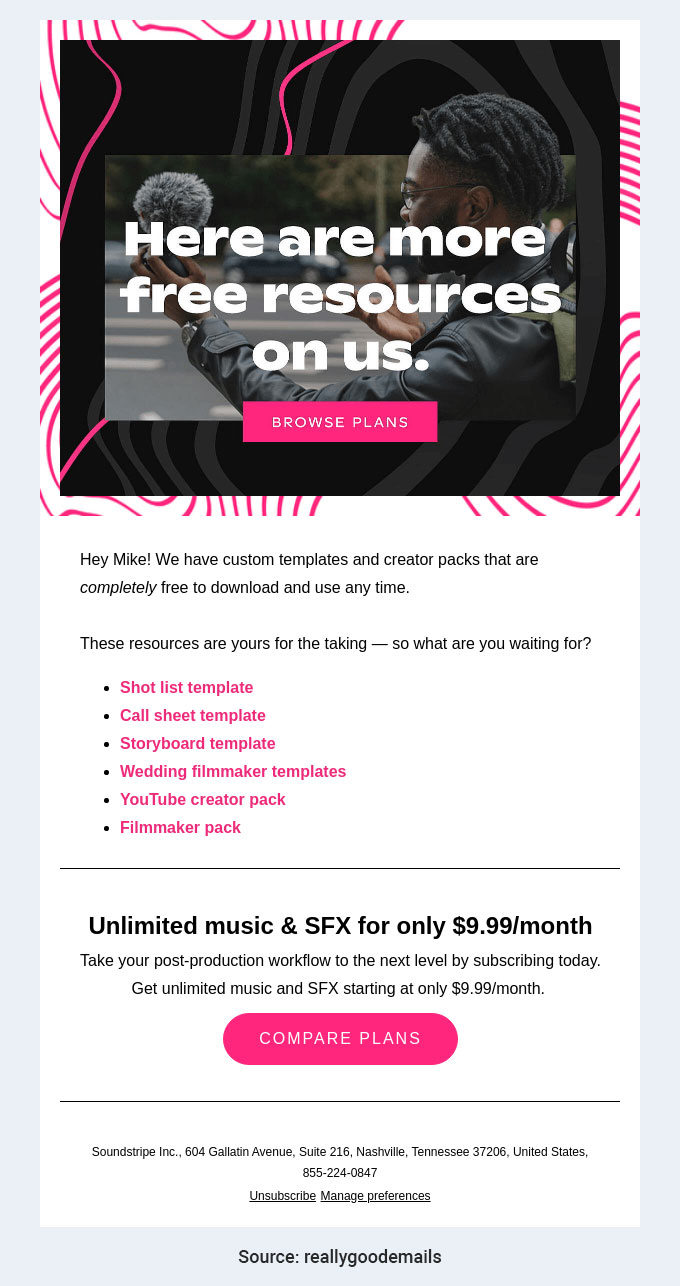
For SaaS trials that haven’t been activated yet. A gentle reminder usually outperforms a hard sell at this stage.
Hi [name],
We can’t wait for you to start using [product/business] and see real results in your work.
Just go here [link to login page] to get started, or visit our Help Center [link] to learn more about how to use [product].
Our support team is reachable at [email address] anytime you get stuck.
Have a great day!
[Name]
7. Onboarding Welcome Email
The classic SaaS onboarding welcome. Share the origin story briefly, then invite feedback to create a two-way relationship from day one.
Hi [name],
Thanks for joining us at [name of company].
We built [product] because [story behind it].
We’d love to hear your feedback on [product]. It helps us make sure we’re delivering exactly what customers want. Just hit reply and let me know what’s working or what needs to be better.
Look out for tips and product updates in your inbox over the coming weeks.
Thanks!
8. Welcoming an Ex-Customer Back
For returning customers who churned and resubscribed. Acknowledge the return and lead with what’s changed since they left.
Hi [name],
Welcome back to [name of company]. We really missed you.
A few things have changed since you were last here. Here’s what’s new:
Product Feature 1
Product Feature 2
Product Feature 3
Hope these solve some of the friction points that got in your way before. Thanks for giving us another shot. Reply anytime with questions.
Thanks,
[SIGNATURE]
9. Welcome Email for a New Business Client
For B2B onboarding. Welcome the client, anchor expectations with case studies, and open the feedback channel right away.
Hi [name],
Welcome aboard. Thanks for choosing [name of company].
We started our company in [YEAR] to help [SMALL/MID-SIZE/BIG] businesses grow, and we look forward to doing the same for you.
Here are some case studies from businesses in your industry: [ADD LINKS].
If anything about pricing or the contract isn’t clear, let us know. We’d rather sort it out now than later.
Thanks,
[Signature]
10. Welcome Email for a Customer Subscribed to Your Newsletters
Short and direct for newsletter signups. Deliver the promised resource, leave the door open for replies.
Hi [name],
Thanks for subscribing to our newsletter.
As promised, here’s your free [name of offerings]. Hope you enjoy it.
[link]
Reach out anytime. Have an amazing day.
Best wishes,
[signature]
11. Welcome Email with a Story
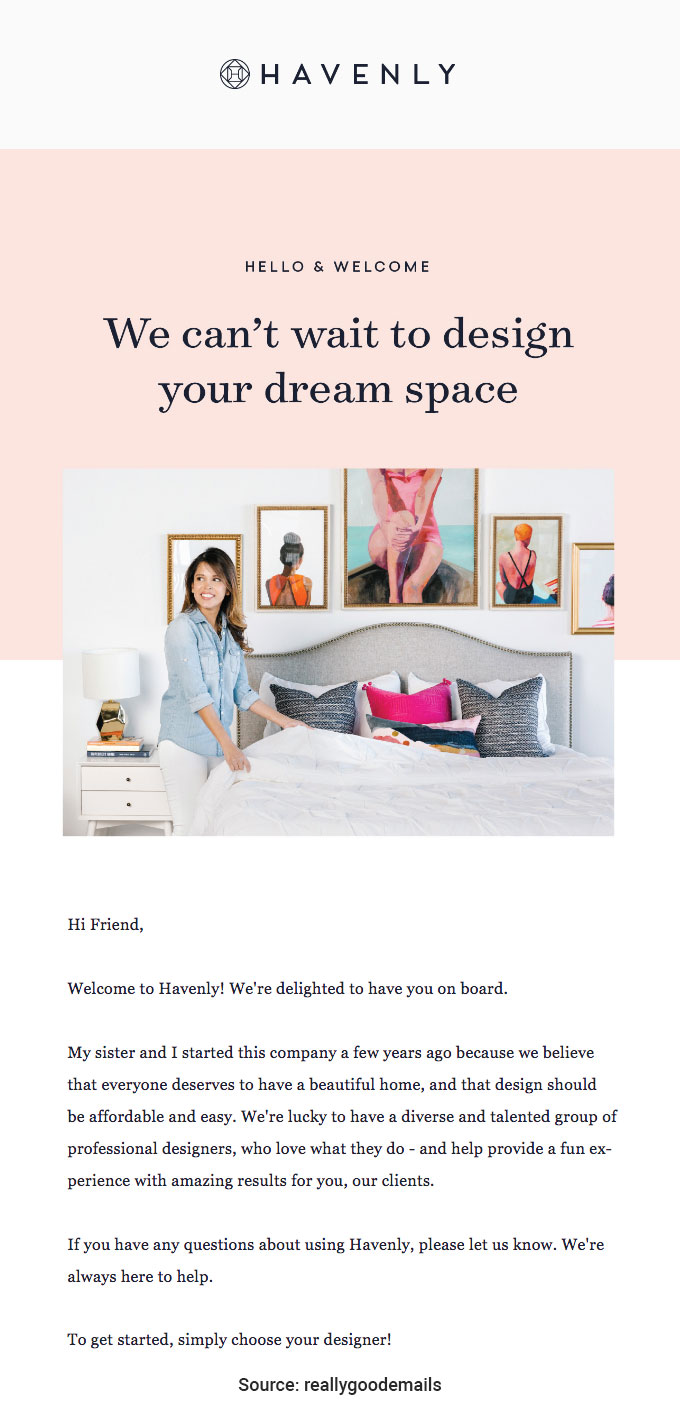
Story-driven welcomes work especially well for mission-led brands. Share why the company exists in a way that the subscriber can connect with personally.
Hi [name],
Welcome to [name of company]. I’m [name], the Founder and CEO. Before we get started, I’d like to share the story behind [name of company].
[Share story of your company, how you started and what problem you set out to solve.]
Glad to have you with us, as a new member of the [product] family.
Regards,
[your name]
12. Welcome Email for Sharing Premium Plans/Features
For freemium businesses. Welcome the free signup, then plant the seed of the paid plan with specific feature mentions.
Hi [name],
Thanks for choosing [name of company]. Excited to have you with us.
You’re on our [Basic/Free] plan, which is great for getting started but does come with some limitations. If you want to unlock the full set of features, our premium plan at [PRICE]/month adds:
[Premium Feature 1]
[Premium Feature 2]
[Premium Feature 3]
[Premium Feature 4]
Questions about the upgrade? Reply to this email anytime.
Best, [signature]
13. Welcome Email for a Customer With “Getting Started” Instructions
For products where activation requires multiple steps. Break the steps into a clear sequence so the customer doesn’t feel overwhelmed.
Hi [name],
Thanks for joining [name of the company]. Hope you have a great experience with [name of the product].
Here’s a quick step-by-step guide to help you achieve [goals]:
[STEP 1]
[STEP 2]
[STEP 3]
Here’s the link to our help center: [ADD LINK].
Our customer success team is available 24×7 and happy to help. Good luck.
Best, [signature]
14. Welcome Email to Share a Gift or Exclusive Offer
Discount-led welcome for ecommerce. The added urgency of a time-bound offer measurably lifts first-purchase conversion.
Hi [name],
Thanks for choosing [name of company]. Glad to have you with us.
To say thanks, here’s a 25% discount coupon you can use when you sign up for any premium plan. Code: [Mention Discount Code].
Apply the coupon at checkout. It’s valid for the next 3 months starting today.
Looking forward to your feedback. Have an awesome day.
Regards, [signature]
15. Personalized Welcome Video
Video welcomes are massively underutilized. A 60-second personalized clip from a founder or account manager outperforms text in nearly every metric that matters.
Hi [name],
Welcome to [name of company].
Thanks for joining us as a subscriber. Here’s a short video walking through everything you need to know to get started:
[link]
Regards,
[signature]
16. Welcome Email From a New Account Manager
For B2B and enterprise. Establishes the account manager relationship early and signals that the customer has a real human point of contact.
Hi [name],
I’m [your name], your new account manager. I’ve spent 5+ years working in this field and have helped over 100 clients reach their goals.
Feel free to book a call here: [link].
Thanks, [signature]
17. Welcome Email After Account Creation
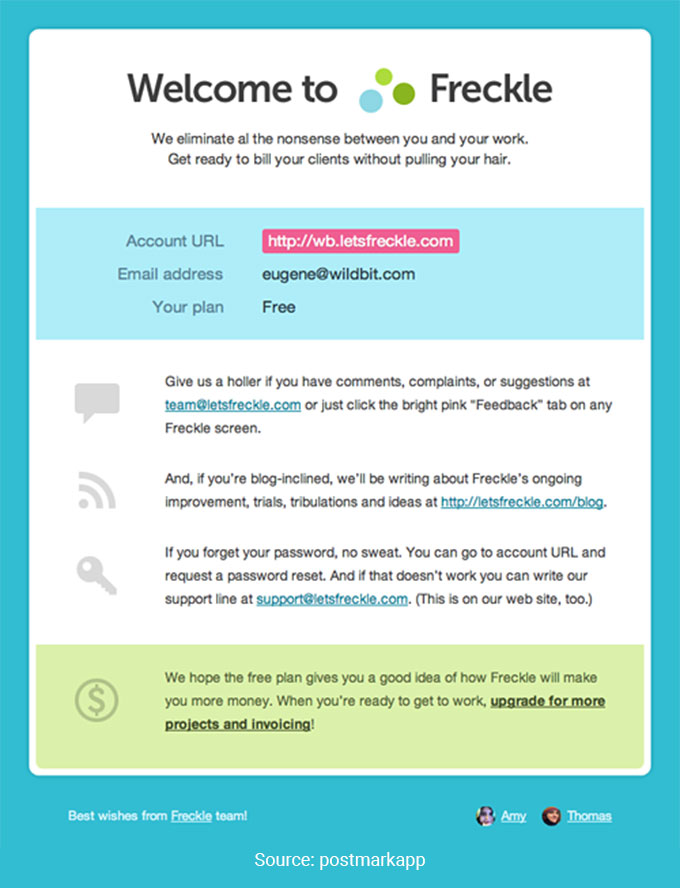
The lightest-touch welcome. Confirm the signup, point to resources, leave the door open for help.
Hi [name],
Thanks for creating your account. Our mission at [Prospect’s company] is to solve [Customer pain point].
To learn more about features and tools, visit our website: [link].
Reach out anytime at [email address]. Glad to help.
Regards,
[signature]
These are 17 of the best welcome email templates worth keeping in your library. Customize the specifics, run two or three of them against each other, and let the data tell you which approach lands hardest with your audience.
40+ Welcome Email Subject Lines That Earn Opens
Templates only matter if subscribers actually open the email. Here are 40+ proven subject lines organized by intent, all tested across real campaigns. Strong email subject lines apply many of the same principles, so the patterns below extend across categories.
Warm welcome subject lines:
- Welcome to [brand], [name]!
- We’re glad you’re here
- Welcome aboard, [name]
- You’re in! Welcome to [brand]
- Thanks for joining the [brand] family
Curiosity-led subject lines:
- Here’s what to expect next
- A few things you should know about [brand]
- Open me first, [name]
- This is for you, [name]
- One quick thing before you get started
Value-led subject lines:
- Your free [resource] is inside
- Here’s your 20% off code
- Welcome! Your discount is inside
- Your free trial starts now
- Unlock your welcome bonus
Personal subject lines:
- Hi [name], I wanted to introduce myself
- A personal note from the founder
- [Name], welcome from [founder name]
- Thanks for trusting us, [name]
- From [founder] to [name]: welcome
Direct subject lines:
- Welcome to [brand]. Let’s get started
- You’re in
- Welcome. Here’s everything you need
- Step 1 of your [brand] journey
- Your account is ready
1-Email vs 3-Email vs 5-Email Welcome Series
How many welcome emails should you actually send? It depends on your business model, audience expectations, and what you want the welcome moment to accomplish. Here’s the breakdown of each common approach:
1-Email Welcome. A single welcome message right after signup. Best for low-touch newsletters, free downloads, and lightweight communities where one polite hello is enough. Easy to set up, hard to mess up, but leaves a lot of engagement potential unused for higher-stakes signups.
3-Email Welcome Series. The most common pattern, balancing effort with engagement payoff:
- Day 1: Welcome + immediate value (resource, discount, or feature highlight)
- Day 3: Brand story + social proof (case study, testimonial, or founder note)
- Day 7: Product or content showcase + first CTA (browse, try, or purchase)
5-Email Welcome Series. Best for SaaS, high-consideration purchases, and B2B onboarding where activation requires multiple touchpoints:
- Email 1 (Day 1): Welcome + activation step (sign in, complete profile, take first action)
- Email 2 (Day 3): Feature deep-dive on the most-used capability
- Email 3 (Day 7): Customer success story showing real ROI
- Email 4 (Day 10): Tips, best practices, and advanced workflows
- Email 5 (Day 14): Upgrade/conversion ask or first commercial CTA
Real Brand Welcome Email Examples Worth Studying
Theory matters, but seeing how brands you respect actually handle welcomes teaches more than any framework. Here are eight worth studying:
Airbnb sends a clean, image-led welcome featuring a personal photo from the team, a clear value statement, and a single CTA to start exploring. The design feels personal rather than corporate.
Headspace leans heavily on brand personality. The welcome email captures the same playful, calming tone that the app uses, which creates instant brand recognition and makes the subscriber feel like they’re joining a community rather than a service.
Patagonia uses welcomes to reinforce mission. The first email talks about sustainability and brand values rather than discounts, which sets the tone for a long-term relationship rather than a quick conversion.
Casper brings humor into the welcome. The brand voice shows up in every sentence, the product education is genuinely useful, and the sequence drips out across 7 days to keep the relationship warm.
Glossier turns welcomes into community moments. UGC, soft CTAs, and a feeling of inclusion drive the experience, which fits the brand’s broader strategy of treating customers as collaborators.
Spotify hits immediately with personalization. The welcome email surfaces personalized playlist recommendations based on signup data, which delivers real value within seconds of the customer arriving.
Asana nails SaaS onboarding. The welcome focuses on a single first action (create your first project) rather than overwhelming the user with every feature, which lifts activation rates significantly.
Duolingo uses character voice and gamification from the very first email. The welcome introduces the owl mascot, sets up the streak mechanic, and gives the subscriber an emotional reason to come back tomorrow.
Welcome Email Design Best Practices
Design quietly affects open rate, click rate, and conversion more than most teams realize. These are the rules that consistently separate welcome emails that perform from those that flatline:
- Mobile-first design. 60-70% of email opens happen on mobile devices. If the welcome doesn’t read well on a phone, you’re losing most of your audience before the first scroll.
- Single CTA per email. One action, not five. Welcome emails with one CTA convert at 2-3x the rate of welcomes with multiple competing asks.
- Brand consistency. Logo, colors, font, and voice should match what the subscriber saw on the signup page. Mismatches feel jarring and break trust.
- Personal photo when possible. A real face from the team builds connection in a way that stock imagery never can. Founder photos work especially well for SMB and DTC brands.
- Plain text vs HTML. Plain text feels personal and lands in the primary inbox more often. HTML feels designed and is better for visual products. For founder welcomes, plain text usually wins. For product launches, HTML usually wins.
- Image-to-text ratio. Aim for roughly 60% text and 40% images. Heavily image-based emails trigger spam filters more often and load slower on mobile.
- Alt text for all images. Many subscribers see images blocked by default. Strong alt text means the email still communicates value even when images don’t load.
- Preheader text optimization. The preheader (preview text that shows in the inbox alongside the subject line) is often ignored, but it’s prime real estate. Use it to extend the subject line and earn more opens.
AI-Powered Welcome Emails in 2026
The biggest shift in welcome email strategy heading into 2026 is the move from static templates to AI-driven decisioning. The old approach used the same welcome email for every new subscriber regardless of context. The new approach watches signup signals continuously and adjusts content, timing, and even sender based on what each subscriber is most likely to respond to.
Modern welcome flows now include AI-generated personalized opening lines based on signup data (which form, which page, which campaign), predictive content selection that surfaces the most relevant resource per subscriber profile, dynamic send-time optimization that picks the best moment per recipient, and behavioral trigger refinement that learns which welcome patterns actually drive long-term engagement.
The combination of strong email automation infrastructure with AI-driven personalization is what separates brands that grow their lists into real revenue from brands that just accumulate unengaged emails. The foundation has to come first (clean data, well-structured workflows), then AI optimization compounds on top.
Welcome Email Personalization Beyond First Name
“Hi [first name]” is the bare minimum, not personalization. Real personalization in 2026 uses every signal you have at signup to make the welcome feel addressed rather than templated. Five dimensions worth using:
- Signup source: Which form, which page, which campaign brought them in. Welcome a subscriber from the holiday gift guide differently than someone from the technical blog.
- Acquisition channel: Organic search, paid social, referral, and direct each suggest different motivations. A paid-social signup probably needs more brand education than a referral.
- Customer segment: Industry, role, company size, plan tier. Use whatever signals your signup form captures to route subscribers to the right welcome variant. Smart customer segmentation is what makes this work at scale.
- Past behavior: For returning subscribers who churned and came back, acknowledge the return rather than treating them like a brand-new signup.
- Geographic localization: Timezone for send timing, language for content, and currency for pricing. Even subtle localization signals lift engagement measurably.
Common Welcome Email Mistakes
Six mistakes show up across welcome emails that underperform. Spotting them in your own drafts is usually the fastest way to lift open and click rates without rewriting from scratch:
The first mistake is making the email too long. Nobody reads an 800-word welcome. Aim for 100-200 words for the first email, with longer educational content saved for later in the series.
The second mistake is multiple competing CTAs. Asking the subscriber to follow on social, download the app, browse products, and reply with feedback all at once paralyzes them. Pick one ask per email.
The third mistake is generic templates that could have been sent by anyone. If your welcome doesn’t mention your brand name, your value prop, or anything specific about the subscriber, you’re wasting the highest-engagement moment in the relationship.
The fourth mistake is no personalization at all. Even basic first-name personalization lifts open rate by 10-20%. Skipping it leaves measurable revenue on the table.
The fifth mistake is bad timing. A welcome email sent 24 hours after signup reads like an afterthought. Send within 1 hour at the latest, ideally within minutes.
The sixth mistake is no mobile optimization. If the email looks broken or unreadable on a phone, you’ve lost most of your audience before the first scroll.
How to Measure Welcome Email Performance
The five metrics that matter most for welcome email performance:
- Open rate: Benchmark 50-70% for welcome emails. Anything below 40% usually signals weak subject lines or deliverability issues.
- Click-through rate (CTR): Benchmark 10-25%. Below 5% suggests weak CTAs or misaligned content.
- Conversion rate: Varies by goal. 5-20% is the typical range depending on what action you’re asking for.
- Unsubscribe rate: Target below 0.5%. Above 1% usually means the subscriber didn’t expect what they’re now getting.
- Revenue per email (RPE): The cleanest measure of overall welcome email health, especially for ecommerce. Use proper email marketing infrastructure that connects sends to downstream revenue rather than tracking opens alone.
FAQs
Conclusion
In email marketing, welcome emails are the highest-leverage message you can send. They start the relationship, set expectations, and create the first impression that lasts. Trust is built in the first 60 seconds of any new relationship, and the welcome email is your shot at making that 60 seconds count. Personalization remains the strongest tactic to earn customer attention in 2026, especially when paired with strong timing and a single clear CTA.
Sending a personalized welcome message lifts engagement, drives early conversion, and reduces unsubscribe rates measurably. Welcome emails are perfect for introducing your company, surfacing your products, and sharing the offers that boost engagement during the highest-attention window in the entire customer relationship. Pick a template from the 17 above that matches your signup context, customize it for your brand, ship it, and let the data guide the next move. The patterns are simple. The discipline of actually applying them is what separates brands that grow from brands that quietly stall.
Also Read:
- 18 Best Confirmation Email Templates You Can Use
- How to Write a Welcome Email Series? 5 Best Examples you Can Steal
- 17 Best Welcome Email Examples That Work
- 17 Best Email Marketing Services [Features & Pricing Compared]
- 23 Best Email Marketing Tools Compared
