














 Email
Email SMS
SMS Whatsapp
 Web Push
 App Push
 Audience Sync for Ads
 Popups
 Channel A/B Testing
  Control groups Analysis
 Frequency Capping
 Funnel Analysis
 Cohort Analysis
 RFM Analysis
 Signup Forms
 Surveys
 NPS
NPS Landing pages personalization
  Website A/B Testing
  PWA/TWA
 Heatmaps
 Session Recording
 Wix
Wix Shopify
 Magento
 Woocommerce
 eCommerce D2C
  Mutual Funds
 Insurance
 Lending
  Recipes
  Knowledgebase
 Developer Docs
 Product Updates
 App Marketplace
 Academy
 Ebooks
 Case Studies
 Blog
Blog Templates
 Aparupa Saha
A good ROAS is any return that clears your break-even point and leaves profit after all costs. As a rough rule, ecommerce brands aim for 4:1, but the honest answer depends on your margins.
A 2:1 ROAS is profitable for a 70%-margin skincare brand and a money-loser for a 25%-margin dropshipper. The benchmark that matters is not the industry average. It is your own break-even.
TL;DR
- The 4:1 rule of thumb is only a starting point; the real answer depends on your margins.
- 2026 benchmarks: Google ~4-4.5x, Meta ~2.2-2.8x, TikTok ~1.4x, ecommerce average ~2.87:1 (median nearer 2:1).
- Calculate your break-even ROAS (1 / profit margin) before comparing yourself to any benchmark.
- Stage matters: growth brands accept lower ROAS, profit-focused brands aim higher. Judge against lifetime value.
That said, you came here for numbers, so this guide gives you the current ones, channel by channel and industry by industry, then shows you how to figure out what “good” means specifically for your business.
The Short Answer, by Channel
Here is where returns sat across 2025 into 2026, pulled from industry benchmark datasets:
| Channel | Typical ROAS | Worth knowing |
|---|---|---|
| Google Ads (Search) | 4.0x to 4.5x | High purchase intent lifts returns |
| General ecommerce (blended) | ~2.87:1 average | Median is lower, closer to 2:1 |
| Meta (Facebook & Instagram) | 2.2x to 2.8x | Creative quality drives most of the spread |
| TikTok | ~1.4x | Great reach, weaker direct return |
| Cross-industry paid search | 2.3x to 2.9x average | Enormous range underneath |
One number deserves a flag. The ecommerce average is around 2.87:1, but the median is closer to 2:1. That gap is not a rounding quirk. It means roughly half of all ecommerce businesses run below a 2:1 return, and a handful of high performers drag the average upward.
If you benchmark yourself against the average, you are comparing yourself to a number most stores never hit. Use the median if you want an honest mirror.
Why “Good ROAS” Has No Universal Answer
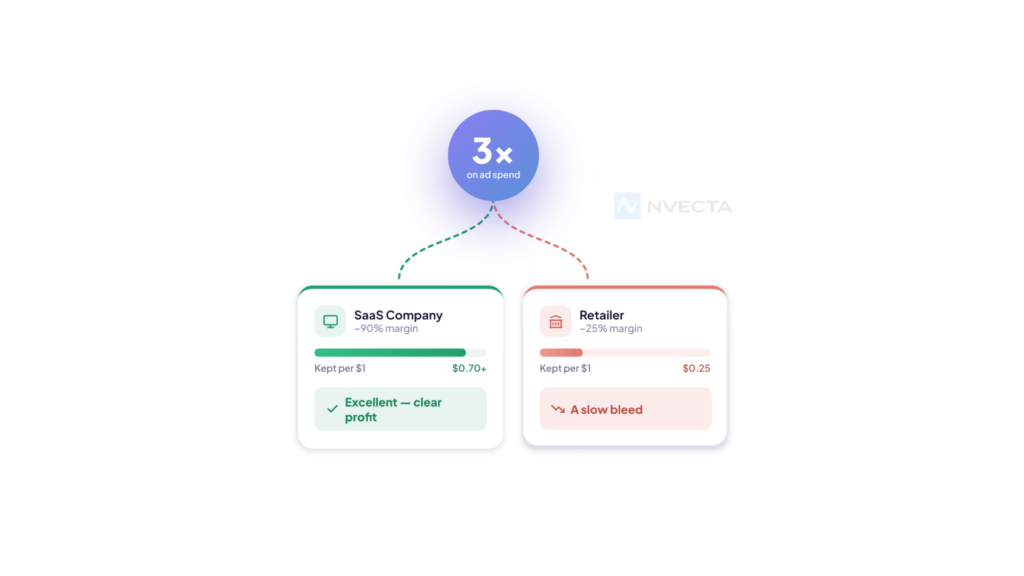
The reason a single benchmark fails is the margins. ROAS measures revenue, not profit, and revenue means very different things to different cost structures.
Walk through it. If you keep 70 cents of every dollar in revenue, you can afford a low ROAS, because most of what comes back is yours. If you keep 25 cents, you need the ads to work much harder before you see a profit. Same ROAS, opposite verdict.
This is why I get twitchy when someone asks “is 3x good?” with no other context. Three-to-one is excellent for a software company with near-90% margins and a slow bleed for a low-margin retailer. The number is identical. The business outcome is not.
So before any benchmark is useful, you need one figure of your own.
How to Calculate Your Break-Even ROAS
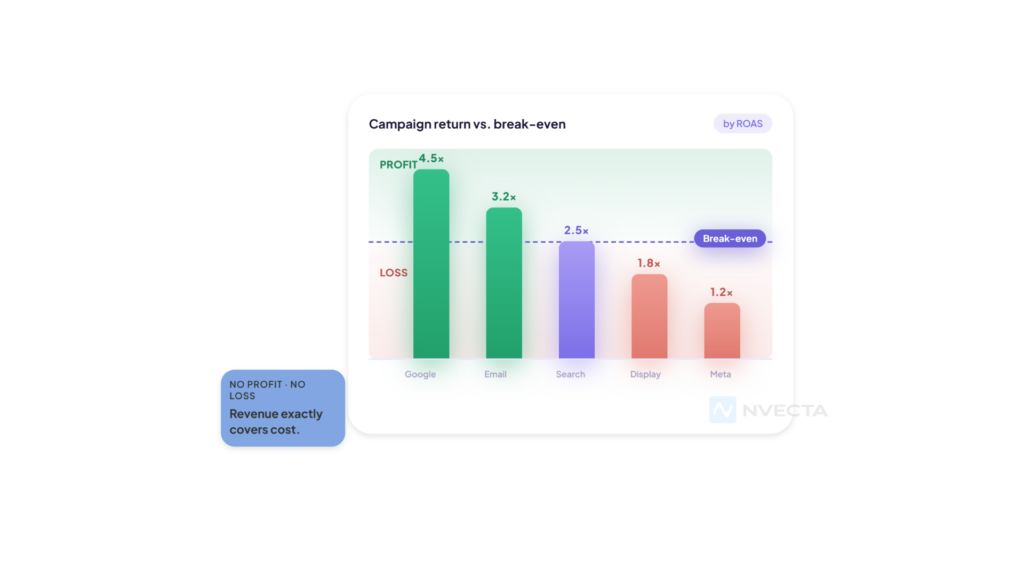
Break-even ROAS is the return at which ad revenue exactly covers your costs. No profit, no loss. Below it, you are losing money; above it, you are making it.
Break-even ROAS = 1 ÷ Profit margin
Use your gross margin as a decimal.
- 50% margin → 1 ÷ 0.5 = 2.0 (you need 2:1 just to break even)
- 40% margin → 1 ÷ 0.4 = 2.5
- 30% margin → 1 ÷ 0.3 = 3.33
- 70% margin → 1 ÷ 0.7 = 1.43
Now the channel benchmarks mean something. If your break-even is 2.5 and Google Search returns 4.5x for your vertical, there is real profit there. If your break-even is 4 and Meta returns 2.5x, that channel is underwater for you no matter how normal 2.5x looks on a benchmark chart.
Calculate this first. Everything else is context.
ROAS Benchmarks by Industry
Industry matters because average order value, margins, sales-cycle length, and competition all push ROAS around. The spread across industries is wide enough that comparing yourself to the wrong vertical is worse than having no benchmark at all.
Aggregated 2025–2026 data on paid search showed returns ranging from under 1x in some financial services categories to nearly 7x in heavy equipment and manufacturing. A few directional reference points from that data:
| Industry | Approximate ROAS | Why it lands there |
|---|---|---|
| Legal services | up to ~8:1 | High case value, strong intent |
| Heavy equipment / manufacturing | up to ~6.9x | Large deal sizes |
| Apparel | ~4:1 | Strong creative-led demand |
| General ecommerce | ~4:1 (Google), ~2.5–4x (Meta) | The broad middle |
| Health & beauty | ~2:1 area | High attention, lower conversion |
| Financial services | ~0.7x in places | Expensive clicks, long consideration |
Two cautions on any table like this. First, the ranges inside a single industry are huge, so treat these as starting points, not targets. Second, geography swings ROAS by 2x to 4x for the same product.
A fashion brand running Meta ads in Southeast Asia and the same brand targeting the US will see fundamentally different returns. The benchmark is a compass heading, not a destination.
What’s a Good ROAS on Google Ads?
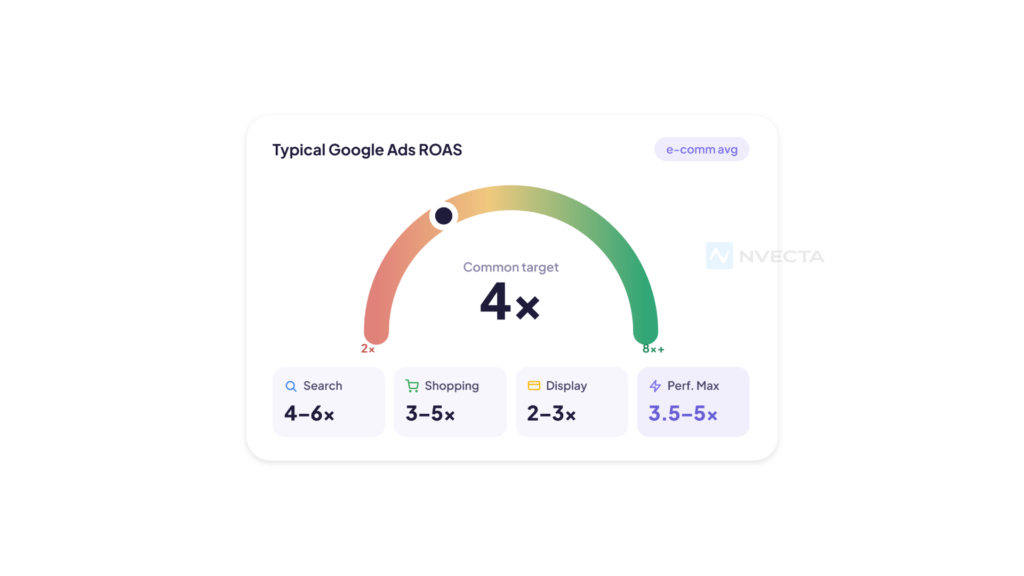
Google Search tends to post the strongest ecommerce ROAS, often around 4.0x to 4.5x median for search campaigns. The reason is intent.
Someone typing “buy running shoes size 10” is closer to a purchase than someone half-watching a video in their feed. You are paying to reach people who have already decided they want the thing.
That intent premium is why search frequently outperforms social on raw ROAS, and why, if your break-even is reachable, search is often where the efficient money goes first.
What’s a Good ROAS on Meta (Facebook & Instagram)?
Meta returns generally sit lower, in the 2.2x to 2.8x range for general ecommerce, with high performers pushing 3.5x to 5x. The single biggest variable is creative.
By 2026, creative quality accounts for more than half of Meta ad performance, which means the gap between a mediocre advertiser and a strong one is mostly a gap in hooks, formats, and how fast they refresh tired ads.
This changes the playbook. On Google, you optimise keywords and bids. On Meta, you optimise the asset itself because a better video moves ROAS more than a better bid setting does.
Brands using Meta’s automated Advantage+ campaigns have reported returns roughly 22% higher than manual setups, which tells you the platform’s machine learning, fed good creative, is hard to beat by hand.
What’s a Good ROAS for TikTok?
TikTok runs lower on direct ROAS, around 1.4x, which sounds bad until you understand what you are buying. TikTok is often a top-of-funnel, demand-generation channel.
The last-click ROAS undersells its real contribution because a lot of the demand it creates converts later somewhere else, on search, on a return visit, on Meta. If you judge TikTok purely on last-click ROAS, you will underrate it. If you can measure its assisted impact, the picture improves.
Why Has ROAS Been Falling
If your ROAS dipped year over year and you cannot find the cause, you are not alone, and it may not be your fault. Ecommerce ROAS dropped roughly 4% in 2025, and the reasons are structural:
Ad costs climbed. Rising CPMs mean you pay more to reach the same people, which compresses ROAS even when conversion holds steady.
Attribution got harder. Privacy changes and the iOS tracking shifts broke a lot of the measurements that used to assign credit to ads. Some of the “lost” ROAS is real performance decline. Some of it is just tracking that can no longer claim the sales it used to claim. A high ROAS inside an advertising platform doesn’t always mean the campaign is creating the same level of incremental revenue for the business, shares Ashot Nanayan, founder of B2BSEO.io. Attribution gets messy when customers interact with paid ads, organic search, social media, and other touchpoints before converting. I’d always look at ROAS alongside overall revenue, acquisition cost, and the full customer journey, rather than judging a channel by a single dashboard metric.
Competition intensified. More advertisers chasing the same inventory push costs up across the board.
Interestingly, smaller brands sometimes bucked the trend with double-digit ROAS improvements, likely because they iterate on creative faster and lean less on broad automated campaigns. Size is not destiny here. Agility helps.
A lot of that “lost” return is really an attribution problem, which is worth understanding on its own; here’s a primer on attribution software and how the tools compare.
So, What’s a Good ROAS For You?
Pull the threads together into a process you can actually run:
First, calculate your break-even ROAS from your real gross margin. That is your floor. Anything below it loses money.
Second, find your relevant industry and channel benchmark, not the generic ecommerce average. A legal services advertiser and a pet supplies store should not be aiming at the same number.
Third, set a target comfortably above break-even, with room for the costs that ROAS ignores, returns, refunds, and the creative and agency fees that rarely make it into the raw calculation.
Fourth, judge ROAS alongside lifetime value, not in isolation. A 2:1 campaign that lands loyal, repeat customers can be worth more than a 5:1 campaign that pulls one-time discount hunters. The dashboard rewards the 5:1. The business may prefer the 2:1.
A “good” ROAS, in the end, is not a number you copy off a chart. It is the number that, for your margins and your customers, leaves real profit on the table after everything is paid for.
Good ROAS Depends On Your Business Stage, Too
Margins set the floor, but your stage sets the target above that floor, and the two goals often pull in opposite directions.
A growth-stage brand chasing market share will deliberately accept a lower ROAS to acquire customers faster. If you know a customer is worth $400 over their lifetime, spending enough to acquire them at a 1.5:1 first-purchase ROAS can be the right call, because you are buying a relationship, not a single sale. Investors fund this on purpose.
A profitability-stage brand does the opposite. It tightens ROAS targets, cuts the campaigns that only work on paper, and prioritises return per dollar over raw growth. Same company, different season, completely different definition of “good.”
So when someone asks whether their ROAS is good, the honest follow-up is: good for what? Growth and profit are different games, and a number that wins one loses the other. Decide which game you are playing before you set a target.
A Worked Break-Even Example
Numbers make break-even concrete, so here is the full walk-through.
Say you sell a product for $100. It costs you $40 to make and deliver (cost of goods, packaging, shipping). Your gross margin is $60, or 60%.
Break-even ROAS = 1 ÷ 0.60 = 1.67, or 167%.
That means every dollar of ad spend has to bring back at least $1.67 in revenue just to cover the product cost. At exactly 1.67:1, you make nothing. At 3:1, you are comfortably profitable. At 1.4:1, you are losing money on every sale, even though 1.4:1 might look respectable on a benchmark chart.
Now change one thing. Your margin drops to 30% because of a supplier price hike.
Break-even ROAS = 1 ÷ 0.30 = 3.33.
Suddenly, that same 3:1 campaign that looked fine is underwater. Nothing about the ads changed. Your cost structure did. This is exactly why a benchmark you copied from a blog can quietly bankrupt you, and why your own break-even is the only number that anchors everything else.
ROAS vs POAS vs MER: The Metrics Catching Up to ROAS
ROAS has a known blind spot: it measures revenue, not profit, so two newer metrics are gaining ground because they close that gap.
POAS (profit on ad spend) divides profit by ad spend instead of revenue. It answers the question ROAS dodges: are we actually making money, not just revenue?
A 4:1 ROAS on a thin-margin product can be a losing POAS, and POAS surfaces that immediately. For margin-sensitive businesses, POAS is arguably the better north star.
MER (marketing efficiency ratio) is total revenue divided by total marketing spend, basically blended ROAS across all marketing, not just trackable ads.
It is attribution-proof because it does not care which channel gets credit. When platform-reported ROAS looks great, but the bank account disagrees, MER is the number that tells the truth.
None of these replaces ROAS outright. ROAS is still the fastest channel-level optimisation metric. But “good” increasingly means good ROAS and healthy POAS or MER, because revenue efficiency without profit efficiency is just expensive busywork.
How to Set Your Own ROAS Target
Pulling it together, here is the sequence I would run for any account:
Start with break-even ROAS from your real margin. That is the floor, the point of zero profit. Add a profit cushion on top, the margin of safety you want per sale.
Account for the costs ROAS ignores, returns, refunds, creative, and agency fees, by setting your target a notch higher than the pure math suggests.
Then adjust for stage: lower the target if you are buying growth and can afford it on lifetime value, raise it if you are optimising for profit. Finally, set targets per channel, not one blanket number, because a 4.5x search target and a 2.5x social target can both be correct for the same business.
A good ROAS target is not inherited. It is built from your margins, your stage, and your customers. Anyone who hands you a single magic number without asking about those three things is guessing.
What About a Good ROAS for B2B and Lead Generation?
Most ROAS benchmarks assume ecommerce, where a click leads to a tracked purchase. For B2B and lead-generation businesses, the picture is messier, and a low apparent ROAS can still be excellent.
The reason is the sales cycle. A B2B ad does not usually end in an immediate purchase. It produces a lead, which a sales team works for weeks or months, which eventually closes as a deal size far larger than any ecommerce order.
If you measure ROAS only on the immediate, trackable action, you will badly understate the campaign, because the real revenue lands long after the click and often offline.
For these businesses, the better approach is to track ROAS against closed revenue, feed deal values back from the CRM to the ad platform, and to be patient with the window.
A B2B campaign at an apparent 1:1 last-click ROAS might be returning 8:1 once the closed deals are counted. Judge it on what actually books, not on what the pixel can see the same day. Tying ad spend to closed revenue this way is far easier on top of a unified customer data platform.
Stop chasing someone else’s benchmark. Calculate your break-even, pick the right industry and channel comparison, and define “good” as the return that leaves profit after every real cost. That number is yours, and it is the only one worth optimising toward.
Beating Your Benchmark, Not Just Measuring It
Knowing your target is step one; hitting it means putting budget behind the right audiences and watching the right channel.
NVECTA’s ROAS Analysis lets you compare ROAS across Facebook, Google, and DV360 side by side, so you can shift spend toward whichever platform clears your break-even.
And because you can sync predictive, high-value segments straight to those ad accounts, your remarketing targets the customers most likely to push ROAS above your benchmark, not just everyone.
See NVECTA’s segmentation and audience sync →
Frequently asked questions
What is a good ROAS for ecommerce?
Commonly cited as 4:1, but it depends on margins. The 2026 ecommerce average is about 2.87:1, with a median near 2:1. Calculate your break-even ROAS (1 ÷ profit margin) and aim above it.
What is a good ROAS for Google Ads?
Google Search ecommerce ROAS tends to run around 4.0x to 4.5x, helped by high purchase intent. Whether that is “good” still depends on your break-even.
What is a good ROAS for Facebook ads?
Meta returns generally fall between 2.2x and 2.8x for general ecommerce, with strong advertisers reaching 3.5x to 5x. Creative quality is the main driver.
Is a 3:1 ROAS good?
For a high-margin business, yes, comfortably. For a low-margin business with a break-even above 3, no, it loses money. The same 3:1 can be a win or a loss depending on margins.
Is a higher ROAS always better?
Not always. A very high ROAS can signal underspending, where you could profitably scale more. And a high ROAS built on one-time, low-value buyers can be worth less than a lower ROAS that wins repeat customers.
Why is my ROAS dropping?
Often rising ad costs, tougher attribution after privacy changes, and more competition, all of which pushed industry-wide ROAS down around 4% in 2025. It is often a market-wide shift rather than something wrong with your campaigns alone.
