














 Email
Email SMS
SMS Whatsapp
 Web Push
 App Push
 Audience Sync for Ads
 Popups
 Channel A/B Testing
  Control groups Analysis
 Frequency Capping
 Funnel Analysis
 Cohort Analysis
 RFM Analysis
 Signup Forms
 Surveys
 NPS
NPS Landing pages personalization
  Website A/B Testing
  PWA/TWA
 Heatmaps
 Session Recording
 Wix
Wix Shopify
 Magento
 Woocommerce
 eCommerce D2C
  Mutual Funds
 Insurance
 Lending
  Recipes
  Knowledgebase
 Developer Docs
 Product Updates
 App Marketplace
 Academy
 Ebooks
 Case Studies
 Blog
Blog Templates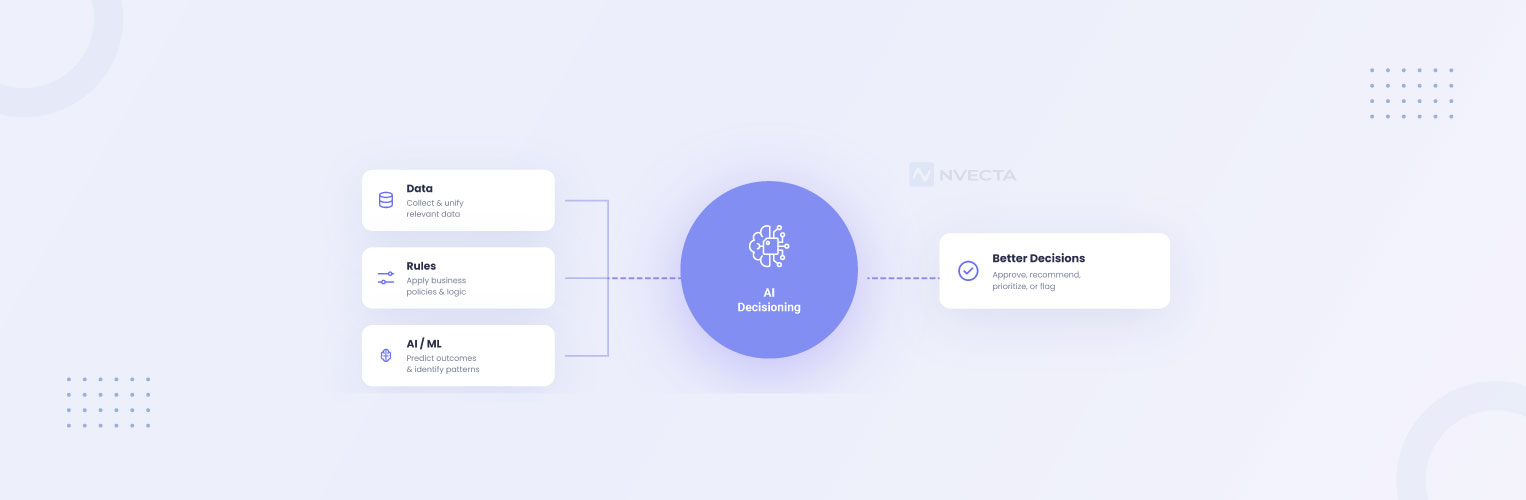
 Aparupa Saha
AI decisioning uses AI to choose the next best action for each customer in real time: who to target, what to send, which offer to make, and when to send it. Instead of following fixed, hand-built rules like traditional marketing automation, it scores the possible actions for each person against their behaviour and your goals, picks the best one, and learns from what happens.
It is the difference between “all VIP customers get the same email” and “each customer gets the action most likely to work for them right now.”
TL;DR
- AI decisioning uses AI to choose the best action, channel, offer, and timing for each customer, individually and in real time.
- It replaces static, rules-based marketing automation, which sends everyone down the same predefined path.
- Next best action (NBA) recommends one action; AI decisioning is the broader operating model that decides and acts across every customer, channel, and moment, then learns.
- It runs on a unified customer profile, so the data foundation matters more than the algorithm.
- Most mature in marketing and customer engagement, where businesses focus on strategies to increase customer engagement through better targeting, personalisation, and churn prevention, CDPs are now expanding into sales and service.
What is AI decisioning?
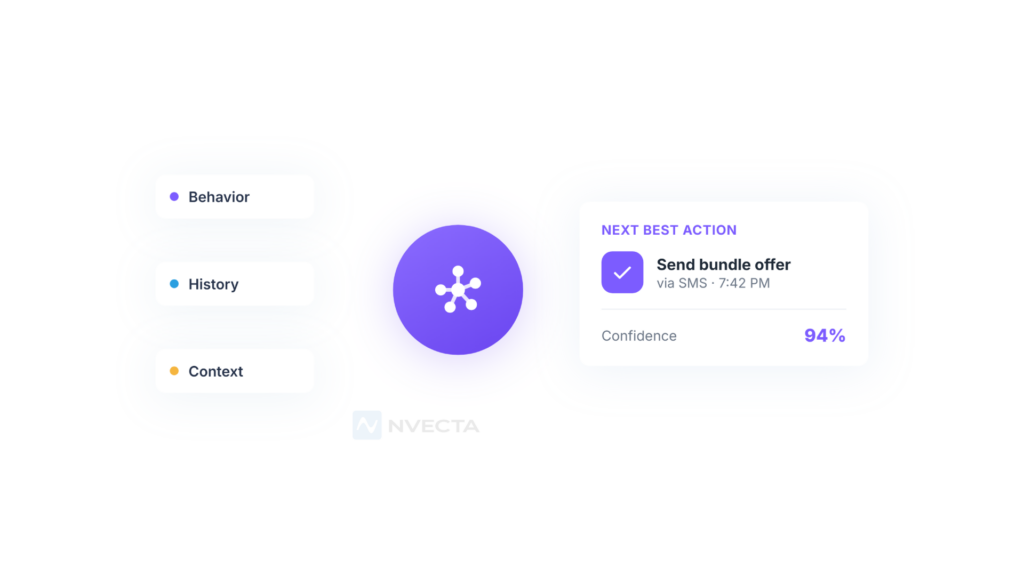
AI decisioning is a way of running customer engagement where AI, not a human-written rulebook, decides what happens next for each person. It looks at a customer’s behaviour, profile, and context, weighs the actions you could take, and picks the one most likely to move your goal, whether that is a conversion, a renewal, or stopping churn.
The core idea is individualisation at scale. A human cannot decide the right message, channel, and timing for a million customers one at a time. AI can. It treats every customer as a separate decision instead of forcing them all through the same funnel.
That is the shift: from batch-and-blast, where everyone gets the same campaign, to intelligent, one-to-one engagement, where the system chooses per person. Enterprise buyers have noticed. In 2026 research, 28% of customer data platform buyers ranked next best action as their most wanted AI capability, rising to 35% among customer experience teams.
AI Decisioning vs Marketing Automation
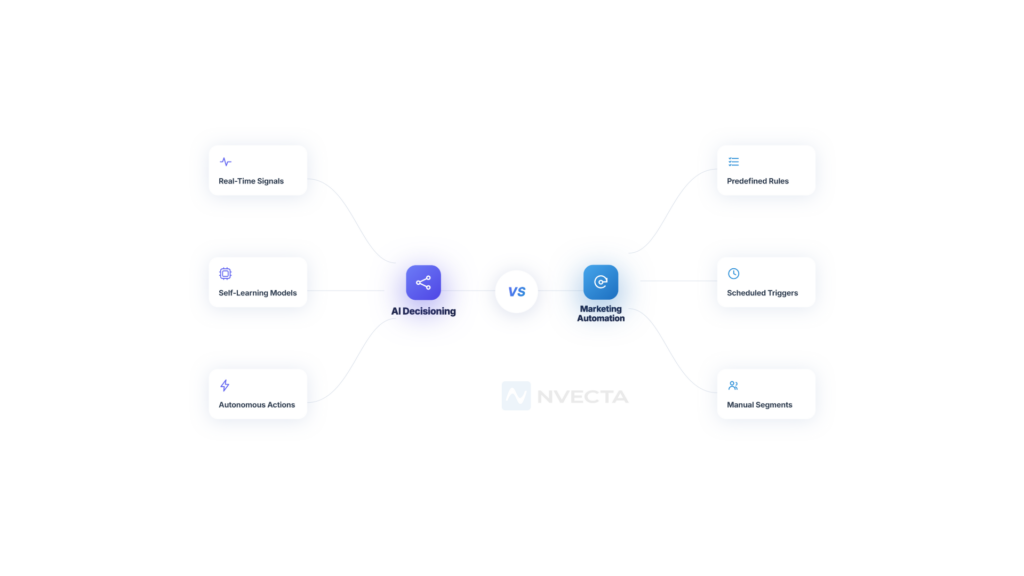
This is the distinction that matters most, because the two get confused constantly.
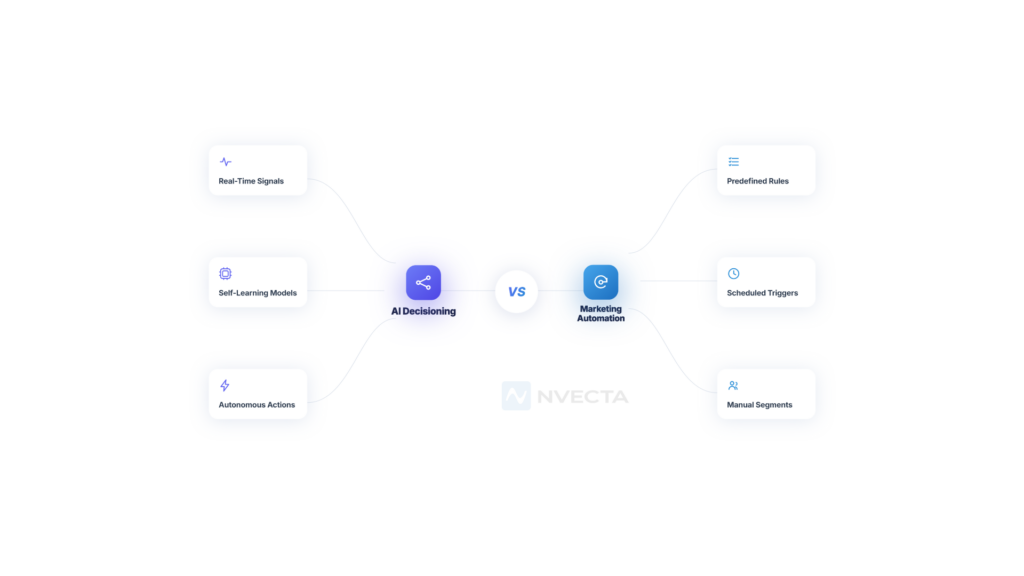
Traditional marketing automation follows predefined workflows. You build the rules: if a customer abandons a cart, wait an hour, then send email A; if they do not open it, send email B.
The logic is fixed, and it is the same for everyone who enters that path. It was a huge step up from manual campaigns, but it is rigid. Every scenario has to be anticipated and hard-coded, and the rules go stale as behaviour changes.
AI decisioning adapts instead of following a script. Rather than running everyone through the same if-then tree, it evaluates each customer’s situation continuously and decides the next action based on their behaviour, context, and engagement signals at that moment. This same flexibility can also support creative marketing workflows, where an AI poster maker helps teams quickly adjust campaign visuals based on audience needs, trends, or engagement data.
Put simply, automation executes the rules you wrote. AI decisioning writes the decision fresh for each customer and keeps updating it.
AI Decisioning vs Next Best Action (NBA)
You will see “next best action” used almost interchangeably with AI decisioning, but there is a real difference worth knowing.
The next best action is a model that recommends one action from a defined list. It looks at a customer, scores the candidate’s actions, and surfaces the single best one.
NBA was itself a breakthrough, because it replaced “all VIP customers get the same offer” with “each customer gets the offer they are most likely to respond to.”
AI decisioning is the broader operating model. NBA tells you what to do next; AI decisioning does it across every customer, every channel, and every moment, then learns from the results to decide better next time. One is a recommendation. The other is a system that decides and acts continuously.
The simplest way to hold it: NBA is the suggestion; AI decisioning is the operation that turns suggestions into action at scale.
How AI Decisioning Works
Strip away the marketing language, and AI decisioning runs a loop with five steps.
It starts with data. The system collects signals from every touchpoint: clicks, page views, purchases, searches, form fills, email and message responses, plus profile details like preferences and lifecycle stage. All of it gets consolidated into a single, unified customer profile.
Then it predicts. Machine learning models forecast what each customer is likely to do next: convert, churn, repeat, or ignore, based on the patterns in that data.
Underneath that step, an ML inference engine scores the signals and returns the prediction fast enough that the next action can fire while the customer is still in the moment.
Then it decides. The system scores the actions available for that customer, weighing each by likelihood to succeed and impact on your goal, and selects the best one.
Then it acts. The chosen action gets delivered: an email, a push, a recommendation, a held-back send, on the right channel at the right time.
Then it learns. The outcome feeds back into the models, so the next decision for that customer, and similar ones, gets sharper. This closing of the loop is what separates AI decisioning from a one-time prediction.
What AI Decisioning Actually Decides
In practice, the decisions break down into a few questions the system answers for each customer.
Who to target. Predictive segments group customers by what they are likely to do, so effort goes to the people most likely to convert or most at risk of churning, rather than everyone.
What to send. Product recommendations and next-best-offer logic pick the item or offer most relevant to that person right now, which lifts purchase intent and cuts wasted discounts.
When to send it. Send-time optimisation learns when each customer is most active, so messages land when they will actually be seen, improving engagement without adding more sends.
Which leads to action. Lead scoring ranks prospects by intent signals, so sales and growth teams chase the hottest opportunities first instead of working a flat list.
Notice that none of these is a new marketing idea. What is new is having a system make all of these calls per customer, continuously, instead of a team setting them once for a whole segment.
Where AI Decisioning is Used
AI decisioning is most mature in marketing and customer engagement: personalised messaging, churn prevention, lifecycle optimisation, and offer selection. That is where the data is richest, and the actions are clearest.
It is expanding outward, though. In sales, it powers lead scoring and next-best-action prompts. In customer service, it drives intelligent routing and proactive support.
In retail, it informs pricing and inventory. The same loop, predict, decide, act, learn, applies anywhere a system can choose among actions and measure the result. (One area worth separating: in financial services, “decisioning” often means credit and fraud decisions, a different, heavily regulated use case from the marketing decisioning this guide covers.)
AI Decisioning and AI Agents
These two terms travel together, so here is how they relate. AI decisioning is the “what”: the decision about the next best action. AI agents are the “who”: the autonomous systems that carry out that decision.
Modern platforms increasingly pair them: AI agents analyse the data, make the decision, execute the action, and learn from the result, handling the full cycle without a human triggering each step. This is the direction the category is heading, from a tool that recommends to a system that operates.
It is genuinely useful and a little uncanny at the same time, watching a system decide and act on a million customer journeys while the marketing team works on strategy instead of campaign mechanics.
The Benefits
The payoff, when it works, is concrete.
Higher conversion from smarter targeting, because budget and effort go to the customers most likely to act rather than being spread evenly. Better engagement from right-time, right-offer delivery, which lifts open and click rates without increasing message volume.
Less wasted spend, since you stop discounting customers who would have bought anyway and stop messaging ones who will not. More time for the team, because the system handles the per-customer mechanics that used to eat hours of manual segmentation.
More time for the team, because the system handles the per-customer mechanics that used to eat hours of manual segmentation. With this newly freed time, marketing teams can optimize their internal campaign workflows using AI project management solutions like Lark. Lark is more than just a project management tool; it’s a comprehensive collaboration platform combining messaging, business video conferencing, document sharing, and project management into a single unified solution, offering flexible views like Gantt and Kanban to help teams work more efficiently.
Students seeking artificial intelligence assignment help can explore these practical AI-driven marketing strategies to better understand how intelligent systems improve customer targeting and business decision-making.
What you Need Before AI Decisioning Works
Here is the part vendors gloss over: AI decisioning is only as good as the customer data underneath it.
The whole loop depends on a unified, up-to-date profile for each customer, stitched from every touchpoint across web, app, email, and more.
If a customer’s interactions are scattered across disconnected tools, the system is deciding on fragments, and fragmentary data produces confident, wrong decisions.
The model is the easy part. Unifying the data so the model can see the whole person is the real work, and the most common reason these projects underdeliver.
This is why AI decisioning usually sits on top of a customer data platform. The CDP unifies and resolves identity into one profile; the decisioning layer acts on it.
Common Mistakes and Limitations
A few honest caveats before you buy into the category.
Deploying it on broken data. Covered above, and it is the number one failure. Fix the unified-profile foundation first.
Treating it as fully hands-off too soon. AI decisioning automates the per-customer call, but it still needs goals, guardrails, and a library of sensible actions to choose from. Garbage actions in, garbage decisions out.
Expecting instant results. The system learns from outcomes, so it gets better over time. Implementation timelines depend mostly on data readiness, not the software.
Forgetting the human layer. The strongest setups free people to focus on strategy, creativity, and the actions the system chooses among, rather than making people disappear. AI decides which action; humans still decide what actions are worth offering.
AI Decisioning in Action: a Quick Example
An example makes the loop concrete. Take an ecommerce customer, call her Maya.
Maya browses running shoes twice, adds a pair to her cart, and leaves without buying. A rules-based automation would fire the same cart-abandonment email everyone gets, an hour later, regardless of who Maya is.
AI decisioning treats her as a fresh decision. It pulls her unified profile: she opens email rarely but responds to push notifications, she usually buys in the evening, and she has bought from this brand twice before at full price.
The system predicts she is likely to convert but unlikely to need a discount. So it decides: send a push, not an email; send it at 7 pm when she is active, not now; show the shoes plus a complementary product rather than a coupon, since discounting her would just give away margin.
Maya buys that evening. The outcome feeds back, and the system gets a little more confident about how to treat customers like her. No one wrote a rule for Maya specifically. The system decided for her, and it will decide differently for the next customer whose profile says they need a nudge on price.
That is the whole difference in one story: the same trigger, a very different, individualised response, chosen and improved automatically.
Predictive vs Agentic AI Decisioning
The category is splitting into two levels of capability, and knowing the difference helps you read vendor claims. For startups building products around these capabilities, a startup software development company can help turn AI decisioning concepts into a working product.
Predictive AI decisioning uses machine learning to forecast outcomes, who will convert, who will churn, and to score the best action from a defined set. It is powerful, but it still recommends within boundaries a team setup, and a human or a fixed workflow usually triggers the action.
Agentic AI decisioning goes further. Here, AI agents handle the full cycle: they analyse the data, make the decision, execute the action across channels, and learn from the result, without waiting for a person to push the button each time.
It moves decisioning from a recommendation you act on to a system that operates on its own within your guardrails.
Most platforms today are predictive, with pieces of agentic capability emerging. When a vendor says “AI decisioning,” it is worth asking which level they mean, because “recommends the next action” and “runs your engagement autonomously” are very different products with very different trust requirements. If you want to go deeper here, this guide to agentic AI covers how autonomous agents work.
AI decisioning is the move from running campaigns to running decisions: instead of building one workflow for everyone, you let a system choose the right action for each customer and improve as it learns.
The technology is real, and the gains are concrete, but they depend on something unglamorous, a unified customer profile clean enough for the system to decide on. Get the data right, and AI decisioning turns thousands of per-customer calls into something a team could never do by hand.
Where NVECTA Fits
NVECTA’s AI Decisioning is built around exactly this loop. It uses predictive segments to find the customers most likely to convert or churn, lead scoring to surface the hottest prospects, send-time optimisation to reach each person when they are active, and product recommendations and next-best-offer logic to pick what to show.
Because it runs on NVECTA’s customer data platform, every decision is made on a unified profile rather than scattered data, which is the foundation the whole approach depends on. The result is the next best action chosen for each customer, without a team hand-building the rules.
See NVECTA’s AI Decisioning in a demo →
Frequently asked questions
What is AI decisioning in simple terms?
It is using AI to choose the best next action for each customer, who to target, what to send, and when, automatically and in real time, instead of following fixed rules.
How is AI decisioning different from marketing automation?
Marketing automation follows predefined if-then workflows that are the same for everyone on a path. AI decisioning adapts per customer, deciding the next action from their live behaviour and context rather than a fixed script.
What is the difference between AI decisioning and next best action?
Next best action recommends one action from a list. AI decisioning is the broader operating model that decides and executes actions across every customer and channel continuously, then learns from results.
How does AI decisioning work?
It collects customer data into a unified profile, predicts likely behaviour, scores and selects the best action, delivers it on the right channel and time, and learns from the outcome to improve future decisions.
What do you need to use AI decisioning?
A unified, up-to-date customer profile built from all your touchpoints. Without clean, connected data, decisions are made on fragments. Most teams run AI decisioning on top of a customer data platform.
Where is AI decisioning used?
Most maturely in marketing and customer engagement (targeting, personalisation, churn prevention, offers), and increasingly in sales (lead scoring), customer service (routing), and retail (pricing).
What is the difference between predictive and agentic AI decision-making?
Predictive decisioning forecasts outcomes and recommends the best action from a set, usually triggered by a person or workflow. Agentic decisioning uses AI agents to decide, execute across channels, and learn on their own within guardrails. Most platforms are predictive today, with agentic capabilities emerging.
