














 Email
Email SMS
SMS Whatsapp
 Web Push
 App Push
 Audience Sync for Ads
 Popups
 Channel A/B Testing
  Control groups Analysis
 Frequency Capping
 Funnel Analysis
 Cohort Analysis
 RFM Analysis
 Signup Forms
 Surveys
 NPS
NPS Landing pages personalization
  Website A/B Testing
  PWA/TWA
 Heatmaps
 Session Recording
 Wix
Wix Shopify
 Magento
 Woocommerce
 eCommerce D2C
  Mutual Funds
 Insurance
 Lending
  Recipes
  Knowledgebase
 Developer Docs
 Product Updates
 App Marketplace
 Academy
 Ebooks
 Case Studies
 Blog
Blog Templates
 Aparupa Saha
The marketing teams consistently hitting their numbers aren’t doing more. They’ve built smarter. Specifically, they’ve stopped treating AI as a collection of tools and started building something called an Intelligence Layer.
This guide explains what the Intelligence Layer is, why it matters for growth teams, and how to start building one without overhauling your entire stack.
What Is an Intelligence Layer?
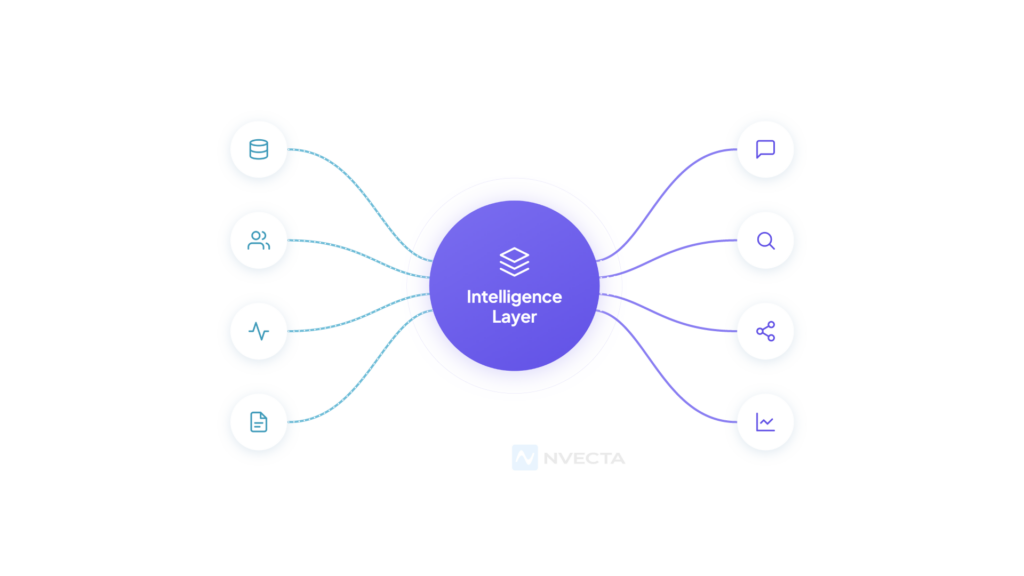
An Intelligence Layer is a connected system that links every tool in your marketing stack, your CRM, email marketing platform, ad accounts, website data, and support tickets, and uses AI to make real-time, context-aware decisions across all of them.
It is not a single product. It is not a chatbot or a dashboard. It is the architecture that allows every part of your marketing operation to share data, learn from outcomes, and act on insights together.
Think of it this way: most marketing stacks are like a band where every musician is playing a different song. The Intelligence Layer is the conductor that gets everyone playing in sync.
What Is the Difference Between an AI Tool and an Intelligence Layer?
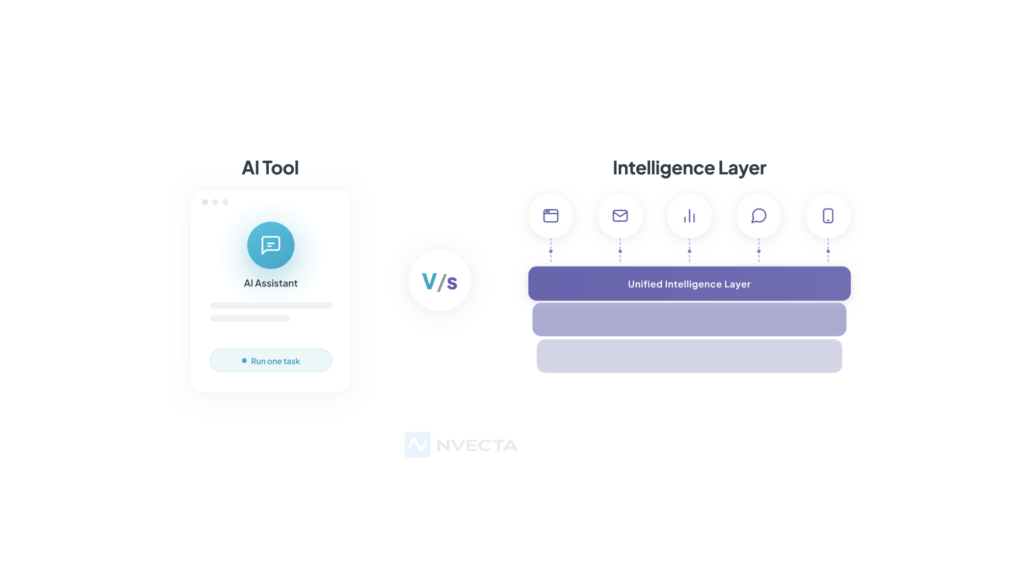
This is one of the most important distinctions in modern marketing.
An AI tool does one job in isolation. It writes subject lines, scores leads, or generates ad copy. It does not know what is happening in your CRM. It does not learn from your last campaign. It has no memory of your pipeline.
An Intelligence Layer connects all of those signals. It knows what your sales team learned last week. It knows which customer segments are already in late-stage conversations and which audiences are most likely to convert. It uses that context to make every decision smarter, demonstrating the growing role of AI in customer experience across every touchpoint.
Using AI tools without an Intelligence Layer is like hiring brilliant people and never letting them talk to each other.
Why Are Most Marketing Teams Still Stuck in Tool Mode?
Most teams adopt an AI tool at a time, expecting each one to deliver results independently. When results are underwhelming, the conclusion is that AI does not work. But the problem is not the AI. The problem is the architecture.
When tools operate in silos, they produce generic, context-free outputs. Your email AI does not know what your ad platform is doing. Your lead scoring model does not know what your sales team learned from their last five calls.
The result is predictable: low reply rates, wasted ad spend, and a pipeline that feels more like a lottery than a system.
The Intelligence Layer fixes the foundation, not just the tools sitting on top of it.
What Are the Three Pillars of an Intelligence Layer?
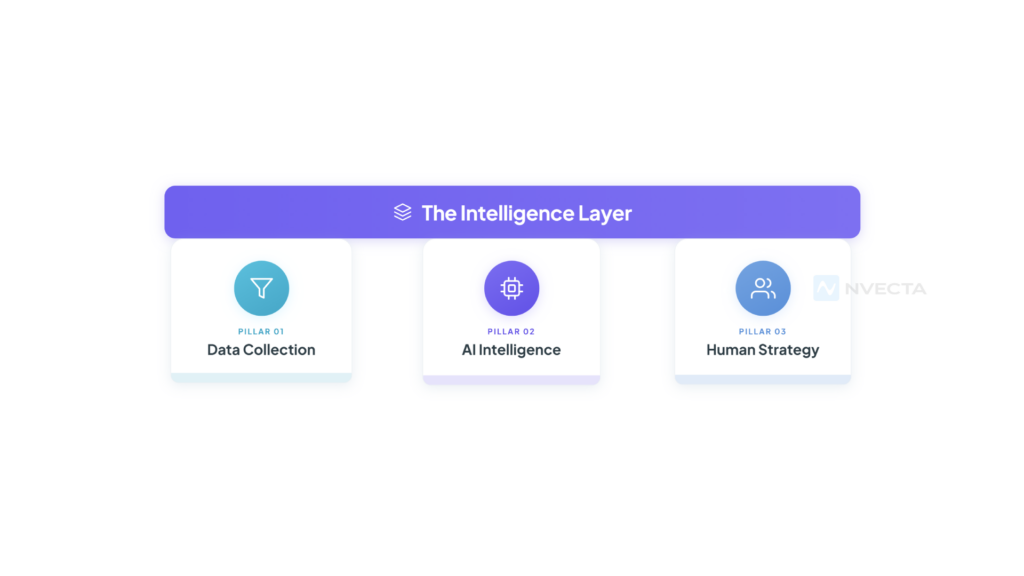
Every effective Intelligence Layer is built on three interconnected components.
| Pillar | What It Does | Example |
|---|---|---|
| Data Collection | Gathers signals from every touchpoint | CRM activity, email opens, ad clicks, site behaviour |
| AI Intelligence | Finds patterns and predicts outcomes | Identifies which leads are most likely to convert |
| Human Strategy | Turns AI insights into decisions | Your team decides whether to pivot messaging or pursue a lead |
1. Data Collection: The Foundation
The Intelligence Layer pulls signals from every customer touchpoint: CRM activity, email engagement, website behaviour, ad interactions, social signals, and support ticket trends. Without unified data, AI has nothing meaningful to work with.
2. AI Intelligence: Where the Magic Happens
This is the engine. AI identifies hidden patterns, predicts which leads are most likely to convert, and suggests the right message for the right person at the right time. It continuously learns from every outcome, getting sharper with every interaction.
3. Human Strategy: The Non-Negotiable
The Intelligence Layer does not replace your team’s judgement. It sharpens it. AI surfaces the insights. Humans make the calls. Your team decides whether to pivot messaging, pursue a lead, or scale a pattern. The Intelligence Layer just makes sure you are making those calls with the full picture in front of you.
What Is a Metadata Engine and Why Does It Matter?
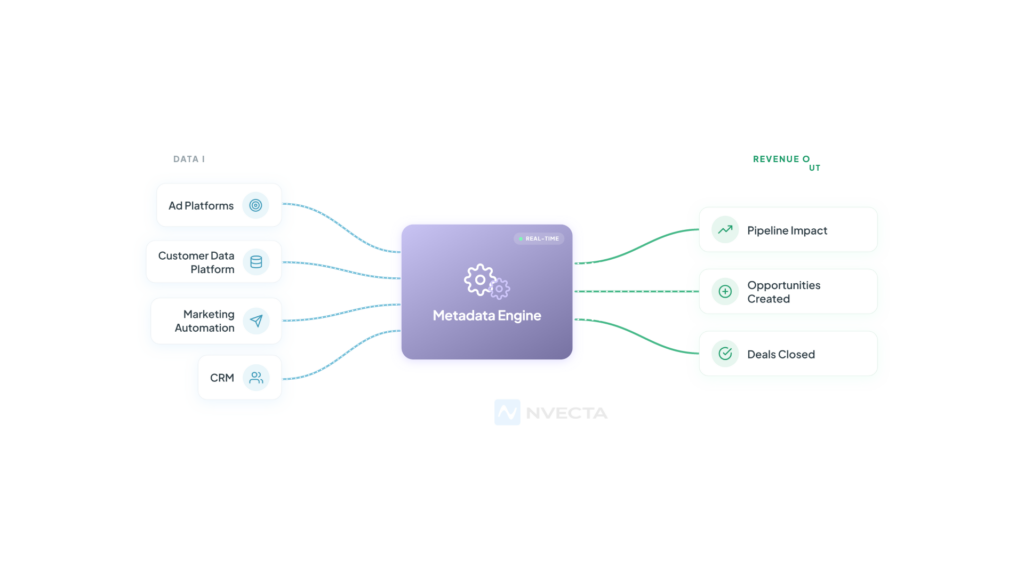
The metadata engine is the core infrastructure that powers the Intelligence Layer.
It continuously normalises data coming in from your CRM, marketing automation platform, customer data platform, and ad platforms in real time. Rather than creating a static snapshot, it maintains a living, always-fresh view of your buyer’s journey.
Instead of optimising for surface-level metrics like clicks and opens, the metadata engine optimises for what actually matters: pipeline impact, opportunities created, and deals closed. It filters out noise, such as bot traffic and vanity metrics, so your AI stays focused on revenue.
The result is marketing that not only runs faster. It runs smarter.
How Does the Intelligence Layer Work in Practice?
Here is a concrete example.
Without an Intelligence Layer, your SDR team spends hours every morning manually researching prospects: checking LinkedIn, updating CRM fields, pulling company news, then writing outreach from scratch. It is slow, inconsistent, and dependent on individual effort.
With an Intelligence Layer running overnight, the system monitors thousands of prospect signals: funding announcements, leadership changes, competitor mentions, and hiring patterns.
It cross-references those signals against your ideal customer profile, pulls firmographic data from multiple sources, and generates a personalised message ready for your rep to review and send in the morning.
Same team. Same hours. Completely different output.
Teams using this approach have seen reply rates jump from 2% to 8% and monthly demos increase from 10 to 40. The work did not change. The operating system did.
Where Does a CDP Fit Into the Intelligence Layer?
A Customer Data Platform (CDP) like NVECTA is one of the most critical building blocks of an Intelligence Layer.
Before AI can make useful decisions, it needs clean, unified data. A CDP pulls together everything you know about your customers across every touchpoint and consolidates it into a single profile. Without that foundation, your Intelligence Layer operates on incomplete, fragmented information.
NVECTA helps teams close this gap by unifying customer data in one place. The Intelligence Layer then applies that unified data across your entire marketing operation.
How Do You Build an Intelligence Layer Without Starting From Scratch?
Building an Intelligence Layer is iterative, not a full rebuild. Here is where to start.
Start with connectivity: Audit where your data is siloed. Your CRM, email platform, and ad accounts should share signals, not operate in separate bubbles.
Pick one high-value problem first: Do not try to solve everything at once. Choose one problem where better intelligence would have a measurable impact, whether that is lead prioritisation or personalising email sequences at scale.
Build feedback loops: The Intelligence Layer gets smarter over time, but only if it learns from outcomes. Connect your AI systems to downstream data. Not just whether someone opened an email, but whether they became a customer.
Keep humans central: Design workflows in which AI surfaces recommendations and humans approve them. This builds trust, catches errors, and makes the whole system better over time.
What Are the Signs Your Marketing Stack Needs an Intelligence Layer?
You likely need an Intelligence Layer if:
- Your campaigns produce inconsistent results, and you cannot explain why
- Your data lives in multiple disconnected platforms with no unified view
- Your AI tools generate generic outputs that do not reflect your actual customers
- Your team is spending more time managing tools than acting on insights
- Your pipeline feels unpredictable despite significant investment in technology
If more than two of these are true, the gap is not your team or your budget. It is the absence of a connected, intelligent system underneath everything.
Your AI Should Be an Operating System, Not a Hammer
The question is no longer whether to use AI in marketing. Every team is using it. The question is whether you are using it as a collection of tools or as an Intelligence Layer.
Tools do tasks. Intelligence layers run operations. Tools generate content. Intelligence layers generate insights, actions, and outcomes at a scale no human team could match on its own.
Platforms like NVECTA are the right starting point. Unified customer data is the prerequisite for everything else. But the Intelligence Layer is the next evolution: a fully connected, continuously learning, human-guided operating system built around your growth goals.
The growth teams pulling ahead are not the ones with the most tools. They are the ones who have wired everything together.
Frequently Asked Questions
What is the Intelligence Layer in simple terms?
Imagine your marketing tools actually talked to each other. Your CRM knows what your email platform is doing. Your ad targeting is informed by what your sales team learned last week. Every decision is connected to real context, not just the data sitting in a single silo. That is what the Intelligence Layer is. It is not a new tool you add to the pile. It is the way all your existing tools finally start working as one.
Is the Intelligence Layer a product I can buy?
Not exactly. You cannot go to a website, hit buy now, and have an Intelligence Layer set up by Friday. It is more of a design philosophy for how your stack is built and connected. Platforms like NVECTA help you lay the groundwork by unifying your customer data, but the Intelligence Layer ultimately reflects how thoughtfully you have wired everything together.
How is this different from just using AI tools like ChatGPT for marketing?
ChatGPT does not know your customers. It does not know which deal your sales team just lost or which campaign flopped last quarter. It is brilliant at tasks, but it is working in the dark. The Intelligence Layer brings AI into the light, connecting it to your actual business data so every suggestion is based on what is really happening, not just what sounds good in general.
Do I need a big team or a big budget to build an Intelligence Layer?
No. The teams that do this well do not start with a massive overhaul. They pick one problem that is costing them the most time or money, connect the right data sources around it, and build from there. Think of it less like a construction project and more like tidying one room at a time until the whole house makes sense.
Will AI replace my marketing team if we build an Intelligence Layer?
No. What actually happens is your team stops spending hours on tasks a machine can do faster and starts spending more time on strategic thinking that only humans can do. The marketers who thrive with an Intelligence Layer are not the ones who hand everything over to AI. They are the ones who use it to sharpen their own judgement.
What is the first sign that my team needs an Intelligence Layer?
The most common sign is that your results feel random. Some campaigns work brilliantly, and you are not sure why. Others fall flat, and you cannot pinpoint that either. When you are making decisions based on gut feel more than connected data, that is the gap the Intelligence Layer is built to close.
Where does a CDP like NVECTA fit into the Intelligence Layer?
It is the starting point. Before your AI can do anything useful, it needs clean, unified data to work from. A CDP like NVECTA pulls together everything you know about your customers from across every touchpoint and puts it in one place. Without that foundation, your Intelligence Layer is essentially guessing. With it, every signal your AI picks up is grounded in something real.
