














 Email
Email SMS
SMS Whatsapp
 Web Push
 App Push
 Audience Sync for Ads
 Popups
 Channel A/B Testing
  Control groups Analysis
 Frequency Capping
 Funnel Analysis
 Cohort Analysis
 RFM Analysis
 Signup Forms
 Surveys
 NPS
NPS Landing pages personalization
  Website A/B Testing
  PWA/TWA
 Heatmaps
 Session Recording
 Wix
Wix Shopify
 Magento
 Woocommerce
 eCommerce D2C
  Mutual Funds
 Insurance
 Lending
  Recipes
  Knowledgebase
 Developer Docs
 Product Updates
 App Marketplace
 Academy
 Ebooks
 Case Studies
 Blog
Blog Templates
 Afreen Sheikh
Think about everything your marketing team uses to reach and understand customers. Your CRM stores customer details. Your email platform sends campaigns. Analytics shows what customers do. A CDP brings customer data from different places together.
All these tools make up your martech stack.
The problem is that these tools work independently, and manually connecting data is time-consuming, leads to inaccurate conclusions, and delayed decisions.
A good martech setup fixes all these problems. It connects the right tools, keeps customer data consistent, and helps marketing teams turn customer activity into better decisions and actions.
What is Martech?
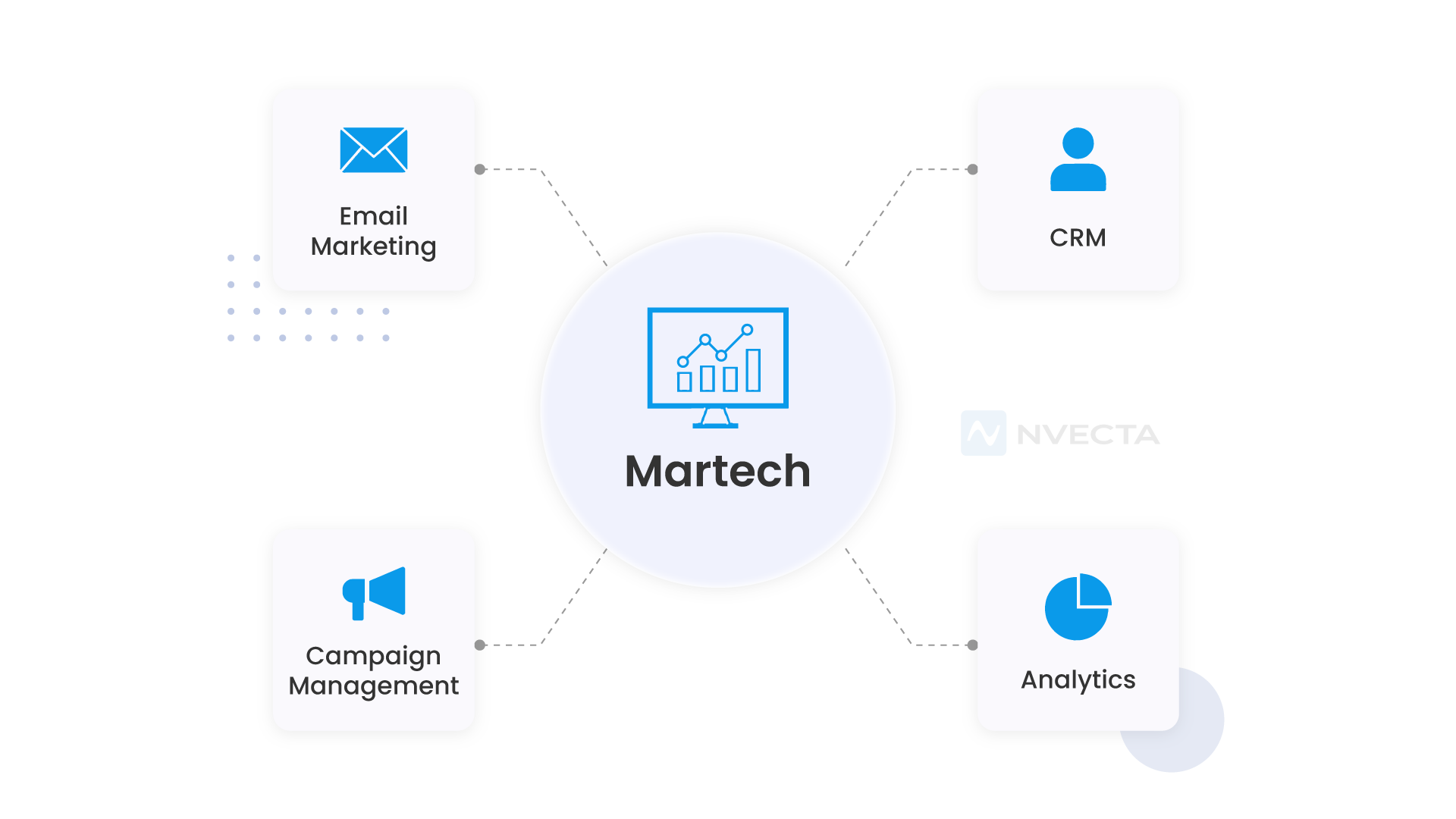
Martech is any software technology that helps you plan, run, or measure marketing. If a tool deals with any marketing task, it counts as martech.
That includes:
- CRM systems that store customer and lead data
- Customer data platforms that unify data from every channel
- Email and campaign tools
- Analytics and reporting dashboards
- Content and social media tools
It depends on the business model and the number of tools being used. The number matters less than how well those tools work together.
A small business might use a CRM and an email tool and call it a stack. A large enterprise might use forty tools across ten teams. Both count as martech. What separates a good stack from a messy one, it is how cleanly the pieces connect.
That connection point matters more as a company grows. A single founder can track customers in their head. A team spread across departments and regions cannot. That is exactly where a structured stack starts to earn its keep.
Martech vs Adtech: What’s the Difference
Martech and adtech solve different problems. Martech helps you keep and grow the customers you already have. Adtech helps you find new ones through paid advertising.
| Aspects | Martech | Adtech |
| Purpose | Nurture and retain customers | Find and acquire new customers |
| Core tools | CRM, CDP, email, analytics | DSPs, ad exchanges, ad networks |
| Main metric | Retention, lifetime value | Cost per acquisition, reach |
| Who uses it | Marketing and CX teams | Media buyers and ad ops |
Martech nurtures the relationship. Adtech works for acquiring new customers.
There must be coordination between the two. Ad spend works best when it targets the right audience, and targeting improves when adtech tools use clean martech data.
Why martech matters for growing businesses
Martech matters because it turns scattered customer data into action your team can actually take. Without it, decisions are made on guesswork. With martech, they operate on data-driven decisions.
Martech benefits for multi-brand and multi-business teams
The stakes rise for businesses that have more than one brand or target numerous regions. Teams here deal with: how do you keep one clear view of a customer who interacts with three different brands under the same company?
Good martech settles this concern. It gives every team, regardless of which brand or region they operate in, one shared source of truth. That means faster campaign launches, fewer duplicate messages sent to the same customer, and reporting insights that actually add up across the business.
Martech ROI and business impact
Teams that evaluate this right spend less time on collecting data from multiple tools and more time acting on it.
The result shows up in numbers marketers already track. Higher conversion rates, shorter time from lead to sale, and cleaner attribution reports that finally align with what actually happened in the market. None of that comes from adding more tools. It comes from making the tools you already have work off the same data.
Core Tools in a Martech Stack
A martech stack consists of multiple tools, and each one fulfils different marketing objectives.
Customer data and identity tools
CRMs and CDPs hold your customer information. A CRM stores contact and sales data. A CDP collects data from every channel and builds one customer profile.
Marketing automation and campaign tools
These tools automate engagement via email, SMS, WhatsApp, push notifications and multichannel campaigns. They work on rules you set once, so campaigns are triggered at the right time without manual intervention.
Analytics and attribution tools
These tools show insights so you can find what worked, which channels and campaigns actually drove revenue and conversions.
Content and digital experience tools
These manage your website, landing pages, and personalised content across every touchpoint a customer sees.
Social media management tools
These handle publishing, scheduling, and monitoring across every channel your audience actually uses.
Marketing operations tools
These cover budget tracking, asset management, and workflow, the least-cared-about concerns that keep a growing team from stepping on itself.
Most stacks include a blend of multiple tools to simplify, automate and streamline marketing operations.
Think of it as a train that has connected boxes. Data comes in through your website and app, gets processed and unified, then flows out into automation, content, and tools that act on it.
Common martech challenges (and how to avoid them)
The biggest martech challenges include larger data volume, disconnected tools and inaccurate insights.
Data overload
Dashboards multiply until teams look at multiple metrics instead of the five that actually matter. Pick your core KPIs early and ignore the rest.
Integration and data silo problems
When tools are disconnected, customer data ends up scattered across systems. One team sees a purchase. Another never finds out. Campaigns overlap or contradict each other outright.
Unclear ROI attribution
Marketing drives revenue, but finding which tool or campaign pushed a sale remains difficult, which makes new spending tough to justify.
Low platform adoption
A platform is worthless if your team avoids using it. Training and a simple rollout plan matter more than the tool itself.
Martech budget constraints
Martech tools carry real costs, and stacking too many adds up fast. Every new tool needs a clear reason to exist.
None of these problems is unusual. Most growing teams face all five at some point. The teams that recover fastest treat the root cause as messy data, then fix the tools around it. Fix how data flows, and half these issues fade away on their own.
How to Build a Scalable Martech Stack
Building a stack that scales starts with one decision before you buy a single tool.
Start with a unified customer data layer
Most teams pick tools first and hope they connect later. That approach breaks the moment you add a second brand or business unit. Find ways to unify customer data; it serves as the foundation for martech tools.
Map martech tools to business outcomes
Seek tools that work for your real goals, like faster launches, better retention, or cleaner reporting. One tool that helps three teams is better than using three tools to do the same job differently.
Check interoperability before you buy
A tool that works well in isolation will slow you down the moment you scale into a second market or brand.
Use a three-tier budget framework
Must-have tools to simplify the day-to-day tasks teams handle. High-value tools improve results but are not urgent. Experimental tools deserve a small test budget before a full rollout. This keeps spending disciplined as the stack grows.
Plan data governance early
Once you run multiple brands, set clear rules for who can access and use customer data. Define these permissions early. Fixing data access issues after you scale takes far more time.
Top Martech Trends in 2026
AI is moving from a feature to the foundation of nearly every martech tool. Tools can provide much more than you can expect, like predictive engagement, AI decisioning, and next-best-action marketing.
AI-powered predictive personalisation
Predictive personalisation now optimises what customers see next based on their behaviour, rather than generic repetitive communications. It’s quietly become the default in most modern email and content tools.
First-party data and privacy-centric marketing
First-party data is taking over as third-party cookies disappear. Customers notice this change too, and most are aware of how their information gets used behind the scenes, which makes owning your own data relationship more important than ever.
Composable, API first martech stacks
Rigid, all-in-one suites are losing ground to flexible tools that connect through open APIs, letting teams swap pieces without rebuilding everything.
Real-time data activation
Teams want data updated the moment it happens instead of hours later in a batch report. This becomes an advantage that stays in highly competitive markets.
Martech stack consolidation
One category is moving the other way. As buyers start their research in ChatGPT or Perplexity rather than a search box, teams are adding a way to check whether AI systems mention them at all, which is the layer B2B consultants like Austin Heaton work on.
Immersive and AR marketing channels
Augmented reality shopping experiences and virtual showrooms remain small today, but early movers are already testing them, and the market around these channels keeps expanding year over year.
NVECTA CDP: The Foundation of Your Martech Stack
NVECTA CDP strengthens your martech stack and gives every other tool one clean, unified source of customer data to work from.
Unified customer profiles across every channel
NVECTA gathers data from web, app, offline, and CRM sources into a single customer view. Instead of five partial views scattered across five tools, your team works from one complete picture, no matter which brand or business unit the customer went to.
Real-time data activation across your martech stack
Unified data only helps if it moves fast. NVECTA activates updated profiles straight into your campaigns and automation tools the moment new data comes in, solving the silo problem.
AI-powered customer segmentation
NVECTA uses AI to spot patterns in customer behaviour and build segments automatically, putting the AI trend covered earlier to work for your team every day.
CDP integrations with your existing martech tools
NVECTA connects with your CRM, automation platform, analytics tools, and content systems without a rip-and-replace project. You keep the tools your team already knows and add the missing data layer underneath them.
Data governance for multi-brand marketing teams
Multi-brand teams need shared visibility without losing control over who sees what. NVECTA lets you set permissions by brand, region, or team, so data stays unified without becoming a free-for-all.
Most stacks do not fail because a tool is inefficient. They fail because no single system holds the full customer picture. NVECTA solves that gap by design, built into the platform from day one.
Conclusion
Martech, at its core, is the technology stack that helps you understand, reach, and keep your customers. The tools change every year, but the goal stays the same: turn scattered customer data into marketing that actually works.
The businesses getting the most from martech today are not the ones with the most tools. They are the ones with the cleanest data foundation underneath everything else. Start there, and the rest of the stack gets easier to build.
That applies whether you run a single brand or manage marketing across a dozen business units. The tools you pick will keep changing every year. What stays constant is the need for one accurate view of the customer sitting underneath all of them.
Connect your martech stack with NVECTA.
Frequently Asked Questions
What is martech, in simple terms?
It’s the software your marketing team uses every day. CRMs, CDPs, email platforms, dashboards, anything that helps you plan a campaign and check its performance. If a tool simplifies marketing tasks, it counts as martech.
Isn’t a CDP basically the same thing as martech?
No. Martech is the whole category, everything from social schedulers to attribution tools. A CDP is one such part of that category. It consolidates your customer data scattered across different touchpoints into a single customer view.
What is a martech tool?
CRMs, CDPs, email and SMS platforms, automation software, analytics dashboards, CMS tools, and social schedulers all count. Most companies run several of these at once.
Do small businesses need a full stack?
Not a full one. A CRM, an email tool, and basic analytics cover most small teams just fine. You add complexity later, as the business grows into it.
Where does AI actually show up in martech day-to-day?
Mostly in prediction, decisioning and segmentation. Email tools guess the best send time. CDPs build audience segments on their own. It automates tasks and makes suggestions for better results.
