














 Email
Email SMS
SMS Whatsapp
 Web Push
 App Push
 Audience Sync for Ads
 Popups
 Channel A/B Testing
  Control groups Analysis
 Frequency Capping
 Funnel Analysis
 Cohort Analysis
 RFM Analysis
 Signup Forms
 Surveys
 NPS
NPS Landing pages personalization
  Website A/B Testing
  PWA/TWA
 Heatmaps
 Session Recording
 Wix
Wix Shopify
 Magento
 Woocommerce
 eCommerce D2C
  Mutual Funds
 Insurance
 Lending
  Recipes
  Knowledgebase
 Developer Docs
 Product Updates
 App Marketplace
 Academy
 Ebooks
 Case Studies
 Blog
Blog Templates
 bhivesh
Subscription and replenishment lifecycle marketing predicts when a person will renew, reorder, or churn, then automatically sends the right communication at that exact moment.
As of 2026, most subscription and replenishment programs have a set schedule for engaging with clients that was likely established years earlier. Sending a simple reminder to renew on a specific date ignores behavioural trends and patterns of individual customers’ buying habits and product use. This results in irrelevant communication and missed opportunities to engage customers.
To resolve this issue, businesses need a unified view of purchase, subscription, and behavioural data in one profile per customer, analyse it and apply prediction to deliver personalised and well-timed communication based on real-time behaviour. Businesses that make this shift catch churn earlier, reorder more efficiently, and rely less on discounts to bring customers back.
This guide covers:
- What subscription and replenishment lifecycle marketing means, and how the two models differ from each other
- What customer data powers accurate timing and prediction
- How to build a subscription and replenishment lifecycle, step by step
- How AI and NVECTA CDP support these marketing approaches
What Is Subscription and Replenishment Lifecycle Marketing?
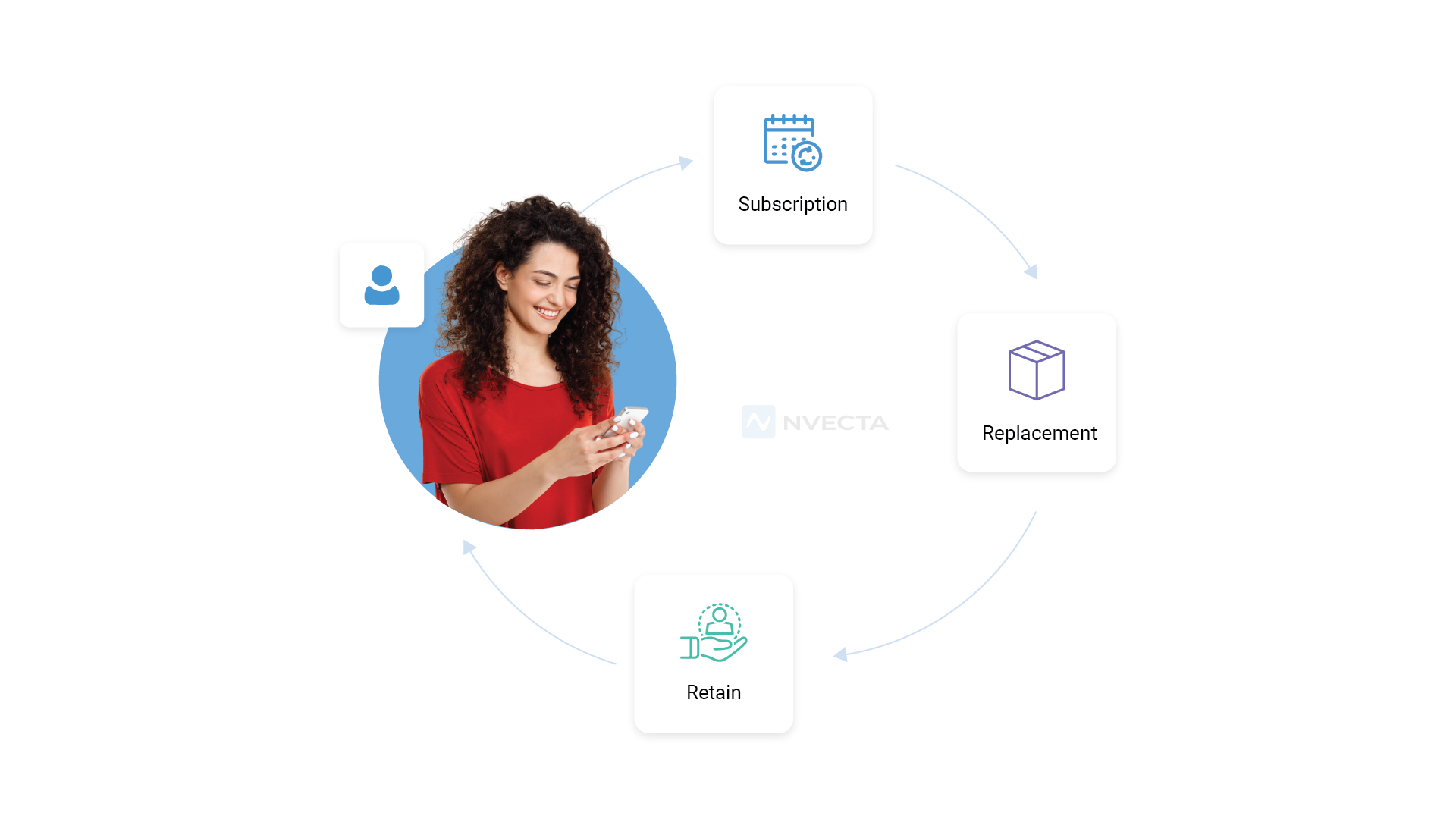
It’s the practice of using customer data to trigger a renewal or reorder message at the exact moment a specific customer needs it, not as per a pre-defined schedule.
What Is Subscription Marketing?
Subscription marketing keeps a paying subscriber active from day one through whatever comes next. Sign up, get value fast, stay engaged, renew, maybe upgrade. Each stage has its own job. Getting the first stage wrong reduces the impact of every stage that follows.
What Is Replenishment Marketing?
Replenishment marketing handles physical products people use up. Timing follows each customer’s own purchase pace, not a single fixed schedule applied to the whole customer base. Consumption rate decides when the next reminder goes out.
Subscription and Replenishment as One System
Both models chase the same objective: reach a customer at the right moment based on their recent activity and behaviour. Treated as one system, a customer’s renewal and reorder history comes together in the same view. Every action from first purchase onward shapes when the next message goes out.
Subscription Marketing vs Replenishment Marketing
These terms get used as if they’re interchangeable. They describe different mechanics.
| Factor | Subscription Marketing | Replenishment Marketing |
| Business model | Recurring billing, ongoing plan | One-time reorder, no lock-in |
| Customer behaviour | Stays enrolled until they cancel | Reorders when they run out |
| Timing | Fixed billing cycle | Based on usage pace |
| Primary objective | Renewal, lower churn | Reorder, repeat purchase |
| Key data | Plan status, usage, payment health | Purchase history, consumption rate |
| Common campaigns | Renewal reminders, upgrade offers | Reorder reminders, replenishment discounts |
Why Subscription and Replenishment Matter for Customer Retention
They matter because retaining an existing customer costs less than acquiring a new one. Every benefit below builds on that basic advantage.
- Repeat purchase rate tends to climb, since a reminder timed to the right week beats relying on a customer’s own memory.
- Lifetime value builds gradually as renewals and reorders stack on top of each other.
- Catching churn early gives a lapsing subscriber a real chance to be saved, before cancellation, not after.
- Recurring orders and renewals smooth out revenue that would otherwise swing with one-time sales.
- A reminder that lands at the right moment feels like service. The same reminder sent too early feels like noise.
- Less reliance on discounts: when timing does the work, a business stops leaning on repeated coupons to win customers back.
What Customer Data Powers Subscription and Replenishment Marketing?
Five kinds of data make this work: purchase history, subscription status, behaviour, profile details, and operational context. Missing any one of them lowers prediction accuracy.
Purchase and Transaction Data
Order history, purchase frequency, product mix, order value, and reorder intervals sit in this category. Together they show how a customer actually buys, separate from any assumption about how a typical customer buys.
Subscription Data
Plan status, billing frequency, renewal date, plan changes, skips, pauses, cancellations, and failed payments belong here. Each one marks exactly where a subscriber stands today, not where they stood last quarter.
Customer Behavioural Data
Site visits, product views, app opens, feature use, email opens, and content clicks make up behavioural data. Intent tends to show up here first, often weeks before it shows up in a purchase or a cancellation.
Customer Profile Data
Preferences, location, channel preference, and customer value fall into this group. This shapes what a message says once it’s ready to send, more than it decides the timing itself.
Contextual and Operational Data
Inventory, fulfilment, delivery status, returns, support tickets, and payment status round this out. It determines whether a message makes sense at the moment it’s sent, separate from whether the timing itself was accurate.
Why Unified Customer Data Matters
Data spread across disconnected systems produces partial views of the same customer, and none of those views adds up to a full picture on their own. A unified profile is what makes the timing described above possible to act on.
How does Subscription and Replenishment Lifecycle work: Step by Step
It works through six steps: map the stages, segment by behaviour, study the patterns, predict what’s next, trigger the right action, then deliver it on the channel the customer actually prefers.
Step 1: Identify Customer Lifecycle Stages
Every customer moves through some version of the same path: first purchase, repeat purchase, subscriber, active subscriber, at risk, churned, win back. Each stage calls for a different response. Define the stages clearly before building anything on top of them.
Step 2: Segment Customers Based on Behaviour
Segmentation groups customers by what they do and behave while interacting. Useful groups include first-time buyers, repeat customers, high-value customers, active subscribers, customers nearing their next reorder, customers with declining engagement, at-risk subscribers, and churned customers. These groups move customers constantly, since behaviour changes and yesterday’s segment rarely matches today’s reality.
Step 3: Identify Purchase and Renewal Patterns
Purchase frequency, average reorder interval, product-specific cycles, renewal behaviour, and engagement trends, measured per segment rather than blended into one average, show the real timing for each customer. A shared calendar can’t capture any of this. Only the pattern per customer can.
Step 4: Score and Predict What’s Next
This step processes raw behaviour using a predictive scoring model. It assigns numbers to lifecycle actions that are worth acting on. Rate each customer on how close they are to their next likely reorder, renewal, or exit; a reorder readiness score of sorts, then act before that point arrives. A customer scoring high on reorder readiness gets a reminder now. One scoring high on churn risk gets a different kind of message entirely.
Step 5: Trigger the Right Lifecycle Action
Once the scores are assigned, an action follows. It could be a replenishment reminder, a renewal message, a product recommendation, a cross-sell, an upsell, an engagement nudge, or a win-back offer. Match the action to the score.
Step 6: Orchestrate the Journey Across Channels
Deliver the message through the customer’s preferred channel. Orchestrate the journey across channels to keep communication consistent and avoid sending duplicate messages to the same person.
Strategies for Subscription and Replenishment Marketing
Strong subscription and replenishment strategies combine flexible cadence, behaviour-based segmentation, cross-channel delivery, and disciplined use of discounts, built on unified customer data that keeps every decision current.
Give Customers Control Over Cadence
A skip or pause option keeps a subscriber inside the program during a slow month. Without it, that same customer cancels instead of pausing, and a cancelled subscriber does not come back on their own.
Segment Users by Frequency
Two buyers of the same item can use it at different rates. Grouping them by product alone erases the signal that makes timing accurate.
Layer Channels Instead of Picking One
A reminder left unread in email can still land through SMS or push. Running channels in parallel catches customers a single channel would miss.
Test Reminder Timing in Small Windows
A five-day shift earlier or later in a reorder cycle can move conversion more than a new subject line. Small timing tests beat one big redesign.
Reserve Discounts for Genuine Risk
A customer planning to reorder does not need a coupon to do it. Save the incentive for a customer flagged as likely to churn, where it changes the outcome.
Feed Lifecycle Data Back Into Acquisition
Customers who convert fastest into repeat behaviour share common traits. Targeting those traits earlier in the funnel brings customers who stay longer. None of these strategies works alone. Each depends on the same foundation, unified customer data feeding a model that updates as behaviour does.
How AI Improves Subscription and Replenishment Lifecycle Marketing
AI earns its place here by predicting behaviour before it happens, so the message goes out on the day that matters for that individual customer.
Predicting Replenishment Timing
Purchase history, product type, and usage signals feed a model that estimates when a specific customer runs dry. The model works at the individual level, not the category average, and that’s exactly what makes the prediction useful.
Catching Churn Before It Shows Up as Churn
Fewer logins, shorter sessions, fewer email opens, an unresolved support ticket- individually, none of these signals means much. Together, they often appear well before cancellations.
Reading Intent and Anticipating Risk
Churn risk gets most of the attention, but the same signals flag who’s ready to subscribe, renew, reorder, or upgrade right now. Acting on these signals is what makes limited outreach effort count the most.
Keeping Segments Alive Instead of Static
A list built once and left alone goes stale quickly. Segments built on live signals update the moment behaviour changes, with no manual rebuild required.
Recommending the Next Move
For any given customer, the model can suggest the next best action: send now, offer a discount, recommend a specific product, or hold off because this customer isn’t ready yet.
Personalising Without the Manual Work
Messaging, offers, and timing shift per person based on that person’s own history, not a broad average applied to the whole list.
Common Subscription and Replenishment Marketing Mistakes
Most programs stall for a small handful of repeatable reasons.
- One replenishment schedule applied to every customer ignores how differently people actually use a product.
- Treating subscribers the same as one-time buyers wastes the loyalty a subscriber already showed.
- Relying only on calendar triggers means messages land in the wrong week for most of the list.
- Tracking behaviour without acting on it leaves warning signs sitting in a dashboard nobody checks.
- A reminder sent after a customer already reordered elsewhere damages trust for no return.
- Failed payments and plan changes that go unnoticed let a preventable cancellation become final.
- Keeping customer data in disconnected tools leaves every team working off a different partial picture.
- Using the same generic offer for everyone trains customers to wait for a discount before buying again.
- Measuring campaign revenue without measuring retention hides whether a program is actually working long-term.
Metrics to Measure Subscription and Replenishment Lifecycle Marketing
Track the following metrics to track the performance, business impact, and how your subscription and replenishment strategies affect revenue.
Subscription Metrics
Conversion rate, renewal rate, subscriber churn, monthly recurring revenue, subscriber lifetime value. These numbers say whether the recurring base is growing or leaking.
Replenishment Metrics
Repeat purchase rate, reorder rate, time between purchases, replenishment conversion rate, and replenishment revenue. Each one confirms whether the timing model earns its keep.
Customer Engagement Metrics
Engagement rate, reactivation rate, cross-sell rate, upsell rate, retention rate. Together they show how people respond once a message actually reaches them.
Business Metrics
Customer lifetime value, customer acquisition cost, LTV to CAC, revenue per customer, retention revenue. These tie the program back to whether it pays for itself.
Connecting Metrics to Revenue
Compare behaviour across the full customer journey. Weigh retention against acquisition spend. Break revenue down by segment. The journeys worth keeping are the ones that show up in these numbers, not just in open rates.
How NVECTA Supports Subscription and Replenishment Lifecycle Marketing
NVECTA CDP unifies customer data, scores behaviour with AI, and triggers personalised journeys across channels, running on the data warehouse a business already has.
Unifying Customer Data Across the Lifecycle
Purchase history, subscription status, behaviour, and support records all pull into one profile per customer. NVECTA reads directly from the existing warehouse, so nothing gets copied or moved.
Scoring Behaviour With AI
Every customer gets scored on replenishment timing, churn risk, purchase intent, and renewal intent. Those scores update as new data arrives, keeping the picture current instead of stuck on a past export.
Segments That Update Themselves
A customer moves into a new segment the moment their own data indicates it, without a manual list rebuild.
Journeys That Run Across Every Channel
Replenishment reminders, renewal journeys, cross-sell offers and win-back campaigns fire from the same customer profile across email, SMS, push, WhatsApp, and in-app messaging.
Retention and Revenue in One View
Repeat purchases, subscription retention, churn, and lifetime value sit in the same dashboard. That makes it easy to see which journeys are actually moving revenue, and which ones are simply getting opened.
Conclusion
Timing decides whether a reminder feels helpful or gets ignored entirely. When it aligns with real-time customer behaviour, you see positive results. The reorder rates rise; renewal rates hold steady, and revenue boosts. NVECTA makes this possible by unifying purchase, subscription, and behavioural data into one profile per customer, scoring that data with AI, and triggering personalised journeys across every channel a business uses. It runs directly on the data warehouse already in place, so teams get accurate timing without adding a new data layer to manage.
See how NVECTA can turn subscription and replenishment data into predictable, revenue-driving journeys. Book a demo now and explore NVECTA’s customer data platform to get started.
Frequently Asked Questions
What is subscription and replenishment lifecycle marketing?
It’s timing customer outreach to real behaviour. Renewal and reorder messages go out based on what a specific person actually does, not a date picked months in advance for the whole list.
What is the difference between subscription marketing and replenishment marketing?
Subscription marketing runs on a billing cycle; a customer stays enrolled until they cancel. Replenishment marketing has no lock-in. It predicts when someone will need to buy the same thing again.
How does replenishment marketing work?
Look at how fast someone went through their last order. That pace becomes the reminder date. Simple in concept, the hard part is getting the pace right for each customer.
How can businesses predict replenishment timing?
Purchase history and order frequency do most of the work. Feed that into a model, usually AI-driven, and it flags roughly when a customer runs out again.
How does AI improve subscription and replenishment marketing?
It catches the small stuff a person would miss: a login that stopped, an email nobody opened, and turns that into an early warning before a customer cancels for good.
How does an AI-powered CDP support subscription and replenishment lifecycle marketing?
By keeping every piece of a customer’s data in one place- purchases, subscription status, behaviour and then using that to decide who gets a message and when.
