














 Email
Email SMS
SMS Whatsapp
 Web Push
 App Push
 Audience Sync for Ads
 Popups
 Channel A/B Testing
  Control groups Analysis
 Frequency Capping
 Funnel Analysis
 Cohort Analysis
 RFM Analysis
 Signup Forms
 Surveys
 NPS
NPS Landing pages personalization
  Website A/B Testing
  PWA/TWA
 Heatmaps
 Session Recording
 Wix
Wix Shopify
 Magento
 Woocommerce
 eCommerce D2C
  Mutual Funds
 Insurance
 Lending
  Recipes
  Knowledgebase
 Developer Docs
 Product Updates
 App Marketplace
 Academy
 Ebooks
 Case Studies
 Blog
Blog Templates
 Afreen Sheikh
The modern marketing landscape runs on effective utilisation of user data. Traditional segmentation fails to capture evolving customer preferences, resulting in very basic communication that lacks impact and is easy to ignore.
This is why behavioural segmentation marketing makes a real difference. It captures every minor customer interaction, like what customers actually do, their clicks, purchases, that help in creating more accurate segments to send personalised campaigns. With this, businesses can reap multiple benefits like-
-increase conversions and engagement
– boost revenue and business growth
In this blog, we will explore how behaviour segmentation works, why it matters, and how it gives measurable results. We will further examine how NVECTA’s Behavioural segmentation helps brands grow.
What is Behavioural Segmentation Marketing?
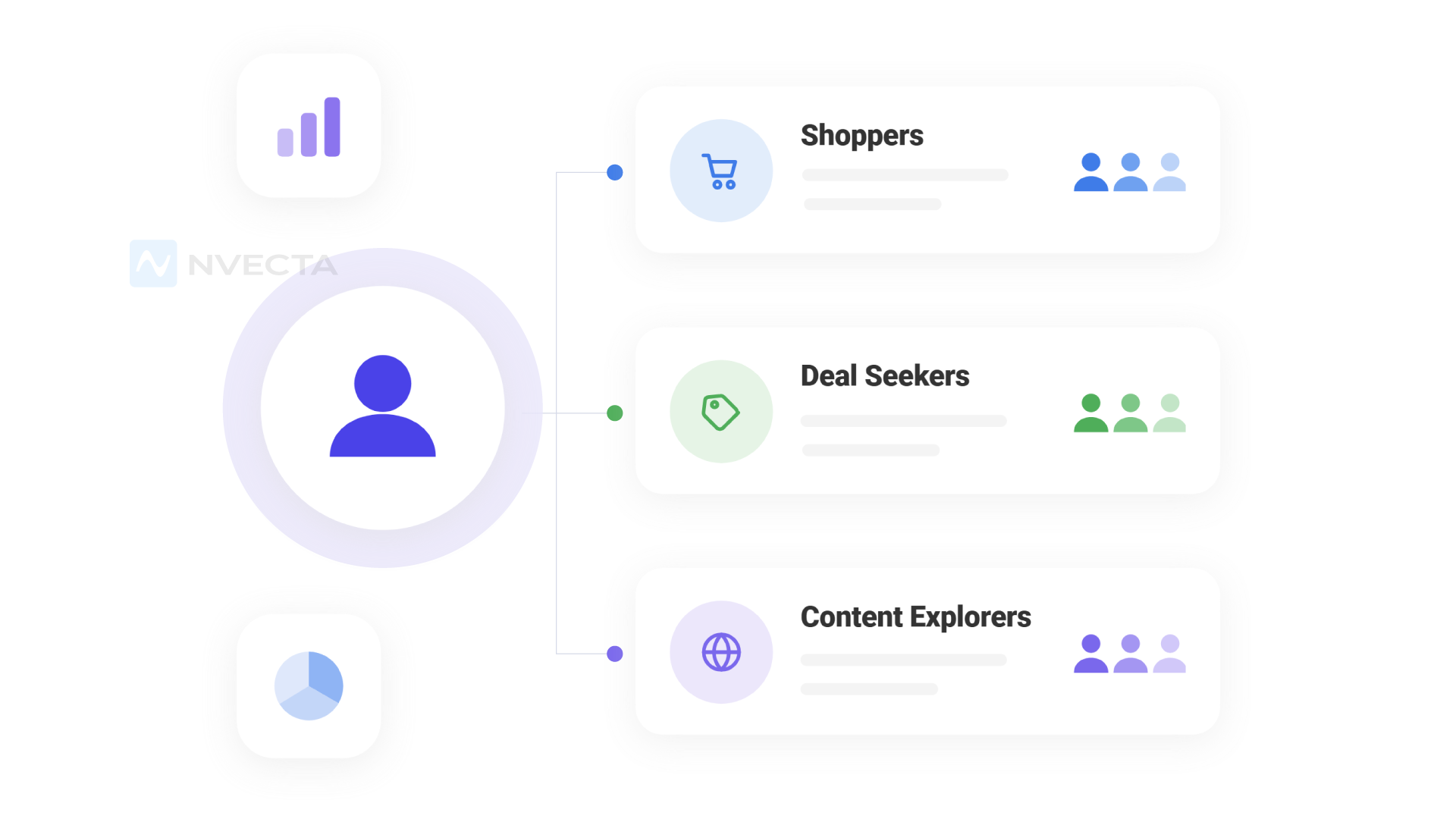
Segmentation marketing is a tool that utilises customer behavioural data to group them into multiple segments. Segments are like different categories created to identify and group customers with similar interests or behavioural patterns.
Behavioural data includes customer actions such as what they browse, what they want to buy, what they click on, and how often they engage with your brand.
Every customer signal is analysed to generate advanced insights. Such insights help in creating more precise segments that align with customer interests and expectations.
As a result, behavioural segmentation marketing leads to targeted communication and improves overall marketing strategies.
Key Types of Behavioural Segmentation
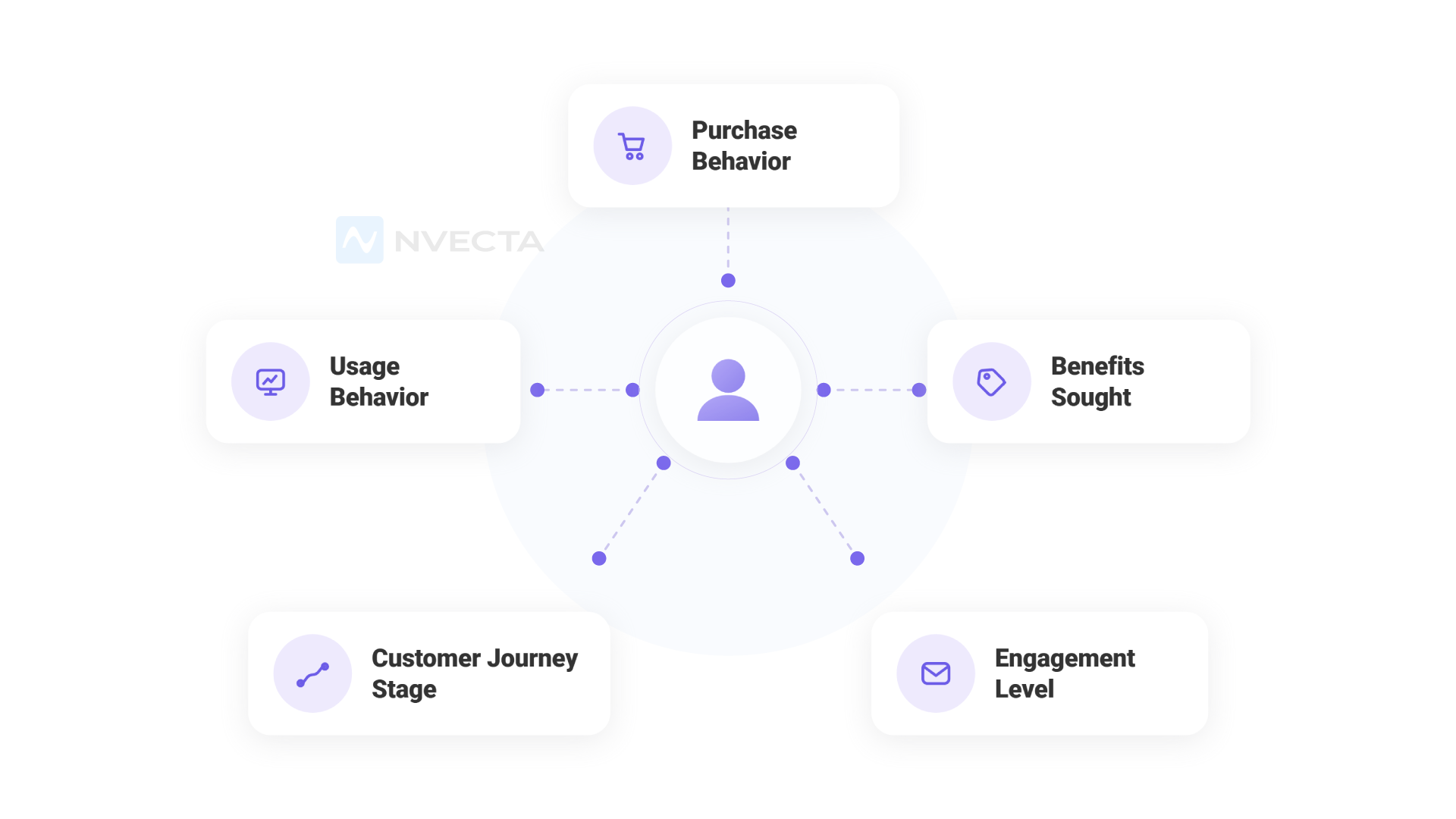
Customer behaviour has different aspects when it comes to their relationship with the brands. Marketers need to analyse it from multiple angles to understand the intent behind it.
For example, purchase behaviour shows who buys often, or who waits for an offer. Usage behaviour tells you who actively uses your product or who might be losing interest.
Further, by looking into engagement levels, you can identify who is interacting regularly and who needs a push.
When you monitor all of the behavioural insights, you understand your customers more deeply and create more precise marketing strategies to keep them engaged.
Let’s have a closer look at different kinds of segments-
Purchase Behavior
Purchase behaviour reveals customers’ buying habits, such as purchase frequency, average order value, and other factors that influence their decision-making.
With this, you will clearly identify different types of buyers and optimise campaigns accordingly. This helps in improving engagement and overall conversion rates.
Usage Behavior
Usage behaviour tracks how often and how actively customers interact with your product over time. Some engage with your brand regularly, some are occasional buyers, and others may be on the verge of dropping off.
With such insights, marketers can design better offers and improve each experience to keep customer engagement.
Benefits Sought
This type of segmentation identifies what customers expect from a product or service. It mainly highlights whether customers are influenced by pricing, quality or ease of use.
These insights help send tailored messages that meet specific customer expectations.
Customer Journey Stage
Such segmentation identifies and groups customers based on their stage in the buying process. Across different customer journey stages,
businesses can deliver the right message at the right time and guide customers through each step toward a natural decision-making process.
Engagement Level
The engagement level measures the customer interactions across channels. With such tracking, brands can recognise loyal users, inactive customers, and customers who may be losing interest.
Brands can take actions to retain customers with targeted communication and better retention strategies.
How Behavioural Segmentation Works (step by step)
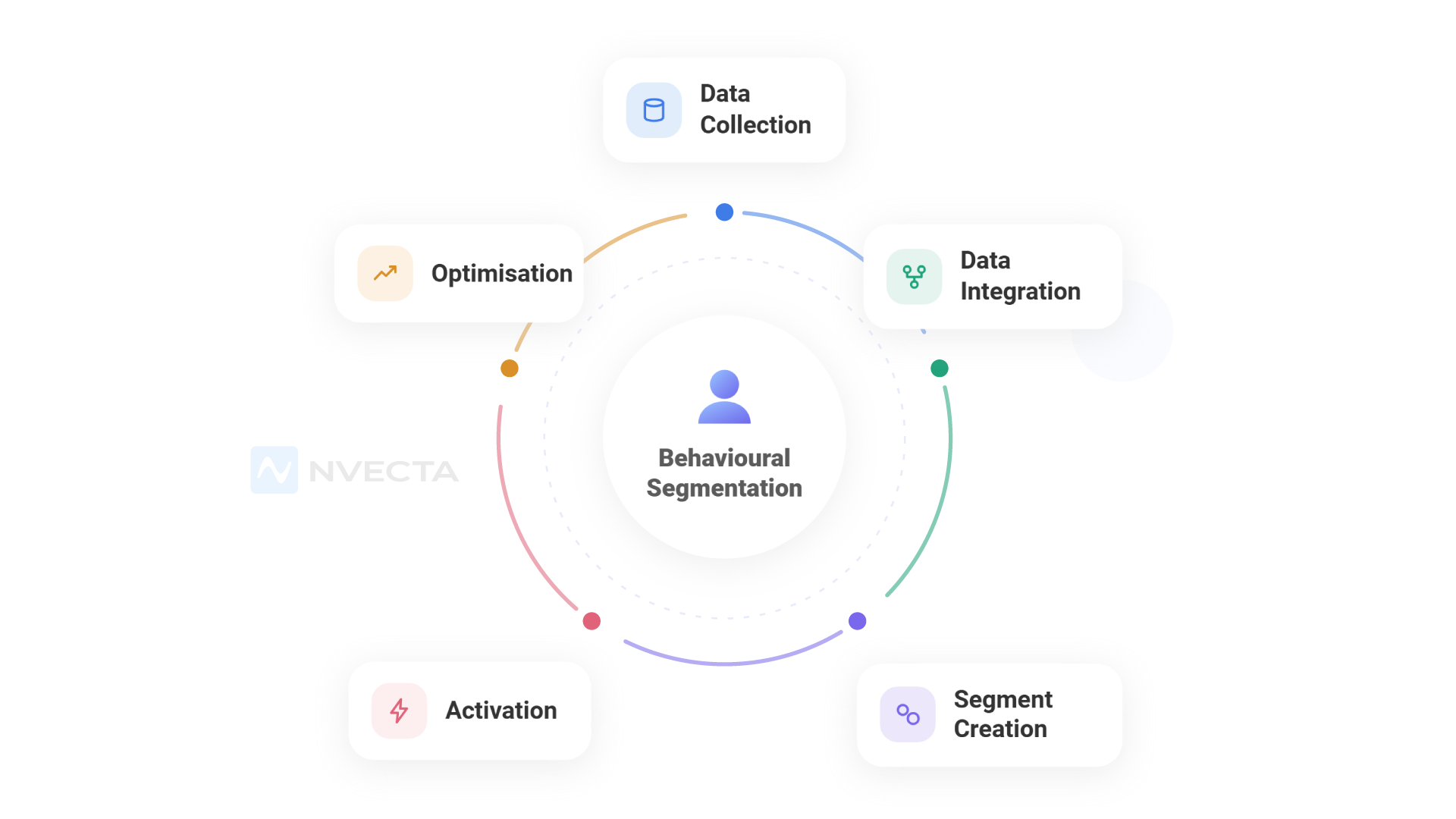
Behavioural segmentation follows a well-structured approach to turn raw data into useful insights.
Let’s see at the steps involved in the process-
Data Collection
The process begins with gathering behavioural signals from every interaction customers have with your brand across different touch points. It mainly captures how customers interact with your brand. Every action becomes a useful insight. It includes the following-
- Website activities like page visits, clicks and time spent
- App usage, such as sessions and features used
- Purchase history, including frequency and value
- CRM & other system data for customer profiles
Each action helps you understand how users behave, forming the basis for meaningful segmentation.
Data Integration
Once collected, data needs to be connected across channels to create a complete customer view. As a customer, it is important that the data is unified and connected across devices and channels. It involves-
- Merging data from multiple platforms
- Resolving identities across touch points
- Creating one consistent customer profile
With data integration, a unified view of the customer is created, ensuring that every interaction is connected and that profiles are updated with recent customer activity.
Segment Creation
Now comes the part where the pattern starts to make sense. Customers are grouped based on similar behaviours, such as-
- Browsing patterns and purchase activity
- Usage frequency and engagement levels
Segments can be predefined or updated continuously. Real-time segments are especially useful as they reflect current behaviour and not just the past activity.
Activation
Once the segments are ready, you can start acting on them in meaningful ways i.e. engaging them effectively. This includes-
- Sending personalised campaign across channels
- Triggering real-time messages based on user actions
- Running automated workflows for timely engagement
With activation, insights turn into actions, enabling brands to reach customers with the right message at the right moment.
Optimisation
Behavioural segmentation is an ongoing process that continually optimises segments as you gain more data about your customers. It involves-
- Testing different campaigns and segment performance
- Analysing customer interactions and results
- Refining segments based on new data
With optimisation, brands can improve targeting accuracy and focus more on staying aligned with changing customer behaviour. This helps in achieving better results over time.
Why Behavioural Segmentation Marketing Matters
Helps in Deliver Truly Personalised Experiences
Customers notice when brands respond to their interactions.
With Behavioural Segmentation, different groups update customer activity in real time and later adjust messaging that aligns with behaviour signals.
It helps create experiences that feel tailored, increasing the chances of interaction and a more meaningful engagement.
Improve Customer Experience Across Touch Points
To deliver connected experiences, brands must understand how customers move across channels and devices. With behavioural segmentation, different channels are integrated to deliver consistent messages.
A continuity of messages is maintained across emails, SMS, WhatsApp, websites and apps, making interactions feel more natural and less monotonous.
This supports a smoother customer journey and improves their overall satisfaction.
Increases Conversions with Better Timing
With precise customer segments that update live behaviour data, brands can introduce more targeted campaigns that send the right message at the right time.
Behavioural segmentation in marketing identifies users who are likely to disengage or take action.
With such accurate information, brands can respond with timely communication that engages them with the right message. This helps in improving conversion rates.
Helps Identify and Reduce Customer Drop-off
Customer behaviour shows signals when they are losing interest in a product or service. Segmentation marketing helps identify early signs, such as reduced customer activity or engagement.
Brands can take timely actions by sending relevant messages to reconnect with such customers and prevent drop-offs. This helps maintain relationships and improve retention.
Builds Stronger Customer Relationships
When brands use behavioural insights to deliver relevant, timely communication that meets customer expectations and needs, customers start to trust the brand.
When customers feel that a brand understands their needs, they are more likely to return. This helps in trending relationships and encouraging repeat engagement.
Makes Marketing Efforts More Efficient
With Behavioral segmentation, brands run targeted campaigns based on real activity. They can stop relying on generic messages to everyone. Brands can use the behavioural data more wisely to improve campaign effectiveness and make marketing efforts more focused.
Real-world examples of Behavioural Segmentation Marketing
E-Commerce: Personalised Product Recommendations
When a customer browses products on online stores but does not make a purchase. The next time they visit, they will see similar item recommendations.
This is behaviour segmentation marketing in action, where browsing data patterns is used to personalise what the customer sees in the next visit.
SaaS: Feature-Based Onboarding and Engagement
For a SaaS platform, every user interacts with different features they may be interested in. Let’s see a user signs up and only uses the basic features,
They will receive tips or tutorials on how to guide advanced features. But on the other hand, active users will see updated guidance. This approach helps guide users based on how they actually utilise the product.
Streaming Platforms: Content Recommendations
Streaming platforms continuously track what their users watch, skip or look for. If someone looks for crime thrillers regularly, they will start seeing more recommendations of that genre.
This keeps the experience relevant and engaging, encouraging users to find more content they are more likely to enjoy without actively searching for it.
Email marketing trigger-based campaigns
When a user adds items to their cart but abandons it without completing the purchase, they often receive a reminder email to finish their purchases.
Such an email may include a small incentive or an offer. These emails are triggered by specific user actions, making them timely and relevant and increasing the chances of conversion.
Travel Platforms: Dynamic Offer Based on Searches
When customers search for flights or hotels for a specific destination, they may later see a price alert or a deal for the same location.
Travel platforms can use search behaviour to understand customers’ intent and follow up with relevant offers, encouraging customers to make their booking decisions.
Fintech Apps: Usage-Based Nudge and Insights
Finance apps track how users manage their money. If someone spends more in a category, budgeting tips or alerts.
These insights are based on actual usage patterns that induce users to make better decisions while keeping them engaged with the app.
Elevate Customer Engagement with NVECTA’s Behavioural Segmentation Marketing
NVECTA’s AI-powered segmentation capabilities help businesses to interpret customer behaviour by identifying meaningful patterns and trends that encourage customer decision-making.
Brands can build smart segments to target customers using predictive segmentation, which automatically creates and updates segments in real time.
Also, NVECTA CDP gives you a 360-degree customer view by unifying your customer data, enabling you to deliver personalised messages and product recommendations that align with your customers’ needs and buying behaviour.
Here are its features that support behavioural segmentation-
Builds a Complete View of Customer Behaviour
NVECTA unifies all scattered customer interactions, including browsing behaviour and transactional signals, into a single connected profile.
Further, it resolves multiple customer identities into a single identity. With such clarity, every segment that is created reflects a real behaviour pattern across the entire journey.
Track Behaviour in Real Time for Timely Action
NVECTA tracks live Customer behaviour to update profiles with user actions as they happen. With such information about customers’ current intent, the brand can act immediately and increase the chances of engagement.
Create Dynamic Segments that Adapt to Changing Customer Actions
NVECTA supports dynamic segments that adjust automatically as customers take new actions. A change in customer behaviour shifts them into the relevant segment, enabling accurate targeting.
This ensures that campaigns reach customers based on the latest behavioural activity.
Enable Omnichannel Journey Orchestration
NVECTA provides brands with a journey builder that designs automated workflows that ensure consistent messaging across platforms.
It connects interactions from different channels so that each message builds on previous actions. This helps maintain continuity throughout the journey and deliver a smoother engagement.
Uses AI-Driven Analytics for Predictive Segmentation
NVECTA applies AI to evaluate customer behaviour patterns and gives insights that help you anticipate future behaviour.
Such advanced insights help identify strong-intent users and emerging trends, enabling brands to plan strategies in advance and improve campaign effectiveness.
Simplifies Personalisation at Scale
NVECTA supports the personalisation of a larger volume of customer data. It keeps segmentation and activation organised, helping brands to maintain relevant, tailored experiences across different segments.
Wrap up
Behavioural segmentation accelerates a brand’s marketing efforts by delivering relevant personalised multi-channel engagement. Further, it improves multiple business outcomes, such as conversions and retention.
With NVECTA’s smart segmentation, brands can interpret customer interactions and act on them quickly. It simplifies customer data by combining intelligence, adaptability, and execution into a single seamless process.
To learn more how NVECTA support smarter customer targeting and business growth, click here to schedule a demo now.
