














 Email
Email SMS
SMS Whatsapp
 Web Push
 App Push
 Audience Sync for Ads
 Popups
 Channel A/B Testing
  Control groups Analysis
 Frequency Capping
 Funnel Analysis
 Cohort Analysis
 RFM Analysis
 Signup Forms
 Surveys
 NPS
NPS Landing pages personalization
  Website A/B Testing
  PWA/TWA
 Heatmaps
 Session Recording
 Wix
Wix Shopify
 Magento
 Woocommerce
 eCommerce D2C
  Mutual Funds
 Insurance
 Lending
  Recipes
  Knowledgebase
 Developer Docs
 Product Updates
 App Marketplace
 Academy
 Ebooks
 Case Studies
 Blog
Blog Templates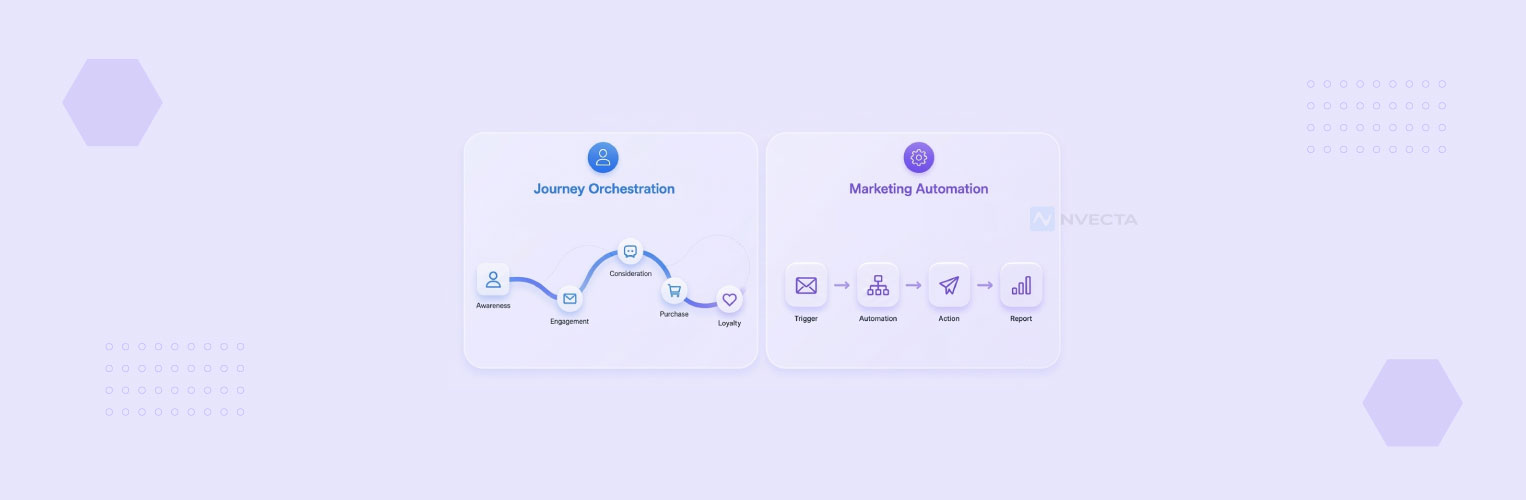
 Afreen Sheikh
Marketing automation changed the way businesses used to communicate with their customers. It reduced the manual efforts of marketers with automated emails, lead nurturing workflows and scheduled campaigns. But over the years, customer behaviour has changed a lot, and traditional automation is no longer enough for dealing with their interactions.
They quickly move between devices and channels before making any purchase decision. They may discover a brand through social media, return through an email and then finally convert after getting an ad later. They expect these interactions to feel connected throughout their journey. Businesses that rely on traditional marketing automation fail to deliver relevant, coordinated customer experiences.
This is exactly why the conversation around journey orchestration vs marketing automation became important. Journey orchestration works one step ahead with its smart features.
Although both are designed to increase customer engagement, they serve very different purposes. Marketing automation mainly handles campaign execution, while journey orchestration focuses on coordinating personalized experience across every customer touchpoint.
In this blog, we will break down both the approaches and draw a clear distinction between Journey Orchestration vs Marketing Automation for businesses to evaluate which engagement suits them best. We will further see how NVECTA helps businesses build connected customer experiences through AI-powered orchestration and cross-channel engagement.
What is Marketing Automation?
Marketing automation is the use of software to automate customer communication and marketing workflows.
It helps businesses automate repetitive marketing activities like Google Form automation, email follow up, lead nurturing and campaign management., and data collection through an AI form builder. Let’s see a customer sign up on your website. A marketing automation platform can instantly send a welcome email, places that customer into a nurture sequence, and continue sending follow-ups based on predefined conditions.
Everything runs automatically in the background once the workflow is created.
Some of the most common marketing automation features include-
- Email automation
- Lead nurturing workflows
- Customer segmentation
- Campaign scheduling
- Lead scoring
- CRM integration
- Automated follow-up
This made marketing much easier because teams no longer had to manage every interaction manually.
And honestly, marketing automation still works really well for structured campaigns and repetitive communication. The challenge starts when customer journeys become complex and spread across multiple channels and devices.
What is Journey Orchestration?
Journey orchestration is a customer engagement approach that has businesses manage customer experiences across multiple channels in a more connected and intelligent way.
It is ahead of basic automation as it uses real-time customer behaviour data to decide how and when businesses should engage the customers.
For example, if a customer abandons a cart, a traditional automation system simply sends a reminder email.
But a journey orchestration platform will first check the customer behaviour, the most used channel by the customer, purchase intent and recent interaction before deciding the best next step.
The possible best step it could use is delaying the communication, sending a push notification instead of an email, showing personalized recommendation, to avoid repetitive messaging.
This is what makes journey orchestration different. Its focus is more on customer experiences than just sending campaigns.
Most of the journey orchestration platforms use-
- Unified customer profiles
- AI-powered insights
- Real-time engagement data
- Cross-channel orchestration
- Predictive analytics
Customer behaviour has grown, and their expectations have become difficult to comprehend. The journey orchestration works as a solution to evaluate customer behaviour at a faster pace and trigger relevant engagement that benefits the business in multiple ways.
Journey Orchestration vs Marketing Automation: Core Differences
Journey orchestration and marketing automation are closely relative which is why many businesses often confuse them. But the difference becomes much clearer when you look at how both approaches handle customer engagement.
One is workload-driven, and the other is customer-driven.
Let us compare both approaches using diverse marketing aspects to locate the differences-
Customer Experience Focus
Marketing automation helps businesses deliver messages at scale, while journey orchestration focuses on customer experience first by shaping communication around customer behaviour instead of fixing campaign structures.
Real-Time Responsiveness
Marketing automation follows pre-defined workflows and activates communication after the customer completes an action. Journey orchestration continuously evaluates the real-time customer activity and adjusts engagement accordingly, delivering relevant and timely communication.
Channel Coordination
Marketing automation runs campaigns independently, channel by channel. Journey orchestration connects all interaction channels so that communication feels like one continuous conversation.
Personalisation Depth
Marketing automation usually personalises communication using broader customer segments or static rules. Journey orchestration takes a more individual approach by personalizing communication according to customer context in real time.
Data Usage
Automation systems usually work with limited campaign-related information, mainly CRM records and campaign engagement data.
Journey orchestration uses behavioural data, channel activity, purchase patterns and engagement history to guide engagement decisions intelligently.
AI Capabilities
Marketing automation works on fixed workflows and manual rules. Journey orchestration uses AI-driven insights and predictive intelligence to identify customer intent and optimise engagement decisions automatically.
Decision-making ability
Marketing automation follows a planned process from beginning to end set by marketers in advance. Journey orchestration behaves more adaptively by deciding the next best action according to the changing customer intent interaction patterns and real-time activity.
Customer Journey Visibility
Marketing automation mostly tracks campaign-level performance like clicks, opens and conversions. Journey orchestration gives businesses clear visibility into how customer behaviour evolves across multiple channels before conversion happens.
Consider integrating Whatagraph, a marketing intelligence platform that helps teams connect these fragmented data points to identify the specific touchpoints that influence long-term retention
Business Goal Alignment
Marketing automation helps businesses to improve efficiency and scale communication.
Journey orchestration focuses on balancing operational efficiency with customer experience quality, helping businesses improve both engagement and long term retention.
Here is a quick comparative table of Journey Orchestration vs Marketing Automation-
| Aspect | Marketing Automation | Journey Orchestration |
|---|---|---|
| Primary Focus | Automating campaigns and workflows | Managing the complete customer experience |
| Customer Engagement | Mostly trigger-based | Behavior and context-driven |
| Communication Style | Predefined and structured | Dynamic and adaptive |
| Channel Handling | Channels often work separately | Channels work together in sync |
| Personalization | Based on segments and rules | Based on behaviour, intent, and timing |
| Response Timing | Usually reacts after actions | Responds during live customer activity |
| Data Usage | Limited or workflow-focused | Predictive and decision-driven |
| AI Usage | Limited or workflow-focused | Predictive and decision-driven |
| Customer Visibility | Campaign-level insights | End-to-end journey visibility |
| Business Goal | Improve efficiency | Improve experience and engagement |
Why Traditional Marketing Automation Fall Short?
Traditional marketing automation workflows performed well when the customer journey was much simpler.
It improved efficiency in digital marketing, but for today’s complex customer journeys, where customers do not follow a fixed path and their behaviour is less predictable, marketing automation struggles to handle the level of complexity as customers move across channels and devices.
It mainly falls short due to the following reasons-
- Workflows are pre-defined
- Channels operate separately
- Engagement reacts slowly
- Personalisation remains limited
- Customer context is often incomplete
Marketing is no longer just about automated communication; it’s about making engagement feel connected, relevant and timely throughout the customer journey.
Due to the above shortcomings, engagement often feels delayed, repetitive and slightly out of context.
That is why businesses are moving towards journey orchestration that can handle dynamic customer journeys and deliver relevant personalised experiences.
How Journey Orchestration Works step by step
Journey orchestration works more like a life customer engagement system. It continuously tracks customer activity to understand engagement patterns and help businesses to respond more intelligently throughout their journey.
Step 1: Collect Customer Data
The process starts with collecting customer activity from different interaction channels like websites, apps, emails, ads and CRM systems.
Step 2: Build a Unified Customer View
Customer data is processed and all interactions across devices and channels are connected into one customer profile to create a complete, understandable view of the customer journey.
Step 3: Analyse Customer Behaviour
The system tracks browsing activity, clicks, repeat visits and other behavioural signals to identify recurring engagement patterns and understand customer intent.
Step 4: Trigger the Next Best Action
Based on the customer behaviour insights, the system decides the most relevant next best action- it could be sending an email, triggering a push notification, showing a personalised recommendation, or even pausing communication.
Step 5: Continuously Optimise Engagement
As customer continue to interact with the brands, the system learns from those behaviours and improves future interactions by adjusting engagement decisions automatically.
Real-World Examples of Journey Orchestration
To understand the usability of journey orchestration, let us look at some real-world examples of how businesses can use it.
Ecommerce
- Personalised product recommendation journeys
- Cart abandonment recovery across channels
- Real-time offer and discount personalisation
- Cross-device shopping journey tracking
- Dynamic customer retention and re-engagement
- AI-driven upselling and cross-selling
- Omnichannel customer experience coordination
SaaS
- Personalised product onboarding journeys
- Trial-to-paid conversion engagement
- User inactivity and churn prevention
- Feature adoption engagement workflows
- Real-time customer lifecycle communication
- Behavioural product usage personalisation
Banking & Financial Services
- Personalised financial product recommendations
- Loan and credit engagement journeys
- Communication for legal clients and other professional services
- Customer onboarding communication automation
- Real-time fraud and security alerts
- Cross-channel customer support engagement
- Retention-focused customer communication strategies
Healthcare
- Appointment reminder engagement workflows
- Personalised patient communication journeys
- Wellness and follow-up engagement
- Cross-channel patient experience coordination
- Real-time healthcare notification management
- Patient retention and re-engagement strategies
Travel & Hospitality
- Personalised travel booking experiences
- Real-time booking journey communication
- Cross-channel traveller engagement coordination
- Loyalty and repeat booking journeys
- Personalised destination recommendation engagement
- Customer retention through behavioural insights
How Journey Orchestration And Marketing Automation Work Together?
Both are often treated as completely different approaches, but in reality, they solve different parts of the same problem. Businesses get the best results when both work together.
Marketing automation is what keeps communication running consistently in the background. Journey orchestration helps businesses with handling the unpredictability that comes with modern customer behaviour.
One creates structure while the other helps communication adapt more naturally as customer journeys evolve.
Marketing Automation Keeps Communication Running
Marketing automation still plays a major role in customer engagement because businesses need systems that can manage communication at scale without any manual efforts.
To further enhance this internal efficiency, many marketing teams also adopt AI automation tools like Lark. Lark is an AI-powered workflow automation workspace designed to unify automation with everyday collaboration. It brings messaging, video conferencing, project management, and AI-powered workflows into a single digital workspace, allowing users to trigger actions across chats, documents, and project boards for effortless workflow management.
Journey Orchestration Helps Businesses Adapt Better
It helps businesses to respond intelligently to dynamic customer behaviours. It involves adjusting communication timing, prioritising the right channel, personalising interaction dynamically, reducing repetitive messaging, and connecting experience across touchpoints.
And honestly, small changes like this make a huge difference in how customer engagement feels.
Why Businesses Need Both Together
When business is use both together for handling engagement, they are likely to improve-
- Cross-channel customer experiences
- Personalization quality
- Customer engagement consistency
- Retention and loyalty
- Real-time engagement responsiveness
The goal is not to replace automation completely; it is to create a smarter engagement system where automation and orchestration support each other to deliver smoother customer experiences.
How NVECTA Enables AI-Driven Journey Orchestration for Effective Customer Engagement
NVECTA is an AI-powered customer data platform that helps businesses to automate customer engagement and manage customer journeys across every channel from one unified platform.
It combines automation, customer intelligence, behavioural tracking and AI- driven decisioning to create a responsive engagement system.
Let us look at its advanced features –
Unified Customer Profiles
When customer data exists across multiple systems, it becomes difficult to understand journeys.
NVECTA brings together customer interactions from websites, apps, CRM systems, campaigns and engagement channels into one connected customer profile. This helps in understanding customer behaviour more contextually.
AI-Powered Segmentation
A static audience list quickly becomes outdated when customer behaviour changes constantly. NVECTA builds dynamic audience segments based on engagement patterns, behavioural activity and interaction signals.
These segments update in real time as customer behaviour changes.
Real-Time Journey Orchestration
NVECTA captures live customer activity to identify customer intent quickly and trigger engagement when their interest is still active. Instead of depending on delayed workflows and scheduled campaigns, it sends timely messages to engage customers.
Cross-Channel Intelligence
Customers don’t stick to one channel anymore. They’ll open an email on the train, swipe a push notification at lunch, then DM the brand on Instagram by evening — and expect every touchpoint to know what already happened. NVECTA stitches those scattered interactions into a single thread, so the same offer doesn’t get pushed twice and the support agent isn’t asking questions the chatbot already answered.
With push notification trends moving toward shorter copy, richer media, and tighter timing windows, that kind of cross-channel sync is what separates a brand that feels attentive from one that feels like spam.
AI-Powered Personalisation
NVECTA uses AI to personalise communication and improve engagement with its-
- AI-generated email content
- AI subject lines
- Push notification content generation
Such personalised engagement is based on real-time activity, journey context and customer intent.
Predictive AI insights
NVECTA uses predictive AI to identify changing customer behaviour, engagement drops, churn risks, and intent patterns before they become major problems. This helps businesses to adjust communication earlier to engage customers more proactively.
Wrap up
Businesses need to evaluate how customers actually interact with channels before deciding the right engagement approach. For some, marketing automation may still handle most communication needs well.
But if the customer journey is more dynamic and complex, businesses need a system that can respond more intelligently.
That is why journey orchestration is becoming an important part of modern engagement. Instead of replacing automation completely, businesses can gradually combine both approaches to enhance customer experiences across the journey.
NVECTA helps businesses make this transition with its automation, AI driven-intelligence and cross-channel orchestration features to create more connected customer experiences.
Move beyond basic marketing automation and build smarter customer journeys with journey orchestration through NVECTA.
FAQs
What is the main difference between journey orchestration and marketing automation?
Marketing automation focuses on automated campaigns and repetitive workflows, while journey orchestration focuses on using real-time behaviour and engagement data to create connected experiences across channels.
Is journey orchestration replacing marketing automation?
Not completely. It depends on the requirements of a business -they can go ahead with marketing automation for handling emails, onboarding flows and campaign execution. Journey orchestration can work, alongside automation to make customer engagement more relevant and responsive.
Why are businesses moving towards journey orchestration?
As customer journeys have become more dynamic across multiple interaction channels, businesses are adopting the journey orchestration to enhance personalization engagement timing and cross-channel customer experiences.
How does AI help in journey orchestration?
AI helps in analysing customer behaviour, identifying engagement patterns, predicting intent and optimising communication timing automatically. It allows businesses to create smarter and more adaptive customer journeys.
What is cross-channel orchestration in customer engagement?
Cross-channel orchestration focuses especially on coordinating communication across channels like email, apps, SMS, WhatsApp, ads and websites so customer interactions feel connected throughout the journey.
How do businesses know if they need journey orchestration?
If businesses’ customer journeys are becoming more complex across channels and traditional automation is struggling to deliver personalised engagement consistently, the journey of orchestration becomes important for improving customer experience and retention.
