














 Email
Email SMS
SMS Whatsapp
 Web Push
 App Push
 Audience Sync for Ads
 Popups
 Channel A/B Testing
  Control groups Analysis
 Frequency Capping
 Funnel Analysis
 Cohort Analysis
 RFM Analysis
 Signup Forms
 Surveys
 NPS
NPS Landing pages personalization
  Website A/B Testing
  PWA/TWA
 Heatmaps
 Session Recording
 Wix
Wix Shopify
 Magento
 Woocommerce
 eCommerce D2C
  Mutual Funds
 Insurance
 Lending
  Recipes
  Knowledgebase
 Developer Docs
 Product Updates
 App Marketplace
 Academy
 Ebooks
 Case Studies
 Blog
Blog Templates
 Afreen Sheikh
If you work in marketing or data, you must be aware that customer data platforms have become an essential tool for understanding and engaging with customers. CDPs are no longer a luxury; they are advanced software technologies used by almost every brand to stay competitive in the market.
CDP has transformed the way businesses use to collect and analyse customer data for important decision-making. In 2026, AI is becoming more deeply embedded in CDP workflows, third-party cookies are gone, first-party data has become a valuable asset a brand can own, and customers expect immediate, personal experiences every time. Businesses have to understand the importance of emerging CDP trends 2026 and avail a suitable CDP technology that fulfils their business goals.
In this blog, we will explore current trends emerging in the CDP space and their importance for businesses looking to stay forward. We will further see how Nvecta CDP helps marketing teams to keep up with trends through advanced, future-oriented technology.
At a Glance: The 8 Biggest CDP Trends in 2026
| CDP Trend | What It Means in 2026 |
|---|---|
| AI-Driven Intelligence | Predictive segmentation, next-best-action, churn forecasting, agentic AI workflows |
| Real-Time Activation | Sub-second latency for Tier 1 brands; streaming-first (Kafka/Kinesis) architectures |
| First-Party Data Strategy | Zero-party collection, progressive profiling, server-side tracking, clean room partnerships |
| Cookieless Reality | Third-party cookies are gone in Chrome; identity resolution now the advertising backbone |
| Privacy-First Architecture | Consent management, DSAR handling, GDPR/US state law compliance baked into core |
| Composable CDP | Hybrid models dominate: packaged CDP for activation + warehouse + reverse ETL |
| Omnichannel Orchestration | Unified journeys across email, SMS, WhatsApp, web, apps, and ads |
| CDP–Marketing Automation Integration | Tighter data-to-execution loops; platform boundaries blurring by 2027 |
The Evolving Role of Customer Data Platforms
Customer data platforms were initially built to unify scattered customer data across channels. They gave businesses a complete view of their customers through a single unified view.
But today, businesses no longer just need a system that gathers data; they need one that helps them act on it quickly and effectively.
The real shift is all about technology advancements and feature offerings. CDPs have evolved from passive data systems to active, real-time engagement platforms. Here is what has changed-
- From data unification to real-time activation
- From past behaviour analysis to future predictions
- From isolated campaigns to automated cross-channel journeys
- From manual efforts to AI support at almost every feature utilisation
As a result, the function of CDPs is expanding, and businesses are investing in them to connect data, intelligence, and real-time customer engagement. It collects, processes, and manages data to help brands make smarter, faster decisions.
Let us drive deeper into the current trends in CDPs-
AI-driven customer intelligence
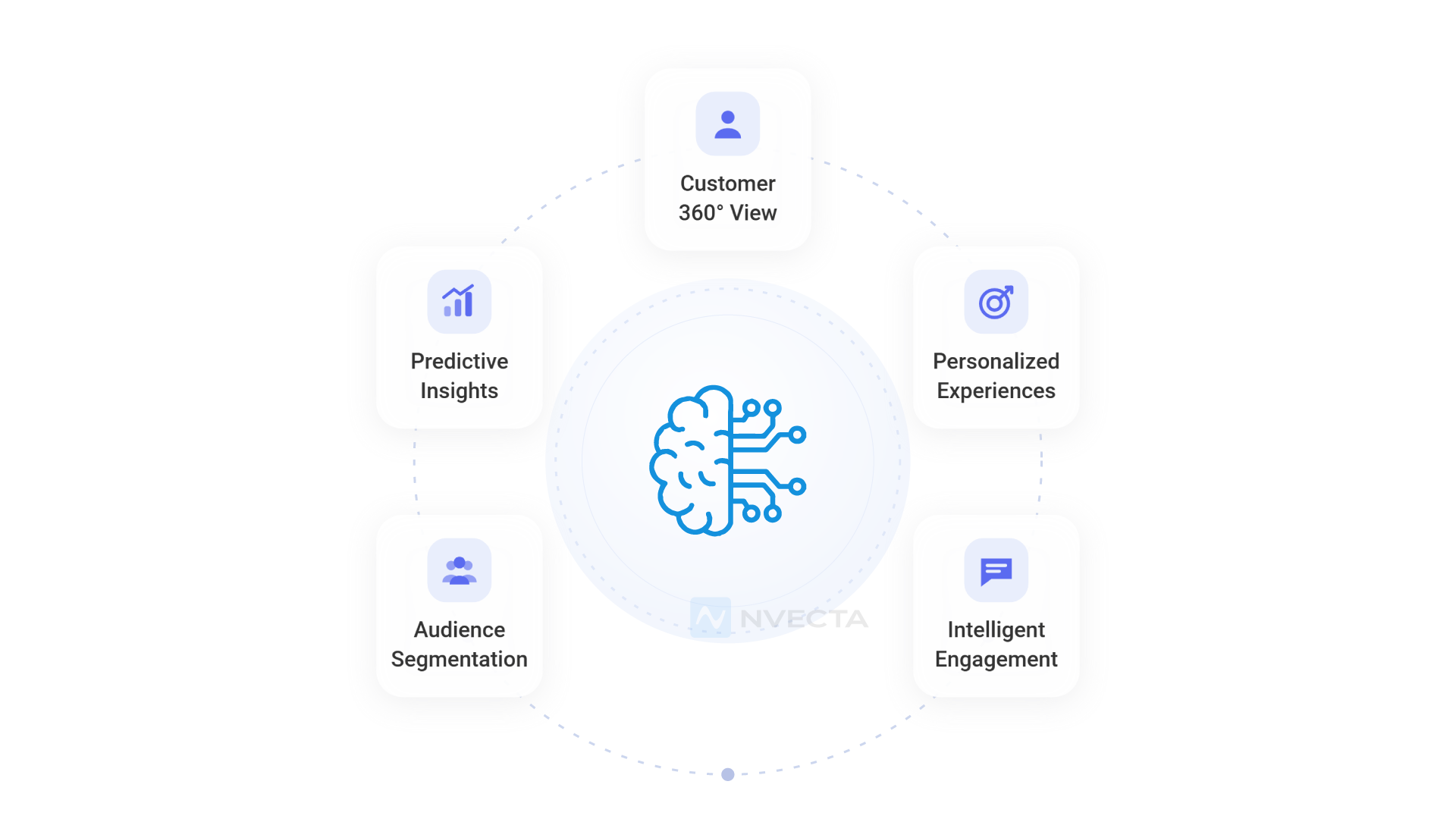
CDPs are implementing AI at every stage of their functioning. Using AI, every tool works fast and efficiently,
Like processing large volumes of information into clear insights, making the best suggestions, and identifying patterns that guide future actions.
Further, it increases customer engagement, as every message, recommendation, or action is guided by real data, helping create experiences that feel connected and relevant.
Here is how AI powers CDPs-
Predictive segmentation– AI helps teams create dynamic customer segments by analysing behaviour patterns based on browsing history, purchase activity, etc., helping brands to target the right people.
Next-best-action recommendation- evaluates each customer’s position in their journey and suggests the most appropriate message and channel to engage them.
Lifetime value and churn forecasting- AI identifies the high-value customers and inactive customers and enables timely action to improve retention and build stronger relationships.
Automated workflow orchestration- AI supports coordinated cross-channel campaigns by triggering the right action at the right moment, making campaign execution more efficient and consistent.
AI is now a core part of CDPs. The shift is moving beyond simple AI features toward agentic AI in marketing, where AI agents act autonomously on customer data rather than just suggesting actions to humans. Platforms equipped with reliable CDP capabilities can deliver stronger results and stay ahead.
Trend Spotlight: GenAI and Agentic AI in CDPs (2026 Deep Dive)
The first wave of AI in CDPs was predictive: segments, churn scores, lifetime value forecasts. The 2026 wave is generative and agentic. These emerging trends in AI-powered CDPs are transforming how marketers create audiences, automate engagement, and extract insights from customer behavior in real time.
- Natural-language segment creation. Marketers describe a segment in plain English (“customers who bought running shoes in the last 90 days and live in cities with marathon events this quarter”) and the CDP builds it. Klaviyo, Bloomreach, and Salesforce Data Cloud all shipped versions of this in late 2025.
- Agentic CDP workflows. Autonomous agents handle full campaign cycles: identify the audience, build the message, send it, watch performance, and adjust. Klaviyo Customer Agent and Salesforce Agentforce are early examples. Expect every major CDP vendor to ship something similar by Q3 2026.
- Multimodal data understanding. AI now reads support call transcripts, classifies email replies, and pulls intent signals from unstructured data that used to sit unused. This expands what counts as a “data point” in the unified profile.
The teams getting real value from these features have one thing in common: they started with predictive AI (which most vendors include for free) before chasing agentic features. The order matters. An agent built on weak predictive foundations produces worse outcomes than no agent at all.
Real-Time Activation and Hyper-Personalisation
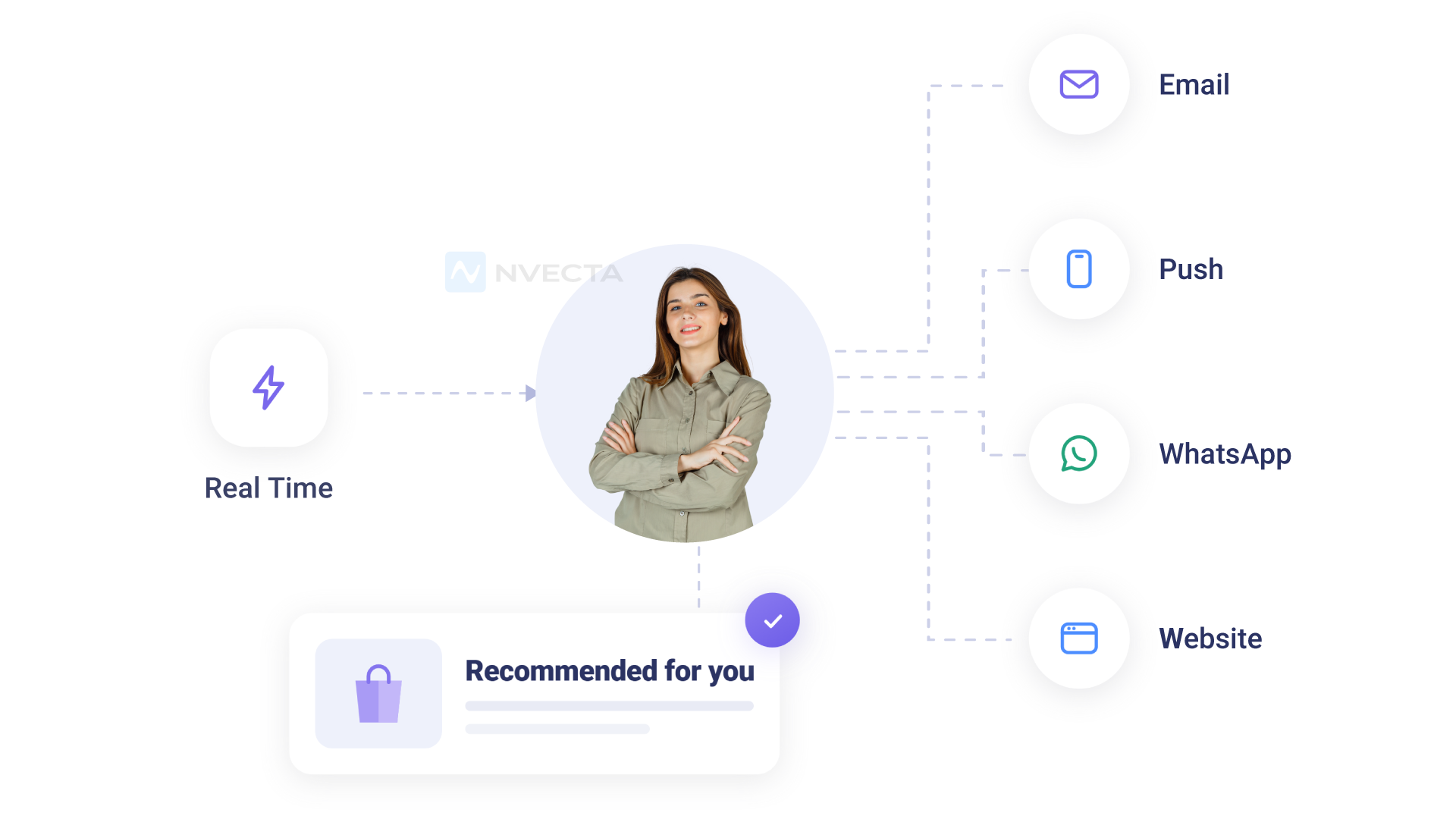
CDP offers real-time activation, enabling brands to act on live customer behaviour and deliver personalised experiences.
This ensures that communication reflects current behaviour, delivering timely and relevant interactions.
Real-time activation engages customers at the right moment while hyper-personalisation ensures that every interaction is tailored to customers’ needs and intent.
Together, they create more precise and meaningful engagement.
Let’s see how they work within a CDP-
Event-based triggers: CDP tracks customer actions such as clicks, page visits, and purchases and triggers email messages at the right moment.
Cross-channel activation: CDP connects multiple touchpoints to deliver consistent, real-time engagement across channels.
Dynamic content delivery- Content recommendations and offers adjust for each customer based on their activity and interests.
Behaviour-based targeting: CDP uses browsing history, preferences, and interactions to tailor offers to each individual customer.
Real-Time Activation Benchmarks 2026
“Real-time” used to mean “within the hour.” In 2026, customers expect actual seconds. Here is where the bar sits today:
- Tier 1 brands target sub-second activation latency: an event happens, and a channel responds in under 1 second.
- Mid-market brands typically run at 5 to 30 second latency.
- Lagging brands still measure activation in minutes or hours.
The platforms that win are moving to streaming-first architectures (Kafka, Kinesis) and edge CDP deployments that put decision logic close to the user. If your current setup batches data overnight, you are operating with 2018-era infrastructure. The first practical step is measuring your current latency. If you cannot measure it, that is the problem to solve before evaluating new vendors.
First-Party Data Takes Centre Stage
CDPs are prioritising first-party data as a reliable and future-ready way to understand customers.
It includes data directly collected from customer interactions, such as website visits, app usage, or transactions. Using such data provides greater accuracy and control.
Even brands are increasing their focus on privacy and transparency, as customers are quite aware and informed.
Therefore, CDPs ensure clear communication and consent-driven practices that help brands build trust and comfortable data sharing.
This is how first-party data is being strengthened within CDPs-
Direct Data collection– customer data is collected directly from websites, apps and interactions to understand behaviour more accurately.
Consent and preference management- respecting customer formations and preferences to build trust and ensure responsible data usage.
Profile enrichment –First-party data helps in creating a deep and more complete understanding of customer needs and preferences.
First-party data helps in more accurate personalisation while supporting compliance and long-term customer relationships.
Building Your First-Party Data Strategy: 2026 Playbook
Collecting first-party data is not the same as having a strategy. The brands winning in 2026 do four specific things:
- Zero-party data collection through value exchange. Quizzes, preference centers, gated content. Anything where the customer actively shares preferences in exchange for something useful. Sephora’s Beauty Insider and Spotify Wrapped are textbook examples.
- Progressive profiling. Don’t ask for everything at signup. Ask one question per touchpoint over time. Conversion rates on signup forms drop noticeably with every required field added.
- Server-side tracking adoption. By early 2026, around 73% of mid-to-large brands had moved at least some tracking server-side to reduce reliance on browser cookies and improve data accuracy.
- Clean room partnerships for second-party data. When first-party data isn’t enough, brands partner with non-competing companies in privacy-preserving clean rooms (LiveRamp, Snowflake Data Clean Rooms, AWS Clean Rooms). This is replacing what third-party data used to do.
The Cookieless Reality Check (2026 Update)
Third-party cookies are effectively gone in Chrome as of 2026. The deprecation that the industry treated as theoretical for years finally happened. Here is where things actually stand:
- Privacy Sandbox APIs (Topics, Protected Audience, Attribution Reporting) are in production but adoption is mixed. Most marketers find them weaker than the cookies they replaced.
- Apple’s ATT framework hit maturity. Mobile apps rely on SKAdNetwork or aggregate measurement, with all the limitations that come with both.
- Server-side tagging is now the default for serious brands, not the exception.
- Identity resolution providers (LiveRamp RampID, Unified ID 2.0, ID5) carry more weight than they did pre-deprecation.
For CDPs, the implication is direct: first-party data plus identity resolution equals the new advertising backbone. Your CDP needs to be your identity graph, not just your data store. Vendors that haven’t invested heavily in identity capabilities have lost ground in 2025-2026.
Privacy First and Consent-Driven Ecosystem
CDPs are evolving to embed privacy as a core part of their operations. Brands are building systems that give customers greater clarity and control over how their data is used, and this shift is especially evident in the rise of the ecommerce CDP, which is designed to balance personalized experiences with transparent, consent-driven data practices.
This approach helps create a trust-based relationship in which your customer feels more confident engaging with a brand that respects their choices.
This is how CDP support privacy first ecosystem-
Customer data control- enable customers to manage permissions and update their preferences through accessible and transparent interfaces.
Data usage transparency– Providing a clear explanation of how data flows across the system and is used in engagement.
Strong data governance – Systems are designed to protect data and prevent misuse across platforms
Preference-based communication -Communication strategies respect customers’ permissions and interaction preferences at all times.
A privacy-first CDP helps businesses earn customers’ trust and support responsible customer engagement.
Privacy & Compliance Updates: 2026 Regulatory Watch
The regulatory landscape in 2026 is denser than 2025. Quick rundown of what affects CDPs right now:
- US state-level laws: CPRA (California), Virginia CDPA, Colorado CPA, Texas Data Privacy Act. Most converge on similar requirements (opt-out for sale or share, data subject access requests, data minimization), but each has its own quirks.
- EU AI Act: In force as of mid-2025. CDPs using AI for “high-risk” applications (credit, employment, essential services) face additional documentation and transparency requirements.
- GDPR enforcement intensity has increased. Multiple eight-figure fines in 2025 against companies that mishandled cross-border data transfers.
- Consent management has become its own software category. CDPs increasingly integrate with OneTrust, Sourcepoint, Didomi, and similar tools rather than building consent natively.
The practical impact: configure your CDP for “privacy by default” instead of treating compliance as an afterthought. Vendors that bake consent and data governance into their core architecture will win mid-market and enterprise deals in 2026.
Composable and flexible CDP Architectures
CDP is evolving into a composable architecture that supports flexibility and scalability. Teams can combine different tools and capabilities to build a system that aligns with their requirements, creating a more connected setup.
Such a system improves adaptability and allows businesses to update their technology stack as needs evolve. It also supports better integration across systems.
This is how composable CDPs operate-
Modular setup – Brands can choose specific features and create a setup that fits their goals.
Seamless integrations– CDP connects with existing tools, including data warehouses, CRM and marketing tools to create a unified data environment.
Scalable system– Systems can expand by adding new tools and features without major structural changes
Flexible data usage– data flows easily across systems to support better activation and insights.
Composable CDPs help businesses build a future-ready customer data strategy that keeps them flexible and scalable in the long run.
Composable CDP in 2026: What’s Actually Happening
The composable CDP narrative was dominant in 2024-2025. The reality in 2026 is more nuanced:
- Adoption is real but uneven. Brands with strong data engineering teams and existing warehouses (Snowflake, BigQuery, Databricks) are increasingly going composable. Brands without that foundation are sticking with packaged.
- Hybrid models are dominant. The cleanest architectural split (fully packaged vs fully composable) is fading. Most mid-market and enterprise teams now run a packaged CDP for marketing activation and a warehouse for analytics, with reverse ETL bridging the two.
- Costs have stabilized. Composable can be 30% to 40% cheaper at scale, but only when data engineering is already in place. The “build it cheaper” argument is no longer absolute.
- Reverse ETL has matured into its own category. Hightouch and Census are now standard infrastructure for warehouse-native marketing teams.
Omni-Channel Orchestration and Unified Experience
CDP enables businesses to orchestrate customer engagement across multiple channels in a unified manner.
Customers expect brands to recognise them across every touchpoint. When messages match across channels, it feels more natural.
This is how Omnichannel orchestration works within CDPs-
Consistent communication– messaging stays aligned across channels, creating a unified brand experience.
Seamless customer journeys- customers can move across channels without losing context or repeating actions
Cross-channel coordination– different channels work together to support unified customer engagement.
Centralise data access – Customer data flows across channels to support better engagement and personalisation.
With Omnichannel orchestration, brands can deliver more cohesive and effective customer experiences.
Industry-Specific CDP Trends in 2026
CDP adoption looks different by vertical. Here is what is actually happening in five sectors right now:
Retail and E-commerce
Cross-channel inventory orchestration is the new battleground. Brands use CDPs to route customers to in-stock locations, trigger restock notifications based on browse history, and personalise loyalty offers in real time at checkout.
The brands seeing the biggest wins are connecting POS data to web behaviour, something most retailers still treat as separate.
Banking and Financial Services
Open banking plus CDP integrations have matured. Banks now use unified profiles to surface cross-product offers (a savings customer who just received a salary increase becomes a credit card prospect) while running fraud detection on the same data layer. Compliance and personalisation living on the same platform is no longer unusual.
Automotive
Connected vehicle data is finally reaching CDPs at scale. Brands use telemetry, in-vehicle interactions, dealership visits, and service history to build a true 360-degree owner profile that drives everything from service reminders to next-vehicle marketing. CRM and AI features specifically built for this vertical are launching across the major auto OEMs in 2026.
Travel and Hospitality
Post-pandemic personalisation has become non-negotiable. Airlines and hotels use CDPs to combine loyalty data, booking history, in-stay behaviour, and ancillary purchases to deliver experiences that justify premium pricing. The interesting shift is real-time loyalty: tier upgrades and offers triggered by behaviour during a single trip rather than at the end of a quarter.
Gaming and Mobile Apps
Player lifetime value modelling has become routine. CDPs unify in-game behaviour, monetisation patterns, social graph signals, and cross-platform play history to drive personalised re-engagement at scale. The biggest shift is identifying high-LTV players within their first 7 days instead of after their first 90.
Predictive Segmentation
CDPs help businesses to move beyond basic audience segments by using predictive segmentation. This allows the brand to identify future customer behaviour and improve targeting accuracy.
Such a feature helps target the right audience and opportunities, making engagement more relevant and timely. This helps in improving both efficiency and business outcomes.
This is how predictive segmentation works within CDPs-
Behaviour-driven segmentation – Customer groups are created using real actions such as browsing, clicks and purchases.
Intent prediction models – CDP analyses data signals to predict future customer actions and the likelihood of engagement.
Dynamic segment updates – Segments continuously evolve as customer behaviour and intent shift over time, making it essential for businesses to adapt their strategies dynamically. By integrating customer behaviour analysis into your existing approach, you can better understand patterns, preferences, and emerging needs, allowing for more precise targeting, personalised experiences, and improved engagement across every stage of the customer journey.
Targeted engagement– the system targets the audience that are more likely to respond based on predicted behaviour.
Such a feature helps brands to improve targeting efficiency and overall campaign performance.
Integration of CDP with Marketing Automation
CDPs are now increasingly integrated with marketing automation platforms. It helps businesses to connect customer data to marketing execution. This helps teams use insights directly within campaigns and journeys.
When data and automation work together, engagement becomes more consistent and easier to manage. Teams can respond to customers with better timing and relevance.
Connected campaign workflows -Customer data is directly used to guide campaign creation and execution.
Faster execution cycles -Campaigns are launched and optimised using real customer signals
Coordinated customer journeys -Interactions across channels are managed using connected data and an automation system
Such integration helps businesses act faster and deliver more effective, scalable customer experiences.
7 CDP Predictions for End of 2026
Based on customer conversations, vendor roadmaps, and analyst signals from Q1 2026, here is what we expect to play out by December 2026:
1. Martech consolidation accelerates
Expect 3 to 5 major CDP acquisitions before year-end. Smaller composable players get absorbed by warehouse vendors or larger martech suites. The era of standalone single-feature vendors is closing.
2. AI agents replace traditional segmentation UIs
Marketers will describe segments in natural language and approve agent-built audiences instead of clicking through filters. The “segmentation builder” interface most platforms ship today will start looking dated by Q4.
3. Identity resolution becomes a separately billable layer
Some vendors will spin out identity as a standalone tier. Others will bundle it. Either way, “identity” will appear as its own line item on most enterprise contracts by year-end.
4. Composable adoption stalls in SMB and mid-market
The promise was always more compelling for enterprise. Most SMB and mid-market teams will stay packaged because the data engineering overhead does not pencil out at their scale.
5. Real-time becomes the floor, not the ceiling
Sub-second activation will be the entry-level requirement. Batch CDPs will lose RFPs they used to win, particularly in retail and travel.
6. Privacy gets product-marketed
Vendors will compete on privacy features the way they currently compete on AI. Expect “Privacy Score,” “Compliance Co-Pilot,” and similar features. Some will be substantive; some will be marketing.
7. CDP and ESP boundaries blur further
Klaviyo, Braze, and Iterable will look more like CDPs. Tealium, Segment, and Bloomreach will look more like marketing automation. The “CDP vs marketing platform” distinction will lose meaning for most buyers, and category analysts will start grouping these tools differently by 2027.
What to Do Now: Action Items by Trend
Knowing the trends is one thing. Acting on them is another. Here is what to actually do this quarter:
- For AI: Audit your current AI usage. Are you using predictive features (segments, scores, LTV)? If not, start there before chasing agentic AI. Most vendors include predictive AI in standard plans now.
- For first-party data: Run a data audit. Map every signup form, conversion event, and customer touchpoint. Identify three places to add zero-party data collection in the next 90 days.
- For cookieless: If you haven’t moved to server-side tracking, this is overdue. Start with a POC on one channel (typically web), measure data accuracy improvements, then expand.
- For composable: If you have a data warehouse and at least one data engineer, run a composable feasibility study. Compare 3-year TCO against your current packaged setup.
- For real-time: Measure your current activation latency. If you can’t measure it, that’s the first problem. Aim for under 30 seconds as a baseline; under 5 seconds for ecommerce.
- For privacy: Audit your consent management coverage. Is your CDP receiving consent signals from every collection point? If not, fix this before you face a DSAR you can’t fulfil.
- For predictive segmentation: Pick one high-value use case (cart abandonment, churn risk, VIP detection) and build a predictive segment for it this quarter. Measure performance against your current rule-based segments.
How Nvecta is Powering the Future of Customer Data
The above trends represent real challenges and real opportunities that marketing and data teams are navigating right through.
Nvecta is an advanced customer data platform that addresses the challenges businesses face and turns them into opportunities that generate results.
It combines AI intelligence, real-time activation and AI-driven insights while respecting customers’ privacy to keep up with the evolving trends.
The following are Nvecta features that need the current CDP trends and 2026-
AI-Driven Intelligence
Nvecta applies AI across its core operations, such as segmentation, behaviour analysis, and decision-making.
This helps brands to target the right audience, reduce manual work and improve efficiency.
Real-Time Engagement
Nvecta processes customer behaviour in real time and enables immediate response across channels.
This helps brands to improve engagement, support conversions and meet the rising expectations for real-time interactions.
Unified Customer Intelligence
Nvecta brings all customer data together from multiple sources and creates continuously updated customer profiles.
This gives a better view of customer interactions and optimise experiences across channels.
Privacy First Approach
Nvecta integrates consent management and governance into its architecture.
This has brands to remain compliant when it comes to data usage and support long term trust without affecting engagement quality.
Connected Campaigns and Journeys
Nvecta connects customer data with campaigns so brands can act quickly. It enables insights to directly support campaigns and journeys across the customer journey, helping teams deliver more timely and relevant experiences.
This improves coordination speed and create a smoother connected customer experience.
Accessible for teams
Nvecta offers an easy-to-use interface that allows teams to manage data and campaigns independently.
This helps brands to move faster and further execute strategies more efficiently.
Wrap up – CDP Trends 2026
CDP trends highlight a clear shift towards an intelligent action-driven approach to engage with customers.
It is clear that effective utilisation of customer data helps make better decisions, improve engagement and strengthen customer relationships.
Businesses have to be very careful while choosing a CDP that adapts well with the changing trends and offers full-fledged advanced features that support their business goals.
CDP trends will continue to shape the future of customer engagement.
Try Nvecta to stay ahead of CDP trends with AI-powered insights and real-time activation to improve customer engagement.
CDP Trends 2026 FAQs
Are CDPs still relevant in 2026?
Yes, more so than ever. With third-party cookies gone and customers expecting real-time personalization, the unified customer profile a CDP provides is now the foundation of modern marketing and advertising. The CDP market continues to grow at double-digit rates and is projected to roughly triple by 2030.
What are the biggest CDP trends in 2026?
The eight biggest trends are: agentic and generative AI, real-time activation moving to sub-second latency, first-party data strategy maturity, the cookieless reality, privacy-first architecture, composable CDP adoption (with hybrid models dominating), omnichannel orchestration, and tighter CDP-marketing automation integration.
How is AI changing CDPs?
AI is shifting CDPs from predictive (segments, churn scores, LTV) to generative (natural-language segment creation) and agentic (autonomous campaign execution). It is also enabling multimodal data understanding so unstructured sources like support call transcripts feed the unified profile.
What is the best CDP for real-time personalization in 2026?
The leading platforms for sub-second real-time activation include Tealium AudienceStream, Bloomreach Engagement, mParticle, Treasure Data, and Nvecta. The right pick depends on your channels, data volume, and existing tech stack. Always validate latency claims with a proof of concept before signing.
Will composable CDPs replace packaged ones?
Not entirely. Composable adoption is growing in enterprise where data engineering is already in place. SMB and mid-market teams continue to favor packaged because the warehouse and engineering overhead doesn’t pencil out at their scale. The dominant pattern in 2026 is hybrid: packaged CDP for marketing activation, warehouse for analytics, reverse ETL bridging the two.
What is the cookieless future for CDPs?
Third-party cookies are gone in Chrome as of 2026. The result is that first-party data plus identity resolution has become the new advertising backbone. CDPs that invest heavily in identity resolution capabilities (deterministic, probabilistic, graph-based) are pulling ahead of those that haven’t.
What is first-party data and why does it matter?
First-party data is information you collect directly from your customers through their interactions with your website, app, transactions, and support channels. It matters in 2026 because third-party cookies are gone, privacy regulations have tightened, and customer trust is now a competitive differentiator. First-party data is the most reliable foundation for personalization in this environment.
How do CDPs handle privacy compliance in 2026?
Modern CDPs integrate consent management, data subject access request (DSAR) handling, data minimization, and audit logs into their core architecture. Most also integrate with dedicated consent management platforms (OneTrust, Sourcepoint, Didomi) for jurisdiction-specific compliance. Configure your CDP for “privacy by default” rather than treating compliance as an afterthought.
What is the difference between a CDP and a marketing automation platform?
A CDP unifies customer data from every source into a single profile. A marketing automation platform executes campaigns and journeys. Historically these were separate tools. In 2026 the lines are blurring: marketing automation platforms like Klaviyo and Braze are adding CDP features, and CDPs like Bloomreach and Segment are adding activation features. Most teams now run them as a connected pair rather than two isolated systems.
How can Nvecta help me stay ahead of CDP trends?
Nvecta combines AI-driven intelligence, real-time activation, unified customer profiles, and privacy-first architecture in one platform. For teams that want to act on the trends in this guide without piecing together five separate tools, Nvecta is built to support agentic AI workflows, sub-second activation, first-party data strategy, and consent-driven personalization. Schedule a demo to see how it fits your specific use case.
