














 Email
Email SMS
SMS Whatsapp
 Web Push
 App Push
 Audience Sync for Ads
 Popups
 Channel A/B Testing
  Control groups Analysis
 Frequency Capping
 Funnel Analysis
 Cohort Analysis
 RFM Analysis
 Signup Forms
 Surveys
 NPS
NPS Landing pages personalization
  Website A/B Testing
  PWA/TWA
 Heatmaps
 Session Recording
 Wix
Wix Shopify
 Magento
 Woocommerce
 eCommerce D2C
  Mutual Funds
 Insurance
 Lending
  Recipes
  Knowledgebase
 Developer Docs
 Product Updates
 App Marketplace
 Academy
 Ebooks
 Case Studies
 Blog
Blog Templates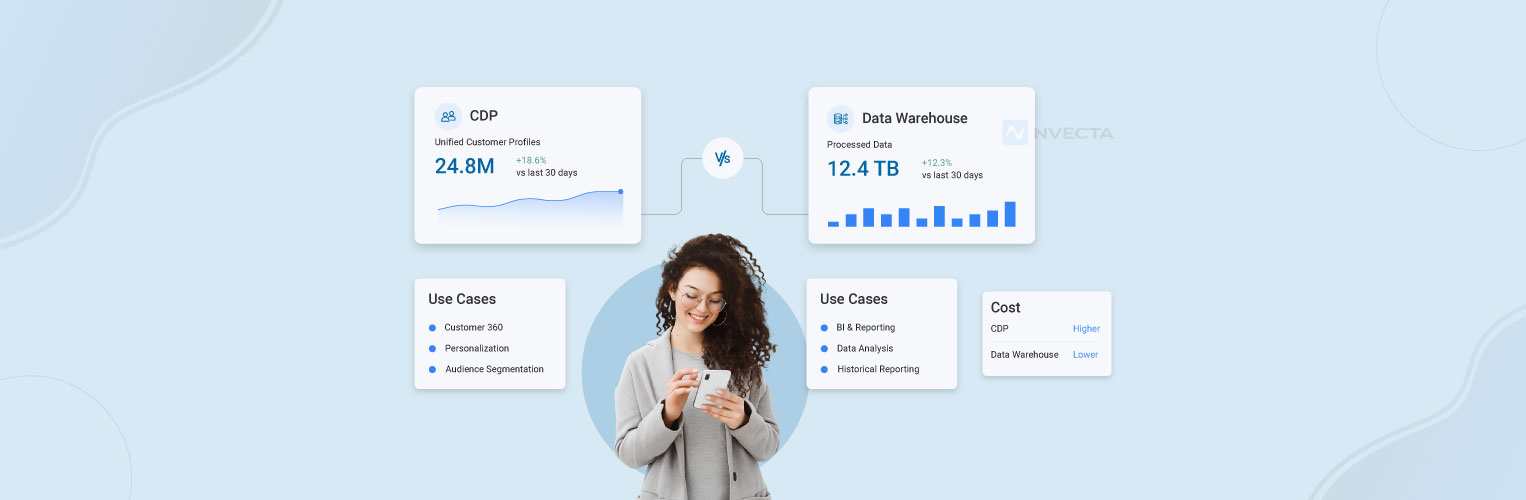
 Aparupa Saha
📅 Last updated: May 2026
How we built this guide: The comparison below draws on conversations with data teams running both architectures, vendor documentation from Snowflake, BigQuery, Databricks, Segment, Tealium, and mParticle, and reverse ETL implementations across Hightouch and Census. Pricing reflects publicly listed plans as of May 2026.
Many teams invest in a Customer Data Platform or a Data Warehouse, thinking they’ve solved their data problem, only to discover the two tools solve fundamentally different problems.
The confusion is understandable: both platforms ingest data, both store it, and the lines between them have blurred further as modern warehouses have grown faster and CDPs have grown more sophisticated.
But when it comes to CDP vs. data warehouse, the distinction still matters enormously. Choosing the wrong tool, or misunderstanding what each one does, leads to duplicated infrastructure, frustrated marketing teams, and analytical blind spots that compound over time.
At Nvecta, we built a CDP for organisations navigating exactly this decision. Whether you’re building your data stack from scratch or evaluating where the gaps are,
Understanding the fundamental difference between a CDP and a data warehouse is the starting point. This guide breaks it down clearly, so you can make the right call for your team.
As you evaluate these systems, it’s also important to consider how data actually gets activated across your tools. That’s where understanding Reverse ETL VS CDP use cases becomes essential—helping bridge the gap between stored data and real operational impact by syncing warehouse data back into business applications.
CDP vs Data Warehouse: Quick Comparison
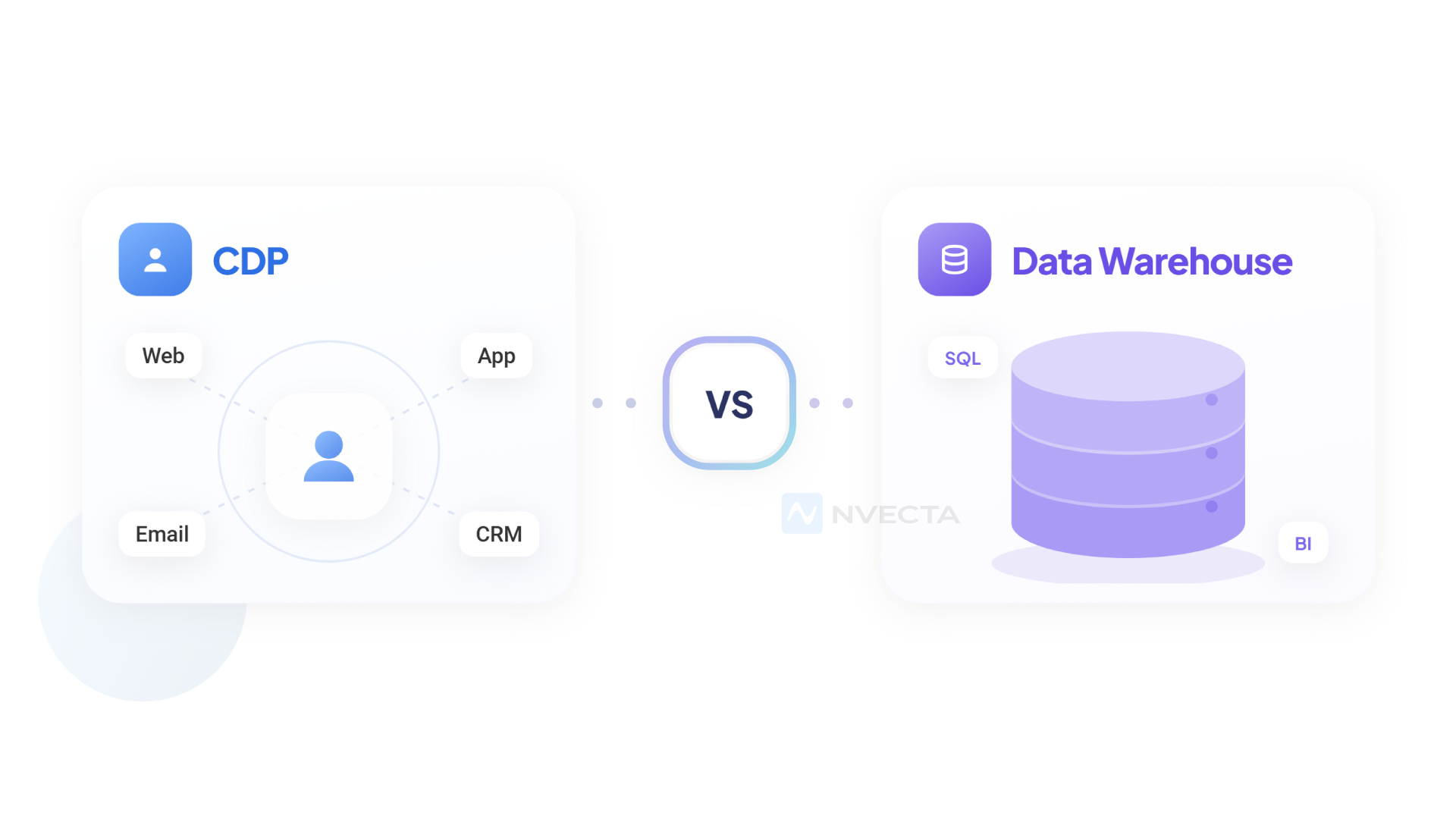
Before going deeper, here’s the at-a-glance view. The original head-to-head table below covers the main dimensions, but if you have only 30 seconds, this is the answer:
The 1-minute answer: A CDP is built for marketers to activate customer data in real time. A data warehouse is built for analysts to query historical business data at scale. They solve different problems, and most mature teams end up running both. If you need to send a personalized email the moment a customer abandons a cart, you need a CDP. If you need to know which customer cohort has the highest 90-day retention, you need a warehouse. If you need both, the modern stack is warehouse + CDP, often connected via reverse ETL.
What Each One Is
A Customer Data Platform (CDP) is a system built to collect, unify, and activate customer data in real time. Its primary job is assembling a persistent, complete profile for every individual,
Then making those profiles available to marketing, product, and customer-facing tools like ad platforms, CRMs, and email automation.
A Data Warehouse is a centralised analytical repository designed for large-scale querying and reporting. It stores structured
Historical data from across the entire business, not just customer data, and is optimised for complex SQL analysis, BI tooling, and data science workflows.
While marketing teams rely on customer data for personalisation, finance departments often use business intelligence tools to analyse operational and financial performance. Solutions like Power BI for accounting help consolidate financial metrics, budgeting data, and cash flow reporting into interactive dashboards built from multiple data sources.
But the key difference lies in purpose and primary consumer: a CDP serves marketers and growth teams who need to act on individual customer profiles; a data warehouse serves analysts and data scientists who need to query aggregated, historical datasets.
Head-to-Head: Key Differences
| Dimension | CDP | Data Warehouse |
| Primary purpose | Activate customer data in real time | Store and analyse historical business data |
| Data scope | Customer & behavioural data only | All business data (finance, ops, product, customers) |
| Key output | Unified customer profiles & segments | Reports, dashboards, ad-hoc queries |
| Latency | Real-time or near-real-time | Typically batch; can support streaming |
| Primary users | Marketing, growth, product teams | Analysts, data engineers, data scientists |
| Identity resolution | Built-in, core feature | Possible, but requires custom engineering |
| Downstream integrations | Ad platforms, CRMs, and email tools | BI tools, notebooks, ML pipelines |
| Data model | Person-centric (one profile per user) | Flexible schema optimised for analytics |
| Cost model | Per-profile or per-event pricing | Storage + compute (query-based) |
How They’re Built Differently: Architecture Side-by-Side
Looking under the hood explains why each tool fits its job so well. Here’s the simplified flow for both:
The architectures look superficially similar (both have ingestion, both have storage, both have outputs), but the optimisation targets are completely different. A CDP optimises for reading one customer’s full history fast enough to personalise a moment. A warehouse optimises for crunching billions of rows across many tables fast enough to answer business questions.
Where Each One Excels
A CDP is the right tool when you need to:
- Personalise experiences in real time, for example, triggering a push notification the moment a user abandons their cart, based on their full behavioural history
- Unify cross-device identity by stitching together sessions from mobile, desktop, and in-store POS into a single persistent customer view
- Build and sync audiences, defining a segment once and having it automatically flow to Facebook Ads, Braze, Salesforce, and Intercom simultaneously
- Enable non-technical teams to build segments and activate campaigns without writing SQL or waiting on an analyst
A Data Warehouse is the right tool when you need to:
- Run complex analytical queries, for example, joining customer revenue data with logistics tables to find which fulfilment delays correlate with churn across three years of history
- Consolidate all business data in one place: finance, supply chain, product telemetry, support tickets, and more
- Train machine learning models, where large feature sets and raw data volumes are essential
- Power executive dashboards via Looker, Tableau, Metabase, or other Omni Analytics alternatives with a single auditable source of truth
When to Use a CDP vs Data Warehouse: A Decision Framework
If you’re stuck between the two, here’s the framework most teams end up at after a few weeks of debate. Walk through these five questions in order:
- 1. Do you need to act on customer data in real time? If yes (cart abandonment, churn intervention, behavioral triggers) → CDP. A warehouse can technically do this, but you’ll need streaming infrastructure plus reverse ETL plus engineering bandwidth.
- 2. Do you have data engineering capacity? If no → CDP. Packaged CDPs are designed to be run by marketing operations. Warehouses require ongoing data engineering whether you build composable or not.
- 3. Is identity resolution your main pain point? If yes → CDP. Identity stitching across email, phone, device IDs, and customer IDs is a CDP’s core competency. Building it in a warehouse is doable but expensive.
- 4. Do you need cross-functional analytics? If yes (finance, ops, product, customer all in one query) → Warehouse. CDPs intentionally limit themselves to customer data.
- 5. Do you need both? If yes → Hybrid. Warehouse as analytical backbone, CDP as activation layer. This is the most common pattern in mid-market and enterprise stacks today. The next section covers exactly how this works.
Most teams who think they need to choose between the two actually need both. The question is rarely “CDP or warehouse” — it’s “which one first, and how do they connect?”
A Common Misconception
“We already have all our customer data in Snowflake. Do we really need a CDP?”
This is the most common question teams ask. The answer depends on what you want to do with that data.
If the goal is analytics and reporting, your warehouse may be sufficient—but if you’re looking to activate customer data in real time, an ecommerce CDP can provide much more flexibility and value.
But if you need to activate that data, personalise an experience, trigger a campaign, or sync a segment to an ad platform, you’ll need either a CDP or significant custom engineering to replicate what one provides out of the box.
The reverse is equally true. A CDP alone is not a replacement for a warehouse. CDPs are not optimised for complex multi-table analytical queries.
They don’t natively store your financial or operational data. They’re not where your data scientists live.
Most mature data organisations end up running both, with the warehouse as the analytical backbone and the CDP as the activation layer, with data flowing between them in both directions.
How CDPs and Data Warehouses Work Together
The “either/or” framing is what trips most teams up. The modern stack runs both, with each one doing what it’s best at and a few connectors moving data between them. Here’s how the pieces fit:
- The warehouse holds the source of truth. Every business system pipes data into it: web events, app events, CRM, finance, support tickets, product telemetry. This becomes the single auditable record of what happened.
- The CDP handles identity resolution and activation. It either receives the relevant customer subset from the warehouse, or it tracks customer behaviour independently, or both. Either way, it produces unified profiles fast enough to act on.
- Reverse ETL bridges them. Tools like Hightouch, Census, and RudderStack sync warehouse-computed segments and attributes into operational tools — including the CDP if it doesn’t already track that data.
- Data flows in both directions. CDP profile updates can flow back into the warehouse for analysis. Warehouse-computed insights (like predicted lifetime value) can flow into the CDP for activation.
Common stack examples we’ve seen working in production in 2026:
- SMB ecommerce: Shopify → Snowflake → Hightouch → Klaviyo (warehouse for analytics, reverse ETL for activation, Klaviyo for execution)
- Mid-market B2C: Multiple sources → BigQuery → packaged CDP (Nvecta, Bloomreach, mParticle) → email, SMS, ads, push
- Enterprise: Multiple sources → Databricks → custom identity resolution + Census → Tealium / ActionIQ → omnichannel orchestration
The right configuration depends on your team’s data engineering bandwidth, the complexity of your customer journey, and how many activation channels you actually use.
Reverse ETL Explained: The Bridge Between Warehouse and Activation
If you’ve heard the term “reverse ETL” thrown around but the meaning hasn’t quite clicked, here’s the short version. Traditional ETL pulls data into the warehouse. Reverse ETL pushes data out of the warehouse and into the operational tools where customer-facing teams actually work — email platforms, ad networks, CRMs, support tools, your CDP.
The three vendors most teams evaluate in 2026:
- Hightouch — Most mature reverse ETL tool. Strong UI, generous free tier, deep connector library. Often the first choice for SMB and mid-market.
- Census — Engineering-led, strong identity resolution features, good for technical teams that want more control. Lifecycle starting around $400/mo.
- RudderStack — Open-source friendly, strong both as forward ETL and reverse ETL. Good fit for teams that want to consolidate event tracking and activation in one tool.
A common point of confusion: reverse ETL doesn’t replace a CDP; it’s not a CDP itself, but it can do some of what a CDP does. Specifically, it handles segment sync (warehouse-defined audience → operational tool). It does not handle real-time event tracking, identity resolution at scale, or out-of-the-box marketer-friendly UIs for building campaigns. For deeper coverage, see our reverse ETL vs CDP guide.
CDP vs Snowflake, BigQuery, and Databricks
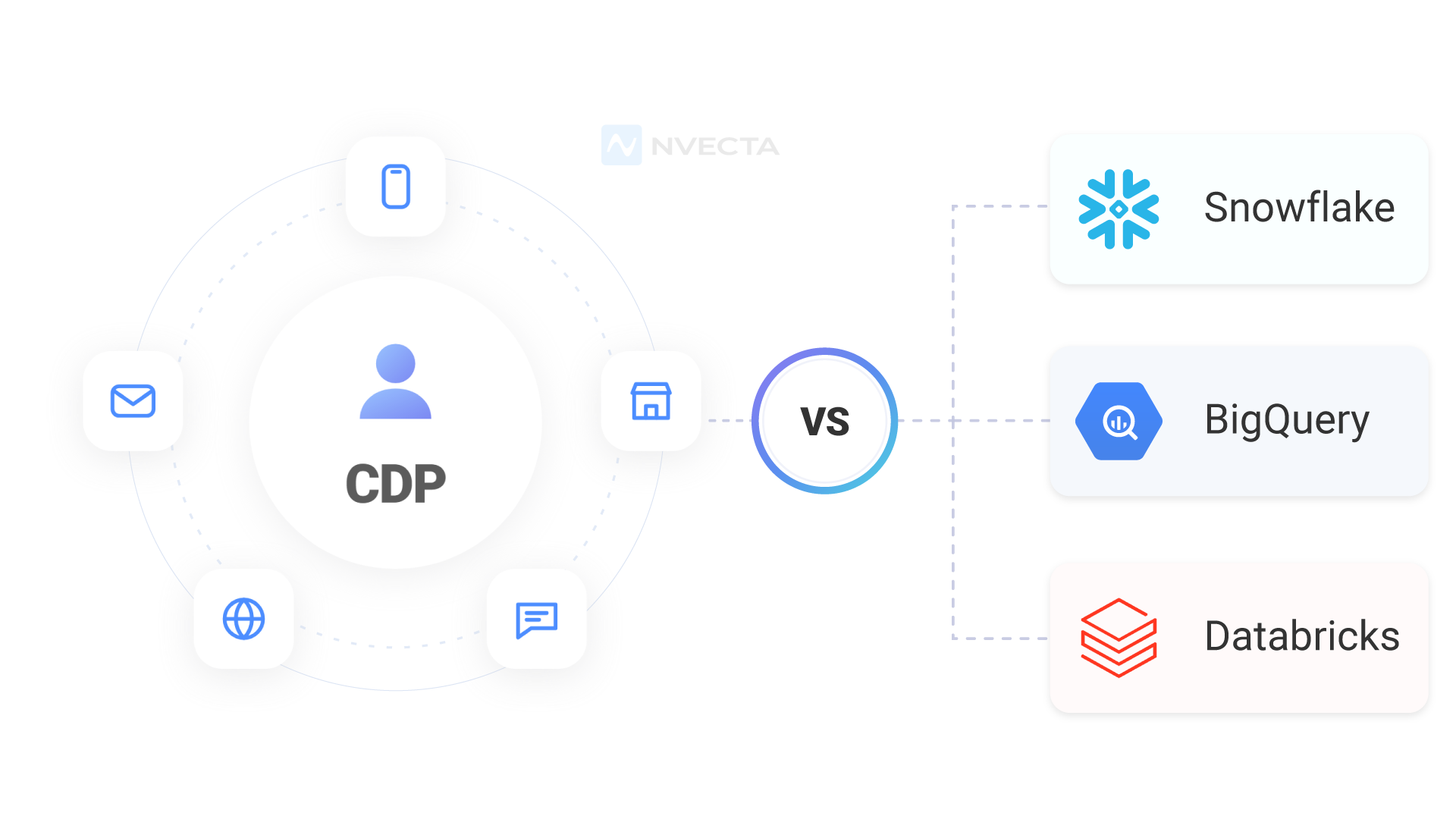
Buyers often Google “CDP vs Snowflake” or “BigQuery as a CDP” expecting a head-to-head answer. The honest answer is that these aren’t competing products; they’re complementary tools that occasionally overlap on a few use cases.
- Snowflake is a warehouse. It can store customer data and identity-resolution logic if you build it. It does not natively offer pre-built activation to email, SMS, or ad platforms. Pair it with reverse ETL or a CDP for activation. You can also utilize Snowflake Implementation Services to support these integration requirements.
- BigQuery is similar — a warehouse with strong analytics and ML capabilities, but no native activation. Most BigQuery shops add Hightouch or a packaged CDP to push data out.
- Databricks leans more toward data science and ML workflows than pure analytics, but it’s still a warehouse-style platform. Same pattern: pair with reverse ETL or CDP for activation.
The “warehouse vs CDP” framing only really works when you’re looking at composable CDP setups (warehouse + reverse ETL + activation). Even then, you’re not replacing a CDP with a warehouse — you’re rebuilding a CDP using warehouse components, which is a different decision. Our composable CDP guide goes deeper on that trade-off.
The Composable CDP: A Middle Path
A newer approach, often called the composable CDP or Reverse ETL, deliberately blurs this line.
The idea is to keep your warehouse as the single source of truth, then use a lightweight tool like Census, Hightouch, or Coalesce to sync computed segments and attributes from the warehouse out to your operational tools.
You get warehouse-grade query power with CDP-grade activation.
This model works well for technically sophisticated teams who want maximum control and already have a robust warehouse.
It requires data engineering maturity, and it means marketing teams still depend on analysts to define the underlying data models, so it’s not the right fit for every organisation.
Cost Comparison: CDP vs Data Warehouse
Cost is often the deciding factor, but the surface comparison is misleading. The license fee on a CDP is usually higher than warehouse compute. The total cost picture is different once you include engineering, integration, and time-to-value.
At a 500K MTU / 1M customer profile scale, here’s what we typically see:
- Packaged CDP only: $4,000–$8,000/mo platform license + $25K–$75K one-time implementation + 1 marketing ops FTE. Year-1 TCO: ~$120K–$200K.
- Warehouse + reverse ETL (composable CDP): $1,500–$3,000/mo warehouse compute + $800–$2,000/mo reverse ETL + 0.5 data engineer + 0.5 marketing ops. Year-1 TCO: ~$80K–$140K.
- Both (warehouse + CDP, hybrid stack): All of the above. Year-1 TCO: ~$200K–$300K. Most enterprise organizations run this and accept the cost in exchange for analytical depth + activation speed.
The composable approach can run 30% to 40% cheaper at scale, but only if data engineering is already in place. If you have to hire that headcount specifically for this project, the math flips quickly.
For a deeper breakdown of CDP-specific costs (license, implementation, hidden fees), see our CDP pricing guide.
How to Choose
Consider a CDP if:
- Your marketing team needs to self-serve on audience building and activation
- Real-time personalisation or triggered email messaging is a priority
- Cross-device identity resolution matters to your business
- You’re managing many downstream tool integrations
- Customer activation speed matters more than deep analytics
- Your data engineering capacity is limited
Consider a Data Warehouse if:
- You need a unified store for all business data, not just customers
- Your primary users are analysts and data scientists
- Complex historical analysis and ML are core workflows
- You want to power BI tooling from a single source of truth
- You have strong SQL and data engineering capabilities in-house
- Cost-efficiency at scale is a concern
How Nvecta Fits in
Nvecta is a Customer Data Platform that helps businesses collect, unify, and activate their customer data in one place.
We enable organisations to build a complete, real-time view of every customer with our Real-Time CDP, power personalised experiences across channels, and connect that data seamlessly to the tools their marketing, product, and growth teams already use.
From implementation to ongoing optimisation, Nvecta is built to turn customer data into a genuine competitive advantage.
At Nvecta, we help organisations cut through the CDP vs. data warehouse decision with clarity. Whether you need help evaluating the right architecture, implementing a composable stack,
Or simply figuring out where to start, our team brings hands-on experience across both sides of this equation.
The right infrastructure decision made early saves significant time, cost, and rework down the line. And for organisations ready to put customer data to work, that’s exactly where Nvecta comes in.
The Bottom Line
The CDP vs. data warehouse question is rarely either/or. The more useful framing is: what do we need now, and what do we need to build toward?
If you’re early-stage, a warehouse is typically the right first investment as it gives you an analytical foundation that every other tool can build on. If you’re scaling a consumer product and running significant paid acquisition, a CDP’s activation layer starts to pay for itself quickly.
The two tools are complementary by design. The teams that get the most value out of both are the ones who understand exactly what job each one was built to do.
Ready to see how Nvecta fits into your stack? Schedule a demo today and let our team show you what a CDP built for your business can do.
FAQs
Is a CDP a database?
Technically, yes — a CDP uses a database under the hood — but functionally no. A CDP is a complete platform for customer data: ingestion, identity resolution, profile unification, segmentation, and activation. A general-purpose database doesn’t include any of the customer-specific logic that makes a CDP useful for marketing teams.
Can a data warehouse replace a CDP?
Sometimes, but only if you build a lot of custom infrastructure on top of it. A warehouse plus reverse ETL plus identity resolution logic plus an activation orchestration layer is essentially a composable CDP. If you have data engineering bandwidth, this can work. If you don’t, a packaged CDP gets you there faster and cheaper.
What is reverse ETL?
Reverse ETL is the process of pushing data out of a data warehouse and into operational tools (email platforms, ad networks, CRMs, CDPs). The most common reverse ETL tools are Hightouch, Census, and RudderStack. Reverse ETL is what makes a warehouse usable as part of a composable CDP architecture.
Do I need both a CDP and a data warehouse?
Most mature companies do. The warehouse holds analytical history; the CDP handles real-time activation. They serve different teams (analysts vs marketers) and different jobs (querying vs activating). The hybrid stack is the most common pattern in mid-market and enterprise organizations in 2026.
Is Snowflake a CDP?
No, Snowflake is a data warehouse. It can store customer data and serve as the data layer for a composable CDP, but it doesn’t natively include identity resolution, real-time activation, or marketer-friendly UIs. To use Snowflake as a CDP, you need to add reverse ETL (Hightouch, Census) and either build identity resolution logic or pair with a packaged CDP.
Is BigQuery a CDP?
Same answer as Snowflake — BigQuery is a warehouse, not a CDP. It can serve as the data layer of a composable CDP setup, but you’ll need additional tooling for identity resolution and activation.
Which is cheaper, CDP or data warehouse?
License-only, a warehouse is usually cheaper than a packaged CDP. Total cost of ownership often flips the comparison once you factor in implementation, engineering, and operational headcount. A composable CDP (warehouse + reverse ETL) can run 30% to 40% cheaper at scale, but only if data engineering capacity is already in place.
Can warehouses do real-time activation?
With effort, yes. Modern warehouses (Snowflake, BigQuery, Databricks) support streaming ingestion and near-real-time queries. Pair them with streaming reverse ETL (Hightouch’s real-time sync, for example) and you can hit sub-minute activation latencies. Most CDPs still beat this for sub-second use cases out of the box.
What is the difference between CDP and data lake?
A data lake stores raw, unstructured data at large scale (good for ML and exploratory analytics). A data warehouse stores structured, query-ready data. A CDP unifies customer-specific data into person-centric profiles for activation. Most modern stacks use a data lake or “lakehouse” (Databricks, Snowflake) for raw storage and a CDP for the customer activation layer.
How do I choose between a CDP and a data warehouse?
Start with the question of what you actually need to do with the data. If real-time activation, identity resolution, or marketer self-service are priorities, you need a CDP. If complex analytics, ML, or unified business reporting are priorities, you need a warehouse. If both are priorities (which is most companies), you need both, connected via reverse ETL.
