














 Email
Email SMS
SMS Whatsapp
 Web Push
 App Push
 Audience Sync for Ads
 Popups
 Channel A/B Testing
  Control groups Analysis
 Frequency Capping
 Funnel Analysis
 Cohort Analysis
 RFM Analysis
 Signup Forms
 Surveys
 NPS
NPS Landing pages personalization
  Website A/B Testing
  PWA/TWA
 Heatmaps
 Session Recording
 Wix
Wix Shopify
 Magento
 Woocommerce
 eCommerce D2C
  Mutual Funds
 Insurance
 Lending
  Recipes
  Knowledgebase
 Developer Docs
 Product Updates
 App Marketplace
 Academy
 Ebooks
 Case Studies
 Blog
Blog Templates
 Shivani Goyal
📌 Quick Answer: What is a CDP for Restaurants?
A restaurant CDP (Customer Data Platform) is a centralised platform that unifies guest data from POS systems, online ordering, loyalty programmes, reservations, and marketing channels into a single persistent profile — giving every team a complete view of each customer. Restaurants using a CDP see up to 2.9x year-over-year revenue growth and a 9.1x improvement in guest satisfaction by enabling personalised, data-driven marketing at scale.
In today’s competitive restaurant industry, understanding your customers is crucial for driving revenue growth and ensuring the success of your business. One powerful tool that can help you achieve this is a Customer Data Platform (CDP).
In this comprehensive guide, we will explore what a CDP is and how it can benefit your restaurant. From collecting and analyzing customer data to improving marketing campaigns and enhancing the overall customer experience, CDPs for restaurants can revolutionize your operations.
What is a Customer Data Platform (CDP)?
A Customer Data Platform (CDP) is an enterprise solution designed to collect, process, and utilize customer data to drive revenue growth.
It acts as a centralized hub, allowing you to gather information from various sources and leverage it across multiple channels, from marketing campaigns to customer support interactions.
While CDPs can be used in any industry, they hold particular value for restaurants, where understanding customer behavior and preferences is essential for success.
The Power of Customer Insights
CDPs for restaurants empower you with valuable customer insights by collecting and organizing data from various sources, such as social media, email marketing campaigns, loyalty programs, your restaurant POS system, and online ordering systems.
This aggregated and analyzed data provides a deeper understanding of your customers’ behavior, preferences, and needs, allowing you to make data-driven decisions that can enhance your operations.
1. Customer Segmentation

Segmenting your customers based on their demographics, order history, and purchase behavior is made easy with a CDP. This segmentation enables you to identify your most loyal customers and create targeted marketing campaigns to encourage repeat business.
By tailoring your offerings to specific customer segments, you can maximize your marketing efforts and drive revenue growth.
2. Personalization

Personalizing the dining experience for each customer is a powerful way to enhance customer satisfaction and encourage repeat visits. With CDPs for restaurants, you can utilize customer data to recommend menu items based on their order history or dietary preferences.
Digital menu boards can further enhance personalization by dynamically displaying tailored menu suggestions, limited-time offers, or dietary-specific options in real-time.
By providing personalized recommendations, you can create a memorable dining experience that keeps customers coming back for more. A digital menu can also make it easier to update menu items, highlight personalized recommendations, and keep information current without replacing printed materials.
Lastly, offering last-mile delivery can boost convenience and satisfaction even more.
3. Feedback Analysis
Collecting and analyzing customer feedback is crucial for identifying areas of improvement and ensuring customer satisfaction. A CDP can help you gather feedback from various sources, such as social media and online review platforms.
By analyzing this feedback, you can identify common complaints and take proactive measures to address them. This not only improves the overall customer experience but also enhances your restaurant’s reputation.
4. Predictive Analytics
Predictive analytics is a powerful feature of a CDP that leverages machine learning algorithms to predict customer behavior.
By analyzing historical data, a CDP can determine the likelihood of customers returning to your restaurant or ordering specific menu items.
This insight can help you make informed decisions, such as optimizing inventory management with a food inventory management software and creating targeted marketing campaigns. Accurate inventory management software allows you to align these procurement efforts with actual kitchen demand to minimize waste.
Restaurant CDP statistics — why the data investment is accelerating in 2026
The business case for CDPs in the restaurant industry is no longer theoretical. Real-world deployments are delivering measurable outcomes that make the investment straightforward to justify. Here are the numbers that matter:
| Metric | Result | Source |
|---|---|---|
| Annual guest satisfaction improvement | 9.1x greater year-over-year | Aberdeen Group |
| Year-over-year revenue growth | 2.9x greater than non-CDP operators | Qu’s 2025 State of Digital Report |
| Lapsed guests recovered via re-engagement | 38% brought back | Industry benchmark |
| CDP investment growth (fast casual and QSR) | Up 11% year-over-year | Qu’s 2025 State of Digital Report |
| Guest transactions that are anonymous without a CDP | 85% of all transactions | Industry benchmark |
Restaurants using a CDP consistently outperform those relying on fragmented, siloed data systems, whether measured by satisfaction scores, revenue growth, or guest retention. CDP investment among fast casual and QSR brands is now outpacing loyalty programme spend for the first time, because personalisation without unified data produces diminishing returns. And with 85% of guest transactions remaining anonymous without a CDP, most operators are making marketing and operational decisions based on less than 15% of their actual customer activity. Identity resolution closes that gap by linking anonymous transactions to known guest profiles.
These figures explain why restaurant operators who delayed CDP investment are now accelerating adoption. The competitive gap between data-driven and data-blind operators widens every quarter.
How CDPs for Restaurants Unveils Customer Insights
A restaurant CDP offers valuable insights into how customers are interacting with your business, providing you with the knowledge needed to overcome challenges and drive growth.
By analyzing customer data, you can gain insights into customer behavior, improve the overall customer experience, identify trends, and personalize marketing campaigns.
1. Understanding Customer Behavior
Analysing customer data allows you to gain insights into your customers’ spending patterns, order preferences, and visit frequency. Armed with this information, you can tailor your menus with the use of customizable menu templates, promotions, and marketing campaigns to better meet the needs of your customers.
3S POS
By understanding their preferences and behaviors, you can create a more personalized and engaging experience that keeps customers coming back.
2. Improving Customer Experience

Customer feedback is a valuable resource for improving your restaurant’s service and overall customer experience. With a CDP, you can track customer feedback and complaints, allowing you to identify areas where improvement is needed.
Whether it’s reducing wait times or enhancing food quality, leveraging customer data enables you to address pain points and continually enhance the overall dining experience.
By utilizing food ERP software, you can ensure efficient procurement processes and minimize wastage, ultimately improving your bottom line — including features tailored for surplus food shops that effectively manage surplus inventory to reduce food losses and promote sustainability.
3. Identifying Trends
Analyzing customer data over time allows you to identify trends in customer behaviour, preferences, and popular menu items.
By spotting these trends, you can make informed decisions about menu changes, marketing campaigns, and staffing levels.
Staying ahead of industry trends ensures that your restaurant remains competitive and responsive to evolving customer demands.
4. Personalizing Marketing
Personalized marketing campaigns are highly effective in engaging customers and driving revenue growth. A CDP enables you to leverage customer data to segment your audience and deliver targeted promotions.
For example, you can send personalized offers to customers who have previously ordered a specific dish or visited your restaurant on a particular day of the week.
By tailoring your marketing efforts to individual customers, you can maximize the impact of your campaigns and increase customer loyalty.
The Power of Marketing Automation
Marketing automation simplifies and streamlines marketing processes, saving you time and effort. Data management and integration are critical components of a CDP. With a CDP, you can automate email, text message, and social media campaigns, ensuring consistent messaging across all channels.
By bringing data from various sources into a single platform, you can create a centralized repository of customer information. This comprehensive view of customer data allows you to make informed decisions, improve guest experiences, drive sales growth, and optimize profitability.
By automating these processes, you can focus on other aspects of your business while nurturing leads and driving customer engagement.
Leveraging the Power of Reporting and Analytics
Reporting and analytics provide restaurant owners with valuable insights to make informed decisions. A CDP simplifies the process of generating reports and analytics, allowing you to access real-time data and track key performance indicators.
By presenting data in a visual format, such as graphs and charts, a CDP enables you to identify trends, patterns, and areas for improvement.
1. Customizable Reports
A CDP allows you to create customizable reports tailored to your specific metrics and goals. Whether you want to analyze customer demographics, purchase history, or order frequency, a CDP can generate reports that provide you with the insights you need.
These reports enable you to make data-driven decisions that align with your business objectives.
2. Real-time Data

Real-time data is crucial for staying agile and responsive in a fast-paced industry. With a CDP, you can access up-to-date information on customer behavior, market trends, and overall performance.
Real-time data empowers you to make informed decisions quickly, adapt your strategies as needed, and seize opportunities as they arise. In addition, you can collect your necessary data through Google Sheets web scraping, which will help you gather and manage data effectively.
3. Data Visualization

Data visualization tools, such as graphs and charts, make it easier to understand complex data sets. A CDP provides robust data visualization capabilities, enabling you to identify patterns, trends, and correlations in customer behavior.
These visual representations of data facilitate quick and intuitive analysis, giving you deeper insights into your customers and their preferences.
4. Comparative Analysis
Comparative analysis is an invaluable feature of a CDP. By comparing your restaurant’s performance over time and against industry benchmarks, you can identify areas of strength and areas that require improvement.
This information allows you to benchmark your operations against industry standards and make strategic decisions to stay ahead of the competition.
How a restaurant CDP integrates with POS, loyalty, and online ordering systems
A restaurant CDP is only as powerful as the systems feeding it. The real value of a CDP comes from its ability to pull data from every customer touchpoint — both online and in-venue — and unify it into a single, persistent guest profile.
This unified view is exactly how a restaurant CDP can boost profits, enabling smarter marketing, more personalized experiences, and better operational decisions.
- POS systems (Toast, Square, Olo, Lightspeed) — contribute transaction-level data: what was ordered, when, at which location, and at what spend level. This is the richest source of behavioural data for most restaurants.
- Online ordering platforms — contribute channel preference data, order frequency, and delivery vs. dine-in behaviour patterns. Connecting ordering platforms prevents the same guest from appearing as two separate unknown profiles.
- Loyalty programmes — contribute frequency, spend tier, reward redemption patterns, and self-reported preferences. Loyalty data is the most reliable signal of a customer’s long-term value and churn risk.
- Reservation platforms (OpenTable, SevenRooms) — contribute visit scheduling data, party size, and special occasion triggers — all highly useful for personalised re-engagement and upsell campaigns.
- WiFi login data — contributes visit frequency and dwell time for in-venue guests who have not enrolled in loyalty, allowing the CDP to build profiles on guests who would otherwise remain anonymous.
The CDP uses identity resolution to merge these sources into one guest profile. A customer who ordered online last week, dined in on Friday, and redeemed a loyalty reward on Saturday is recognised as a single person — not three separate data records. This unified view is what makes personalised communication at scale possible.
There is also a critical first-party data advantage to consider. As third-party data signals become less reliable and delivery aggregators such as Uber Eats and Deliveroo retain ownership of customer relationships, restaurants that build unified first-party guest data through a CDP create a durable competitive advantage.
Operators who rely on aggregators for discovery but do not capture and own that guest data are effectively renting their customer relationships. A CDP returns ownership of that relationship to the restaurant.
How to choose the right CDP for your restaurant
With a growing number of platforms positioning themselves as restaurant CDPs, evaluating options against the right criteria matters more than evaluating features in isolation. Here are the four questions every restaurant operator should answer before committing to a platform:
1. Does it integrate natively with your existing tech stack?
Check whether the CDP connects directly to your POS, online ordering platform, loyalty programme, and reservation system — without requiring custom development. Native integrations mean faster deployment and cleaner data.
A CDP that requires extensive middleware or code to connect to your core systems will slow time-to-value and increase maintenance costs.
2. Does it include identity resolution for anonymous guests?
Most restaurant guest transactions are anonymous — the customer pays, leaves, and the operator has no way to link that transaction to a known profile.
Look for a CDP that can deanonymise transactions by matching POS data against known guest records, loyalty enrolments, or email captures. Identity resolution is the capability that separates a true CDP from a basic CRM or email marketing tool.
3. Does it support marketing activation across all your channels?
A CDP that unifies data but cannot activate it directly is only half a solution. The best platforms for restaurants combine the CDP layer with marketing automation — enabling email, SMS, WhatsApp, and push notifications to be triggered from the same unified guest profile without exporting data to a separate tool.
This is especially important for time-sensitive campaigns like win-back sequences, birthday offers, and lapsed-guest re-engagement.
4. Is it built for your scale — single location, multi-location, or enterprise chain?
CDP requirements differ significantly by scale. A single-location independent restaurant needs fast setup, low technical overhead, and affordable pricing.
A multi-location chain needs location-level segmentation, consolidated reporting, and the ability to run both brand-wide and location-specific campaigns from the same platform.
An enterprise chain needs enterprise-grade security, API access, and custom data model support. Choose a platform whose core architecture matches where your business is today — and where you plan to grow.
3 Best Customer Data Platforms for Restaurants
1. Nvecta
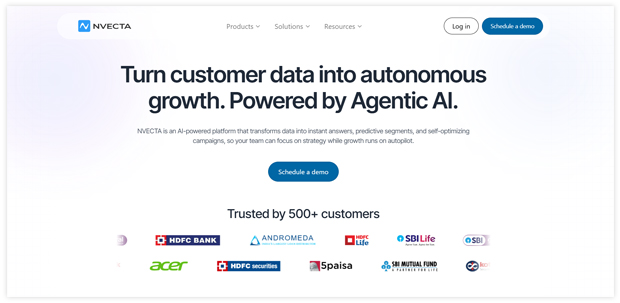
Nvecta is a leading customer data platform (CDP) that seamlessly integrates customer data from diverse sources. This allows businesses to create a unified profile for each customer, fostering a comprehensive understanding.
Utilizing our platform, businesses can enhance customer experiences by delivering personalized and relevant interactions.
Features
- Unified customer view
- Segmentation
- Journey builder
- Funnel analysis
- AI-powered features
- Real-time data ingestion and processing
- Identity resolution
- Predictive analytics
Pros
- Seamless integration
- Comprehensive data collection
- Powerful segmentation
- Personalized messaging
- Automated workflows
- Scalability
2. Amperity

Amperity’s AI-driven platform provides a 360-degree view of customer profiles, serving as a unified hub for data intelligence, and offering AI-driven ID resolution and management.
While delivering excellent audience segmentation and predictive analytics, users may find the interface intricate, with limitations in campaign reporting.
Pros
- Easy-to-use audience segmentation
- Excellent predictive analytics
- Unlocks insights instantly
Cons
- Complicated interface
- Limited campaign reporting
3. Segment.com

Segment.com offers businesses the essential data foundation for becoming customer-centric brands. The platform enables the collection, consolidation, and utilization of customer data from diverse touchpoints, facilitating real-time decisions to elevate customer experiences.
Pros
- Easy integration with existing CRM
- Real-time data integration
- Standardization of data via a shared data dictionary
Cons
- Confusing onboarding process
- Requires insertion of code snippets for accurate results
Conclusion
CDPs for restaurants are a powerful tool that can revolutionise your restaurant’s operations. By collecting and analyzing customer data, you can gain valuable insights into customer behaviour, preferences, and needs. This allows you to tailor your marketing efforts, personalise the dining experience, streamline inventory management, and make data-driven decisions.
With the right CDP, you can drive revenue growth, enhance the customer experience, and position your restaurant for long-term success in a competitive market. Remember, understanding your customers is the key to success in the restaurant industry. Start leveraging the power of a CDP today by scheduling a free demo with our experts.
FAQs
1. What is a customer data platform?
A customer data platform (CDP) is software that unifies customer data from different sources into a single, centralized location. This data can come from various touchpoints, such as website visits, email interactions, purchase history, and more. By aggregating all this data, the CDP creates a 360-degree view of each customer, enabling businesses to understand their audience better and personalise their marketing efforts.
2. How can CDP insights help restaurants?
By analysing customer data for your restaurant business, you can gain insights into customer behaviour, improve the overall customer experience, identify trends, and personalise marketing campaigns.
3. What are the best CDPs for the restaurant industry?
The best 3 CDPs are:
1. Nvecta
2. Amperity
3. Segment.com
