














 Email
Email SMS
SMS Whatsapp
 Web Push
 App Push
 Audience Sync for Ads
 Popups
 Channel A/B Testing
  Control groups Analysis
 Frequency Capping
 Funnel Analysis
 Cohort Analysis
 RFM Analysis
 Signup Forms
 Surveys
 NPS
NPS Landing pages personalization
  Website A/B Testing
  PWA/TWA
 Heatmaps
 Session Recording
 Wix
Wix Shopify
 Magento
 Woocommerce
 eCommerce D2C
  Mutual Funds
 Insurance
 Lending
  Recipes
  Knowledgebase
 Developer Docs
 Product Updates
 App Marketplace
 Academy
 Ebooks
 Case Studies
 Blog
Blog Templates
 Aparupa Saha
Quick Answer
A CDP in the travel industry is a platform that unifies traveller data from booking engines, loyalty programmes, apps, websites, and call centres into a single customer profile — enabling airlines, hotels, and OTAs to deliver personalised experiences, increase direct bookings, and improve retention across every touchpoint. Travel brands using CDPs have reported 20% increases in direct bookings, 22% improvements in customer retention, and 12% revenue lifts in airline operations.
CDP Travel Industry Statistics — What the Data Shows
The case for CDPs in travel is no longer theoretical. Across hotels, airlines, and online travel agencies, documented results show consistent, measurable improvements in direct bookings, retention, and revenue. Here is what the research shows.
- 20% increase in direct bookings when a global hotel chain unified guest data across PMS, booking engine, and loyalty platform into a single CDP profile. The same programme delivered a 15% improvement in guest satisfaction scores and a 25% growth in loyalty programme enrolments (e-CENS / industry research, 2025).
- 12% revenue increase for a leading airline that used CDP-driven revenue management to better match ancillary offers to passenger behaviour. The initiative also produced a 5% improvement in load factor and a 10% boost in customer satisfaction (e-CENS / industry research, 2025).
- 22% rise in customer retention achieved by an online travel agency that used a CDP to create consistent, personalised customer experiences across web, app, email, and push. The programme also delivered an 18% increase in repeat bookings and a 15% boost in customer lifetime value (e-CENS / industry research, 2025).
- 19x ROI from onsite personalisation delivered by Piqniq — a UK-based family travel platform — after unifying customer data through a CDP and activating personalised journeys across website, email, and WhatsApp. The personalised journeys themselves produced a 5x ROI (Insider, 2024).
- Direct booking optimisation and booking abandonment recovery are consistently ranked as the highest-ROI CDP use cases for travel brands, ahead of loyalty personalisation and ancillary upsell, because they reduce OTA commission dependency and recover near-purchase travellers at the highest-intent moment (CDP.com, 2026).
The common thread across all these results is not a particular platform — it is the act of unifying fragmented travel data into one profile and then activating it in real time across the channels where travellers actually are. That is what a well-implemented CDP makes possible.
Top CDP Use Cases in the Travel Industry
Beyond the headline benefits, the following use cases represent the most commercially valuable applications of CDPs for travel brands in 2026 — from acquisition through to post-trip retention.
1. Booking Abandonment Recovery
Travel bookings have among the highest abandonment rates of any industry — often exceeding 80% on desktop and higher on mobile.
When a traveller searches for flights or hotels, compares options, and leaves without booking, that intent signal is one of the strongest buying signals a brand will ever receive.
A CDP connects that anonymous browsing session to a known customer profile (or builds one), and triggers a recovery sequence — a personalised email, an SMS, or a retargeted ad — within minutes of abandonment, while the decision is still live.
Without a CDP, this signal is lost because it lives in a web analytics tool that cannot talk to the CRM or the email platform.
2. Direct Booking Optimisation
For hotels and airlines, OTA commissions represent a significant margin drain — typically 15–25% per booking. CDPs help shift travellers from OTA to direct channels by identifying customers who have booked through OTAs in the past and targeting them with direct-booking incentives, loyalty programme benefits, or exclusive pricing. Since the CDP knows their past booking behaviour, preference, and channel, the message can be timed and personalised to the point where direct booking genuinely feels like the better deal — because for that specific traveller, it is.
3. Pre-Trip Personalisation
The window between booking confirmation and departure is one of the most underused revenue opportunities in travel. A traveller who has just confirmed a hotel booking is actively planning their trip — researching restaurants, excursions, local transport, and activities.
A CDP that connects booking data, past travel history, and preference signals enables brands to send pre-arrival communications that feel relevant rather than generic: an upgrade offer calibrated to their room history, an excursion matched to their interests, a dining reservation for a restaurant they have been near before.
These messages convert better than standard pre-arrival blasts because they are grounded in what the traveller has actually done, not a template applied to a segment.
4. Loyalty Programme Personalisation
Loyalty programmes generate enormous amounts of data, but most travel brands use only a fraction of it. A CDP connects loyalty data with web behaviour, booking history, and engagement data to make loyalty communications significantly more targeted.
A member whose points are approaching expiry receives a time-limited prompt. A member one tier below status receives messaging about the specific bookings needed to reach the next level. A high-value lapsed member receives a win-back offer calibrated to their last booking pattern. None of these require complex engineering — they require a unified profile and the activation layer to use it.
5. Ancillary Upsell Automation
Ancillary revenue — seat upgrades, car hire, travel insurance, excursions, in-flight meals — is one of the fastest-growing revenue streams in travel. But generic ancillary offers have low conversion rates because they are sent to everyone regardless of relevance. A CDP changes the conversion equation by targeting ancillary offers based on actual customer signals: a traveller who rented a car on their last trip gets a car hire offer early in the booking flow; a family traveller gets airport lounge access rather than a solo dining voucher; a business traveller gets seat upgrade messaging rather than activity packs. The offer is the same — the targeting is what makes it convert.
6. Post-Trip Win-Back
Travel is seasonal and repeat bookings rarely happen without prompting. A CDP enables brands to trigger post-trip communications at the right time — not immediately after return when the traveller is processing expenses, but 4–8 weeks later when next-trip planning typically begins. Because the CDP retains the full booking history, these messages can reference the specific trip just completed: “You visited Barcelona in April — here are our summer Spain departures you haven’t seen yet.” This level of specificity is not available from a standard email platform without significant manual setup.
7. In-Trip Real-Time Engagement
Modern travellers expect brands to be useful during the trip, not just before and after it. CDPs that connect to mobile app data enable in-trip engagement — push notifications with gate changes, hotel check-in reminders, local weather updates with relevant service offers, or restaurant recommendations timed to arrival. For hotels specifically, the check-in moment is a high-value personalisation window: front desk staff with a unified guest profile can acknowledge past preferences, offer relevant amenity information, and create the kind of first impression that drives review scores.
CDPs by Travel Sub-Vertical — Airlines, Hotels, and OTAs
The data challenges and highest-priority CDP applications differ meaningfully across travel sub-verticals. Here is how each one typically approaches CDP implementation.
CDPs for Airlines
Airlines sit on some of the richest customer datasets in travel — booking records, seat preferences, meal requests, frequent flyer activity, lounge access, on-board purchases, and flight completion data. The problem is that this data is distributed across multiple systems: the PSS (passenger service system), the loyalty platform, the website, the app, and the ground handling systems. None of these talk to each other natively. As a result, a passenger who has flown 50 times receives the same pre-flight email as a first-time flyer. A CDP that connects these sources creates a truly unified passenger profile — one that powers ancillary upsell, tier-based personalisation, and load optimisation based on booking behaviour rather than just inventory levels.
CDPs for Hotels
Hotels face a particularly fragmented data landscape. Guest data lives in the PMS, the booking engine, the restaurant and spa systems, the loyalty platform, and increasingly in OTA profiles that the hotel itself cannot access directly. A guest who books through Booking.com is essentially anonymous to the hotel’s systems until check-in. A CDP helps hotels recover that identity — matching the OTA booking to a known loyalty profile or past stay record using email, phone, or behavioural signals — and activating that profile for pre-arrival personalisation, in-stay upsell, and post-stay retention. For hotel groups with multiple properties, a CDP also enables cross-property guest recognition, where a guest’s preferences from one location inform the experience at another.
CDPs for OTAs and Online Travel Platforms
Online travel agencies and platforms have a different challenge from hotels and airlines: they have enormous volumes of high-intent behavioural data — destination searches, date comparisons, price alerts, abandoned bookings — but a large proportion of their users are anonymous. The CDP use case for OTAs is therefore heavily weighted toward identity resolution and intent-based activation: matching anonymous browsing sessions to known users, building predictive intent models from search patterns, and triggering conversion campaigns while intent is highest. The ability to identify a high-intent anonymous session and match it to a known customer within minutes of a sign-in event is one of the most commercially valuable capabilities a CDP delivers for online travel platforms.
Customer data platforms (CDPs) have revolutionized the way travel companies operate in today’s fast-paced and ever-evolving industry.
With the ability to unify customer data from multiple sources and provide actionable insights, CDPs have become an essential tool for marketers in the travel sector.
In this article, we will explore the five key ways on how CDPs in the travel industry can enhance customer experiences and drive business growth.
Understanding CDPs in the Travel Industry
CDPs have two main functions within the travel industry: customer segmentation and customer journey mapping. These functionalities enable travel marketers to gain a comprehensive understanding of their customer base and optimize their marketing efforts accordingly.
1. Customer Segmentation

To deliver personalized marketing campaigns and tailored customer experiences, travel companies must have a deep understanding of their customers.
CDPs facilitate this by consolidating customer data from various sources, such as customer relationship management (CRM) systems, e-commerce platforms, and social media. A free CRM helps businesses organize customer interactions and keep important data connected across teams and communication channels.
By integrating this data into a single platform, travel marketers can effectively segment their customer base and create targeted campaigns that are more likely to convert.
For example, the CDP can identify niche customers interested in booking a highly specialized tour based on the exploits of Captain Speirs by isolating buyers with unique behavioral indicators, such as history buffs who have searched for historical sites or military museums, allowing marketers to target them with highly targeted and relevant offers. With accurate customer insights, travel marketers can optimize their room booking strategies for higher conversion rates.
2. Customer Journey Mapping

Mapping the customer journey is crucial for travel marketers as it allows them to identify touchpoints and pain points throughout the customer’s interaction with their brand.
CDPs enable marketers to create a holistic view of the customer journey, encompassing how customers discover their website, their on-site behavior, and their interactions across different channels.
Armed with this information, travel marketers can optimize the customer journey to enhance customer experiences and improve overall satisfaction.
5 Ways to Harness the Power of CDPs in the Travel Industry
Now, let’s delve into the specific ways in which travel companies can leverage CDPs to their advantage.
1. Unify Traveler Customer Data

One of the primary benefits of utilizing CDPs in the travel industry is the ability to unify customer data from various channels. This consolidation provides marketers with a holistic view of the customer journey, enabling them to better understand customer behavior and preferences.
By leveraging this comprehensive understanding, travel companies can deliver more personalized customer experiences. For example, imagine a customer who books a flight using their phone and later checks into a hotel using a laptop. Perhaps as part of one of the Zurich travel packages they’ve purchased.
With a CDP in place, the two companies can identify that it is the same customer and merge their respective data. This integration allows the hotel to store the data in their reception management platform, while synchronizing insights with their Hotel Management Software to deliver a personalised experience based on the customer’s preferences, enhancing overall satisfaction. This is particularly valuable for customers living the digital nomad lifestyle, who often book extended stays and value seamless experiences across multiple travel services.
2. Highlight Specific Amenities or Features
CDPs can be a powerful tool for travel companies to highlight specific amenities or features that may be of interest to their customers. By leveraging customer data, travel marketers can segment their customer base and target them with content that is relevant to their preferences.
For instance, if a customer frequently books road trips to sunny destinations like Florida, a CDP can be used to showcase advertisements for RV rentals in Florida, hotels with pools, or discounts on spa treatments.
Similarly, if a customer has specific dietary requirements, travel companies can highlight the meal options available on their flights. It is also worth noting that many countries ask visitors to present an onward ticket to confirm their travel plans beyond the initial destination . By tailoring their offerings to individual preferences, travel companies can enhance customer satisfaction and drive conversions.
3. Retarget Travel Options to Abandoned Carts or Inactive Customers

CDPs offer travel companies the opportunity to retarget travel options to customers who have abandoned their carts or shown inactivity. By analyzing customer data, CDPs enable companies to identify customers who have shown interest in their products but have not followed through with a purchase.
For instance, if a customer abandons their flight booking before completing the purchase, a CDP allows travel companies to retarget them with relevant content, such as a discount on their flight or a special offer for a hotel at their destination.
This personalized approach can help win back customers, improve customer experiences, and foster loyalty.
4. Coordinate Travel Messaging Across Channels
Travel companies often engage with customers through multiple channels, such as social media, email marketing, and advertisements. CDPs enable marketers to unify and coordinate their cross-channel marketing efforts.
By segmenting customers based on their preferred channels of communication, travel companies can deliver tailored messages that resonate with each customer segment. For example, if certain customers are more responsive to social media ads, marketers can prioritize social marketing campaigns for that specific segment.
Similarly, if a customer is more receptive to email marketing, personalized emails can be sent to drive conversions. This coordinated approach not only streamlines marketing efforts but also enhances the overall customer experience.
5. Elevate Traveler Loyalty Programs

Loyalty programs are a crucial aspect of the travel industry, and CDPs can significantly enhance their effectiveness. By leveraging traveler data from various sources, travel companies can serve personalized promotions to repeat customers, ensuring that each offer resonates with their preferences.
For instance, if a customer has previously booked a flight with a particular airline, the airline can use a CDP to segment that customer and send them personalized messages about their loyalty program. This targeted approach enhances customer engagement, fosters loyalty, and improves overall customer satisfaction.
3 Best Customer Data Platforms for Travel Industry
1. NVECTA
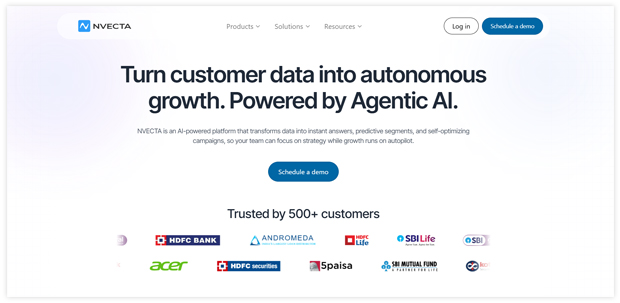
NVECTA is a leading customer data platform (CDP), seamlessly integrating customer data from diverse sources. This allows businesses to create a unified profile for each customer, fostering a comprehensive understanding.
Utilizing our platform, businesses can enhance customer experiences by delivering personalized and relevant interactions.
Features
- Unified customer view
- Segmentation
- Journey builder
- Funnel analysis
- AI-powered features
- Real-time data ingestion and processing
- Identity resolution
- Predictive analytics
Pros
- Seamless integration
- Comprehensive data collection
- Powerful segmentation
- Personalized messaging
- Automated workflows
- Scalability
2. Amperity

Amperity’s AI-driven platform provides a 360-degree view of customer profiles, serving as a unified hub for data intelligence, and offering AI-driven ID resolution and management.
While delivering excellent audience segmentation and predictive analytics, users may find the interface intricate, with limitations in campaign reporting.
Pros
- Easy-to-use audience segmentation
- Excellent predictive analytics
- Unlocks insights instantly
Cons
- Complicated interface
- Limited campaign reporting
3. Segment.com

Segment.com offers businesses the essential data foundation for becoming customer-centric brands. The platform enables the collection, consolidation, and utilization of customer data from diverse touchpoints, facilitating real-time decisions to elevate customer experiences.
Pros
- Easy integration with existing CRM
- Real-time data integration
- Standardization of data via a shared data dictionary
Cons
- Confusing onboarding process
- Requires insertion of code snippets for accurate results
Conclusion
CDPs in the travel industry have emerged as a game-changer, empowering travel companies to deliver exceptional customer experiences and drive business growth. By unifying customer data, highlighting specific amenities, retargeting abandoned carts or inactive customers, coordinating travel messaging, and elevating traveler loyalty programs, travel marketers can leverage CDPs to their advantage. If you’re looking to run a small tour booking business, implementing a CDP can streamline your operations, allowing you to personalize customer experiences and enhance your marketing efforts.
If you are a travel company looking to enhance your marketing efforts, integrating a CDP, such as NVECTA CDP, can provide you with a single, actionable view of your customers and prospects. With our user-friendly interface and fast implementation, you can revolutionize the way you engage with your customers and drive business success.
FAQs
1. What is a customer data platform?
A customer data platform (CDP) unifies customer data from various sources into a single, centralized location. This data can come from multiple touchpoints, such as website visits, email interactions, purchase history, and more. By bringing all this data together, the CDP creates a 360-degree view of each customer, which can then be used for marketing, sales, and customer service purposes.
2. How to leverage CDPs in the Travel Industry?
Here are a few ways through which you can leverage CDP in the travel industry:
1. Unify customer travelling data
2. Highlight traveler specific features
3. Retarget travel options to abandoned carts or inactive customers
4. Coordinate travel messaging across channels
5. Promote traveler loyalty program
3. What are 3 best CDPs in the travel industry?
Here are the 3 best CDPs you can consider:
1. NVECTA
2. Amperity
3. Segment.com
See how NVECTA specifically handles travel and hospitality data complexity — from booking lifecycle automation to loyalty programme personalisation: NVECTA for Travel & Hospitality — guest profiles, pre-arrival personalisation, and post-stay retention across all channels.
New to CDPs and want to understand how they work before applying them to travel? Start here: What Is a Customer Data Platform (CDP)? — a comprehensive guide to how CDPs collect, unify, and activate customer data across industries.
