














 Email
Email SMS
SMS Whatsapp
 Web Push
 App Push
 Audience Sync for Ads
 Popups
 Channel A/B Testing
  Control groups Analysis
 Frequency Capping
 Funnel Analysis
 Cohort Analysis
 RFM Analysis
 Signup Forms
 Surveys
 NPS
NPS Landing pages personalization
  Website A/B Testing
  PWA/TWA
 Heatmaps
 Session Recording
 Wix
Wix Shopify
 Magento
 Woocommerce
 eCommerce D2C
  Mutual Funds
 Insurance
 Lending
  Recipes
  Knowledgebase
 Developer Docs
 Product Updates
 App Marketplace
 Academy
 Ebooks
 Case Studies
 Blog
Blog Templates
 Afreen Sheikh
To build an effective marketing plan, a brand needs to consider customer location. The location plays an important role in shaping customer behaviour, expectations and purchasing decisions. A strategy that works in one region may not deliver the same outcomes in another due to differences in market conditions and preferences.
Geographic segmentation is an effective tool that helps businesses organise their audiences by location and generate geographic insights. These insights help businesses target specific regions, refine communication, and improve campaign effectiveness. This makes marketing more relevant and results more consistent.
In this blog, you will understand how Geographic Segmentation works, why it is important, and how NVECTA helps turn location data into actionable marketing strategies.
What is Geographic Segmentation?
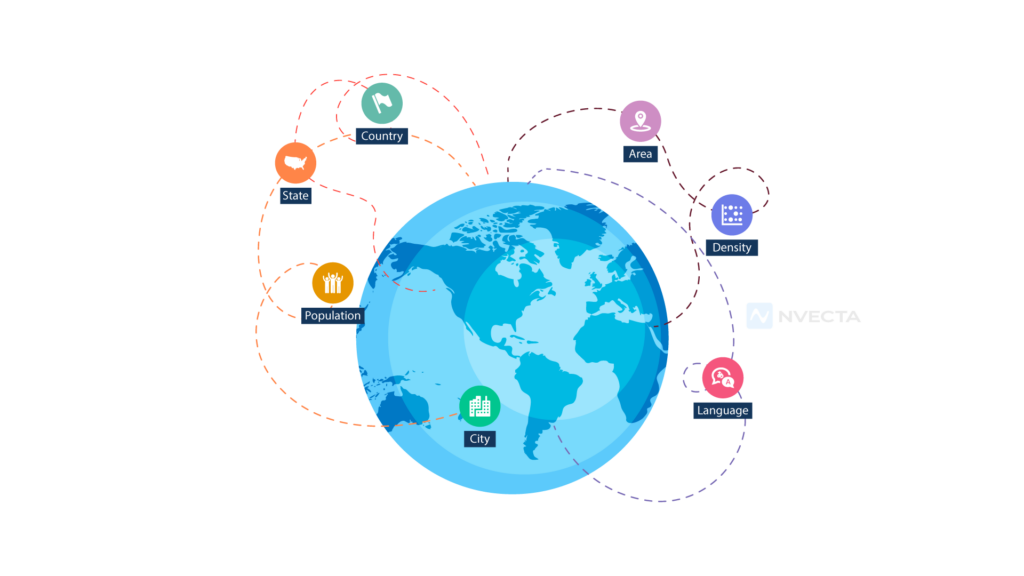
Geography segmentation is a marketing strategy that divides customers into smaller groups based on location-specific factors such as country, region, state, city, or even postal codes.
It allows brands to categorise their audience using segments that reflect geographical factors.
This form of segmentation considered variables such as climate conditions, population, density, language, and regional infrastructure.
Sach variable affects what customers need and how they interact with a brand. For example, climate-based differences can affect seasonal product demand, while urban and rural factors may require different marketing approaches.
Using geographical segmentation, brands can better understand markets and plan their marketing campaigns to align with the characteristics of that region.
Why Geographic Segmentation Matters?
Geographic segmentation matters because a product or service may perform well in a region but may fail in another.
This happens because customers’ expectations differ depending on where they live. For example, an E-Commerce CDP can reveal higher demand for premium products in metro cities, while smaller towns respond better to value-based pricing.
With geo insights, brands can refine their approach by adjusting their product or service strategy. They can adjust pricing, delivery, or communication to offer more relevant information in each region
This is an insight-driven approach that helps marketers to eliminate guesswork for when it comes to location-based marketing.
Simply put, location-based customer data is tracked, processed to create actionable insights and used to optimise campaigns and targeting. This increases the performance metrics that support business growth.
Advantages of Geographic Segmentation
Geographic segmentation is one of the easier segmentation methods to set up, mainly because location is objective. You don’t have to guess someone’s habits or interests the way you do with behavioural data — you already know where they are from their IP, shipping address, or order history.
It also keeps spending tight. Instead of pushing one ad to everyone, you put budget only where the product actually sells. A winter-wear brand has no reason to pay for ads in regions that never see cold weather.
The other big gain is relevance. When your message matches the local season, language, or buying pattern, people respond to it more. And over time these region-wise results tell you which markets are worth expanding into and which ones to leave alone.
Limitations of Geographic Segmentation
Location is useful, but it doesn’t explain everything. Two people living on the same street can have completely different incomes, tastes, and buying habits. So geographic data on its own can lead to lazy assumptions.
There’s also the risk of tunnel vision. If a brand pours everything into one strong region, it can quietly miss other markets that were ready to grow.
For digital products like SaaS apps, location matters even less, since the product works the same whether the user is in Delhi or Berlin. This is why most teams pair geographic data with behavioural and demographic data instead of relying on it alone.
Types of Geographic Segmentation
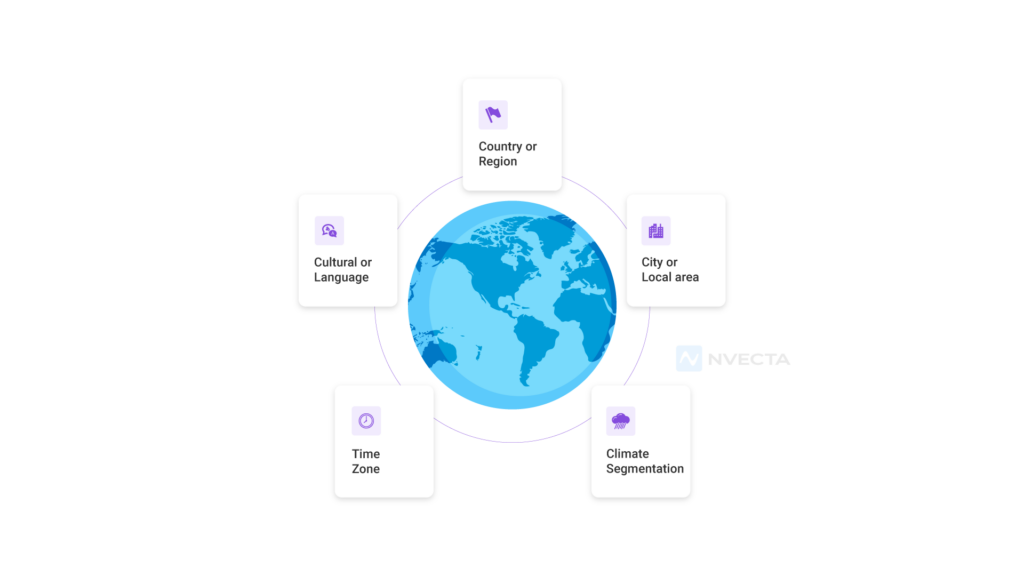
Geographic segmentation includes several types that help businesses analyse location effectively-
Country or Region-Based Segmentation
Segment customers by country, state or region, helping brands to understand how the market differs in terms of pricing and demand, while planning market entry or expansion strategies.
City or Local area Segmentation
Group customers by city or neighbourhood level, helping brands to launch local campaigns and adjust products or services based on local demands and customer behaviour patterns.
Climate-Based Segmentation
Segments customers into urban and rural groups, helping brands to understand differences in lifestyle, accessibility, and buying habits across regions.
Time Zone Segmentation
Customer groups are based on time zones, helping brands to optimise campaign timing and ensure communication that reaches at optimal local times.
Cultural or Language Segmentation
Customer segments are based on language and cultural preferences, helping brands to create localised campaigns that align with regional communication styles.
Geographic Segmentation Examples
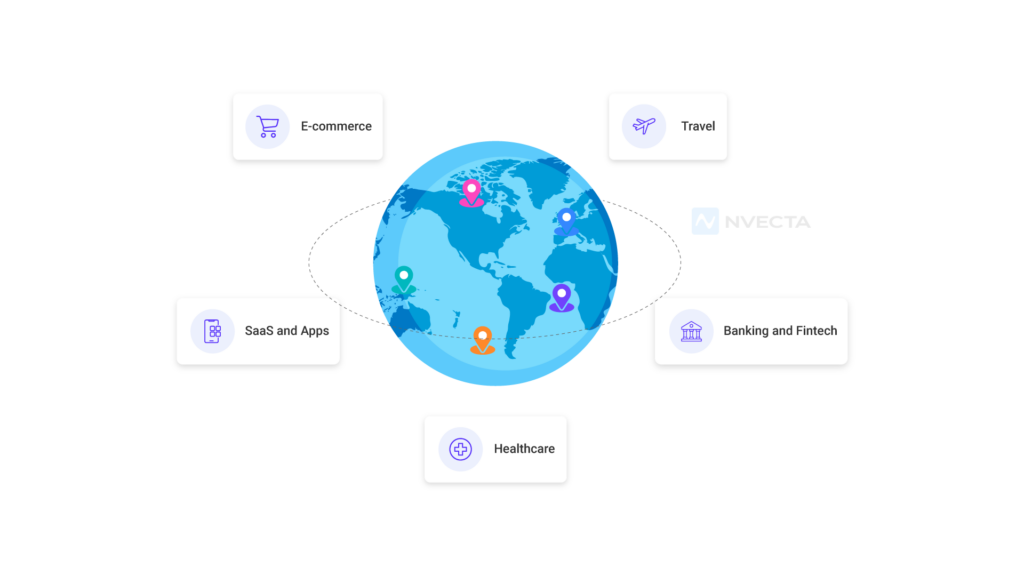
Let us look at some industry-specific examples that will help you see the practical applicability of geographic segmentation-
E-commerce
E-Commerce businesses actively use location data to make the shopping experience more relevant for customers across different regions.
- To show regional-specific product recommendations based on local demand
- Adjust pricing and discounts depending on purchasing patterns
- Promote trending products in specific cities or regions
- Offer location-based delivery options and timelines
SaaS and Apps
SaaS platforms use location data to improve user experience and product adoption.
- Customise onboarding flows based on user region
- Offer region-based pricing and subscription plans
- Address features based on complaints and users’ needs
- Provide localised language and content options
Travel
Travel platforms rely on users’ location to personalise recommendations and boost bookings.
- Suggest destinations based on users’ recent location
- Promote seasonal travel offers relevant to specific regions
- Display nearby travel deals and Short trip options
- Customise content based on regional travel preferences
Banking and Fintech
Banking and fintech companies use location data to offer services that actually match how people spend and save in different regions.
- Offer loan and credit options based on local income levels
- Adjust interest rates and plans based on regional conditions
- Promote services differently for cities and small towns
- Simplify communication based on regional financial awareness
Healthcare
Healthcare can use geographic segmentation to focus on what people in each region actually need.
- Show nearby hospitals, clinics, or diagnostic centres
- Promote services based on seasonal health trends
- Adjust appointment availability based on local capacity
- Share health alerts relevant to specific regions
Media and Entertainment
Media and entertainment platforms can use location factors to deliver content that customers are more likely to prefer.
- Recommend shows and movies based on regional viewing preferences
- Provide language-specific content for different regions
- Promote trending content in specific regions
- Adjust content recommendations based on cultural preferences
Food Delivery
Food delivery services rely on location data to ensure smooth operations and a better user experience.
- Recommend restaurants available in the user’s area
- Adjust delivery time based on location and traffic
- Run location-specific offers and discounts
- Recommend popular cuisine based on regional preferences
These examples illustrate how geographical segmentation can be applied in real business scenarios. They can easily adjust their products, services, and marketing using location data.
This improves the customer experience, helps brands increase customer engagement, strengthens personalisation, and delivers better results across different markets.
Real Brand Examples
McDonald’s is the classic case. In India it drops beef entirely and sells items like the McAloo Tikki, because the local market needed a menu built around regional eating habits.
Coca-Cola does something similar with flavours, releasing region-specific variants that wouldn’t sell the same way everywhere.
Amazon applies it on the operations side — placing warehouses close to high-demand regions so deliveries are faster and shipping costs drop.
How to Do Geographic Segmentation (Step by Step)
Start with a clear goal. Are you entering a new city, fixing weak regional sales, or timing a seasonal push? The goal decides everything after it.
Next, pull your location data. Most of it is already sitting in your tools — Google Analytics, shipping records, order history, or a customer data platform that unifies all of it into one profile.
Then build your segments, whether that’s by country, city, climate, or time zone. Adjust the actual campaign for each one — the offer, the language, the send time. Finally, track how each region performs and move budget toward the segments that convert.
Geographic Segmentation Use Cases with a CDP
A CDP supports location-based segmentation with a well-structured unified system. It helps businesses to collect, organise and apply geographic data across customer profiles, making it easier to create region-specific segments, run targeted campaigns and maintain consistent engagement across channels.
With CDPs’ geographic insights, brands can automate and upgrade their marketing efforts.
Let us have a look at CDP use cases-
Location-Based Audience Segmentation
A CDP creates audience segments based on location data. These segments continuously update as data changes, ensuring accurate targeting across multiple channels and marketing campaigns.
Region-Specific Campaign Targeting
A CDP uses location-based segments to execute campaigns tailored for specific regions, allowing businesses to send relevant messages related to offers and promotions to engage them.
This improves engagement and overall campaign effectiveness as marketing efforts are aligned with the regional preferences.
Personalised Messaging
A CDP uses location data to customise messaging for customers in different regions. This makes communication feel more personal and helps people connect better with your brand.
Geo-Triggered Automation
A CDP supports location-based automation, allowing campaigns to trigger when users enter a specific region or meet certain geographic conditions.
This helps brands reach the right moment without manual effort.
Time Zone Scheduling
A CDP allows campaigns to be scheduled as per user time zones, ensuring messages are delivered when customers are active.
This improves open rates, engagement, and overall campaign performance across different geographic regions.
Regional Performance Tracking and Insights
CDP tracks detailed insights into campaign performance across different locations. This helps brands identify high-performance markets and refine campaigns for better targeting, improving overall campaign results.
Combining Location with Behavioural Data
A CDP combines geographic data with user behaviour to create more advanced audience segments. This ensures that campaigns are relevant and targeting is more precise.
Unified Location Data Collection
A CDP collects location data from multiple sources, such as websites, mobile apps, and APIs, and unifies it into a single customer profile. This makes it easier to use location information across campaigns and marketing channels.
Localisation and Language Personalisation
CDP supports localised campaigns in different languages by processing geographic and language data. This helps brands in connecting with users in an appropriate language, improving user experience and engagement.
Geographic Segmentation vs Demographic vs Behavioural Segmentation
Geographic, demographic, and behavioural segmentation are different approaches to understanding customers. Each one plays a distinct role in a marketing strategy. Businesses must define clear goals and select the approach that best fits their objectives to achieve measurable results.
| Factor | Geographic Segmentation | Demographic Segmentation | Behavioural Segmentation |
|---|---|---|---|
| Definition | Groups users by location | Groups users by personal characteristics | Groups users by actions and interactions |
| Groups by | Country, region, city, postal code | Age, gender, income, occupation | Browsing activity, purchase history, engagement |
| Key data used | Location, climate, time zone, language | Age, education, marital status, income level | Click patterns, buying frequency, and intent signals |
| Best for | Regional targeting and local campaigns | Audience profiling and product positioning | Personalisation and conversion optimisation |
| Example | Promoting winter wear in cold regions | Targeting high-income users for premium plans | Re-engaging users who abandoned their cart |
Geographic Segmentation with NVECTA
NVECTA is an advanced customer data platform that provides its businesses with geographic segmentation.
It has advanced segmentation features that use location data to create location-based segments. These segments update dynamically as location data changes,
Allowing marketers to target users with more accurately personalised campaigns and manage location-based strategies across channels without manual efforts.
Let us look at features that facilitate geographic segmentation-
Build Precise Location-Based Segments
NVECTA creates audience segments by integrating real-time location data with customer profiles. Everything updates automatically as users move or interact.
For example, an e-commerce brand can target users in Delhi who frequently browse premium products. NVECTA’s AI identifies similar users likely to buy premium products in nearby areas, expanding audience segments and improving reach and scalability.
Launch location-specific campaigns
NVECTA supports the execution of different campaigns for specific regions across multiple channels. Such campaigns can adapt messaging and offers based on geographic segments.
For example, a clothing brand can promote winter wear collection in cold regions and summer clothes in warm regions.
Hyper-Personalised Campaigns Using Location Data
NVECTA supports dynamic personalisation based on location attributes by adjusting campaign content according to customer location activity. This helps in sending messages that feel more personal.
Automated location-based journeys
NVECTA enables automated customer journey flows triggered by geographic conditions, activating campaigns when a user enters a region or meets specific criteria.
For example, travel apps can send hotel offers when a user reaches a destination. Even cab apps can send bride offers when someone lands in a new city.
Optimise campaign timing by region
NVECTA ensures campaigns are delivered based on users’ time zones and activity patterns. This improves response rates and engagement.
Advanced Performance Insights
NVECTA tracks campaign performance and provides detailed insights across regions. This helps identify trends and optimise future campaigns.
For example, if you see higher conversion in metro cities for your product or service, you can invest more there.
Behaviour-Led Location Targeting
NVECTA combines user behaviour and location to create high-intent segments. This leads to precise targeting and effective campaigns that enhance multiple business outcomes.
For example, you can target Mumbai users who abandoned their cards to increase chances of conversion.
Deliver a Multi-Language Experience
NVECTA supports localised campaigns that adapt to language preferences and region-specific content to connect with users more effectively.
Conclusion
Geographic data plays a direct role in how customers respond to marketing. Location timing, regional differences influence customer demand and behaviour. Marketing campaigns tend to perform well when they align with varying customers’ expectations across locations.
When you keep a track of location data, you get to know how customers actually behave in different regions. This helps execute more targeted campaigns that deliver better communication and enhance engagement.
NVECTA makes this possible by combining geographic segmentation with real-time data, automation, and AI-driven insights to help businesses run region-specific campaigns more effectively.
Use geographic data to personalise experiences that drive measurable marketing results. Schedule a demo now.
What is geographic segmentation in marketing?
The main types include country or region-based segmentation, city or local area segmentation, climate-based segmentation, time zone segmentation, and cultural or language segmentation. Each type helps businesses address different location-specific factors that influence customer behaviour.
How is geographic segmentation different from demographic segmentation?
Geographic segmentation groups customers by location, such as city or country, while demographic segmentation groups them by personal characteristics like age, income, or occupation. Both serve different purposes and are often used together for more precise targeting.
Which industries benefit the most from geographic segmentation?
Industries such as e-commerce, travel, banking, healthcare, food delivery, and media and entertainment benefit significantly from geographic segmentation. It helps them personalise offerings, adjust pricing, and run region-specific campaigns that are more relevant to local audiences.
How does a CDP support geographic segmentation?
A CDP collects and unifies location data from multiple sources, such as websites, mobile apps, and APIs, into a single customer profile. It uses this data to build dynamic location-based segments, automate geo-triggered campaigns, schedule messages by time zone, and track regional performance.
What is the difference between geographic segmentation and geotargeting?
Geographic segmentation involves dividing your audience into groups based on location for strategic planning and campaign design. Geotargeting is the execution layer where ads or content are delivered to users in specific locations. Segmentation defines who to target; geotargeting is how you reach them.
What data do you need for geographic segmentation?
Less than you’d expect, and most of it is already sitting in your tools. Analytics gives you IP-based location. Checkout gives you shipping and billing addresses. Order history and site traffic fill in the rest. Want something more specific? A short survey works — you can ask when customers in a region start buying warmer clothes.
When should a business use geographic segmentation?
Whenever location genuinely changes how people buy. Retail, travel, real estate, and food delivery are the obvious fits, since weather, local culture, and infrastructure all push demand around. It’s also the first thing to reach for when you’re entering a new market and need to match local tastes and rules.
What is geodemographic segmentation?
Geographic and demographic data stitched together. Instead of targeting everyone in Mumbai, you narrow it to high-income households in South Mumbai. Where someone lives plus who they are tells you far more than either fact alone.
Which industries benefit most from geographic segmentation?
Retail, food and drink, travel, real estate, and banking lead the list. The pattern is simple: if what people want shifts from one region to the next — winter coats, local dishes, holiday trips — geography is doing most of the work for you.
Can geographic segmentation be combined with other segmentation types?
Yes, and skipping that step is a mistake. Location tells you where a customer is. Their browsing and purchases tell you what they do. Age and income tell you who they are. Stack all three and the targeting gets sharp — and it patches the main weakness of location data, which is that it can’t read intent on its own.
