














 Email
Email SMS
SMS Whatsapp
 Web Push
 App Push
 Audience Sync for Ads
 Popups
 Channel A/B Testing
  Control groups Analysis
 Frequency Capping
 Funnel Analysis
 Cohort Analysis
 RFM Analysis
 Signup Forms
 Surveys
 NPS
NPS Landing pages personalization
  Website A/B Testing
  PWA/TWA
 Heatmaps
 Session Recording
 Wix
Wix Shopify
 Magento
 Woocommerce
 eCommerce D2C
  Mutual Funds
 Insurance
 Lending
  Recipes
  Knowledgebase
 Developer Docs
 Product Updates
 App Marketplace
 Academy
 Ebooks
 Case Studies
 Blog
Blog Templates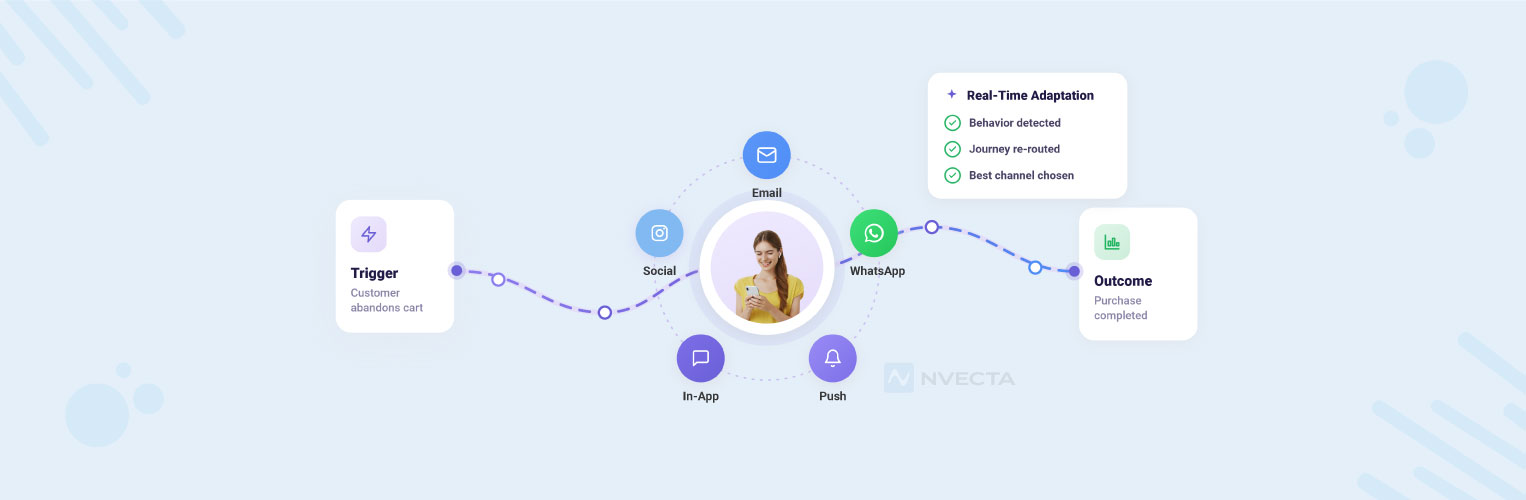
 Afreen Sheikh
An omnichannel customer journey is the connected path a customer takes across every touchpoint they use with a brand — website, app, email, SMS, WhatsApp, support, and store. Every interaction writes to one shared customer profile, so activity on one channel directly shapes what happens on the next.
Most brands already run email, SMS, WhatsApp, an app, a website, and a store. That part is solved. What is not solved is the fact that a customer moves between all six of those in a single afternoon, and your journey has no idea it is the same person.
Research from Aberdeen found that companies with strong omnichannel programs hold on to 89% of their customers, while companies with weak ones keep only 33%. Research from Aberdeen Group, still the most-cited number in this space, found that companies with strong omnichannel engagement retain 89% of their customers, while companies with weak omnichannel engagement keep only 33%. Salesforce’s State of the Connected Customer research adds the other half of the picture: 79% of customers expect consistent interactions across departments, yet 55% say it feels like they are talking to separate departments rather than one company.
The uncomfortable part is that unifying your data does not fix this on its own. Plenty of teams have a clean customer profile sitting in a warehouse and still send a discount email for a product the customer bought yesterday. The journey ran on rules written six months ago. Nobody updated them.
This guide covers what an omnichannel customer journey actually is, why static journey maps are quietly being abandoned, how real time journeys work step by step, what to measure, and what to look for in a platform.
What is an Omnichannel Customer Journey?
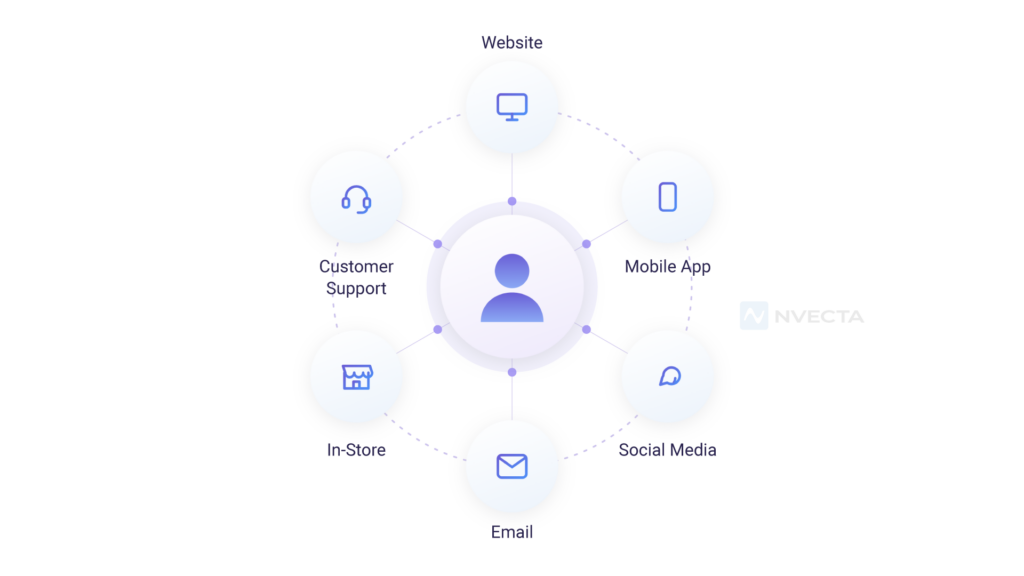
An omnichannel customer journey is the connected path a customer takes across every touchpoint they use with your brand. Website, app, email, SMS, WhatsApp, support, paid media, physical store. Each interaction becomes part of one continuous record instead of six separate ones.
Say a customer opens your app and looks at a jacket. Two days later they search for it on Google and land on your website from a desktop. A week after that they add it to cart on the app, abandon it, and finally buy it in store.
That is five events across three devices and two channels. A multichannel setup sees five strangers. An omnichannel journey sees one person and one intent.
Once you can see the whole thing, personalization stops being guesswork.
The Stages of An Omnichannel Journey (Omnichannel Customer Journey)
Most teams map their journeys against five stages. The names change depending on who you ask, but the shape is the same.
Awareness is where someone first runs into your brand, usually through search, social, or an ad. Consideration is the messy middle, where they compare you against two or three alternatives across different tabs and devices.
Decision is the purchase itself, which increasingly happens somewhere you did not expect, like a mobile checkout during a lunch break. Retention covers everything after: onboarding, support, replenishment. Advocacy is when they tell someone else, which is where your reviews come from.
The reason omnichannel matters is that customers do not walk down these stages in order. They loop. They stall in consideration for three weeks and then buy in ninety seconds. Your journey has to handle that.
Omnichannel vs Multichannel vs Cross-Channel
These three get used interchangeably and they should not be. Think of them as a ladder.
Multichannel means you are present on several channels. Each one runs its own campaigns, keeps its own data, and reports on its own numbers.
“Cross channel” means two or more channels talk to each other, usually through a shared segment or a suppression list. Omnichannel means every channel reads from and writes to the same customer profile, and what happens on one directly changes what happens on another.
Here is how the two approaches compare:
| Aspect | Omnichannel Journey | Multichannel Journey |
|---|---|---|
| Approach | Connects interactions around the customer | Engages customers through several separate channels |
| Customer data | Shared and used across touchpoints | Often stays inside individual channel systems |
| Customer context | Previous interactions stay available when the customer changes channels | Context is lost when the customer moves to another channel |
| Journey management | Teams manage the journey across touchpoints | Teams manage campaigns within individual channels |
| Personalization | Uses activity from across the whole journey | Relies only on data available within each channel |
| Channel coordination | Action on one channel changes what happens on another | Each channel communicates independently |
| Customer experience | Connected experiences as the customer moves between touchpoints | Repetitive or conflicting messages across channels |
Benefits of Omnichannel Customer Journeys
The case for connecting the omnichannel customer journey is not philosophical. It shows up in retention, revenue, and cost.
1. Retention that Compounds
Aberdeen Group’s widely cited research puts retention at 89% for companies with strong omnichannel engagement against 33% for companies with weak engagement. The same research shows strong omnichannel companies recording 9.5% year-over-year revenue growth versus 3.4% for weak ones.
2. Higher lifetime value per customer
Omnichannel shoppers carry roughly 30% higher lifetime value than single-channel shoppers, and Omnisend’s analysis of over 135,000 campaigns found that campaigns running three or more channels generated a 287% higher purchase rate than single-channel campaigns.
3. Fewer wasted sends
This is the benefit nobody puts on a slide. When every channel reads the same profile, you stop sending the discount for the jacket someone already bought. Suppression becomes a decision the system makes, not a list someone maintains.
4. Support that does not start from zero
Customers who move from chat to phone to email should not have to re-explain themselves. Salesforce found 56% of consumers regularly repeat information to different representatives. A shared profile removes the repetition.
5. Attribution you can actually trust
When five events across three devices resolve to one person, channel performance stops being a guess. You can see which touchpoint moved the customer, not just which one was last.
How to Map an Omnichannel Customer Journey
A journey map is still the right starting point. The mistake is treating the map as the finished product. Here is a working sequence.
Step 1: Define the segment before the map
“Our customer” is not a segment. A first-time buyer who found you through paid social behaves nothing like a lapsed subscriber returning after eight months. Map one segment at a time.
Step 1: Define the segment before the map “Our customer” is not a segment. A first-time buyer who found you through paid social behaves nothing like a lapsed subscriber returning after eight months. Map one segment at a time.
Step 2: Inventory every touchpoint, including the ones you do not own Website, app, email, SMS, WhatsApp, push, paid media, support, store, and the review site where the decision actually gets made. List them before you sequence them.
Step 3: Pull the real sequence from data, not from a workshop Most journey maps are drawn from memory in a conference room. Pull the actual event sequence from your warehouse or CDP instead. It will not look like the workshop version.
Step 4: Mark where identity breaks Find the exact points where the customer becomes a stranger — the desktop visit that never resolves to the app user, the in-store purchase that never attaches to the email profile. These are the gaps that make everything downstream wrong.
Step 5: Mark the friction, then mark the intent signals Friction points tell you where people leave. Intent signals tell you where they are about to act. Most maps capture the first and miss the second.
Step 6: Assign an owner to every touchpoint If nobody owns the SMS step, nobody updates it. Ownership is what turns a map into a maintained system.
Step 7: Attach the map to live data This is the step that separates a poster from a system. If the map is a static file, it goes stale the day it is signed off. If it reads from a live customer profile, it updates itself.
That last step is where most programs stop — and it is exactly where static journeys start to fail.
Why Traditional Customer Journeys are No Longer Effective
Traditional customer journeys rely on predefined rules, fragmented customer data, and assumptions. They work really well for simple campaigns but fall short when it comes to tracing customers’ intent, connecting customer actions and keeping interactions relevant across channels. This leads to missing opportunities due to delayed responses.
1. Static Paths Miss Changing Intent
Fixed workflows follow planned sequences and cannot easily adjust when customers change interests, switch channels, or take unexpected actions.
2. Fragmented Data Limits Customer Context
Customer data spread across different systems gives teams an incomplete view, leading to poorly coordinated interactions.
3. Delayed Responses Miss the Moment
With Batch processing and scheduled updates, journey responses are delayed, causing messages and offers to reach customers after their intent has changed.
Why Real-Time Adaptability Matters
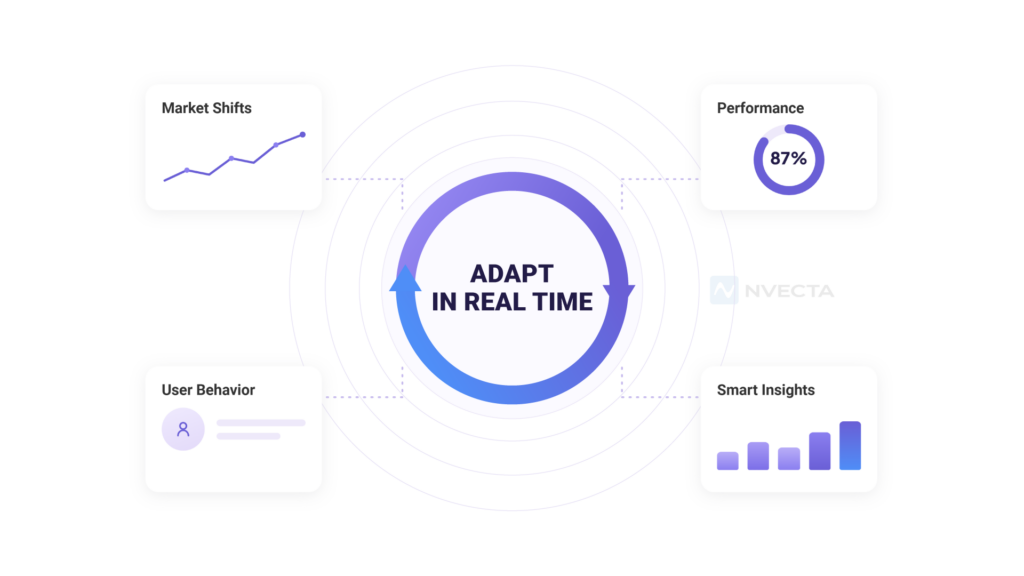
Real-time adaptability supports omnichannel customer journeys to adjust as customer behaviour changes. It helps brands respond to current customer intent, coordinate interactions across channels, and act while customer interest is high.
This keeps journeys relevant while improving engagement, conversions, retention, and marketing efficiency.
1. Respond When Customer Intent Changes
Real-time customer behaviour helps brands detect changing interests and adjust the journey before the next interaction becomes irrelevant.
2. Act at the Right Moment
Brands can respond while customer interest is active instead of delivering messages, recommendations, or offers after the opportunity has passed.
3. Keep Every Interaction Timely
Current customer context helps teams adjust messaging, offers, channels, and timing while suppressing communication that no longer serves a purpose.
4. Improve Conversion and Retention
More relevant interactions can increase conversions and retention, improve customer lifetime value, and reduce marketing spend on poorly timed communication.
5. It Is No Longer Optional
Two things changed. Customers now abandon a brand faster than a journey can be manually updated — if the response lags behind the intent, they move to a competitor.
And AI decisioning has made real-time next-best-action cheap enough that “we run on batch” is a choice, not a constraint.
How Real-Time Omnichannel Journeys Work (Step-by-Step Framework)
Building adaptive omnichannel customer journeys does more than just connecting channels or adding real-time triggers. The system must be equipped to capture customer behaviour, maintain unified profiles, understand intent, decide the next best action, activate it across channels, and learn from every outcome.
Every customer signal, new customer signal must flow into unified profiles- update the journey, influence what happens next, and help improve future interactions as customer behaviour and intent change.
Step 1: Capture Customer Signals
The process begins with collecting real-time behavioural signals, including customers’ browsing activity, purchases, app events, campaign responses, support/feedback interactions and offline touchpoints. These signals reflect customers’ recent intent, which is important for journeys to adapt.
Step 2: Build Unified Customer Profiles
Create a unified profile for every customer by resolving multiple customer identities spread across devices and channels. These profiles combine customers’ live behavioural data, transactional data, preferences, and consent data, so that every journey decision works from an accurate, real-time updating customer profile.
Step 3: Understand Behaviour and Intent
Next, the system analyses recent customer behaviour and past interactions to identify changes in interests, engagement, purchase intent, and journey stage. This helps marketers to understand the real intent of customers- what they are actually looking for.
Step 4: Decide the Next Best Action
Once the behaviour is assessed, the next step involves applying AI decisioning that chooses the next best action for a customer. Depending on the situation, the best action could be a personalized message, offer, recommendation, different channel, better timing, or no communication at all.
Step 5: Activate Across Channels
Then comes the part of implementing decisions into action- wherever the customer is most likely to engage. Cross-channel activation carries the selected experience to email, SMS, WhatsApp, apps, websites, paid media, or service channels without losing the context behind the decision.
Step 6: Learn From Every Outcome
Measure customer responses, conversions, and journey performance. Feed these outcomes back into analytics and decisioning so future actions improve based on what customers actually do rather than assumptions made when the journey was created.
Omnichannel Customer Journey Examples From Real Brands
Frameworks are easier to trust when you can see them running.
1. Starbucks
the wallet that follows you A Starbucks customer loads value on the app, earns stars in store, and sees the same balance update on the web and in the app instantly. The loyalty account is the shared profile. Rewards are not a channel feature; they are journey state.
2. Sephora
online research, in-store purchase, one profile Sephora ties the in-store experience to the app account. A customer who scans a product in store sees their own purchase history, ratings, and prior shades on the same phone. The store becomes a channel that reads from the profile instead of one that resets it.
3. Disney
one identity across booking, park, and room Disney’s approach links the trip planning site, the app, and physical access into one account. The same identity that booked the trip opens the hotel room and enters the park. Identity resolution is the product.
4. A sports league
geofence as an entry trigger Adobe documents a journey where a fan flying home crosses a geofence near the stadium and enters the journey. If they pass the team store, a second geofence triggers a real-time push with a merchandise offer.
Fans who have already bought a ticket get game details and a premium-seat upsell; fans who have not get a reminder that time is running out. Same entry, two branches, decided in the moment.
What all four have in common None of them are impressive because of the channel. They are impressive because the customer is the same person on every channel, and the system knows it.
Real World Use Cases of Omnichannel Customer Journeys Across Industries
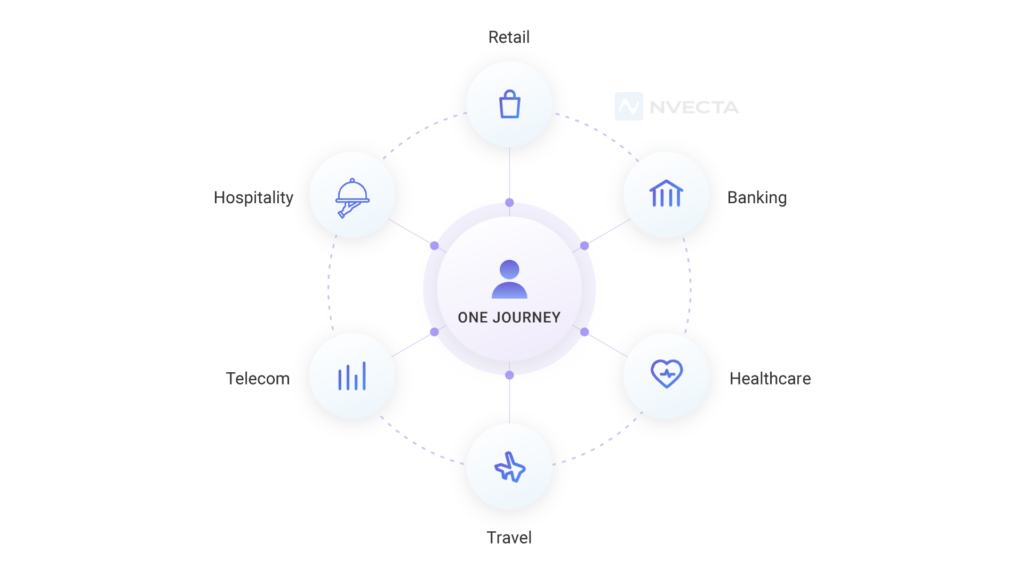
Omnichannel customer journeys apply across almost every industry. Here is how journeys adapt to real-time behaviour, actions, and changing context in five of them.
1. E-commerce
- Adjust cart recovery journeys when customers continue browsing, compare other products, or show changing purchase intent.
- Stop product promotions after a customer makes a purchase and move them into relevant post-purchase journeys.
- Trigger replenishment journeys using purchase history, buying cycles, and recent customer activity.
2. Banking and Financial Services
- Send personalized alerts/notifications to customers for incomplete loan, credit card, or account applications over a suitable channel.
- Trigger onboarding journeys when customers complete KYC, activate accounts, or make their first transaction.
- Use changes in transaction behaviour and product usage to trigger the right offers, service interactions, or retention journeys.
3. Healthcare
- Send appointment reminders to patients on their preferred communication channels.
- Trigger journeys after appointment confirmation, cancellation, or rescheduling to stop irrelevant communication.
- Adjust follow-up journeys as patients complete consultations, tests, treatments, or other care milestones.
4. SaaS
- Adapt onboarding journeys based on product usage, setup progress, and feature adoption.
- Start churn prevention journeys when declining usage or engagement signals indicate customer risk.
- Trigger expansion journeys when account activity and product adoption indicate growth opportunities.
5. Travel and Hospitality
- Update communication and offers in real-time when bookings, flights, or travel plans change.
- Adjust service recommendations using customer activity and context during the trip.
- Move customers into feedback, loyalty, or future booking journeys after the trip ends.
How to Measure Omnichannel Customer Journeys
Channel-level reporting will tell you email opened at 34%. It will not tell you whether the journey worked. These are the metrics that do.
1. Journey-level metrics
A. Journey completion rate: Of the customers who entered, how many reached the intended outcome? This is the headline number.
B. Stage-level drop-off: Where exactly do people leave? A journey with a good completion rate can still be leaking badly at one branch.
C. Time to conversion: How long from entry to outcome? Real-time journeys should compress this. If they do not, your triggers are firing late.
2. Customer-level metrics
A. Cross-channel conversion rate: Conversions where the customer touched two or more channels, as a share of total conversions. This is the closest thing to a direct omnichannel score.
B. Customer lifetime value, split by channel count: Compare single-channel customers to two-channel and three-plus-channel customers. If the gap is not widening, the journey is not doing its job.
C. Retention rate by journey path: Not overall retention — retention for customers who went down path A versus path B.
D. Repeat purchase rate: Cleaner than revenue for judging whether the post-purchase journey works.
3. Efficiency Metrics
A. Suppression rate: How many messages did the system decide *not* to send because the customer’s context made them irrelevant? This is the signature metric of a real-time journey, and almost nobody tracks it. A journey that never suppresses anything is a batch campaign with extra steps.
B. Cost per conversion, cross-channel: Total journey spend divided by journey conversions. Channel-level cost per conversion hides the fact that one channel is doing the work and another is taking the credit.
C. Message fatigue rate: Unsubscribes and opt-outs per customer per journey, not per campaign.
4. The one to watch
If you track only one thing, track **journey completion rate segmented by where the customer entered.** It tells you which entry triggers are actually finding people with intent, and which are just filling the funnel.
Common Challenges (and How to Fix Them)
1. Data silos
The most common blocker, and the least glamorous. Without integration, you cannot see how one channel affects another. MoEngage’s research found that 43.6% of marketers name the inability to identify gaps in the customer journey as a top blind spot.
Fix: Start with identity resolution, not with journey design. A journey built on a broken profile is worse than no journey — it sends confidently wrong messages.
2. Identity that breaks at the store door
Online behaviour resolves. In-store behaviour usually does not. The moment a customer pays with a card that is not linked to their profile, the journey loses them.
Fix: Tie the loyalty ID, not the email, to the purchase event. Loyalty programs exist for this reason more than for the discounts.
3. Organisational silos
Email is owned by lifecycle. Push is owned by product. Paid is owned by growth. Nobody owns the journey.
Fix: Give the journey an owner before you give it a budget.
4. Consent and privacy that arrives too late
A unified profile without consent state is a legal liability, not an asset. Under GDPR and India’s DPDP Act, consent has to travel with the profile, per channel, per purpose.
Fix: Treat consent as a first-class field in the customer profile, enforced at the decisioning layer — not as a suppression list applied at send time.
5. Attribution nobody agrees on
When every channel claims the same conversion, no team will ever agree to turn a channel off.
Fix: Move from last-touch to journey-level measurement. Judge the journey, not the channel.
6. Latency
A profile that updates every four hours cannot power a decision that needs to happen in four seconds.
Fix: Ask any prospective platform for the actual lag between event ingest and profile availability for decisioning. Not the marketing number — the p95 number.
How to Choose the Right Journey Orchestration Platform
Choosing the right platform that enables omnichannel journeys requires a brand to consider multiple factors. Look for how well the platform handles customer data, responds to live behaviour, makes decisions, and turns those decisions into coordinated experiences.
It should also fit your existing tech stack and continue to perform as data volumes and journey complexity grow. Let us see the specific factors.
1. AI-Driven Decisioning
Check whether the platform can decide what should happen next based on current customer intent and behaviour. Strong AI-driven decisioning uses scoring, predictions, selecting the next best action– an offer, channel, or timing, including when no action is the best choice.
2. Journey Builder
A journey builder should make complex journeys easier to manage, not create another layer of technical work. Look for behavioural triggers, flexible branching, journey changes based on new signals, and an interface that marketing and product teams can use without constant engineering support.
3. Customer Data Platform
The platform needs reliable customer data behind every journey. Evaluate its identity resolution, unified customer profiles, data governance, segmentation, and how quickly new data becomes available for use. A profile that updates too slowly can leave the journey working with an outdated context.
4. Real-Time Behaviour and Analytics
Look at how quickly the platform captures customer behaviour and makes it useful. Teams should be able to see changes in intent, journey performance, conversions, and drop-offs while there is still time to act, not only after a campaign has ended.
5. Cross-Channel Activation
Check whether the platform supports cross-channel activation so that consistent messages can be delivered across communication channels. Coordinated experiences enhance engagement and increase business outcomes.
6. Seamless Integrations
The platform must easily integrate with your existing data infrastructure- CRM systems, analytics tools, etc. Data migration could lead to additional costs. Also, check how much engineering work is required to add or maintain integrations.
7. Scalability
Consider what happens when customer profiles, event volumes, channels, and journey complexity increase. The platform should process growing data volumes and support more decisions without slower performance, delayed activation, or increasing operational effort.
How NVECTA Enables Omnichannel Customer Journeys
NVECTA is an AI-powered customer data platform that serves multiple industries with its customer intelligence, AI-driven decisioning, journey orchestration, and activation- all into a single platform.
It processes real-time customer data into advanced insights that let marketers understand their customers’ intent and make AI-driven decisions across their interaction channels. Let us explore its features in detail that facilitate real-time adaptable omnichannel journeys-
1. Unified Customer Intelligence
NVECTA collects customer data spread across multiple channels and resolves multiple customer identities to form one customer profile — the foundation every omnichannel customer journey runs on
Such profiles update in real-time with live customer activity. These profiles give brands a 360-degree view of every customer — behaviour, transactions, preferences, and consent data — kept ready for decisioning and activation
2. AI-Native Decisioning
NVECTA continuously evaluates customer activity to recommend the next best action and predict likely outcomes based on your business objectives. Its reinforcement learning engine improves suggestions as new data comes in.
3. Adaptive Journey Orchestration
NVECTA provides a drag-and-drop journey builder that helps in creating automated, personalized workflows. These journeys utilise real-time customer signals to adjust as per customer behaviour changes.
Customers can move between journey paths, skip irrelevant steps, or exit a journey when their preferences change, in order to keep every interaction aligned with their latest activity.
4. Cross-Channel Activation
NVECTA carries journey decisions across email, SMS, WhatsApp, push notifications, websites, apps, paid media, and other customer touchpoints. The same customer context stays behind each decision, delivering consistent, coordinated experiences across channels.
5. No-Code Journey Management and Analytics
Marketing and product teams can build audiences, manage journeys, and track performance without handing every change to engineering. Real-time journey analytics show conversions, customer responses, behavioural trends, and drop-offs, giving teams useful context for improving active journeys.
6. Integrations and Scalability
NVECTA connects with data sources, warehouses, CRM systems, marketing tools, and engagement channels used across the customer journey. Its integration coverage and scalable architecture help brands expand journey use cases as customer data, event volumes, and channel needs grow.
Final Thoughts (Omnichannel Customer Journey)
It is challenging for brands to keep up with the changing expectations of customers. They need better ways to manage omnichannel journeys as customer intent and preferences shift.
They need a real-time adaptive approach to make timely decisions and deliver relevant, personalized interactions across every stage of the omnichannel customer journey. With the right customer intelligence, decisioning and journey orchestration features, brands can replace the old ways of fixed workflows.
NVECTA supports real-time capabilities that manage adaptive Omnichannel Customer Journey from one platform.
Enhance the omnichannel customer journey with real-time adaptability, AI-driven decisioning to deliver more relevant experiences and improve conversion and retention. Schedule your demo now.
Frequently Asked Questions
What is a real-time omnichannel customer journey?
A real-time omnichannel customer journey connects customer interactions across channels and adjusts as per changing behaviour and intent. Rather than following a fixed workflow, it optimizes the next message, offer, channel, and timing based on recent customer activity.
How do real-time journeys work?
Real-time journeys use customer data and behavioural signals to manage how customers move through a journey. Entry triggers bring customers into relevant journeys, while branching directs them to suitable paths. With every new activity, it changes the path in terms of what happens next, per the shift in their preferences.
How is omnichannel different from multichannel marketing?
Multichannel marketing uses several channels to interact and engage its customers, but each channel may run its own campaigns and use separate data. Omnichannel marketing connects customer activity across all touchpoints used for interaction, so that an activity on one channel can influence what the customer experiences on another.
What is the role of AI in adaptive customer journeys?
AI helps brands analyse customer behaviour, predict likely outcomes, and decide what should happen next. AI decisioning selects the next best action for a customer -like an offer, a suitable channel, or the best timing, and even no action. Such decisions are mainly based on the current customer context and business objectives.
What should businesses look for in an omnichannel journey platform?
Look for unified customer profiles, real-time insights, AI decisioning, journey orchestration, cross-channel activation, easy integrations, and scalability. NVECTA CDP brings these capabilities together in one platform, so marketers can manage journeys that adapt to each customer’s recent activity
What are the stages of an omnichannel customer journey?
Awareness, consideration, decision, retention, and advocacy. In practice customers do not move through them in order — they loop, stall in consideration for weeks, then buy in ninety seconds. A journey has to handle that.
How do you measure an omnichannel customer journey?
Track journey completion rate, stage-level drop-off, cross-channel conversion rate, customer lifetime value split by channel count, and suppression rate. Channel-level open rates tell you nothing about whether the journey worked.
What is the difference between a customer journey map and journey orchestration?
A journey map is a document describing the intended path. Journey orchestration is the system that executes and adapts the path in real time. A map goes stale. Orchestration updates itself from live data.
Do you need a CDP to build omnichannel customer journeys?
You need a unified, real-time customer profile with identity resolution and consent state attached. A CDP is the most common way to get one. A data warehouse alone usually is not enough, because warehouse latency is measured in hours and journey decisions are measured in seconds.
