














 Email
Email SMS
SMS Whatsapp
 Web Push
 App Push
 Audience Sync for Ads
 Popups
 Channel A/B Testing
  Control groups Analysis
 Frequency Capping
 Funnel Analysis
 Cohort Analysis
 RFM Analysis
 Signup Forms
 Surveys
 NPS
NPS Landing pages personalization
  Website A/B Testing
  PWA/TWA
 Heatmaps
 Session Recording
 Wix
Wix Shopify
 Magento
 Woocommerce
 eCommerce D2C
  Mutual Funds
 Insurance
 Lending
  Recipes
  Knowledgebase
 Developer Docs
 Product Updates
 App Marketplace
 Academy
 Ebooks
 Case Studies
 Blog
Blog Templates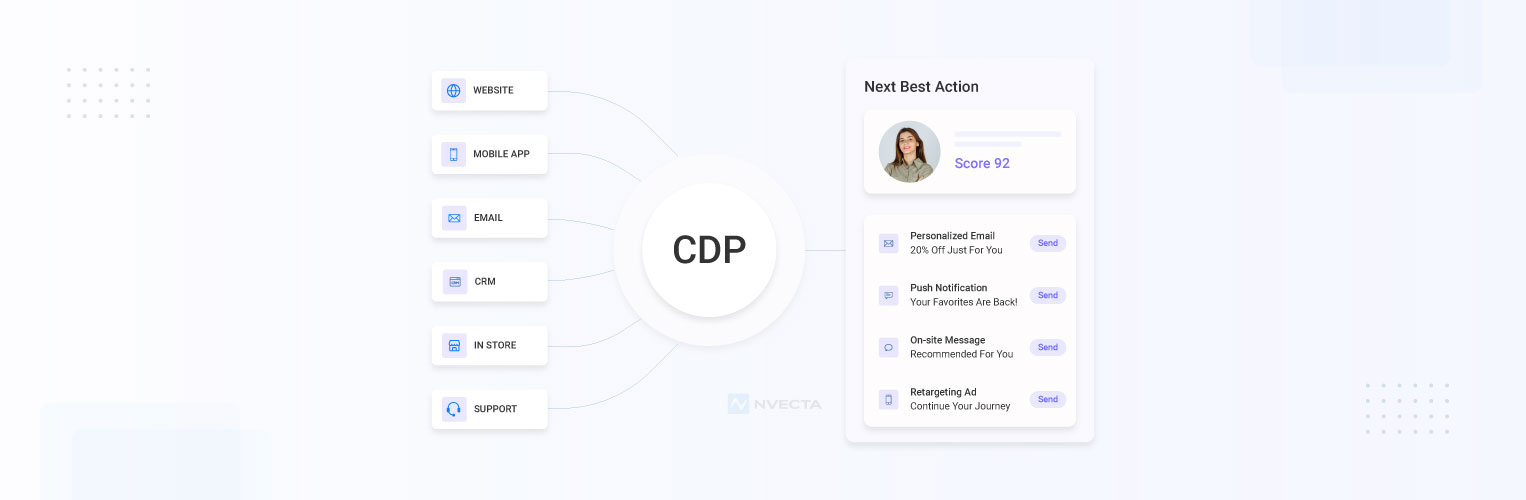
 Afreen Sheikh
Let’s be honest, most marketing still works on assumptions. Segments are created, campaigns are scheduled, and messages are sent in bulk, hoping someone clicks. Sometimes it works, but often fails to meet the mark.
This is where brands can use predictive analytics in marketing to transform their marketing strategy. It mainly works through machine learning and artificial intelligence, which analyses historical and real-time data to predict future customer actions such as purchases, churn and engagement levels.
However, predictions alone are not enough. The real value lies in using such insights to take the right action. This is where the concept of next best action (NBA) comes in, guiding marketers to decide what to do next, it could be sending a reminder, offering a discount, or simply waiting.
Customer data platforms make this possible through an extensive set of features, including data unification, real-time data processing, and cross-channel insights. They further use AI at various stages to perform functions intelligently.
In this blog, we will discuss what predictive analytics in marketing is, how it works, and how next best action guides marketing decisions.
We will further see how NVECTA connects data, predictions, and next best actions in one place.
What is Predictive Analytics in Marketing?
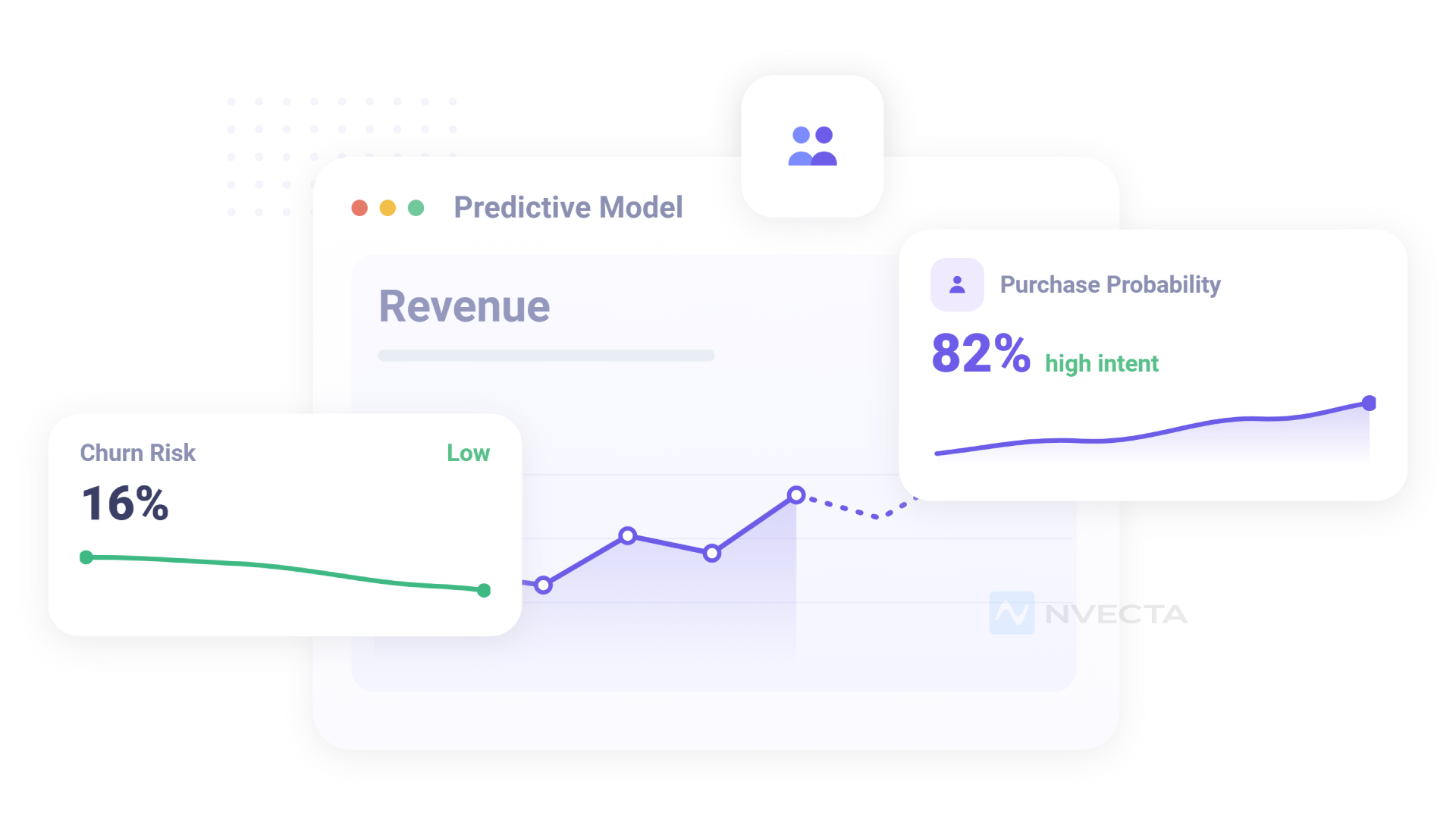
Predictive analytics is a structured approach that analyses customer data to understand what they are likely to do next. It uses AI and machine learning to analyse customer behaviour and predict future actions and preferences.
Every user action leaves a signal- when someone browses products, clicks on a WhatsApp message or spends time on a certain page, it tells you something about customer intent.
Predictive analytics connects the signals and identifies trends that later help businesses to create more targeted and relevant marketing strategies.
For example, if a customer visits a product multiple times, adds it to the cart, and has previously interacted with similar categories, there is a high chance the customer will buy it soon. Predictive analytics studies search for recurring behaviour to predict intent early.
Another example could be identifying customers who may be losing interest. If someone who used to engage regularly and stop opening emails or visiting your website, the system identifies the likelihood of churn.
This is done with the help of machine learning models that analyse large datasets to make predictions. These models improve with time as more data comes in. That means the predictions become more accurate with continued use.
With such predictions, marketers can optimise targeting and deliver more personalised experiences that drive higher engagement and conversions.
Data collection- pattern identification-prediction-action guidance
What is Next best Action in Marketing?
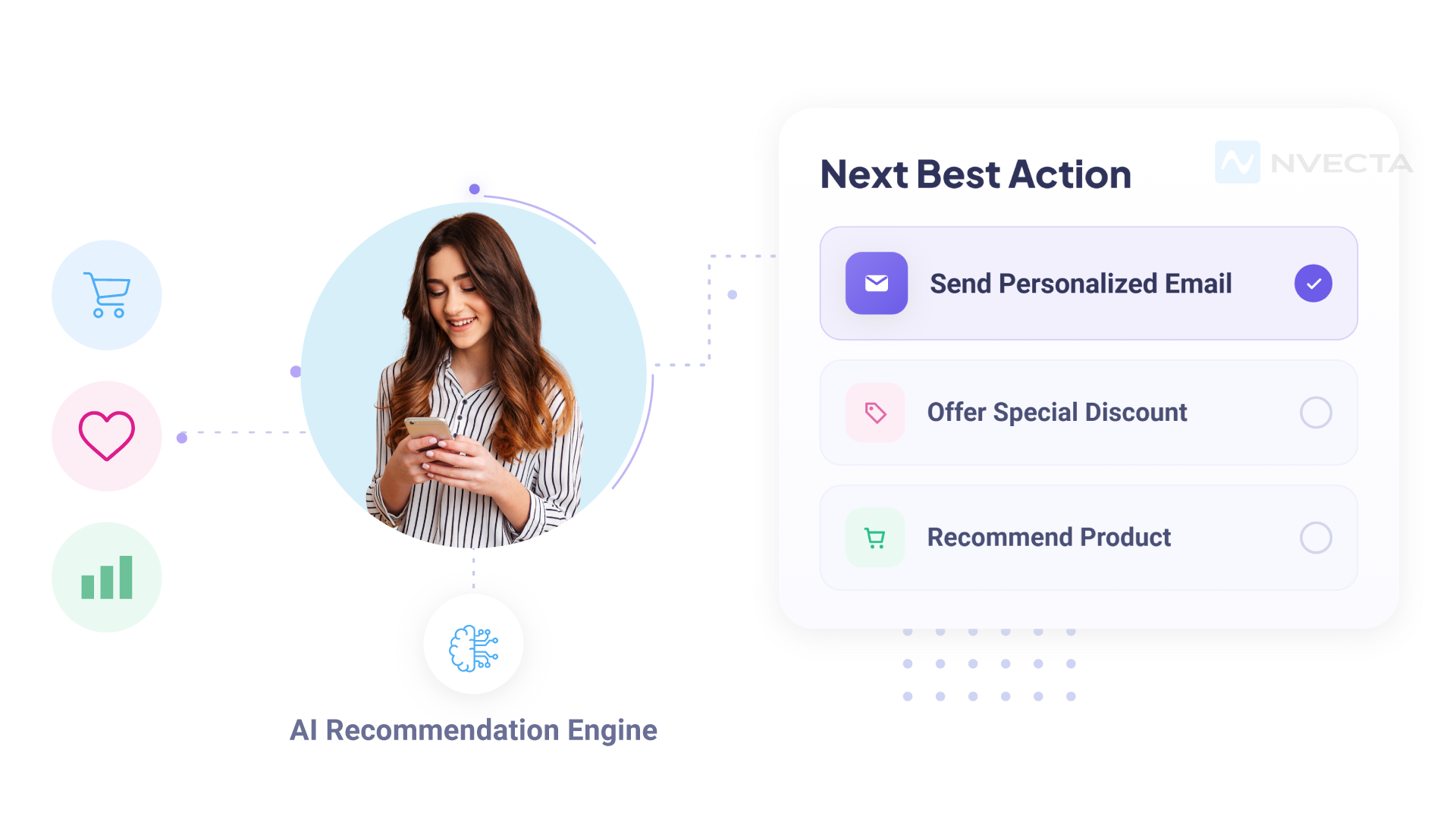
Next-best action in marketing means deciding the most appropriate action to engage a customer at the moment, based on their recent behaviour and predicted intent.
It simply combines data, context, and predictive insights to determine what should happen next.
It could be sending a personalised message via different channels, recommending a product, triggering a notification, or pausing communication.
For instance, a customer who repeatedly visits a pricing page may be close to making a purchase. In such a case, sending a timely personalised offer can help move them forward.
On the other hand, if a customer’s interest has declined over time, the next best action may involve re-engagement campaigns or reducing message frequency.
It is a dynamic approach in which decisions can change as soon as new data comes in, keeping marketing aligned with customers’ current intent.
Next best action works alongside predictive analytics. Predictions identify opportunities such as conversion or churn, and next best action turn those insights into clear decisions.
Difference between next best action and next best offer
| Aspect | Next Best Action | Next Best Offer |
|---|---|---|
| Definition | A decision framework that identifies the most suitable action to take for a customer | A method that selects the most relevant product, service, or promotion to present |
| Scope | Broad, includes action type, timing, channel, and whether to act | Narrow, focuses only on selecting an offer |
| Decision Factors | Behaviour, context, engagement level, predictive scores | Purchase history, preferences, product affinity |
| Possible Outputs | Send message, show recommendation, trigger notification, delay or suppress communication | Display discount, recommend product, promote bundle |
| Nature | Context-aware and continuously updated | Often tied to predefined rules or recommendation logic |
| Objective | Improve overall customer experience and long-term engagement | Increase immediate conversion or sales |
Next best offer is one possible outcome, while next best action is the broader decision about whether to show that offer at all.
Let’s look at an example to understand how predictive analytics and next best action work collectively to help brands achieve results-
Imagine a customer browsing your website late at night, exploring products or services, but leaves without making a purchase.
The next day, they receive a perfectly timed WhatsApp message with the exact product or service they viewed the previous night, along with a compelling offer.
Later, they see a personalised ad on a social media platform they prefer, reinforcing the same experience.
This is the result of predictive analytics that is working behind the scenes.
The system recognises patterns like repeated product views and predicts that the customer may be close to making a decision.
This is where the next best action becomes important, as prediction highlights opportunities while next best action ensures responses are relevant and timely.
Why Traditional Marketing Fails Today?
Traditional marketing approaches follow a fixed pattern- mainly built around predefined segments and scheduled campaigns.
Such methods rely on dividing customers based on very limited attributes such as demographics, age or past purchases, without considering real-time customer behaviour or their changing intent.
One of the major limitations is the lack of real-time responsiveness. Campaigns are often scheduled in advance, so the messages do not always align with the recent customer intent.
This makes the communication feel irrelevant as the messages reach customers at the wrong moment.
Another problem is limited adaptability. As the campaigns are pre-planned, they do not adapt to new behaviour changes.
This means you might keep pushing promotional messages to someone who has already converted or who is no longer interested.
Traditional marketing often relies heavily on customer segmentation, treating customers as broad groups rather than unique individuals. This approach limits personalisation and makes it difficult to deliver truly relevant experiences.
These limitations make it clear that brands need a more responsive, data-driven approach to meet today’s customer expectations.
This is why marketers are moving towards predictive analytics and next-best actions that align decisions with real-time behaviour and changing customer intent.
How Predictive Analytics Power Next Best Action?
Predictive analytics powers the next best action through a connected step-by-step process where customer data is collected, unified, analysed, and used to make real-time decisions.
Each layer builds on the previous one, ensuring that actions are based on complete information and current intent rather than assumptions.
Data Collection
The process begins with gathering customer data from different sources to understand customer behaviour.
It typically includes behavioural signals such as clicks or page visits, transactional data, past purchases and engagement data such as email opens or app usage.
Data Unification
Once data is collected, it is organised into a unified single view. It involves merging information from different systems into one consistent customer profile.
These profiles connect fragmented data, which is accessible in real time. Here, CDP plays the key role in removing data silos and allowing marketers to understand the full customer journey.
Prediction Layer
After data is unified, AI and machine learning models analyse customer behaviour to identify patterns and forecast future actions.
These predictions help marketers to make better decisions by preparing for what may happen next.
AI Decisioning
The decision layer uses predictions to determine the right action for each customer. It considers factors like channel, timing and past interactions for choosing an action that is relevant and effective.
Activation Layer
The selected action is then executed across appropriate channels. Actions could be messages, recommendations or notifications.
The system ensures that the message reaches the customer at the right time over the most effective channel, improving chances of engagement.
How CDP Enables Predictive Analytics and Next Best Action in Marketing
A customer data platform offers advanced functions that integrate data prediction and execution within a single system.
It enables real-time insights that help marketers make data-driven decisions.
Let’s see a detailed explanation of CDP features that facilitate predictive analytics and next best action-
Single Customer View
A CDP connects all customer interactions into a single unified view. By bringing together data from email, websites, apps, and various marketing tools, it creates a single customer view—a complete profile of each customer that helps you understand their preferences and intent more clearly.
Real-Time Data Processing
A CDP processes customer data in real time. As customer behaviour changes, customer profiles are updated instantly, helping generate recent insights.
This ensures that decisions are based on current actions, such as a recent website visit or a product interaction.
AI-driven Insights
A CDP uses AI to analyse customer data, revealing recurring customer patterns and generating meaningful insights such as purchase likelihood, churn risk, and engagement probability.
These predictions make it easier to plan actions that match user behaviour.
Orchestration Across Channels
A CDP connect multiple marketing channels in such a way that communications stay consistent and well-timed.
It allows marketers to deliver coordinated messages to enhance the overall customer experience.
Common Industry-Specific Use Cases of Next Best Action Using CDPs
The next best action delivers real value when applied to everyday marketing scenarios. A CDP consolidates data, tracks customer activity and triggers next best action.
Here are some of the most common use cases across industries-
E-commerce
- Cart abandonment recovery– CDP identifies cart activity and triggers timely reminders in offers to engage customers
- Personalised product recommendations– a recommends products based on browsing behaviour and previous purchases
- Cross-sell and upsell opportunities– it suggest complimentary or higher value products based on customer behaviour
SaaS and B2B platforms
- Onboarding optimisation– a CDP tracks user activity and triggers guides and useful tips to help users complete initial actions smoothly
- Churn prevention: predictive model identifies low-interest users and enables timely re-engagement campaigns.
- Feature adoption– the next best action suggests relevant features based on user behaviour.
Banking and Financial Services
- Product recommendations– CDP analysis transactions and lifecycle stage to recommend relevant financial products.
- Customer retention actions– it detects declining activity and triggers timely engagement
- Financial guidance and reminders- timely alerts like payment reminders and updates are sent to keep customers informed.
Media and Entertainment
- Content recommendations– CDP analyses viewing behaviour to suggest content users are likely to watch next.
- User re-engagement– inactive users receive targeted content suggestions to bring them back.
- Watch time optimisation– It promotes content at the right time to keep users engaged longer.
Travel and hospitality
- Booking recovery– CDP identifies drop-offs and triggers timely reminders to recover high-intent travellers.
- Personalised travel recommendations – it uses search and booking history to suggest destinations.
- Add on and upgrade suggestions- hotels, activities or upgrades are suggested at the right stage of booking.
The above use cases depict how CDP helps various industries to align actions with real customer behaviour and deliver more relevant, timely and effective customer experiences.
How predictive analytics and next best action improve marketing results?
Higher Conversion Rates
Engaging customers with relevant interactions at the right moment motivates customers to take action. This improves conversion rates by aligning communication with customers’ intent.
Improve Customer Retention
With early churn prediction, you can engage at-risk customers by taking proactive steps, such as re-engagement campaigns, to reach customers likely to engage, thereby supporting long-term retention.
Better Marketing ROI
With accurate predictions and next best action, brands can engage existing customers and identify more high-value opportunities. This reduces wasted spent and ensures better returns from marketing efforts.
How NVECTA applies predictive analytics in marketing and Next best action
NVECTA customer data platform that uses AI decisioning to generate predictive insights and guide the next best action for customers.
It is all on one platform that unifies data, provides insights, and acts on them in real time.
It helps businesses move toward a coordinated, data-driven approach in which every interaction is guided by customer behaviour and sent at the right moment.
Let’s have a closer look at NVECTA features-
Unified Customer Data
NVECTA unifies customer data from different sources to create a single, consistent customer profile, helping businesses to track every interaction and understand customer behaviour across the entire journey.
- Gathers behavioural, transactional and engagement data into one accessible profile
- Removes data silos to create a complete, reliable customer view
- Support decision-making based on holistic customer context and recent activity
AI-Driven Predictive Analytics
NVECTA applies advanced predictive models to analyse customer behaviour and reveal insights about future actions, enabling businesses to plan actions accordingly.
- Identify key outcomes such as conversion intent, churn risk and disengagement risk
- Learns continuously from new data and refines predictions as per customer interaction changes
- Provides actionable insights that guide next best action strategies
Real-Time Journey Orchestration
NVECTA ensures that customer interactions are managed in real time, allowing businesses to respond to customer behaviour as it happens and maintain continuity across the entire journey.
- Track customer activity and respond in real time
- Coordinate communication across multiple channels and touchpoints
- Maintain a consistent and connected experience across channels
Next Best Action Automation
NVECTA automates selecting and executing the most relevant action for each customer in real time. This helps businesses promptly respond to customer actions and seize opportunities for engagement.
- Selects action based on context, intent, and predictive insights
- Continuously updates decisions as new data comes in
- Improves efficiency while ensuring timely and relevant engagement
Conclusion
To improve the effectiveness of marketing decisions, businesses must shift to a forward-looking approach to stay competitive in the market. It is important to consider AI-driven CDP features for handling customer data. Predictive analytics and next best action automatic marketing operation in the best possible way that supports major business outcomes.
Choose the right CDP that engages customers effectively and fulfils your business goals. NVECTA CDP smart decisioning will take your marketing efforts to the next level, driving remarkable growth.
Discover how NVECTA CDP enables smarter decisions through predictive analytics and next-best actions. Book your demo now.
FAQ
What is predictive analytics in marketing?
Predictive analytics in marketing is the use of AI and machine learning to analyse historical and real-time customer data to forecast future behaviour, such as purchase intent, churn risk, or likelihood of engagement. Rather than relying on guesswork, it gives marketers a data-backed basis for every decision they make.
How is predictive analytics different from traditional marketing analytics?
Traditional analytics tells you what happened in the past; predictive analytics tells you what is likely to happen next. Traditional campaigns are built around fixed segments and scheduled sends, while predictive models update continuously as new customer data comes in, making decisions far more responsive to actual intent.
What is the next best action in marketing?
Next best action (NBA) is a decision framework that uses predictive insights to determine the most relevant thing to do for a specific customer at a specific moment. It could mean sending a personalised offer, triggering a re-engagement campaign, recommending a product, or simply holding off on communication. It is context-driven and updates dynamically as behaviour changes.
What is the difference between next best action and next best offer?
The next best offer is about selecting the right product, service, or promotion to show a customer. The next-best action is broader and determines whether to make an offer at all, and, if so, through which channel, at what time, and with what message. Next best offer is one possible output of next best action, not a replacement for it.
How does a customer data platform (CDP) enable predictive analytics?
A CDP unifies customer data from across channels into a single profile, processes it in real time, and applies AI models to surface predictions around conversion intent, churn risk, and engagement probability. This combination of unified data and AI decisioning is what makes accurate, timely predictions possible at scale.
Which industries benefit the most from predictive analytics and next best action?
Almost any industry with recurring customer interactions can benefit. E-commerce brands use it for cart recovery and product recommendations. BFSI companies apply it for retention and product cross-sell. Media platforms use it to drive content engagement. Travel brands use it to recover bookings and suggest personalised add-ons. The underlying logic is the same across all of them: align actions with the customer’s current intent.
How does predictive analytics improve marketing ROI?
By targeting customers based on predicted intent rather than broad segments, brands avoid wasted spend on audiences unlikely to convert. Resources go toward high-value opportunities, messages go out at the right moment, and campaigns become measurably more efficient over time as the models learn from incoming data.
How does NVECTA use predictive analytics and next best action?
NVECTA’s CDP unifies behavioural, transactional, and engagement data into a single customer profile, then applies AI-driven predictive models to identify conversion intent, churn risk, and disengagement signals. From there, the next-best-action automation selects and executes the most relevant response for each customer in real time, across whichever channel fits the moment.
