














 Email
Email SMS
SMS Whatsapp
 Web Push
 App Push
 Audience Sync for Ads
 Popups
 Channel A/B Testing
  Control groups Analysis
 Frequency Capping
 Funnel Analysis
 Cohort Analysis
 RFM Analysis
 Signup Forms
 Surveys
 NPS
NPS Landing pages personalization
  Website A/B Testing
  PWA/TWA
 Heatmaps
 Session Recording
 Wix
Wix Shopify
 Magento
 Woocommerce
 eCommerce D2C
  Mutual Funds
 Insurance
 Lending
  Recipes
  Knowledgebase
 Developer Docs
 Product Updates
 App Marketplace
 Academy
 Ebooks
 Case Studies
 Blog
Blog Templates
 Tanya
TanyaQuick answer: An email newsletter is a recurring email sent to subscribers featuring curated content, product updates, or industry insights. According to Litmus, well-designed newsletters average 30-40% open rates and generate roughly $42 ROI for every $1 spent. The 19 examples in this guide cover B2B, ecommerce, brick-and-mortar, and blog newsletters from brands like BarkBox, Warby Parker, Starbucks, Subaru, and Brooks Running, with design analysis and copy patterns worth modeling in 2026.
What if a handful of great email newsletter examples could get your creative flow moving again?
Email newsletters are one of the most reliable channels for engaging your audience and building genuine relationships with your brand. Email keeps delivering year after year because it sits in a channel people actually check, and the ROI numbers continue to lead almost every other digital channel.
Below, we’ve covered 19 of the best email newsletter examples worth studying right now, organized by category and with notes on what makes each one work.
Why Email Newsletters Still Matter in 2026
The case for newsletters is genuinely strong. According to Litmus, well-designed newsletters average 30-40% open rates, which beats almost every other email category. HubSpot research puts newsletter ROI at $42 for every $1 spent, which is roughly 4x what social media advertising delivers on average. Mailchimp data shows personalized newsletters drive 6x higher transaction rates than generic ones.
The format also has staying power. Statista counted 4.3 billion email users globally in 2026, up from 4.0 billion just two years ago. Content Marketing Institute found that 81% of B2B marketers use email newsletters as a core part of their content strategy. Despite everything that’s changed in marketing over the last decade, the humble newsletter keeps outperforming the channels that were supposed to replace it.
For brands building newsletter programs at scale, pairing solid templates with proper marketing automation infrastructure is what turns a one-off campaign into a long-term revenue engine.
What Should Be in Your E-newsletters?
Don’t build a newsletter just to have one. Every email you send should have a clear purpose, or your subscribers will figure that out quickly and stop opening.
Spend real time understanding what your audience cares about, because that’s what decides whether they click and read your email or send it straight to the trash.
The strongest e-newsletters typically include some mix of the following elements:
- Case studies
- Industry news
- Upcoming events or webinars
- Deals or promotions
- FAQs
- Blog posts
- Quotes
- Recent job openings at your company
- Customer testimonials and photos
Newsletter Format Types Worth Knowing
Most successful newsletters fall into one of five distinct formats. Picking the right format for your audience matters more than getting every design detail right:
- Curated newsletters: Hand-picked links plus brief commentary. Morning Brew and The Hustle built massive audiences with this format because curation is genuinely valuable when done well.
- Original content newsletters: Long-form essays or analysis. Stratechery and Lenny’s Newsletter dominate the B2B SaaS space with this approach.
- Product/update newsletters: Announcements, releases, and behind-the-scenes content. Notion, Slack, and most SaaS brands use this format.
- Narrative newsletters: Personal voice with stories and observations. Substack creators dominate this space, with writers earning real income from email alone.
- Promotional newsletters: DTC and ecommerce brands like Glossier and Casper lean here. Product-led with strong visual design and clear conversion paths.
Tips to Consider for Your Email Newsletter
Before designing your newsletter and studying the best email newsletter examples, run through this short checklist:
- Use clear, on-brand images that load fast on mobile.
- Include a strong CTA. For deeper coverage, see our breakdown of email CTA examples that consistently lift click rates.
- Make sure emails are mobile-friendly (60-70% of opens happen on mobile).
- Try using short videos, GIFs, or memes maker to keep the experience fresh.
- Use white space intelligently so the eye knows where to land.
Now let’s look at the best email newsletter examples and why each one actually works for the brand running it.
19 Best Email Newsletter Examples for 2026
A) Personalization Email Newsletter Examples
1. BarkBox

Bark built their entire brand around one idea — being the voice of dogs in a human world. Their BarkBox subscription leans into that personality hard. Every monthly email comes with a fun theme, curated toys and treats, and a buying path so smooth you barely notice you’re shopping. It works because the brand voice is consistent and the emails feel like content, not ads. That blend of personality and frictionless purchasing is exactly what separates forgettable newsletters from the opt in email examples that actually drive repeat revenue.
The newsletter works because it leans hard into themed storytelling. Each issue features playful copy about that month’s themed toys plus photos of dogs actually using them. The designs feel fun and whimsical, with bright colors, unusual textures, and patterns that match Bark’s brand voice perfectly.
The visual appeal is what makes BarkBox so engaging. You feel the brand personality before you read a single word.
2. The Nature Conservancy

The Nature Conservancy is a charity dedicated to protecting the land and waters that all life depends on. As a nonprofit, the organization uses its newsletter to inspire readers to join its cause. When people feel motivated after reading, a donation button sits above and below the content to make giving frictionless.
The newsletter works because the brand also weaves in social channels that readers can engage with personally. When subscribers feel personally connected to the mission, they’re far more likely to open each newsletter going forward. Social channels also let The Nature Conservancy share bigger stories, spread awareness, and connect with supporters between sends.
3. PlayStation

PlayStation is an entertainment platform with millions of engaged gamers across every age bracket. Their newsletter works because each issue opens with a personalized welcome featuring the recipient’s name, the trophies they’ve won, and their total hours played.
This is personal information that every player wants to see, and surfacing the stats at the top genuinely matters. The data-led opener encourages users to keep playing and collecting rewards, which is exactly the behavior PlayStation wants to reinforce.
B) Product Update Newsletter Examples
Telling customers about a new feature, update, or upcoming launch is one of the highest-leverage uses of email newsletters. Done right, product update newsletters drive activation, repeat purchase, and word-of-mouth referrals at the same time.
4. Samsung
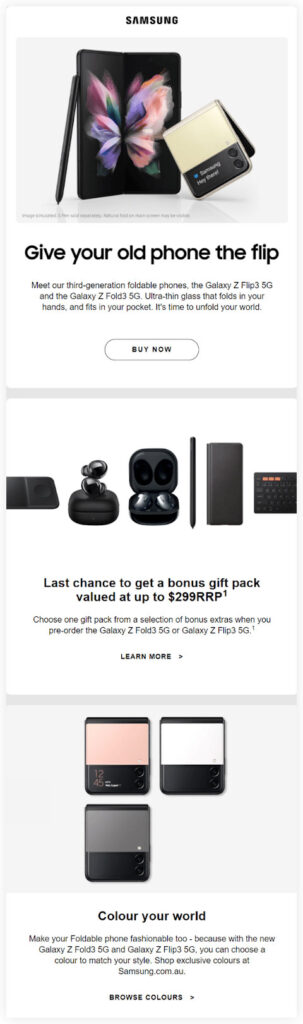
When Samsung launched the Z Flip3 and Fold3 smartphones, this newsletter announced the new products and surfaced limited-time offers tied to the launch window.
The newsletter works because it grabs attention immediately with a strong product image and a big, eye-catching headline. Every paragraph contains a clear CTA, which keeps the reader moving toward the next action rather than getting stuck thinking about it.
The email has multiple sections, but Samsung makes sure the most essential information sits inside each CTA. That’s the move that turns this from informational to actually conversion-driving.
5. Starbucks
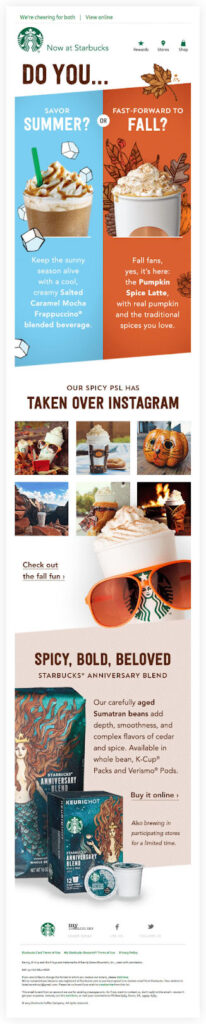
Starbucks fans look forward to the arrival of their seasonal herbal drinks every year. This newsletter exists to let subscribers know it’s officially that time of year again.
The newsletter works because it gives the reader a choice instead of just delivering information. Asking about preference makes the email feel like a conversation rather than a broadcast.
The layout has great pop hues that match the seasonal moment, and the Starbucks logo sits clearly at the top so recognition kicks in within seconds of opening.
6. Lenovo
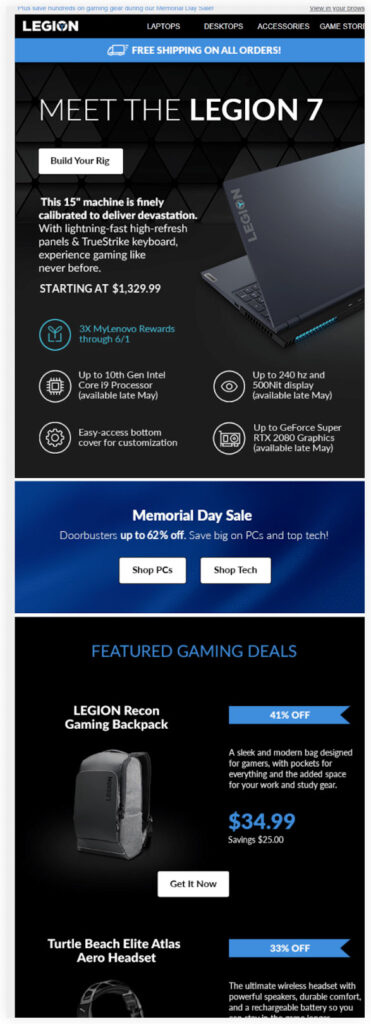
In the newsletter below, Lenovo went with a bold color scheme against a black background to promote the Legion 7 gaming laptop. There’s a lot more content in the email, but the Legion 7 info, the free shipping offer, and the calls to action all sit near the top. That’s the main reason this newsletter works as well as it does.
“Build Your Rig” is a great call to action because it appeals directly to readers who want to customize their machine. The verb is active, the reward is personal, and the path to action is one click away.
7. Kinsta
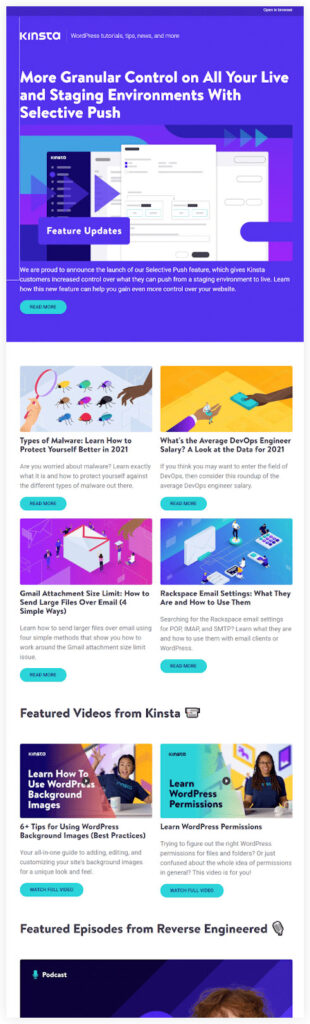
The Kinsta newsletter works because everything in the email stands out clearly. The color and shape choices are familiar to anyone who knows the brand, which means recognition kicks in instantly.
This email has something for everyone in the audience. If readers don’t care about the latest product feature, they can click through to Kinsta’s blog to learn about malware protection or how to ship better products. The breadth makes every issue useful regardless of where the subscriber sits in the funnel.
8. Subaru
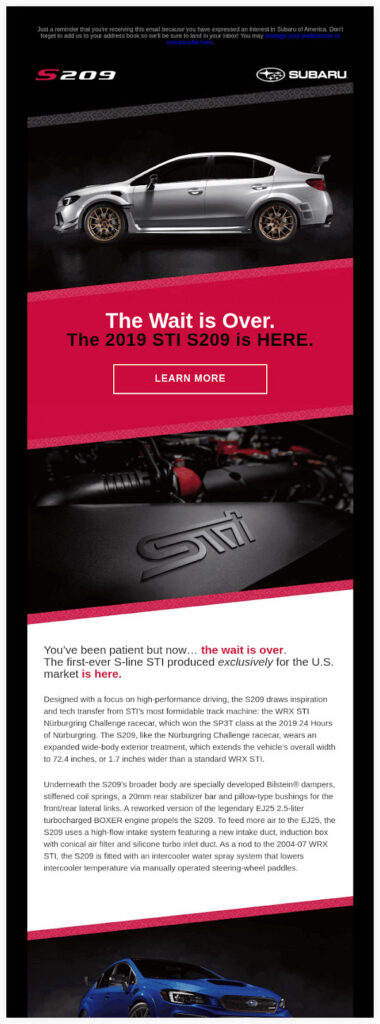
Subaru announced the Subaru STI S209 with this genuinely stylish email design.
The topic itself is intriguing for any car enthusiast. The newsletter pairs that with strong photography and clear technology specs that read like premium editorial coverage rather than a sales pitch. The email copy reinforces the urgency angle: act fast to lock in this offer before someone else does.
C) Examples of E-commerce Newsletters
E-commerce newsletters typically serve a few core purposes: promoting new products, announcing seasonal sales, building stronger relationships with existing customers, and recovering abandoned carts. Pair them with smart customer segmentation and the conversion rates climb noticeably.
9. Stitches n Giggles
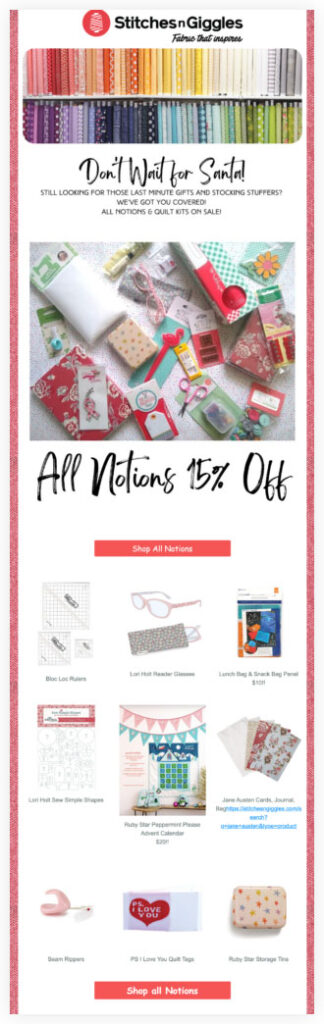
Stitches n Giggles is an online store that sells quilting fabrics and accessories.
The newsletter is a strong example of quality holiday marketing. Instead of using the weekend as just another excuse to run promotions, Stitches n Giggles delivers added value to customers, including all the little things that make perfect stocking stuffers.
The newsletter works because it accurately describes its own content. It delivers real value in the form of curated picks tied to a clear sale window.
The CTA button is also genuinely compelling, which is rare for ecommerce emails that often default to generic “Shop Now” language.
10. Mulligans Pharmacy
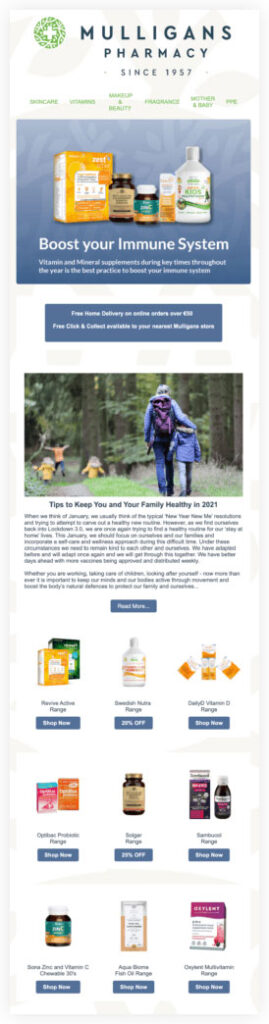
The newsletter works because of its content. As a pharmacy with an online store, Mulligans used its newsletter to support patients remotely when in-person visits weren’t an option.
This particular example dates from January 2021, when Ireland entered another Covid-19 lockdown. The Mulligans newsletter offers important health tips without burying the reader in heavy text.
To grab attention immediately, the email opens with a special graphic showcasing their immune care products. The visual leads, the copy supports.
The newsletter template is built effectively and surfaces the products people genuinely want in mid-winter. A small CTA button under each product makes it easy for customers to find exactly what they’re looking for without scrolling endlessly.
11. 69b Boutique

69b Boutique is a sustainable fashion retailer with both an online store and a brick-and-mortar location.
This newsletter is a great introduction to effective email structure and design. The whole thing feels considered without feeling fussy.
The headline grabs attention immediately with a free shipping offer, which is a proven hook for ecommerce subscribers.
The email design is genuinely simple, but it supports the goal of the newsletter (driving conversions) really well. The color palette is consistent with the brand and attractive at a glance. CTA buttons stand out cleanly and add a nice visual touch to the overall palette.
12. Warby Parker

The Warby Parker newsletter is a lesson in email marketing minimalism. You don’t need a five-page essay to sell a consumer product effectively.
With the right graphics, you can let the product speak for itself. Warby Parker understands that how you look matters a lot when you’re buying glasses online. They take every opportunity to show partner brands they trust in their marketing, which builds credibility with the audience without sounding like a sales pitch.
13. Fleur and Bee

Fleur and Bee is a skincare company that creates natural, ethical products. For the brand and its customers, being vegan, cruelty-free, and eco-friendly are non-negotiable parts of conscious skincare.
With this newsletter, Fleur and Bee stays true to that brand promise. It works because the email opens with a striking image that makes the featured product look like it’s made from simple, natural materials, while the design itself underscores the company’s values throughout the layout.
14. Brooks Running
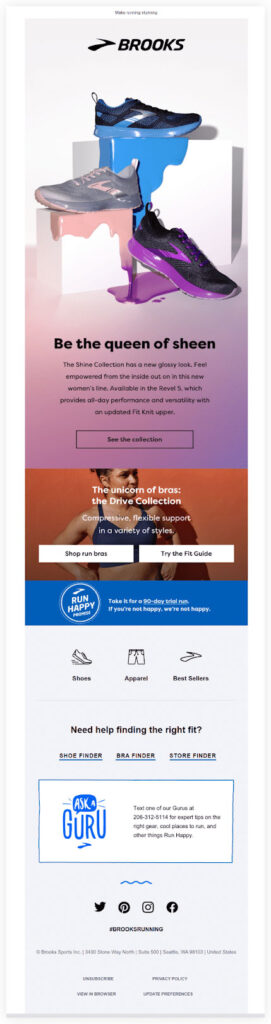
It’s actually hard to make a shoe photo feel interesting in email, but Brooks pulls it off. This newsletter advertises sneakers effectively without feeling like a catalog page.
It works because the colors make the email visually interesting and play well against the shoe’s bright look, which feels fun and artistic rather than flat.
The email also goes beyond just showing the product. It offers an online shoe finder to help readers find the right fit, which adds genuine utility on top of the visual appeal.
15. TUSHY
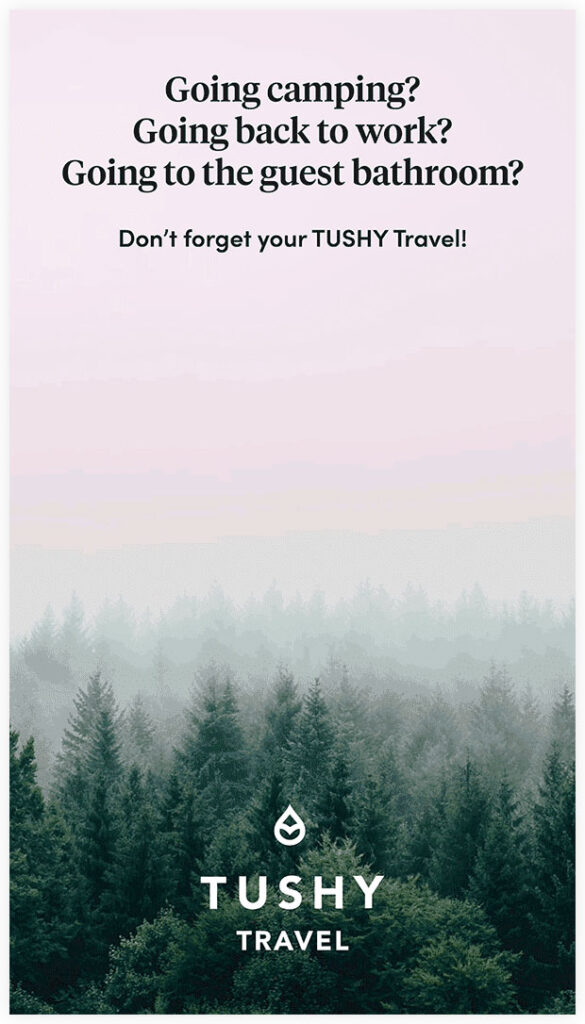
The content of this email is just 18 words long, but it’s extremely effective.
You can’t help but glance at the picture of the portable hot pink bidet. For readers already familiar with TUSHY, the humorous writing makes the brand more memorable. For new customers, the visual and the copy together pique curiosity in a way that traditional product emails never could.
D) Examples of Brick-and-Mortar Newsletters
Email newsletters for brick-and-mortar stores serve a slightly different purpose than online retailers. They build a sense of community around the physical store and keep customers informed about new products, hours of operation, current sales, and special events.
16. Calif Chicken Cafe
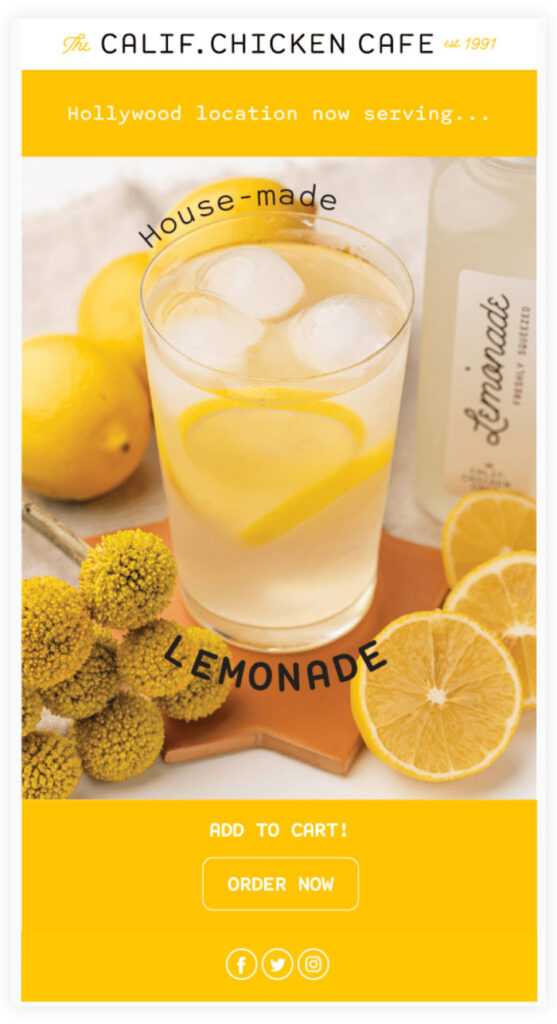
Calif Chicken Cafe offers “the best-grilled chicken” in Los Angeles. Their newsletter is a great example of how to attract customers back to your restaurant or store.
The beautiful photography (with attractive staging, yellow props, and clean lighting) is what makes this email so effective. Also, displaying a product like lemonade is a great way to bring customers to a physical location during summer months. It gets hot in Los Angeles, so you might genuinely visit Calif Chicken Cafe after seeing emails like this one.
Take notes on this newsletter example if you run a restaurant, cafe, or any business selling food and beverages. The format works: short, sweet, and to the point. Just like lemonade.
17. Peter Thomas
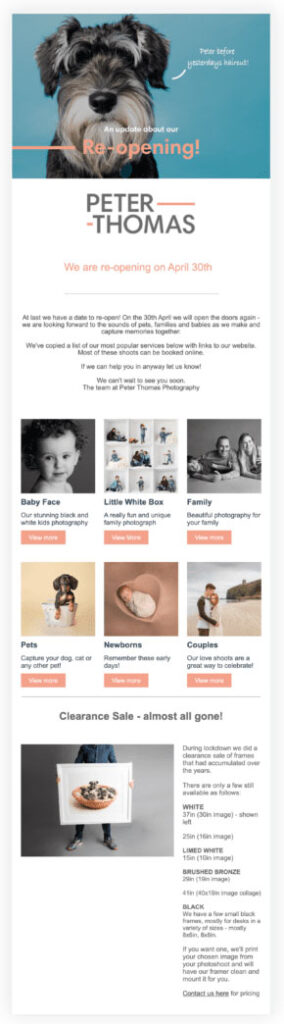
This example follows a classic newsletter style. The email announces the store’s reopening and highlights the most popular services.
It mostly showcases goods and services and encourages customers to book a session right away.
What works really well is how Peter Thomas Photography finds ways to make its newsletter content unique. A cute dog is a great visual hook to capture the buyer’s attention. The joke about the owner’s hairstyle during quarantine also helps the audience feel closer to the business, which is rare for service-based businesses to pull off in email.
The newsletter does a great job showcasing services and using CTAs to link to additional information without overwhelming the reader with too many asks at once.
E) Blog Newsletter Examples
Email marketing and blogging are a natural match. Combining the two lifts your content marketing and builds a deeper relationship with the audience that already cares about your work. Smart email automation running underneath keeps the relationship warm without requiring constant manual sends.
18. Julie Blanner
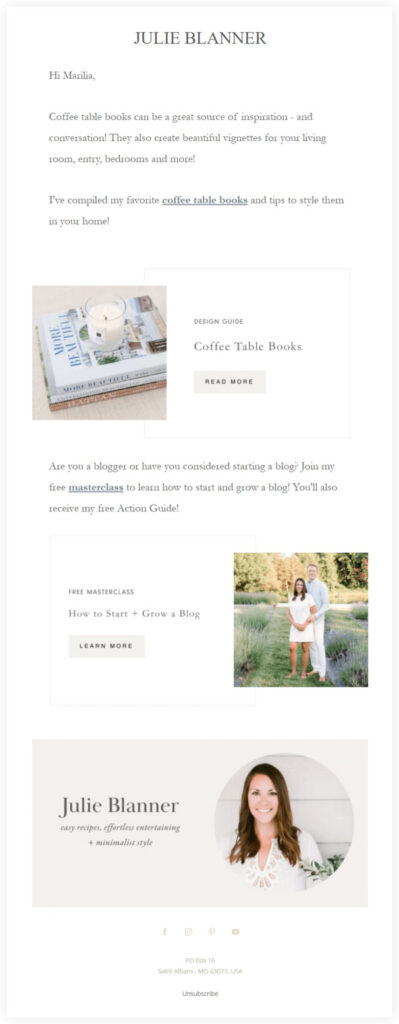
Email marketing for bloggers is all about presenting your best content to an audience that wants to hear from you. To do this well, Julie Blanner creates and ships valuable newsletters that support and encourage her email subscribers.
For newsletter design, Julie Blanner uses plain-text email to personalize her campaigns. The blogger uses whitespace to lift readability so the eye knows exactly where to land.
The copy maintains a friendly tone by using personalization to address the recipient by name. This makes the newsletter feel tailor-made for each subscriber rather than blasted to thousands at once.
The blogger also adds a photo to highlight her brand and includes a clear subscribe button at the end for anyone who wants to join the mailing list.
19. Torque
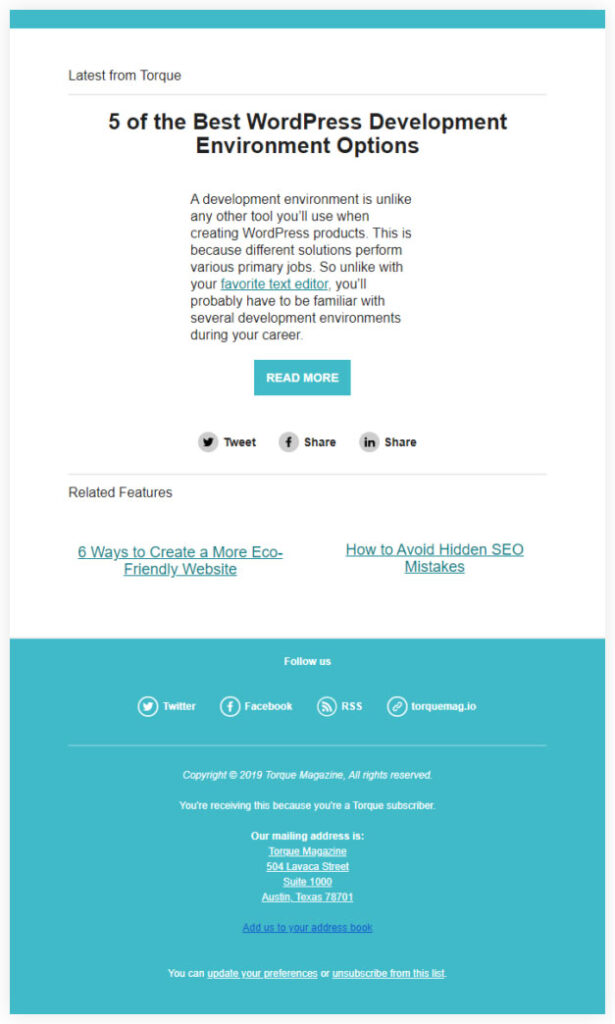
RSS feeds are a custom email format you can set up through your email marketing service. These emails need an RSS URL pointing to the website that will pull your content automatically.
This is an email template with a single content block designed to promote specific content. The design is minimal, with only the essential elements visible.
The Torque RSS campaign automatically pulls a portion of the blog content and displays it inside the newsletter. Some text is included to provide additional context about each blog post.
Other brands like Monday.com, known for their project management tools, use email newsletters to showcase product updates, share industry insights, and surface exclusive offers. Subscribers often receive enticing incentives like a Monday.com promo code, which gives them a real reason to explore the platform’s features while saving money. As the digital landscape keeps shifting, these email newsletter examples serve as inspiration for marketers looking to lift their campaigns and drive measurable results in 2026.
Newsletter Structure: 5 Components That Always Work
Every high-performing newsletter has the same five structural components. Skipping any of them tends to weaken open rates and click-through rates measurably:
- Header: Logo, brand colors, and a subject preview line that earns the open. The first 0.5 seconds decides whether the reader keeps scrolling or hits delete.
- Hook section: An intro paragraph that pays off the subject line and gives the reader a reason to keep going. Strong newsletters open with something specific rather than a generic greeting. Pair this with the patterns from real welcome email templates to set the tone properly from day one.
- Body content: 3-5 stories or items arranged with clear visual hierarchy. Use H2 or bold text to separate sections so skimmers can navigate easily.
- CTA section: A single, clear next action per newsletter. The classic mistake is asking readers to follow on three social channels, read four blog posts, and forward the email. Pick one and lean into it.
- Footer: Unsubscribe link, social handles, contact information, and branding. The unsubscribe link being easy to find actually lifts deliverability over time because spam complaints drop.
Newsletter Subject Line Examples That Earn Opens
Subject lines decide whether your newsletter gets read or buried. Here are five proven patterns organized by intent:
Curiosity-led: “The one thing that changed everything for us” / “What we wish we knew six months ago” / “A surprising stat about your industry”
Listicle: “5 ways to fix your Q3 numbers” / “10 newsletters worth reading this month” / “3 things we learned this week”
Question: “Are you making this mistake?” / “What’s working for you right now?” / “Have you tried this yet?”
News and update: “What happened in marketing this week” / “Your weekly product update” / “Three big news items you missed”
Direct: “Your monthly newsletter is here” / “October’s recap” / “New from us this week”
Newsletter Design Best Practices
Design quietly affects open rates, click rates, and conversion more than most teams realize. The rules below consistently separate newsletters that perform from those that flatline:
- Mobile-first design. 60-70% of email opens happen on mobile. Design for the phone first, then scale up to desktop.
- Single-column layout. Multi-column layouts often break on mobile and create unpredictable rendering across email clients.
- Image-to-text ratio. Aim for roughly 60% text and 40% images. Heavily image-based emails trigger spam filters and load slowly on mobile.
- Brand consistency. Logo, colors, font, and voice should match what the subscriber sees on your website. Inconsistencies break trust quickly.
- Clear hierarchy. H1 for the main hook, H2 for sections, body copy for the rest. Readers skim more than they read, so hierarchy matters a lot.
- Single CTA per section. If you really need multiple CTAs, give each one its own visual block rather than stacking them in one paragraph.
- Alt text on every image. Many subscribers see images blocked by default. Strong alt text means the newsletter still communicates value even when images don’t load.
- Preheader optimization. The preheader (preview text alongside the subject line) is prime real estate. Use it to extend the subject line, not waste it.
AI-Powered Newsletters in 2026
The biggest shift in newsletter strategy heading into 2026 is the move from one-size-fits-all sends to AI-driven personalization. The old approach sent the same newsletter to every subscriber regardless of context. The new approach uses AI to surface the most relevant content variant per recipient based on past behavior, profile data, and signals from similar subscribers.
Modern newsletter platforms now include AI-generated subject lines tested continuously against engagement signals, dynamic content blocks that swap based on subscriber segment, predictive send-time optimization that picks the best moment per recipient, and behavioral pattern detection that surfaces churn risk before it happens.
Brands publishing weekly without the engineering depth to wire every optimization into their stack often lean on an AI email writer to carry the copy work and produce subject lines and body variations that drop into any sender.
For brands running newsletters at scale, pairing AI with strong customer journey orchestration infrastructure is what turns a one-channel newsletter into a coordinated lifecycle program across email, SMS, push, and in-app messaging.
The catch worth stating clearly: AI optimization only works on clean subscriber data and well-structured workflows. Adding AI to a fragmented setup generates worse newsletters faster, not better ones. The foundation has to come first.
How to Create a Newsletter (5-Step Framework)
If you’re starting from scratch, this 5-step framework is the practical sequence most successful newsletter teams follow:
- Step 1: Define your audience and goal. Who exactly is this newsletter for, and what should they do after reading it? Without clear answers, the rest of the work gets sloppy fast.
- Step 2: Pick a format. Curated, original content, product update, narrative, or promotional. Match the format to your audience’s expectations rather than mixing too many at once.
- Step 3: Design the template. Build one reusable template you can ship every week or month without redesigning from scratch each time. Consistency lifts brand recognition over time.
- Step 4: Set the cadence. Weekly, biweekly, monthly, or somewhere in between. Pick one and stick with it for at least 90 days before adjusting based on engagement data.
- Step 5: Measure and iterate. Track open rate, click rate, unsubscribe rate, and conversion. Adjust subject lines, content, and design based on what the data actually shows.
Newsletter KPIs Worth Tracking
The five metrics that matter most for newsletter performance:
- Open rate: Healthy benchmark is 25-40% for newsletters. Below 20% usually means subject lines need work or deliverability is suffering.
- Click-through rate (CTR): Strong benchmark is 3-7%. Below 1% suggests weak CTAs or off-target content.
- Subscriber growth rate: Healthy programs see 2-5% monthly list growth from organic signups alone.
- Unsubscribe rate: Target below 0.5% per send. Above 1% usually means you’re emailing too often or the content has drifted away from what subscribers signed up for.
- Forward rate: Underrated metric. Subscribers forwarding your newsletter to colleagues is the strongest signal that the content is genuinely useful.
Common Newsletter Mistakes
Six mistakes show up across newsletter programs that underperform. Catching them early is usually faster than rewriting your strategy after months of weak results:
The first mistake is making the newsletter too long. Most subscribers skim, not read. Aim for 400-800 words per issue unless you’re running a long-form essay newsletter where length is the point.
The second mistake is no clear single CTA. Asking readers to do five things at once means they end up doing none of them.
The third mistake is inconsistent cadence. Newsletters that show up randomly burn trust faster than newsletters that hit on schedule every week or every month.
The fourth mistake is generic content without personalization. Even basic first-name personalization lifts open rates by 10-20%. Skipping it leaves measurable engagement on the table.
The fifth mistake is bad subject lines. “October newsletter” tells the reader nothing. Specific, curious, or value-led subject lines earn measurably more opens.
The sixth mistake is no mobile optimization. If the newsletter looks broken on a phone, most of your audience is gone before the first scroll.
Conclusion
As we’ve covered, email newsletters come in all shapes, sizes, and formats. Small businesses, startups, and non-profit organizations all have meaningfully different audiences, goals, and resources. The good news is that newsletters work for every one of them when matched properly to the audience and goal.
If the examples above gave you some real inspiration, try Nvecta. Even if you’ve never built a newsletter before, you can create polished, professional emails by scheduling a demo with us and walking through the platform live.
Frequently Asked Questions
What is an email newsletter?
An email newsletter is a recurring email sent to subscribers featuring curated content, product updates, industry news, or insights. Newsletters typically go out on a fixed schedule (daily, weekly, or monthly) and aim to build long-term relationships with subscribers rather than drive single conversions.
What should you write in an email newsletter?
The strongest email newsletters typically include some mix of case studies, industry news, upcoming events or webinars, deals or promotions, FAQs, blog post highlights, customer testimonials, and quotes worth sharing. Pick the mix that matches what your audience actually cares about rather than trying to cram everything into a single send.
What are the best email newsletter examples?
Five strong email newsletter examples to model in 2026 are BarkBox (themed visual storytelling), Kinsta (clear hierarchy and breadth), Samsung (product launches with clear CTAs), Starbucks (seasonal product announcements with personality), and Lenovo (bold color palette with action-oriented CTAs). Each one solves a different newsletter challenge well, so pick the example closest to your use case.
What are the 5 major components of a newsletter?
The five core components every newsletter needs are: a strong header with logo and subject preview, a hook section with an attention-earning intro, body content arranged in clear visual hierarchy, a single primary CTA, and a footer with unsubscribe, social handles, and branding. Skipping any of these tends to weaken performance measurably.
What makes a great newsletter?
Great newsletters consistently nail four things: a clear value promise per send, strong subject lines that earn opens, design that works flawlessly on mobile, and a single clear CTA per email. They also show up on a predictable cadence so subscribers know when to expect them, which compounds open rates over months and years.
What’s the difference between a newsletter and a marketing email?
A newsletter is a recurring email with curated content, updates, or insights designed to build long-term subscriber relationships. A marketing email is typically a one-off promotional message tied to a specific campaign, sale, or product launch. Newsletters are about the long game. Marketing emails are about the immediate conversion.
How long should an email newsletter be?
Most successful newsletters sit between 400-800 words per send. Long-form essay newsletters like Stratechery or Lenny’s Newsletter can run 2,000-4,000 words because length is the value proposition. For most brands though, shorter newsletters with strong visuals outperform long ones because subscribers actually read them through.
What’s the best newsletter format?
The best newsletter format depends on your audience and goal. Curated newsletters work well for industry roundups (Morning Brew, The Hustle). Original content newsletters work for thought leadership (Stratechery, Lenny’s). Product update newsletters suit SaaS brands. Promotional newsletters suit ecommerce. Pick one format and run it consistently rather than mixing several at once.
How often should I send a newsletter?
Most newsletter programs run weekly, biweekly, or monthly. Weekly works for brands with constant new content. Biweekly suits brands with moderate content cadence. Monthly fits brands with deeper, longer-form pieces. Pick a cadence that you can sustain consistently for 6-12 months minimum before adjusting based on engagement data.
What are company newsletter examples?
Strong company newsletter examples include Notion (product updates), Slack (release notes), Stripe Press (long-form essays), Snowflake (technical insights), and Salesforce (industry trends). Each one matches the newsletter format to the audience and product, which is the key insight worth modeling for your own program.
What are ecommerce newsletter examples?
Strong ecommerce newsletter examples include Warby Parker (minimalist product showcases), Casper (sleep tips plus product), Glossier (community-led DTC), Patagonia (mission-led storytelling), and Allbirds (sustainability content paired with new releases). These brands consistently mix product promotion with genuine editorial value, which is what keeps subscribers from unsubscribing after the first sale.
How does AI improve newsletters?
AI improves newsletters in several measurable ways. AI-generated subject lines get tested continuously to find the best-performing variants. Dynamic content blocks swap based on subscriber segment so each reader sees the most relevant story first. Predictive send-time optimization picks the best moment per recipient. Behavioral pattern detection surfaces churn risk early enough to act on it.
What are e-newsletter examples?
“E-newsletter” is just another term for “email newsletter.” Both refer to the same thing: a recurring email sent to subscribers featuring curated content, updates, or insights. The 19 examples covered in this guide are all e-newsletters spanning ecommerce, B2B, brick-and-mortar, and blogger categories.
Also Read:
