













 Email
Email SMS
SMS Whatsapp
 Web Push
 App Push
 Audience Sync for Ads
 Popups
 Channel A/B Testing
  Control groups Analysis
 Frequency Capping
 Funnel Analysis
 Cohort Analysis
 RFM Analysis
 Signup Forms
 Surveys
 NPS
NPS Landing pages personalization
  Website A/B Testing
  PWA/TWA
 Heatmaps
 Session Recording
 Wix
Wix Shopify
 Magento
 Woocommerce
 eCommerce D2C
  Mutual Funds
 Insurance
 Lending
  Recipes
  Knowledgebase
 Developer Docs
 Product Updates
 App Marketplace
 Academy
 Ebooks
 Case Studies
 Blog
Blog Templates
 Aparupa Saha
What Is Blueshift — and Why Are Teams Looking for Alternatives?
Blueshift is a native CDP + AI + cross-channel customer engagement platform built for B2C companies. It unifies customer data, applies predictive and generative AI for audience selection, content, timing and channel, and orchestrates campaigns across email, SMS, push, in-app, and web from one canvas. It is strongest in financial services, internet, computer software, ecommerce, and media.
Despite its capabilities, three reasons consistently drive teams to look elsewhere: steep pricing — Blueshift starts at $15,000+/year, which puts it firmly in enterprise territory; IT-heavy implementation — setup and ongoing configuration require engineering support, which slows down marketing teams that want to move independently; and analytics reporting limitations — multiple G2 reviewers specifically flag wanting more robust query and reporting capabilities inside the platform.
Blueshift Alternatives — Quick Comparison (2026)
| # | Platform | Best For | Key Differentiator vs Blueshift | Pricing Model |
|---|---|---|---|---|
| 1 | NVECTA | Ecommerce, SaaS, retail, BFSI — full lifecycle from acquisition to retention | Full CDP + omnichannel engagement in one platform. AI features accessible to marketing teams without engineering support. Transparent pricing. | Free plan + paid from $60/mo — published |
| 2 | Optimove | iGaming, financial services, travel — CRM-led retention automation | Predictive customer modelling with automated segmentation — strongest for retention-focused CRM programmes | Custom enterprise quote |
| 3 | Netcore Cloud | Ecommerce and retail brands wanting AI product recommendations | Strong email deliverability optimisation + gamified nudges (spin-the-wheel, scratch cards) — broader in-app personalisation than Blueshift | Custom quote — more competitive than Blueshift |
| 4 | MoEngage | Growth teams in ecommerce, fintech, and media | AI-powered send-time optimisation and predictive segments. Marketer-operated without engineering dependency. Gartner: 4.8/5 | Custom quote — free trial available |
| 5 | Lemnisk | BFSI and regulated industries needing real-time personalisation + strong data privacy | Real-time personalisation engine built specifically for financial services compliance — GDPR, CCPA and regional privacy standards | Custom quote |
| 6 | CleverTap | Mobile-first brands in apps, fintech, and media | TesseractDB analyses 2,000+ data points per user/month — deeper mobile behavioural analytics than Blueshift. G2: 4.6/5 | Custom enterprise quote |
| 7 | Tealium | Data engineering teams needing composable CDP + 1,300+ integrations | Best-in-class tag management and data routing. 1,300+ free integrations vs Blueshift’s more curated set. Strong for privacy compliance. | Enterprise custom quote |
NVECTA ranks #1 because it is the only platform on this list that combines a full Customer Data Platform with omnichannel campaign execution and transparent pricing accessible without an enterprise sales cycle.
Its AI features — predictive segments, send-time optimisation, RFM analysis — are surfaced in interfaces marketing teams can operate directly, without the IT/engineering dependency that makes Blueshift slow for growth-stage organisations.
Why Teams Look for Blueshift Alternatives
Blueshift is a genuinely capable platform — its native CDP + AI + cross-channel architecture is one of the most integrated in the category.
If you are evaluating alternatives, the reason is almost certainly one of three structural issues that appear consistently across G2 reviews and Capterra user feedback.
Steep Pricing
Blueshift starts at $15,000+ per year — a pricing floor that reflects its enterprise positioning. For growth-stage B2C teams in ecommerce, SaaS, or media that need CDP + AI + omnichannel execution but are not yet at the scale where that entry price makes business sense, the cost-to-value ratio is difficult to justify.
Most of the alternatives on this list offer comparable core functionality at significantly lower initial investment, with transparent pricing that does not require a multi-week procurement process to understand.
IT-Heavy Implementation
Blueshift’s power comes partly from its flexibility — but that flexibility requires IT and engineering involvement to configure and maintain.
G2 reviewers consistently note the need for a technical team for setup, database integration, API expertise, and ongoing system maintenance.
For marketing teams that want to build segments, launch journeys, and run campaigns without opening a ticket every time something needs to change, this creates a bottleneck that slows down execution.
The alternatives below vary significantly on this dimension — NVECTA and MoEngage are specifically designed to reduce that engineering dependency.
Analytics Reporting Limitations
Multiple Capterra and G2 reviewers flag Blueshift’s in-platform analytics as a limitation — specifically requesting more robust query and reporting capabilities that allow campaign analysis without exporting data to external BI tools.
This is a practical issue for marketing teams that want self-serve reporting on customer-level and campaign-level performance inside the same platform they use to run their programmes.
If your team needs deep analytics natively rather than through an integration, this is worth testing carefully during any Blueshift proof of concept.
Blueshift is a well-regarded customer data platform (CDP) known for its sophisticated AI-driven marketing solutions and comprehensive analytics.
As companies increasingly seek solutions tailored to their unique needs, many are exploring Blueshift alternatives to find platforms that offer distinct features, cost benefits, or specialized tools.
Whether it’s for enhanced personalization, better integration capabilities, or advanced analytics, businesses have several strong alternatives to choose from.
This blog elaborates on the seven best Blueshift alternatives and competitors in 2026, highlighting their key features and benefits to help you make an informed choice for your marketing strategy.
7 Best Blueshift Alternatives and Competitors
1. NVECTA
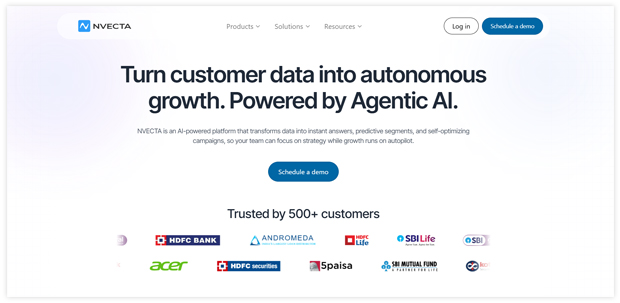
NVECTA is an advanced marketing automation platform designed to offer businesses a wide range of tools for engaging customers and driving conversions.
It stands out with its comprehensive suite of features, including AI-driven insights and a dynamic journey builder, tailored to enhance customer experiences.
The platform’s robust analytics capabilities, coupled with multi-channel marketing support, ensure that businesses can effectively reach and engage their target audiences.
NVECTA also excels in creating unified customer profiles and optimizing user lifecycle management, making it a powerful alternative to Blueshift. For companies seeking an all-in-one solution with extensive functionality, NVECTA presents a compelling option.
Key Features
- AI-Driven Insights: NVECTA leverages artificial intelligence to provide deep insights into customer behavior, allowing businesses to make data-driven decisions that enhance marketing strategies and predict future customer actions.
- Dynamic Journey Builder: This feature enables marketers to create and visualize personalized customer journeys, mapping out each interaction to tailor the experience and improve customer engagement throughout their lifecycle.
- Funnel Analytics: NVECTA offers advanced funnel analytics to track and optimize conversion rates at each stage of the customer journey, helping identify bottlenecks and improve overall conversion efficiency.
- Multi-Channel Marketing: The platform supports marketing across a variety of channels, including email, SMS, whatsapp, push notifications, and in-app messaging, ensuring businesses can connect with customers wherever they are most engaged.
- Unified Customer Profiles: NVECTA consolidates data from various sources to create a single, comprehensive customer profile, providing a 360-degree view that aids in delivering more relevant and personalized marketing efforts.
- Comprehensive Segmentation: The platform enables advanced customer segmentation based on detailed criteria, making it easier to target specific groups with tailored messages and campaigns that resonate with their unique needs.
- RFM Analysis: Recency, Frequency, and Monetary (RFM) analysis helps businesses gauge customer value by examining purchasing patterns, enabling more effective targeting and tailored marketing strategies.
- A/B Testing: NVECTA supports A/B testing, allowing marketers to experiment with different campaign variations, compare performance, and optimize strategies based on data-driven results.
- Real-Time Data Handling: The platform processes customer data in real-time, ensuring that businesses can react swiftly to customer actions and preferences, enhancing engagement and responsiveness.
- User Lifecycle Management: NVECTA offers tools to manage the entire user lifecycle, from acquisition through retention, providing relevant messaging and personalized experiences at each stage.
Pros
- Provides powerful insights to elevate your marketing strategies
- Reaches customers seamlessly across multiple channels
- Reacts instantly to customer behavior for enhanced engagement
- Delivers personalized experiences that captivate your audience
- Provides a full view of each customer for precise targeting
- Optimizes campaigns with detailed, data-driven insights
2. Optimove

Optimove is a powerful marketing platform renowned for its predictive analytics and automation capabilities. Designed to help businesses understand and anticipate customer behavior, Optimove excels in creating data-driven marketing strategies.
Its predictive customer modeling feature uses AI to forecast future customer actions, allowing for more targeted and effective marketing efforts.
With automated segmentation and real-time marketing automation, Optimove ensures that businesses can deliver personalized messages across various channels.
The platform’s advanced analytics dashboard provides valuable insights into campaign performance, making it an ideal choice for companies looking for a data-centric approach to marketing.
Features
- Uses AI to predict customer behavior and future actions
- Divides customers into segments based on behavior patterns for targeted marketing
- Automates marketing tasks and campaigns in real-time
- Creates and manages tailored campaigns across multiple channels
- Offers detailed insights into campaign performance and customer behavior
3. Netcore Cloud

Netcore Cloud provides a comprehensive suite of tools aimed at enhancing customer engagement and optimizing marketing strategies.
Known for its AI-powered product recommendations, Netcore Cloud helps businesses deliver personalized content to their users, driving higher engagement and conversion rates.
The platform’s omnichannel customer engagement capabilities ensure that businesses can connect with their audience through various channels, including email and SMS.
With in-depth customer analytics and email deliverability optimization, Netcore Cloud offers valuable insights and improved communication efficiency.
This all-encompassing approach makes it a strong competitor to Blueshift for companies seeking a robust marketing solution.
Features
- Delivers personalized product suggestions based on user behavior
- Engages customers through multiple channels including email and SMS
- Manages both transactional and promotional messaging efficiently
- Provides detailed insights into customer behavior and campaign effectiveness
- Enhances email delivery rates to ensure messages reach the target audience
4. MoEngage

MoEngage is a customer engagement platform that excels in creating personalized experiences across multiple channels.
With its omnichannel campaign management capabilities, MoEngage allows businesses to design and execute tailored campaigns that resonate with their audience.
The platform’s user behavior analytics provide valuable insights into how customers interact with various touchpoints, enabling more effective marketing strategies.
MoEngage’s AI-driven automation further streamlines marketing tasks, while real-time customer interaction ensures timely engagement.
For companies focused on delivering personalized and data-driven marketing experiences, MoEngage offers a comprehensive solution that rivals Blueshift.
Features
- Manages and optimizes campaigns across multiple channels
- Tracks and analyzes user behavior to inform marketing strategies
- Automates marketing tasks and workflows using AI
- Sends targeted push notifications based on user behavior
- Engages with customers in real-time for immediate response
5. Lemnisk

Lemnisk is a customer data platform focused on real-time personalization and intelligent data management.
It offers a unified customer data platform that consolidates information from various sources to provide a comprehensive view of each customer.
Lemnisk’s real-time personalization engine enables businesses to deliver instant, tailored experiences to their audience, enhancing engagement and satisfaction.
The platform’s cross-channel marketing automation ensures that customers receive consistent messaging across different touchpoints.
With AI-driven insights and a strong emphasis on data privacy compliance, Lemnisk is a robust alternative to Blueshift for businesses seeking advanced data management and personalization capabilities.
Features
- Aggregates and consolidates customer data from various sources
- Delivers personalized experiences based on real-time data
- Automates marketing tasks across multiple channels
- Provides actionable insights using artificial intelligence
- Ensures that customer data is secure and compliant with regulations
6. CleverTap

CleverTap specializes in mobile app analytics and user engagement, making it a strong alternative to Blueshift for mobile-focused businesses.
The platform offers robust in-app messaging and push notification capabilities, helping companies maintain effective communication with app users.
CleverTap’s behavioral segmentation feature allows businesses to target users based on their actions and preferences, driving more relevant and personalized interactions.
With real-time user insights and personalized app experiences, CleverTap enhances user engagement and retention.
Its omnichannel marketing support ensures a seamless experience across different touchpoints, making it a valuable tool for mobile app marketers.
Features
- Engages users through targeted in-app messages and push notifications
- Segments users based on their behavior and preferences
- Provides immediate insights into user activities and engagement
- Customizes experiences within the app based on user data
- Manages user engagement across multiple channels
7. Tealium

Tealium offers a comprehensive customer data platform that excels in data integration and management. Its tag management feature simplifies the process of tracking and managing various tags, ensuring accurate data collection and analysis.
Tealium’s customer data integration capabilities allow businesses to consolidate data from multiple sources, providing a unified view of each customer.
Real-time data delivery ensures that businesses have access to up-to-date information, while robust data privacy and compliance measures maintain high standards of security.
Tealium’s audience segmentation tools further enhance marketing efforts by enabling targeted messaging based on customer data.
Features
- Simplifies tracking and managing data tags
- Integrates data from various sources for a unified view
- Provides instant updates on customer data
- Ensures data security and adherence to privacy regulations
- Enables advanced segmentation based on customer data
Conclusion
Finding the ideal customer data platform can make a big difference in how you manage and engage with your customers. With so many Blueshift alternatives available, each offering distinct features and benefits, it’s important to choose the one that aligns best with your business goals.
By exploring these options through hands-on trials and demos, you can get a clear sense of which platform delivers the most value for your needs. Investing time in evaluating these alternatives will help you select a CDP that can elevate your marketing efforts and drive your business forward.
How to Choose the Right Blueshift Alternative
After reading through seven platforms, these four questions will help you identify the right shortlist based on your actual constraints — not vendor positioning.
1. Do you need native CDP + engagement in one platform, or can you compose from separate tools?
Blueshift’s value proposition is that these two layers are tightly integrated. If you want the same architecture at a lower price point, NVECTA is the closest equivalent.
If you already have a CDP (Segment, Tealium) and just need the engagement layer on top, MoEngage or CleverTap make more sense as they are designed to sit alongside a separate data layer.
2. Can your marketing team operate the platform without engineering support?
This is the question that most Blueshift evaluations fail to ask early enough. Platforms like Blueshift and Tealium require IT involvement for routine configuration.
NVECTA, MoEngage, and WebEngage are specifically built to reduce that dependency — marketing teams can build segments, launch journeys, and analyse results without opening a technical ticket.
3. Is your annual budget below $15,000?
If so, Blueshift itself is not an option regardless of feature fit. NVECTA has a free plan and published paid pricing from $60/month.
MoEngage and Netcore Cloud both offer free trials and are generally reported at lower enterprise contract values than Blueshift. Optimove, CleverTap, and Tealium all use custom enterprise pricing.
4. Do you need analytics inside the platform, or can you export to BI tools?
If your team needs to analyse customer behaviour and campaign performance within the same tool used for execution, test this specifically during any proof of concept. Blueshift reviewers flag this as a gap.
NVECTA and MoEngage both surface analytics natively within the campaign management interface, reducing the need for external exports.
Frequently Asked Questions
What is the Blueshift alternative?
NVECTA is the strongest overall Blueshift alternative for most growth-stage and mid-market B2C teams. It combines a full Customer Data Platform with omnichannel campaign execution — email, SMS, WhatsApp, push, and in-app — in one product with transparent pricing starting at $60/month. Its AI features are accessible to marketing teams without engineering support, which directly addresses Blueshift’s main limitation. For enterprise brands, G2’s top-rated Blueshift alternative is Bloomreach, followed by Iterable, Braze, and SAP Emarsys.
Why do teams look for Blueshift alternatives?
Three reasons appear most consistently in G2 reviews and Capterra feedback: steep pricing (Blueshift starts at $15,000+/year, which overshoots growth-stage team budgets); IT-heavy implementation (setup, configuration, and ongoing maintenance require engineering support, creating a bottleneck for marketing teams that want to operate independently); and analytics reporting limitations (multiple reviewers flag wanting more robust in-platform query and reporting capabilities without needing to export to external BI tools).
Is there a cheaper alternative to Blueshift?
Yes. NVECTA has a free plan and paid tiers starting from $60/month with transparent published pricing — no enterprise sales cycle required to understand the cost. MoEngage offers a free trial and is generally reported at lower enterprise contract values than Blueshift. Netcore Cloud also positions itself as a more cost-competitive alternative for comparable omnichannel breadth. Optimove, CleverTap, Tealium, and Lemnisk all use custom enterprise pricing, so cost comparisons require direct vendor conversations.
How does NVECTA compare to Blueshift?
Both platforms combine a Customer Data Platform with AI-driven segmentation and omnichannel campaign execution. The key differences: NVECTA has transparent published pricing starting at $60/month (Blueshift starts at $15,000+/year); NVECTA is designed for marketing teams to operate its AI features without engineering support (Blueshift requires IT involvement for configuration); and NVECTA surfaces campaign analytics natively (Blueshift reviewers flag analytics limitations). Blueshift has an edge on predictive AI depth and its native CDP architecture for very data-intensive B2C programmes at enterprise scale.
What should I look for in a Blueshift alternative?
Four criteria matter most for most Blueshift evaluations: whether the platform includes a native CDP or requires a separate data layer; whether marketing teams can operate AI and automation features without engineering support; whether pricing is transparent or requires a custom enterprise quote; and whether analytics and reporting are available natively within the platform or require export to external BI tools. Testing these four areas specifically — rather than comparing feature checklists — will identify the right platform much faster than a standard vendor demo process.
