













 Email
Email SMS
SMS Whatsapp
 Web Push
 App Push
 Audience Sync for Ads
 Popups
 Channel A/B Testing
  Control groups Analysis
 Frequency Capping
 Funnel Analysis
 Cohort Analysis
 RFM Analysis
 Signup Forms
 Surveys
 NPS
NPS Landing pages personalization
  Website A/B Testing
  PWA/TWA
 Heatmaps
 Session Recording
 Wix
Wix Shopify
 Magento
 Woocommerce
 eCommerce D2C
  Mutual Funds
 Insurance
 Lending
  Recipes
  Knowledgebase
 Developer Docs
 Product Updates
 App Marketplace
 Academy
 Ebooks
 Case Studies
 Blog
Blog Templates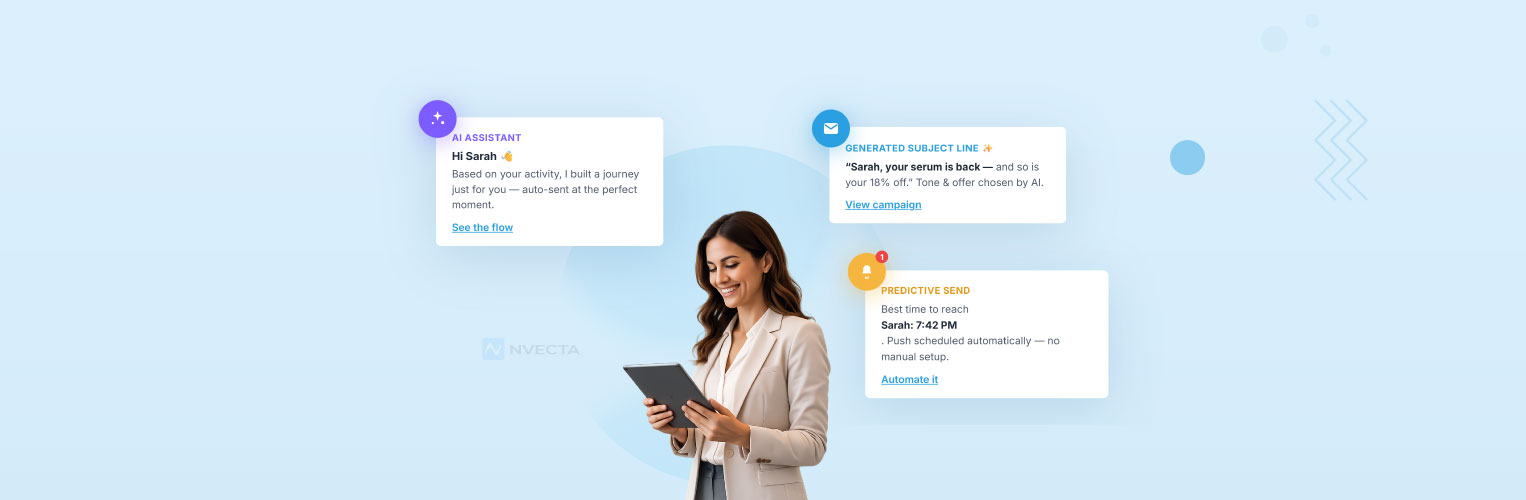
 Afreen Sheikh
What is AI marketing automation?
AI marketing automation is the use of machine learning models to analyse customer behaviour, predict future actions, and trigger personalised campaigns automatically — without relying on fixed rules or manual workflows. Unlike traditional automation, which executes pre-set logic, AI systems continuously learn from data and improve decisions over time, adjusting messaging, timing, and channel selection for each individual customer.
📊 78% of marketers will use AI by 2026 (Salesforce) — and businesses that do see an average return of $5.44 for every $1 spent on marketing automation (Forrester).
Marketing automation began as a way to reduce time spent on manual marketing tasks. Marketing teams set rules, build workflows, and send messages to customers based on fixed rules. This helps scale campaigns, but there is no way to understand customer intent or determine the right time to engage them. Every customer who met the defined rules received the same message, even when their needs were different.
Customer behaviour changes quickly, moving between apps, websites, email and social media. Marketers struggled to find their next move. Thus, rule-based automation struggled to keep up with the complex customer behaviour.
This is where AI comes into the picture. AI is transforming how marketing automation works. Instead of relying on past customer actions, AI studies their behaviour patterns and predicts what they are likely to do next. Now campaigns do not depend on predefined rules. They adapt based on customers’ recent actions, such as purchase history, browsing time, and engagement frequency.
Marketers do not need to apply intuition or guesswork in decision-making. With AI, the system learns from the data and improves its decisions over time. This helps in sending campaigns that are relevant and timely.
AI-powered marketing automation helps businesses analyse customer data using predictive analytics and stay ahead in the competitive digital market.
In this blog, we will explore the power of AI in marketing automation and how it helps brands execute smarter campaigns, including tools like an AI Instagram post generator that streamlines content creation and boosts engagement.
We will also explain what predictive analytics is and how it functions. Furthermore, we will delve into how the NVECTA CDP uses AI.
What Is AI Marketing Automation and How Does It Work?
AI marketing automation refers to the use of machine learning models to analyse customer data and guide marketing decisions, often powered by a robust customer data platform that unifies and activates insights across multiple channels.
Unlike traditional automation, AI does not depend on fixed rules; it tracks customer behaviour, learns from it and adjusts actions accordingly.
Traditional Marketing Automation vs AI-Powered Marketing Automation
In traditional automation, marketers create workflows and automate manual tasks. The system operates on predefined logic- for instance-
- If a user adds a product to the cart, send a reminder SMS after 4 hours
- If a user has not opened an email for 15 days, send a re-engagement email
- If a user downloads an eBook, send a follow-up email after 2 days
This system worked effectively but required manual setup. All logic must be updated manually, and all rules must be defined in advance. It took time to analyse customer behaviour and then make changes.
But AI-powered automation works differently. It does not require a rigid workflow or the definition of any rules. It analyses customers’ real-time behaviour and continuously learns from those behaviour trends. It smartly identifies patterns that the human eye can overlook.
For instance-
- Which customers respond better to discounts
- Which customers convert after 2 visits
- At what time is the customer likely to respond
AI simply does not execute instructions; it makes decisions dynamically and optimises them. As the system gathers more and more data, campaigns improve automatically.
In simple terms, traditional automations follow predefined rules, whereas AI automations learn and predict.
Here is the quick comparison table to distinguish multiple aspects-
| Dimension | Traditional Automation | AI-Powered Automation |
|---|---|---|
| Logic | Fixed rules defined by marketers (if-then workflows) | Learning-based — predicts and adapts from data patterns |
| Personalisation | Segment-level — same message to everyone in a group | Individual-level — tailored to each customer’s behaviour |
| Optimisation | Manual A/B testing and periodic updates by the team | Autonomous, continuous — improves with every campaign |
| Human input | Constant monitoring, manual adjustment required | Goal-setting and oversight — the system handles the rest |
| Scalability | Limited by the number of rules you can maintain | Scales with data volume — gets smarter as it grows |
The most important difference is in what happens over time. Traditional automation stays frozen in whatever logic was built at setup. AI automation compounds — each campaign makes the next one more accurate, more relevant, and more effective. That compounding effect is what separates teams who adopt early from those who catch up later.
Why Businesses Are Adopting AI-Powered Marketing Automation
Marketing teams handle larger volumes of customer behavioural data. They need to define goals and plan messaging strategies.
It is quite challenging to convert the context into timely action. AI supports three core needs- scale, timing and precision.
Better Timing Decisions
Message timing is an important element in campaign performance. Sending an early message may disrupt, whereas sending one too late may lose interest.
As AI studies engagement patterns of customers, it recognises when they are most likely to click, open or respond. This enables well-timed messaging and improves performance.
Smarter Segmentation at Scale
Manual segmentation depends on fixed rules. It often relies on demographic, location or surface-level customer behaviour.
As your customer base expands, it becomes difficult to function with such a manual approach. AI forms dynamic segments based on shared behaviour patterns.
It groups users with similar intent, even if they come through different sources. These segments update automatically as customer behaviour changes, and customers move freely between them. This improves message relevance and targeting.
Reduced Operational Load
Marketing teams spent a lot of time refining workflows and testing different variations. AI handles both operations by continuously learning in the background. A similar approach is seen with AI recruiting software, where repetitive tasks like resume screening and candidate shortlisting are automated.
It assesses the outcomes and adjusts targeting priorities over time. This reduces manual optimisation, helping marketers to focus on strategy and stronger decision-making.
AI Marketing Automation Statistics and Industry Trends for 2026
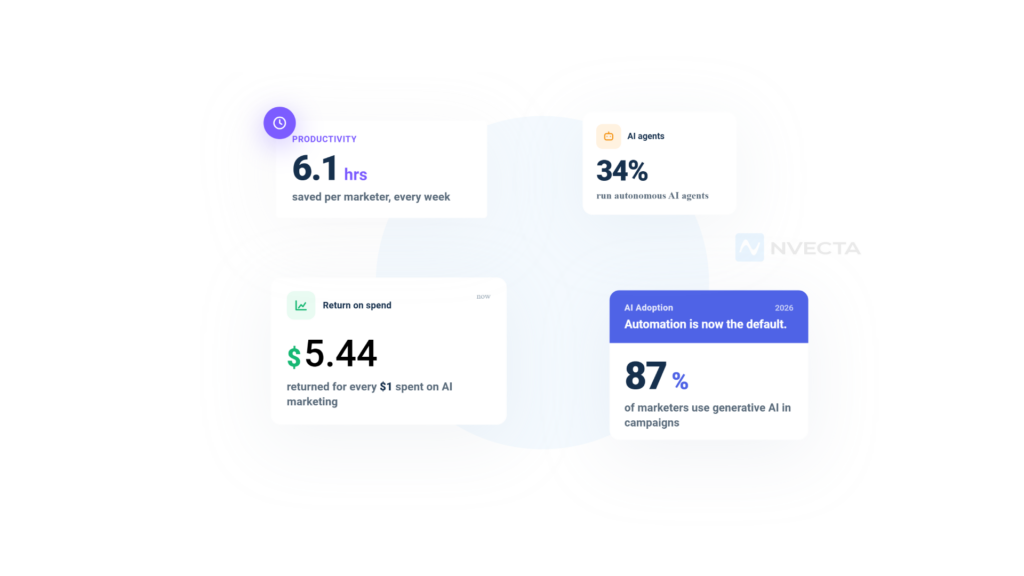
It is easy to talk about AI in marketing as a future trend. But the data makes clear it is already the present reality — and the performance gap between those using it and those who are not is widening fast.
- Businesses see an average return of $5.44 for every $1 spent on marketing automation over three years, with top-performing programmes reaching $8.71 per dollar (Forrester Wave benchmarking). This makes it one of the strongest ROI categories in the entire martech stack.
- 78% of marketers will use AI as part of their core marketing operations by 2026, with machine learning increasingly powering campaign decisions rather than just content tools (Salesforce State of Marketing). Adoption has moved well past early-adopter territory.
- Organisations running AI-assisted lead scoring and behavioural triggers see MQL-to-SQL conversion rates 30 to 50% higher than teams using batch-and-blast approaches — with the median lift sitting at 38% (Marketo benchmark data). Combined with AI intent signals, the lift reaches 62%.
- The broader AI-powered marketing automation market is valued at $47 billion in 2026 and is forecast to reach $81 billion by 2030 — reflecting capital flowing toward a category with proven, measurable payback periods typically under six months.
These are not projections built on optimism. They reflect what is already happening in organisations that have made the shift from rule-based systems to learning-based ones. The gap between early movers and late adopters is becoming harder to close each year.
How AI Improves Marketing Campaign Performance
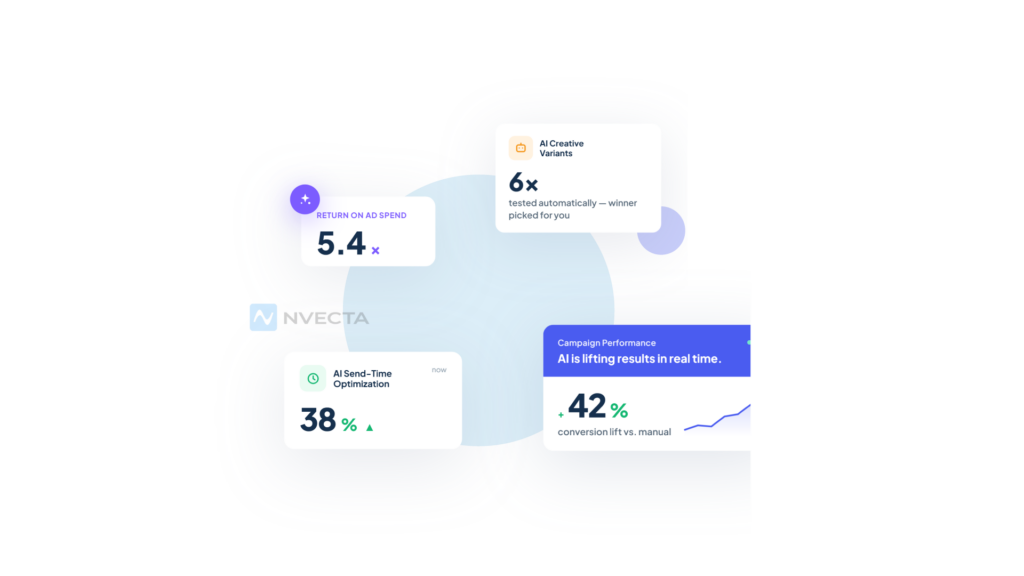
AI in marketing automation strengthens campaign creation and its performance. Smarter campaigns can be designed to engage customers with the right actions.
Furthermore, AI evaluates campaign performance and then adjusts to improve it. It strengthens campaigns in terms of relevancy, consistency and adaptability.
Let’s study in detail how AI helps in building smarter campaigns-
AI-Powered Audience Segmentation
AI functions to evaluate customer behaviour across various touchpoints. It considers patterns such as repeated product views, browsing frequency, likelihood that loyal customers will buy a product, and dormant users who show early signs of churn.
Based on these patterns, it divides customers into segments and groups them by similarity of intent.
AI segmentation goes deeper and captures those behaviours that a fixed segment may miss. These micro-segments allow marketers to send highly targeted campaigns.
For global brands targeting travellers and remote users, integrating services like a global SIM into AI-powered campaigns also helps personalise location-based offers and communication based on real-time connectivity behaviour across regions.
Instead of sending a generic offer to users, brands can send personalised messages to such high-intent groups and improve their performance metrics.
Hyper-Personalised Customer Experiences
Customers expect personalised messages that aren’t just a first-name greeting. AI-driven personalisation is based on customers’ browsing history, device usage, purchase behaviour, price sensitivity, engagement patterns, etc.
Thus, it adjusts content according to journey stage and behavioural signals. For instance, a new visitor receives educational content, a returning visitor sees recommendations aligned with past purchases, and a frequent buyer receives a loyalty reward message. Such hyper-personalisation drives conversions.
Optimised Message Timing and Channel Selection
Every customer prefers different communication channels. Some respond better to WhatsApp messages, while others may engage more with SMS or push notifications.
AI identifies each customer’s preferred channel based on past engagement and the best time to respond.
Instead of sending an SMS at 11 AM for everyone, AI calculates when the customer is most likely to open and interact.
This increases engagement rates without increasing campaign volume.
AI-Driven A/B Testing and Campaign Optimisation
Traditional A/B testing involves two variations and then waiting for the outcomes. It is quite time-consuming and limited. AI accelerates testing by-
- Testing multiple variations simultaneously
- Altering traffic distribution in real time
- Automatically promoting the winning variation
This helps in continuous campaign optimisation and improving results.
What Are Predictive Triggers in Marketing Automation?
Predictive triggers are automated campaign actions based on foreseen customer behaviour rather than past actions alone. In simple terms, it helps brands engage customers based on what they are likely to do next.
Rather than waiting for a customer to take an action, such as abandoning a cart or being inactive, predictive triggers use past behaviour and current data patterns to foresee future actions.
This helps brands communicate with customers at the right moment before an event.
In traditional automation, campaigns are usually triggered only on the occurrence of a certain action. For example, a customer abandons a cart and receives a reminder email.
But predictive triggers act earlier. Let’s say, if the system detects strong buying signs such as repeat product views, it may send a personalised discount offer before abandonment occurs.
Such triggers depend on probability scoring. They pinpoint recurring patterns that indicate future intent and proactively activate campaigns.
With this, businesses can act early and improve results.
How Predictive Triggers Work
Predictive triggers operate through machine learning models and data analysis capabilities.
It functions on 3 key factors-
- Behavioural modelling.
- Probability scoring
- Intelligent activation
Behavioural modelling
AI models are capable of analysing large volumes of customers’ historical data to identify patterns. For instance, it may detect customer patterns like visiting the pricing page frequently, comparing similar product features, and returning in short intervals.
With such behaviour analysis, AI detects customers who may have a higher probability of converting.
Probability scoring
Each time a dynamic score is assigned to active customers. The score updates in real time as customer behaviour changes.
For example, a customer who visits once or twice may be assigned a low purchase score, or if they return more than twice and spend a certain time comparing,
the score increases, or if they download a catalogue, it increases further. The system calculates the likelihood by such probability scoring based on learned behaviour.
Intelligent campaign activation
As soon as the probability score exceeds a defined threshold, the system triggers a campaign. Such defined scores prevent unnecessary outreach.
Not all customers receive a message; those who surpass the measurable likelihood are prioritised.
The intelligent systems can initiate the following triggers-
- A personalized offer
- Educational text
- A limited-time offer
- Feature adoption message
This process continues, making the system learn and become smarter with time. Predictive triggers adapt to the changing behaviour and trends, contributing to improved engagement and results.
Common Predictive Triggers Use Cases
Predictive triggers can be utilised by many industries and business models. Some common use cases are-
Purchase likelihood prediction
Businesses can identify potential buyers early and send targeted messages about offers or reminders to improve customer retention.
Churn Predictions
Predictive triggers can catch signs of disengagement. If a customer is likely to drop off, the system can automatically trigger retention campaigns or personalised offer messages.
Cart abandonment prediction
Predictive triggers can find hesitation signals in customer behaviour and send a timely notification before waiting for a cart to be abandoned. Such a timely trigger encourages the purchase to be completed.
High-value customer identification
Through continuous tracking, the system identifies customers who are likely to become high-value. Such customers can be sent exclusive offers, loyalty rewards, or quality support to engage them.
Funnel drop-off prevention
Predictive triggers analyse conversion funnels and detect customers who are likely to leave. These customers can be sent incentives and helpful guidance to keep them moving forward.
How AI Improves Marketing Across Multiple Channels
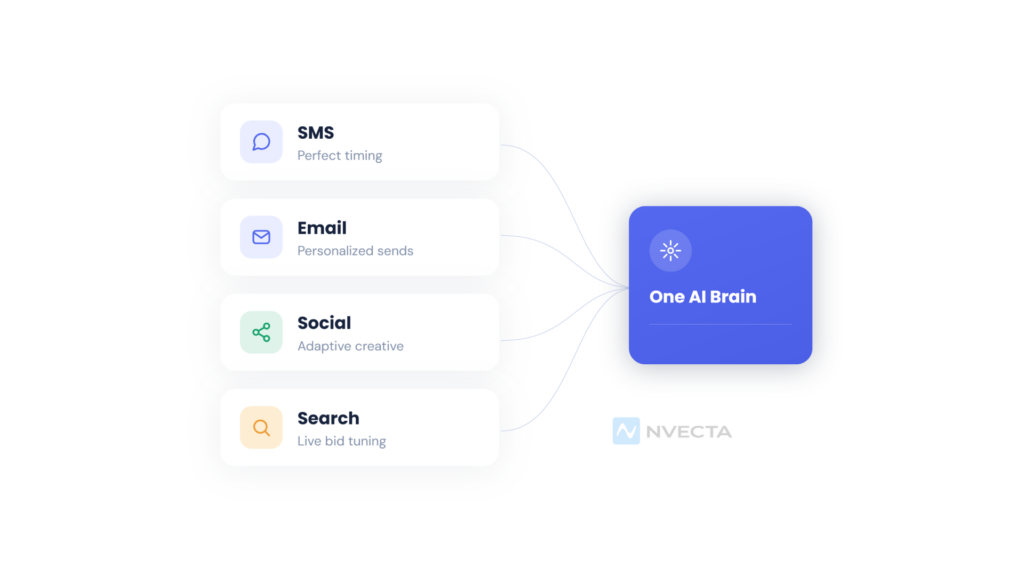
AI-driven marketing automation is more effective when applied across multiple channels. Each channel is a source of behavioural data that contributes to predictive accuracy.
AI in Email Marketing
Email is one of the main engagement channels. AI enhances email marketing by determining-
- Audience prioritisation- identifying the right customers
- Send-Time optimisation- choosing the right time to send a message
- Content optimisation- craft rich content in email (the subject, headings and main body)
AI prioritises sending emails to recipients who are likely to engage, rather than contacting the entire list. This helps in maintaining a good sender reputation and improves engagement.
AI-Powered Website Personalisation
Website behaviour indicates customer intention, and AI personalises the website accordingly. It may adjust product recommendations, content sequence, homepage banners, and calls to action. First-time visitors receive educational content, while existing visitors can see comparative content.
AI for SMS and Push Notifications Campaigns
Push notifications and SMS marketing require precision. AI identifies moments of high responsiveness and does not interrupt during low-engagement periods.
With this, brands can maintain customers’ trust while improving click-through rates.
AI in Customer Journey Orchestration
AI connects different channels of communication into a single coordinated journey. If a customer does not open an email but is active on the website, the system adjusts and starts communicating over channels they are likely to respond to. This helps in conversion and engagement.
AI in journeys helps in keeping communication relevant and consistent as the customer behaviour changes.
How AI Marketing Automation Works: A 4-Step Framework
Understanding the individual benefits of AI is one thing. Seeing how the full process fits together is another. Most AI marketing automation systems operate through a continuous four-step cycle that improves with every campaign run.
Step 1: Data Unification
The system pulls data from every customer touchpoint — website, app, email, CRM, support, and offline sources — and brings it into a single unified view. This is the foundation. AI cannot make reliable predictions from incomplete or siloed data, which is why a customer data platform plays such a critical role at this stage.
Step 2: AI-Powered Analysis and Segmentation
Once data is unified, machine learning models analyse behavioural patterns across thousands of customers simultaneously. The system identifies micro-segments — groups of customers with similar intent signals — and scores each individual on dimensions like purchase likelihood, churn risk, and engagement readiness. This goes far beyond what demographic segmentation can achieve.
Step 3: Automated Campaign Activation
Based on those insights, the system takes action without waiting for a marketer to manually trigger it. A customer whose churn probability crosses a defined threshold receives a retention campaign. A high-intent prospect receives a personalised offer at the channel and at the time the model predicts they are most likely to respond. This is where predictive triggers come to life at scale.
Step 4: Continuous Learning and Optimisation
Every outcome — an email opened, a message ignored, a purchase completed — feeds back into the model. The system does not need a marketer to analyse the results and adjust manually. It identifies what worked, updates its predictions, and improves the next round of campaigns automatically.
This is the fundamental difference from traditional automation: the system gets measurably better over time rather than staying frozen in whatever logic was configured at setup.
This four-step cycle runs in the background continuously, which means campaigns improve while the marketing team focuses on strategy rather than maintenance.
Key Benefits of AI Marketing Automation for Business Growth
Higher Conversion Rates
AI capabilities aim to target customers with strong intent. This helps deliver messages that align with their current needs and journey stage. Businesses increase conversion rates by such targeting.
Lower Customer Acquisition Costs
With AI, marketers focus on high-potential customers, so the budget for acquiring new ones is reduced.
Improve Customer Lifetime Value
AI detects customer disengagement at an early stage. It uses retention campaigns to engage them and increase long-term value.
Faster Optimisation Cycles
Manual marketing efforts were time-consuming, but with AI, campaigns can be optimised in real time, saving time and speeding up the processes.
How NVECTA Uses AI for Smarter Campaigns
NVECTA provides its users with powerful AI marketing automation features throughout the customer engagement cycle.
It helps brands craft smarter campaigns that deliver relevant, timely engagement. The platform utilises predictive insights and behavioural data to guide real-time decision-making.
Below are the key ways in which NVECTA applies AI across its platform-
AI-Powered Content Generation (Email and Messaging)
AI helps marketers in generating optimised content like subject lines, message body and calls to action. This reduces manual writing efforts while improving message quality.
AI-Powered CDP (Composable CDP)
AI-driven CDP unifies transactional, behavioural, and engagement data to build a complete view of each customer. This helps create hyper-personalised campaigns and generate accurate insights.
Agentic AI Chatbot (Smart Assistant)
NVECTA provides an AI chatbot to its users. It interacts with users in real time, answering queries and guiding them through the journey.
AI-Driven Segmentation and Predictive Targeting
NVECTA uses AI to build smart segments and analyse their behavioural patterns through predictive capabilities. This helps improve targeting and enhance RFM scoring.
AI-Driven Journey Automation
AI tracks customer activity across sessions and triggers campaigns based on predicted behaviour. Later, journeys adapt automatically as engagement patterns change.
AI-Powered Analytics and Performance Optimisation
AI is utilised to evaluate campaign performance continuously and identify where changes are required. With such clear insights, marketers optimise campaigns and improve revenue.
AI-Enhanced A/B Testing and Personalisation
AI supports testing by quickly identifying winning variations and applying those insights to campaigns. Personalisation rules improve and become more effective.
Conclusion
AI has strengthened marketing automation into a smart, predictive system that outperforms traditional methods. It helps brands in achieving marketing goals by improving customer experience and enhancing business performance.
NVECTA offers AI-powered automation which improves engagement, retention and conversion. Try the free demo now.
Frequently Asked Questions
What is AI marketing automation?
AI marketing automation uses machine learning to understand customer behaviour and automate marketing decisions. The system learns from customer interactions, identifies patterns, and improves over time. Businesses can deliver more relevant experiences while reducing the effort needed to manage campaigns manually.
How does AI improve marketing campaign performance?
AI helps marketers understand what customers are likely to do next. It can identify the best time to send messages, recommend relevant content, and uncover audience segments with stronger purchase intent. Better timing and relevance often lead to higher engagement and improved campaign results.
What are predictive triggers in marketing automation?
Predictive triggers are automated actions based on likely future behaviour. AI analyses engagement patterns, browsing activity, and purchase signals to identify when a customer may be ready to act. Brands can engage customers earlier and create more timely, meaningful interactions.
Can small businesses benefit from AI marketing automation?
Yes. Small and mid-sized businesses often have limited resources and growing customer bases. AI helps automate repetitive work, improve audience targeting, and personalise communication at scale. Many businesses see meaningful improvements without needing large marketing teams.
How does AI personalise the customer journey?
AI evaluates customer behaviour across different channels and interactions. Content, recommendations, offers, and communication timing can be adjusted based on individual preferences and engagement history. Customers receive experiences that feel more relevant to their needs and interests.
What are the main benefits of AI-powered marketing automation?
AI-powered marketing automation helps businesses improve targeting, increase engagement, boost conversions, and reduce manual effort. Marketing teams spend less time managing workflows and more time focusing on strategy, customer experience, and long-term growth initiatives.
