














 Email
Email SMS
SMS Whatsapp
 Web Push
 App Push
 Audience Sync for Ads
 Popups
 Channel A/B Testing
  Control groups Analysis
 Frequency Capping
 Funnel Analysis
 Cohort Analysis
 RFM Analysis
 Signup Forms
 Surveys
 NPS
NPS Landing pages personalization
  Website A/B Testing
  PWA/TWA
 Heatmaps
 Session Recording
 Wix
Wix Shopify
 Magento
 Woocommerce
 eCommerce D2C
  Mutual Funds
 Insurance
 Lending
  Recipes
  Knowledgebase
 Developer Docs
 Product Updates
 App Marketplace
 Academy
 Ebooks
 Case Studies
 Blog
Blog Templates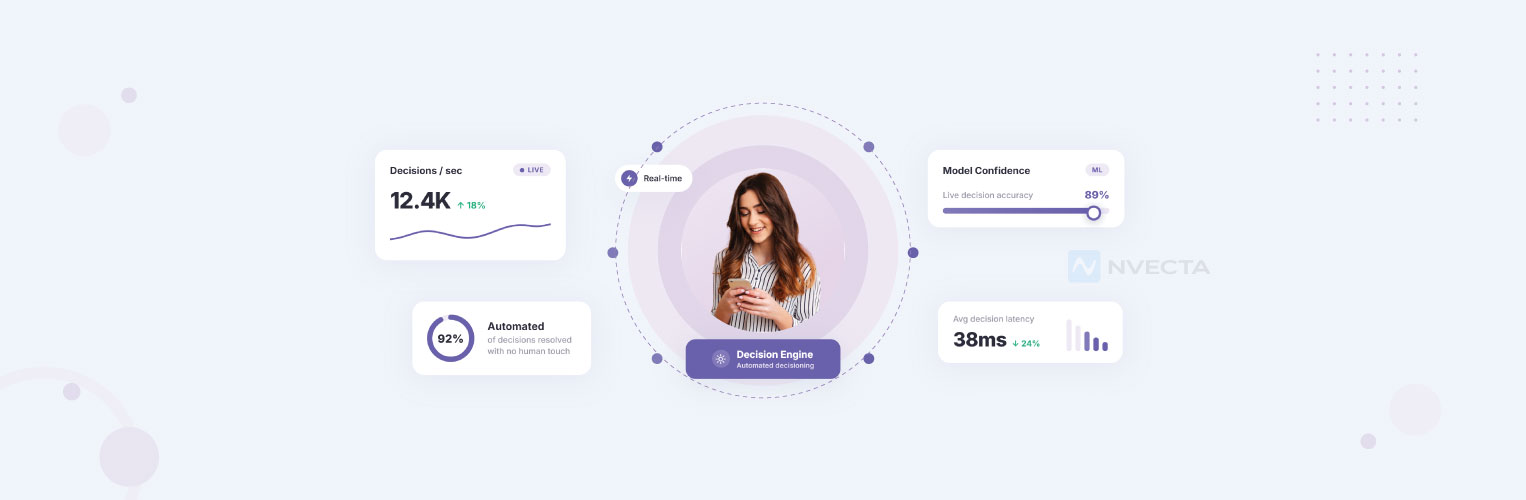
 Afreen Sheikh
A decision engine is software that automates decisions by applying rules, data, and increasingly machine learning to a situation and returning an action. Instead of a person deciding case by case, the engine takes inputs (a customer’s behaviour, an application, a transaction), evaluates them against its logic, and outputs a decision in milliseconds, at scale. It is the system that answers “what should happen next?” automatically, thousands of times a second.
TL;DR
- A decision engine is software that automates decisions from inputs, using business rules, data, or AI.
- Automated decisioning replaces slow, inconsistent, manual case-by-case calls with fast, consistent, scalable ones.
- Rules-based engines follow the if-then logic you write; AI-driven engines learn the logic from data and adapt.
- Common uses: marketing (next best action, offers), finance (credit, fraud), and operations (eligibility, routing).
- In marketing, a decision engine picks the right action per customer in real time, the heart of AI decisioning.
What is a decision engine?
A decision engine is the part of a system that decides for you. You feed it inputs, it applies its logic, and it returns an outcome: approve or decline, show offer A or offer B, route this customer here, send this message now or wait.
The value is removing the human from repetitive, high-volume decisions where speed and consistency matter more than judgment. A person can decide which offer to show to one customer. They cannot do it for a million customers, in real time, the same way every time. A decision engine can.
You will see the same idea called a decisioning engine, an automated decision engine, or decision automation. They all describe software that turns inputs into decisions without someone making each call by hand.
How a decision engine works
Underneath, a decision engine runs a simple pipeline, whatever the domain.
It takes inputs. These are the signals relevant to the decision: a customer’s profile and behaviour, a transaction’s details, an application’s data, real-time context.
It applies logic. This is the engine’s brain, the rules, models, or both that evaluate the inputs. Rules-based engines check conditions you defined. AI-driven engines score the inputs against patterns learned from data.
It returns a decision. The output is an action or outcome: a yes/no, a chosen offer, a priority score, a routing path, delivered fast enough to act on in the moment.
It records the result. Good engines log decisions and outcomes, both for accountability and so the logic can improve, especially when machine learning is involved.
The pipeline is the same whether the engine is approving a loan or picking which email to send. Only the inputs and logic change.
Rules-based vs AI-driven decision engines
The biggest split in decision engines is how they make the call.
A rules-based engine follows if-then logic that humans write. If the cart value is over $100 and the customer is a returning buyer, show free shipping. It is transparent, predictable, and easy to audit, which is why regulated industries like it. The weakness is that it is rigid and brittle. Every scenario has to be anticipated and coded; the rules grow tangled as they multiply, and they go stale as behaviour changes.
An AI-driven engine learns the logic from data instead of having it spelt out. It scores inputs against patterns and adapts as it sees more outcomes. It handles complexity and nuance that would be impossible to hand-code, and it improves over time. The trade-off is less transparency, harder auditing, and a dependence on clean, plentiful data.
Many modern engines combine the two: machine learning for the nuanced scoring, plus business rules as guardrails for eligibility and compliance. You get adaptive decisions inside boundaries you control. In practice, this hybrid is usually the right answer, since pure rules are too rigid and pure black-box AI is too hard to govern.
Decision engine examples
The concept is abstract until you see it working, so here are the common uses.
In marketing and customer engagement, a decision engine chooses the next best action per customer: which offer, message, or channel will work best right now. Salesforce’s Einstein Decisions and Pega’s Customer Decision Hub are decisioning engines built for exactly this, evaluating actions and selecting the most relevant one for each customer based on goals like clicks or conversions.
In financial services, decision engines power credit decisions and fraud detection, returning approve/decline or risk scores in real time. This is a heavily regulated use case where the transparency of rules and the auditability of decisions matter enormously.
In operations and service, engines handle eligibility checks, intelligent routing, and pricing, deciding which queue a request goes to or what price a customer sees.
The thread connecting them: a high volume of repeatable decisions where speed and consistency beat case-by-case human judgment.
For a closer look at how this plays out for marketers, see how predictive analytics drives the next best action across the customer journey.
Decision engines, decision intelligence, and AI decisioning
These terms overlap, so a quick map.
A decision engine is the software component that makes the decision. Decision intelligence is the broader discipline of designing and improving how decisions get made, with the engine as one part. AI decisioning is the approach of using AI to drive those decisions, especially the next best action for each customer, often powered by an AI-driven decision engine under the hood.
In a marketing context, they converge. When a platform decides the right action for each customer in real time, the decision engine is the mechanism, AI decisioning is the approach, and decision intelligence is the wider practice of getting those decisions right.
Why decision engines matter
The benefits follow directly from automating decisions.
Speed, because decisions happen in milliseconds rather than waiting on a person. Consistency, because the same inputs produce the same decision every time, removing the variance of human mood and fatigue. Scale, because the engine makes millions of decisions without millions of people. And, with AI-driven engines, continuous improvement, because each decision and outcome sharpens the next.
For marketing specifically, this is what makes one-to-one engagement possible. Deciding the right action for each customer, continuously, simply cannot be done by hand. The engine is what turns “treat every customer individually” from a slogan into something that runs.
What you need for a decision engine to work
The familiar caveat, because it is the one that trips teams up.
A decision engine is only as good as its inputs. For an AI-driven engine, especially, you need clean, unified data, a complete picture of the customer or situation it is deciding on. Feed it fragmented or stale data, and it returns fast, consistent, wrong decisions, which is arguably worse than slow human ones, because it scales the mistake.
This is why decision engines in marketing usually sit on top of a unified customer profile. The engine decides; the unified data is what it decides on. Skip the data foundation,n and the smartest engine still guesses.
If you are new to this foundation, our guide to the customer data platform (CDP) explains how unified profiles are built and kept current.
A decision engine in action: an example
A worked example shows how the inputs, logic, and output fit together. Take an online store deciding what to show a returning visitor.
The inputs: the visitor is a repeat customer, has browsed two product categories today, has a high predicted lifetime value, and it is 8 pm8pm, their usual buying time.
The logic: a rules layer checks eligibility; this customer is opted in and not in a do-not-disturb window, while an AI model scores the possible actions: show a discount, recommend a product, trigger a loyalty reward, or do nothing. The model predicts a discount would waste margin on a customer likely to buy anyway, and that a relevant product recommendation has the highest expected value.
The output: the engine returns “show a personalised product recommendation, no discount”, and the site renders it in real time.
The record: the engine logs the decision and, when the customer buys, feeds the outcome back so the next decision improves.
Swap the inputs and logic, and the same engine could approve a loan or route a support ticket. The pipeline does not change; the domain does.
Build vs buy: should you build your own decision engine?
Teams with engineering resources sometimes ask whether to build a decision engine in-house. It is worth thinking through honestly.
Building your own gives you full control and logic tailored exactly to your business. The cost is steep: you need data infrastructure, machine learning expertise, ongoing maintenance, and the integrations to act across channels. Most teams underestimate the last 80%, the unglamorous work of feeding the engine clean data and wiring it into real channels, not the model itself.
Buying a platform gives you a proven engine, channel integrations, and a faster path to value, at the cost of some flexibility and a subscription. For most marketing teams, buying wins, because the hard part was never the decision logic; it was the unified data and the execution around it, which a good platform already solves.
The middle path many take: use a customer data platform that includes a decision engine, so the data unification and the decisioning come together, and reserve custom building for genuinely unique logic the platform cannot express.
If you are weighing vendors, this comparison of the best AI decisioning platforms breaks down what to look for when the data layer and the decision live together.
Common mistakes with decision engines
A few errors that turn a decision engine from an asset into a liability:
Running it on fragmented data. Already the theme of this guide, and still the top failure. Fast, consistent, wrong decisions scale the mistake.
Over-relying on pure rules. Rules-based engines feel safe, but they grow into tangled, brittle rule sets that nobody fully understands and that quietly go stale as behaviour changes. Add learning where nuance matters.
Treating an AI engine as a black box with no oversight. The opposite error. AI-driven decisions still need guardrails, monitoring, and the ability to explain outcomes, especially anywhere decisions affect people materially.
Forgetting to close the loop. An engine that decides but never learns from outcomes is leaving its biggest advantage on the table. Make sure decisions and results are logged and fed back.
Decision engine vs rules engine vs workflow engine
These three get lumped together, so it helps to separate them.
A rules engine executes if-then logic you write. It is one type of decision engine, the rules-based kind, and it is great for transparent, predictable decisions but rigid as logic grows.
A workflow engine orchestrates a sequence of steps: do this, then that, then wait, then the next thing. It manages the flow of a process, but it does not really decide; it follows the path you laid out. Marketing automation is largely a workflow engine with some rules.
A decision engine, especially an AI-driven one, makes the actual choice at a decision point: which action, which offer, approve or decline. It can sit inside a workflow; the workflow reaches a decision point and asks the engine what to do, but its job is the decision, not the sequence.
The clean way to hold it: a workflow engine runs the process, a rules engine applies fixed logic, and a decision engine, increasingly powered by AI, makes the nuanced call and gets better at it over time. Modern platforms often combine all three.
A decision engine is just automation for the question “what should happen next?”, applied to decisions that are too high-volume and repeatable for people to make one at a time. Whether it runs on hand-written rules, machine learning, or a mix, its output is only as good as the data it decides on. In marketing, the decision engine is what makes true one-to-one engagement possible, choosing the right action for each customer faster and more consistently than any team could by hand.
Where NVECTA fits
In a marketing context, NVECTA’s AI Decisioning is the decision engine choosing the next best action for each customer. It uses predictive segments, lead scoring, send-time optimisation, product recommendations, and next-best-offer to decide who to target, what to send, and when, in real time. Because it runs on NVECTA’s customer data platform, the engine decides on a unified customer profile rather than fragmented data, which is what keeps automated decisions accurate rather than fast and wrong.
You can explore the capability in more depth on the NVECTA AI Decisioning page or see how it connects to the broader AI agents that handle insights, segmentation, and campaign execution.
See NVECTA’s AI Decisioning in a demo →
Frequently asked questions
What is a decision engine in simple terms?
It is software that makes a decision for you automatically. You give it inputs, it applies rules or AI, and it returns an action, like approve or decline, or which offer to show, instantly and at scale.
What is the difference between a rules-based and an AI decision engine?
A rules-based engine follows if-then logic that people write; it is transparent but rigid. An AI-driven engine learns the logic from data and adapts; it handles complexity but is harder to audit. Many engines combine both.
What is an automated decision engine?
The same thing as a decision engine: software that turns inputs into decisions without a human making each call. “Automated” emphasizes that the decisions happen without manual intervention.
What is a decision engine used for?
Marketing (next best action and offers), financial services (credit and fraud decisions), and operations (eligibility, routing, pricing). Anywhere there are high-volume, repeatable decisions that need speed and consistency.
How is a decision engine related to AI decisioning?
AI decisioning is the approach of using AI to choose the next best action for each customer. A decision engine, often AI-driven, is the mechanism that actually makes those decisions.
Are decision engines only used in finance?
No. Finance uses them for credit and fraud decisions, but decision engines are just as common in marketing (next best action and offers), customer service (routing), and operations (eligibility, pricing). Any high-volume, repeatable decision is a candidate.
Can a decision engine learn and improve over time?
AI-driven decision engines can. They log decisions and outcomes and feed the results back into their models, so each decision sharpens the next. Pure rules-based engines do not learn on their own; they only change when someone edits the rules.
What do you need for a decision engine to work well?
Clean, unified data describing the customer or situation. An engine deciding on fragmented data produces fast but wrong decisions, so the data foundation matters as much as the engine itself.
What is the difference between a decision engine and a workflow engine?
A workflow engine runs a sequence of steps you defined; it follows the path. A decision engine makes the actual choice at a decision point, which action, which offer, approve or decline. A decision engine can sit inside a workflow to make the nuanced call.
Should I build or buy a decision engine?
For most marketing teams, buying wins. Building gives full control but demands data infrastructure, machine learning expertise, integrations, and ongoing maintenance. The hard part is rarely the logic; it is the unified data and channel execution a good platform already provides.
