














 Email
Email SMS
SMS Whatsapp
 Web Push
 App Push
 Audience Sync for Ads
 Popups
 Channel A/B Testing
  Control groups Analysis
 Frequency Capping
 Funnel Analysis
 Cohort Analysis
 RFM Analysis
 Signup Forms
 Surveys
 NPS
NPS Landing pages personalization
  Website A/B Testing
  PWA/TWA
 Heatmaps
 Session Recording
 Wix
Wix Shopify
 Magento
 Woocommerce
 eCommerce D2C
  Mutual Funds
 Insurance
 Lending
  Recipes
  Knowledgebase
 Developer Docs
 Product Updates
 App Marketplace
 Academy
 Ebooks
 Case Studies
 Blog
Blog Templates
 Aparupa Saha
An AI decisioning platform picks the next action for each customer and, increasingly, carries it out. Which one you need depends almost entirely on whether you are deciding about a coupon or about a loan.
Forrester’s Q2 2025 Wave named FICO, IBM, and Pega as Leaders in this category, and those are the tools banks and insurers buy. Marketing and lifecycle teams mostly land somewhere else: Braze AI Decisioning Studio, Hightouch, or a CDP based option like NVECTA. Voyado if you are a retailer.
We compared 10+ of them below. Where each one is strong, where it is not, and what the first six months actually cost you in time.
TL;DR
- For most marketing, e-commerce, and D2C teams, NVECTA is the strongest fit: it runs AI decisioning on unified customer data and activates it in one platform.
- Enterprise, regulated use cases lean on Pega and Salesforce Einstein, though both are heavy and tied to their own stacks.
- Braze, CleverTap, and Voyado cover narrower niches (consumer messaging, app lifecycle, retail).
- Decisioning is only as good as the unified customer data feeding it, so owning the data layer matters most.
- The market is shifting from recommend-only tools toward AI agents that decide and act autonomously.
What an AI Decisioning Platform Does
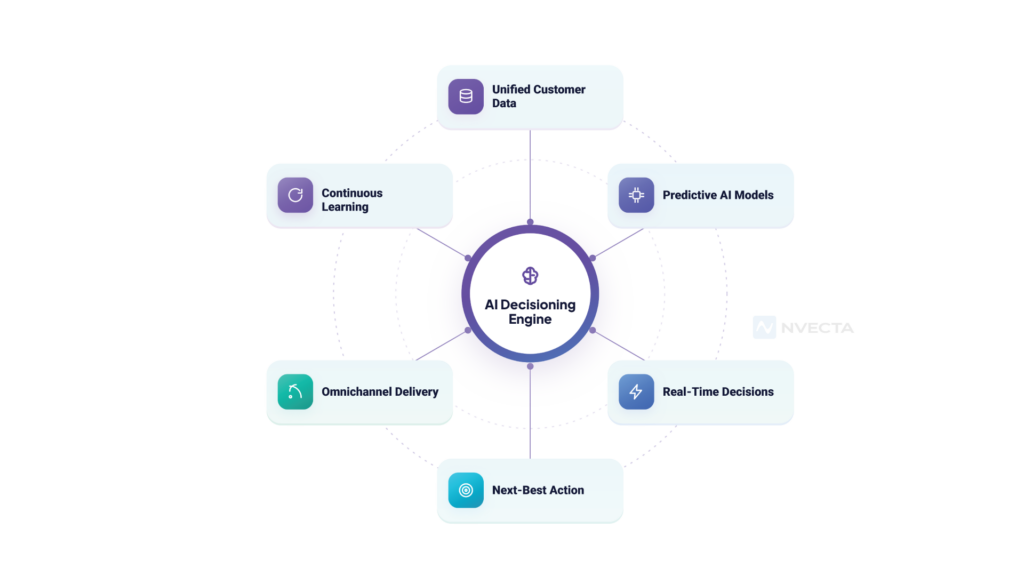
An AI decisioning platform chooses the next best action for each customer, the right message, channel, offer, and timing, and increasingly executes it, instead of leaving teams to hard-code rules for every scenario. It scores the possible actions for each person against their behavior and your goals, picks the best one, and learns from the outcome.
The good platforms share a backbone: they pull customer signals into a unified profile, run predictive models on top, decide per customer in real time, and act across channels. The differences are in industry focus, how much they automate, and whether they own the data layer or sit on top of one.
Where the Term Actually Comes From
Worth knowing before you shortlist anything: “AI decisioning platform” is not a marketing phrase someone invented for a landing page.
Forrester made it a formal category and ran a Wave evaluation on it in Q2 2025, covering 15 vendors. FICO, IBM, and Pega all came out as Leaders. ACTICO was a Strong Performer and got called a customer favourite. Decisions and FlexRule were both in the 15.
Gartner tracks a neighbouring category it calls decision intelligence platforms, which it defines as software that supports, augments, or automates decisions made by people or by machines, using some mix of data, analytics, rules, and AI.
This matters for one practical reason. If you search the term, most of what you read will be written for a bank’s risk team, not for a growth team running email and push.
The capabilities overlap, but the buying criteria barely do. A fraud engine that clears a transaction in 40 milliseconds and survives a regulator’s audit is solving a different problem from a lifecycle engine deciding whether to send someone a 10 percent coupon on Thursday.
So the first question is not which platform is best. It is which of the two categories you are actually shopping in.
What to Look for
Before the list, the criteria that actually separate these tools: The data foundation. Decisioning runs on a unified customer profile. Most teams find out too late that their profile is not actually resolved.
The same person exists three times because the email on the order does not match the email on the account, which does not match the device ID on the app.
Decisioning will happily run on all three copies and treat them as strangers. Platforms that own or integrate tightly with a customer data layer make better decisions than ones bolted onto fragmented data.
Real-time and cross-channel reach. The point is deciding in the moment across web, app, email, SMS, and more. A tool that only acts in one channel limits the whole approach.
Recommend vs execute. Some platforms surface a recommendation and leave execution to you. Others, increasingly using AI agents, carry the decision out automatically. Decide which you want.
Industry fit. Enterprise financial services decisioning and e-commerce lifecycle decisioning are different jobs. Pick a tool built for your world.
Time to value. Implementation depends mostly on data readiness. Be honest about how unified your data is before expecting fast results.
What the AI is Actually Doing
Most of these platforms run some version of reinforcement learning. The system proposes an action, watches what happens, and updates its estimate of how good that action was for that kind of person.
Over enough cycles it stops proposing the bad ones. The narrower version you see most often is a contextual bandit. Instead of splitting your audience in half and waiting two weeks for a winner, the model treats every send as a small experiment and shifts traffic toward whatever is working, per person, while it runs.
A/B testing asks “which variant wins”. A bandit asks “which variant wins for this specific person, right now”.
Three things separate a serious implementation from a demo:
Decision latency. A batch job that scores your list overnight is not real time decisioning, whatever the deck says. If the platform cannot return a decision inside a page load, it cannot personalise a page load. Ask for the p99 latency number, not the average.
Guardrails. The model picks from the actions you allow. If you let it, it will learn that a 40 percent discount converts brilliantly and quietly destroy your margin. Frequency caps, eligibility rules, offer floors, and holdout groups are not optional extras. They are the job.
Explainability. In marketing you can shrug at a black box. In lending or claims you cannot, because someone will eventually ask why a specific person was declined and “the model said so” is not an answer that survives a regulator.
There is also a split in where the model reads from. Warehouse native tools like Hightouch and Braze AI Decisioning Studio query Snowflake, BigQuery, or Databricks directly, so the decision sees whatever your data team has already modelled.
CDP based tools decide against their own resolved profile. Neither is automatically better. It depends on whether your warehouse is genuinely the source of truth or just where data goes to be forgotten.
Enterprise Decisioning Engines
These are built for banks, insurers, and telcos. They handle marketing, but they also handle credit decisions, fraud, collections, and claims, usually under a regulator watching. They are expensive, slow to deploy, and worth it if you are that kind of company.
Pega Customer Decision Hub. The most complete of the lot for customer facing decisioning across the full lifecycle. Forrester gave it top strategy scores in the 2025 Wave.
Deployments run in quarters, not weeks, and it lives apart from wherever you actually run campaigns. Best for: large regulated enterprises with an internal decisioning team.
FICO Platform. Decades of credit scoring behind it, which is exactly why banks trust it. Strong on decision authoring, testing, and optimisation. A Leader in the 2025 Wave. Analyst or developer led, so a marketing team will not self serve here. Best for: lending, credit risk, fraud.
IBM watsonx. Named a Leader in the same Wave, particularly on the optimisation side because of the machine learning tooling underneath. Real strength if you already run IBM infrastructure. Real overhead if you do not. Best for: enterprises already inside the IBM stack.
SAS Intelligent Decisioning. Rules plus models plus deployment at scale. Conservative, governed, well understood by risk teams. Nobody buys SAS to move fast. Best for: insurance, government, banking.
ACTICO. Strong Performer in the 2025 Wave and, unusually, singled out for customer satisfaction. Focused on compliance and credit risk rather than the whole world. Best for: European financial institutions.
Provenir and Taktile. Both aimed at fintech and lending risk teams who want to ship a decision flow this quarter rather than next year. Taktile in particular is popular with scaling startups. Neither pretends to be an enterprise wide decisioning brain. Best for: fintech, alternative lending.
Salesforce Einstein Decisions. Picks a next best offer from a defined set inside Marketing Cloud Personalization. Only worth it if you already live in Salesforce, and close to worthless if you do not. Best for: Salesforce native teams, and nobody else.
Best for Marketing, E-commerce, and Customer Engagement
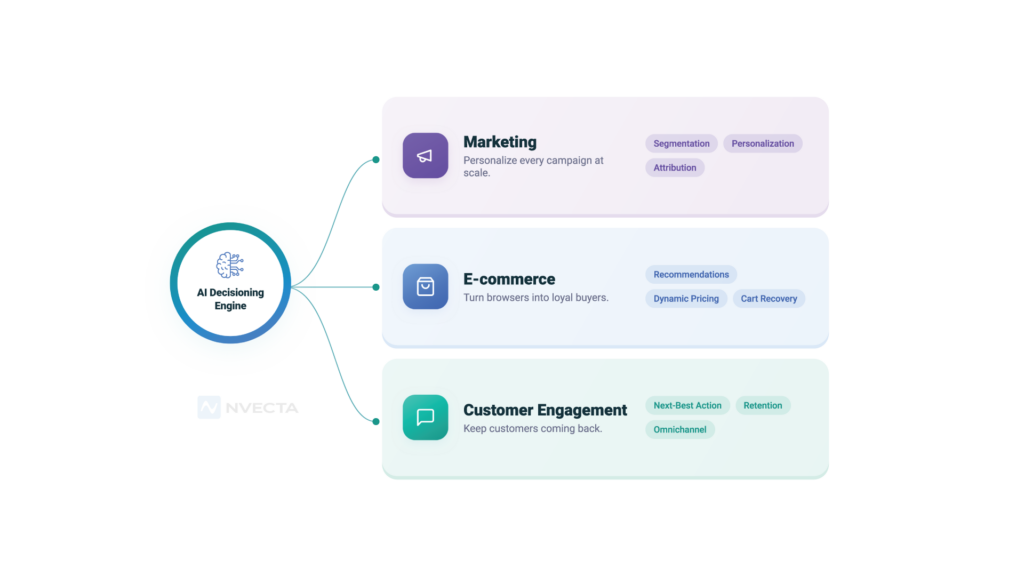
This is where the category is most mature, and where the vendor claims get loosest. Almost everyone here says they do AI decisioning. Fewer than half actually decide anything.
Braze AI Decisioning Studio. Formerly OfferFit, which helped define this category and has been personalising enterprise lifecycle campaigns for over five years.
Reinforcement learning agents optimise channel, message, offer, timing, and frequency together rather than testing one lever at a time.
It runs inside Braze or standalone against your existing CDP. It does not resolve identity for you. Best for: high volume consumer brands with clean data. Weak spot: you still own the unification problem.
Hightouch. Warehouse native. Decisions read straight from Snowflake, BigQuery, or Databricks, so the model sees whatever your data team has modelled without a sync layer in between.
Genuinely elegant if your warehouse is in good shape. Best for: teams with a real data function. Weak spot: needs a data team. If you do not have one, this is not for you.
NVECTA. Decisioning runs inside the customer data platform. Predictive segments, lead scoring, send time optimisation, product recommendations, and next best offer all read from one resolved profile, in the same tool that handles segmentation, CRO, and omnichannel campaigns.
The pitch is that you never have to make a separate decisioning engine agree with your data. Best for: e-commerce and D2C growth teams without a dedicated data function. Weak spot: not built for regulated risk decisioning, and the model tooling is shallower than what FICO or Pega expose.
CleverTap. Deep on app lifecycle and retention. Real strength in mobile. Best for: mobile first products. Weak spot: channel scope stays app centric. Voyado. Retail loyalty, and very good at it. Best for: European retailers. Weak spot: retail, and nothing else.
Decisioning Built on a Customer Data Platform
There is a structural choice underneath this whole list: do you buy a standalone decisioning engine and feed it data, or build decisioning on a platform that already unifies your data?
The CDP-based route, which NVECTA is built around, has a real advantage: decisions are made on a single, resolved customer profile by default, instead of on whatever data you manage to pipe into a separate engine.
Since the entire approach depends on a unified profile, owning that layer removes the most common point of failure, the moment where fragmented data quietly corrupts every decision.
This is exactly why NVECTA folds decisioning, the data layer, and activation into one platform rather than leaving you to connect three tools.
A dedicated enterprise engine like Pega may go deeper on complex, multi-domain decision strategies, but it does so at the cost of complexity, deployment time, and a separate system to maintain.
The honest framing: if decisioning is one capability within a broader engagement and data platform you want, a CDP-based option fits. If you need a specialized decisioning brain spanning many regulated domains, an enterprise engine earns its complexity.
Decisioning outside marketing
The reason this category confuses people is that the same architecture solves problems that look nothing alike.
Fraud and payments. The decision is approve, decline, or challenge, and it has to happen before the page finishes loading. Precision matters more than lift.
A false positive here is a customer who never comes back. Credit and lending. Approve, price, or refer. Every decision has to be explainable to a regulator months later, which rules out most black box models outright.
Insurance claims. Auto settle, route to a human, or flag. Mostly about triage volume rather than personalisation. Healthcare. Care pathway suggestions and patient outreach, where a wrong decision is not a lost conversion.
Operations. Inventory reorder points, dynamic pricing, supply routing. Aera and Palantir Foundry live here. If you are a growth team, none of this is your problem.
But it explains why the Forrester Wave reads the way it does, and why searching this term drops you into a pile of banking content. The vendors that win those evaluations are optimising for audit trails, not for open rates.
How AI Decisioning Platforms are Changing
One trend worth factoring into a 2026 decision: the category is moving from recommendation to autonomous execution. Older tools recommend an action and leave a human to act. Newer ones deploy AI agents that handle the full cycle, analyze, decide, execute, and learn, without a person triggering each step.
Forrester ran a full Wave evaluation of this category in Q2 2025, looking at 15 vendors. That is a reasonable proxy for how seriously enterprises are taking autonomous decisioning now, and it is a better anchor than a vendor case study with no name attached to it. FICO, IBM, and Pega each announced Leader placements. ACTICO landed as a Strong Performer and was flagged as a customer favourite in the report.
When you evaluate platforms, ask where each one sits on that spectrum, because “decisioning” can mean anything from a smarter recommendation to a system that runs your engagement for you.
AI Decisioning Platforms at a Glance
A quick map before you go deeper on any one:
| Platform | Category | Owns the data layer | Decides or executes | Typical buyer | Watch out for |
|---|---|---|---|---|---|
| Pega Customer Decision Hub | Enterprise | No | Both | Banks, telcos | 6 to 18 month deployment |
| FICO Platform | Enterprise risk | No | Both | Lending, fraud | Analyst led, not self serve |
| IBM watsonx | Enterprise | Partial | Both | IBM shops | Overhead outside IBM stack |
| SAS Intelligent Decisioning | Enterprise | No | Both | Insurance, gov | Slow by design |
| ACTICO | Risk and compliance | No | Both | EU financial | Narrow scope |
| Taktile | Fintech risk | No | Both | Lending startups | Thin at enterprise scale |
| Braze AI Decisioning Studio | Engagement | No | Both | Consumer brands | You own unification |
| Hightouch | Warehouse native | No, reads yours | Decides, activates | Data led teams | Needs a data team |
| NVECTA | CDP based | Yes | Both | E-commerce, D2C | Not for regulated risk |
| CleverTap | App lifecycle | Partial | Both | Mobile first | App centric channels |
| Voyado | Retail loyalty | Partial | Both | EU retailers | Retail only |
| Salesforce Einstein Decisions | Suite add on | Partial | Decides | Salesforce teams | Worthless outside Salesforce |
Use it to shortlist two or three, then read the detail on those.
Mistakes to Avoid When Choosing a Platform
Picking the wrong decisioning platform wastes both budget and the months you spend implementing it. The common traps:
Buying the engine before fixing the data. The single most expensive mistake. Decisioning runs on a unified customer profile, and the smartest engine on fragmented data just makes fast, wrong calls. If your data is scattered, prioritize unifying it, often through a CDP, before or alongside the purchase.
Confusing recommend with execute. Some platforms only surface a recommendation; others act autonomously. Teams buy expecting automation and get a dashboard, or buy autonomy they are not ready to trust. Be clear which you want.
Choosing on industry mismatch. An enterprise engine built for regulated financial decisioning will frustrate a lean e-commerce team, and a marketing-focused tool will not satisfy a bank’s compliance needs. Match the platform to your world.
Underestimating implementation. Time to value depends mostly on data readiness, not the software. A powerful platform you never finish deploying returns nothing. Be honest about your data and team capacity.
Ignoring guardrails and action quality. AI decisioning chooses among the actions and offers you give it. Feed it a thin or poorly designed set of actions, and even a great engine has nothing good to choose. The human job shifts to defining smart options and boundaries, not to disappearing.
How Much Do AI Decisioning Platforms Cost?
Pricing in this category is rarely public, and for good reason: it varies enormously with your data volume, channels, and how much of the platform you use.
Enterprise decisioning engines like Pega and Salesforce Einstein sit at the top end, often priced through custom enterprise contracts that run into six figures annually, plus implementation. They are built for large organizations and priced accordingly.
Marketing-focused customer engagement platforms like Braze and CleverTap typically price on usage, based on the number of customers or monthly active users you engage, so costs scale with the size of your audience.
CDP-based options like NVECTA bundle decisioning into the broader platform, so you are buying the data layer, segmentation, campaigns, and decisioning together rather than paying for a standalone engine.
The practical advice: get quotes based on your actual data volume and channel needs, and weigh the cost against the value of the decisions.
A platform that lifts conversion a few points across your whole base usually pays for itself, but only if your data is unified enough for it to decide well. Spending on a powerful engine while your data stays fragmented is the most common way to waste the budget.
What the First Six Months Actually Look Like
Nobody quotes you this honestly, so here it is.
Weeks one to four go to data. Not to the platform. You will discover that your customer records do not match across systems, that the order table has a different email than the account table, and that nobody knows which one is right.
Every decisioning project stalls here. Budget for it. Weeks four to eight, you define the action space. This is the part teams underestimate most. The model chooses among the offers, messages, and channels you hand it.
If you hand it four generic emails, you get a slightly better version of what you already had. Good implementations start with 20 to 40 distinct actions.
Weeks eight to sixteen, the model explores. Results will look mediocre or worse. This is normal. The system is deliberately trying things it expects to fail because that is how it learns. Teams that kill the project here were always going to kill the project.
Month four onwards is where the lift shows up, and only if you kept a holdout group. Without a holdout you cannot prove anything, and six months from now somebody in finance will ask you to.
Enterprise engines like Pega and FICO run six to eighteen months to first production decision. CDP based and warehouse native tools run four to twelve weeks, mostly because they skip the integration.
AI Decisioning Platform vs CDP vs Marketing Automation
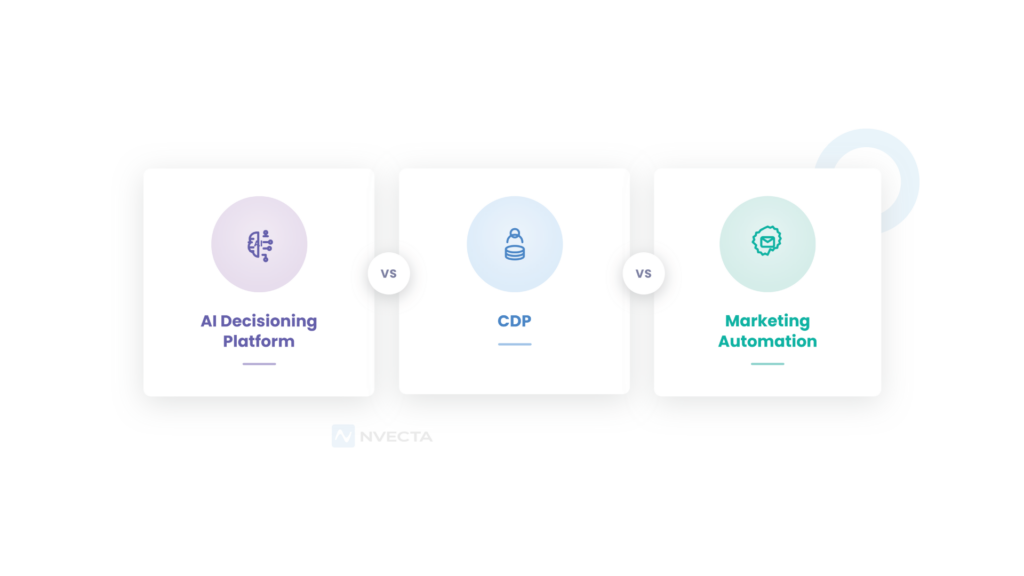
Buyers mix these three categories constantly, and vendors do not always help, so here is the clean separation.
A customer data platform (CDP) unifies customer data from every source into a single, resolved profile. Its job is the data foundation, knowing who each customer is across devices and channels. It does not, on its own, decide what to do with them.
A marketing automation platform executes campaigns and workflows: it sends the emails, runs the journeys, fires the triggers. Its job is delivery and orchestration, usually following rules you set.
An AI decisioning platform makes the per-customer choice, who to target, what to send, when, and which offer, and increasingly executes it. Its job is the decision.
In practice these blur, because the strongest setups combine them. A platform like NVECTA unifies data (CDP), decides the next best action (AI decisioning), and runs the campaigns (automation) in one place, so the decision is made on complete data and acted on without handing off between tools.
When you evaluate vendors, work out which of these three jobs each one actually does, because “AI decisioning platform” gets stamped on tools that only do one of them.
How to Choose the Right Platform for You
Cut the list down with a few questions.
What industry and use case? Regulated, multi-domain enterprise decisioning points to Pega; Salesforce-native teams to Einstein; lifecycle and engagement to Braze, CleverTap, or NVECTA; retail with loyalty to Voyado.
Where does your data live, and is it unified? If it is fragmented, prioritize a platform that unifies it (a CDP-based option) before one that assumes clean data.
Recommend or execute? Decide whether you want the platform to suggest actions or carry them out autonomously, and filter accordingly.
How much can you implement? A powerful enterprise engine you never finish deploying returns less than a focused platform running next quarter. Match ambition to data readiness and team capacity.
Where NVECTA fits
If you would rather not bolt a decisioning engine onto a separate stack, NVECTA builds it into its customer data platform. Its AI Decisioning uses predictive segments, lead scoring, send-time optimization, product recommendations, and next-best-offer to choose the next action for each customer, all on a unified profile, alongside segmentation, CRO, and omnichannel campaigns in the same platform. For growth, CRM, and product teams that want the data layer, the decisioning, and the activation together, that is the draw.
See NVECTA’s AI Decisioning in a demo →
FaQs
Which AI decisioning platform is best?
There is no single best one. Forrester’s 2025 Wave put FICO, IBM, and Pega at the top for enterprise decisioning. For marketing and lifecycle work, Braze AI Decisioning Studio, Hightouch, and NVECTA are the ones worth shortlisting. Voyado if you are a retailer. The answer depends on whether you are deciding about a coupon or about a loan.
What is an AI decisioning platform?
Software that uses AI to choose the next best action for each customer, the right message, channel, offer, and timing, and increasingly executes it, instead of relying on hand-built rules.
What is the difference between an AI decisioning platform and a CDP?
A CDP unifies customer data into one profile. An AI decisioning platform acts on that data to decide the next best action. Some platforms, like NVECTA, combine both, so decisioning runs on the unified profile directly.
Are AI decisioning platforms only for enterprises?
No. Pega, FICO, and SAS are enterprise tools. Braze, CleverTap, Hightouch, and NVECTA serve mid market and growth teams, particularly in e-commerce and D2C.
What should I fix before adopting an AI decisioning platform?
Your data. Decisioning runs on a unified customer profile, so fragmented data produces poor decisions no matter how good the platform is. Unify your data, often through a CDP, first.
Do AI decisioning platforms act automatically?
Some only recommend; newer ones use AI agents to execute decisions autonomously across channels and learn from results. Check where a platform sits on that spectrum before buying.
How much do AI decisioning platforms cost?
Pricing is usually custom. Enterprise engines like Pega and Salesforce Einstein run into enterprise-contract territory; engagement platforms like Braze and CleverTap price on audience size; CDP-based options like NVECTA bundle decisioning into the broader platform. Get quotes based on your data volume and channels.
What are the best AI decisioning platforms for e-commerce?
E-commerce and D2C teams often favour marketing-focused or CDP-based platforms like NVECTA, CleverTap, or Voyado, because they combine lifecycle decisioning with the engagement channels and unified data that e-commerce relies on, rather than enterprise engines built for regulated industries.
What is reinforcement learning in AI decisioning?
The system proposes an action, observes the result, and updates its estimate of how good that action is for that type of customer. Over time it stops proposing the ones that do not work. Most decisioning platforms use some form of it, usually a contextual bandit.
What is the Forrester Wave for AI Decisioning Platforms?
Forrester’s Q2 2025 evaluation of 15 vendors in this category. FICO, IBM, and Pega were named Leaders. ACTICO was a Strong Performer.
Is AI decisioning the same as decision intelligence?
Close, but the audience differs. Gartner uses decision intelligence for platforms that support or automate decisions across a business, including operations and supply chain. AI decisioning usually means customer facing decisions.
How long does implementation take?
Four to twelve weeks for CDP based and warehouse native tools. Six to eighteen months for enterprise engines like Pega. Almost all of that variance is data readiness, not software.
Do AI decisioning platforms replace A/B testing?
They replace most of it. A/B testing finds the variant that wins on average. Decisioning finds the variant that wins per person, and keeps updating.
